Showing posts with label early years. Show all posts

Wednesday, December 10, 2025

THE EARLY YEARS OF FATS WALLER

Before the world knew him as “Fats,” the jovial jazz virtuoso with a grin as wide as his stride piano style, Thomas Wright Waller was just a boy growing up in the vibrant, music-soaked streets of Harlem, New York. Born on May 21, 1904, to Adeline, a church organist, and Edward Waller, a Baptist lay preacher, young Thomas was surrounded by both discipline and melody—a combination that would shape his life in unexpected ways.

From the age of six, Thomas was drawn to the piano like a moth to flame. He played the reed organ at his father’s open-air sermons, absorbing the rhythms of gospel and the structure of classical music. His mother, a talented musician herself, introduced him to the works of J.S. Bach, while his grandfather, Adolph Waller, a respected violinist from Virginia, added another layer of musical heritage to the boy’s upbringing. 

But Harlem in the early 1900s was more than just church music—it was becoming the beating heart of Black artistic expression. As the Harlem Renaissance began to bloom, so did the young Waller’s curiosity. He was captivated by the sounds spilling out of clubs and rent parties, where jazz was being born in real time. Despite his father’s disapproval—he called jazz “music from the Devil’s workshop”—Thomas couldn’t resist the pull. 


By his early teens, he was working in a grocery store to pay for music lessons, and soon dropped out of DeWitt Clinton High School to pursue music full-time. His first steady gig was as an organist at Harlem’s Lincoln Theatre, and it wasn’t long before he caught the attention of James P. Johnson, the legendary stride pianist who became his mentor. Johnson introduced him to the world of rent parties, where Waller’s infectious energy and dazzling technique quickly made him a favorite. 

The nickname “Fats” came early—an affectionate nod to his size, but also to his larger-than-life personality. He was already composing, performing, and charming audiences with a mix of virtuosity and humor that would become his trademark. By the time he was 20, he had written his first hit, “Squeeze Me”, and was well on his way to becoming one of the most beloved figures in American music. 

In those early years, Waller wasn’t just learning music—he was living it, absorbing the pulse of Harlem, the discipline of classical training, and the improvisational spirit of jazz. His story is one of joy, rebellion, and genius, all wrapped in the rhythm of a piano that never stopped swinging....


Sunday, May 25, 2025

THE EARLY YEARS OF ANN MILLER

In 1941, Ann Miller was already a rising star in Hollywood, dazzling audiences with her extraordinary dancing skills and captivating screen presence. Known for her energetic tap dancing, Miller became a staple of the Golden Age of Hollywood musicals. Her journey to stardom began early; she signed her first contract with RKO Pictures at just 13 years old, after lying about her age. By 1941, she was signed to Columbia Pictures, where she appeared in films like Time Out for Rhythm and Reveille with Beverly. These films showcased not only her dancing prowess but also her vibrant personality, which made her an audience favorite. Ann Miller's ability to combine athleticism and grace in her performances helped redefine what it meant to be a female dancer in Hollywood during this era.

The early 1940s marked a transformative period in Hollywood, with Ann Miller contributing to a surge in musical films that lifted spirits during World War II. The genre provided escapism and joy, and stars like Miller were instrumental in its popularity. Known for her incredible speed—reportedly capable of executing 500 taps per minute—Miller brought an unmatched dynamism to the screen. She often performed in elaborate sequences that required not only technical skill but also an unyielding stamina. Alongside contemporaries like Ginger Rogers and Cyd Charisse, Miller became synonymous with the glamour and innovation of 1940s Hollywood musicals. Her appearances in films like Too Many Girls (1940) and Hit Parade of 1941 helped set the stage for her eventual work with MGM, where she would solidify her status as one of the great musical stars.

Ann Miller’s legacy is a testament to the enduring power of talent and determination during Hollywood’s Golden Age. By the late 1940s, she signed with MGM, where she starred in iconic musicals like Easter Parade (1948) and On the Town (1949), often partnering with legends like Gene Kelly and Fred Astaire. While her films are celebrated for their vibrant choreography and grand sets, Miller herself became a symbol of resilience, having overcome personal challenges, including a back injury she sustained as a child. Her contribution to the film industry extended beyond her performances; she was an advocate for the preservation of Hollywood’s history and a proud custodian of its traditions. Today, Ann Miller’s work remains a vital part of the classic Hollywood tapestry, celebrated for its artistry, energy, and undeniable charm...


Saturday, November 4, 2023

BEA ARTHUR: THE EARLY YEARS

Bea Arthur was a television icon. From her days on "All In The Family" and her own 70s show "Maude" to her crowning performance on "The Golden Girls", she is remembered for these roles from the middle to late stage of her life. However, she had an interesting early years of her life. Bernice Frankel was born on May 13, 1922, in Brooklyn, New York City, to Rebecca (born in Austria) and Philip Frankel (born in Poland). Arthur was raised in a Jewish home with her older sister Gertrude and younger sister Marian (1926–2014).

In 1933, the Frankel family relocated to Cambridge, Maryland, where her parents subsequently operated a women's clothing shop. At age 16, Bernice developed a serious condition, coagulopathy, in which her blood would not clot. Concerned for her health, her parents sent her to Linden Hall, an all-girls' boarding school in Lititz, Pennsylvania, for her final two years of high school. Afterwards, she studied for a year at Blackstone College for Girls in Blackstone, Virginia.

During World War II, Frankel enlisted as one of the first members of the United States Marine Corps Women's Reserve in 1943. After basic training, she served as a typist at Marine headquarters in Washington, D.C. In June 1943, the Marine Corps accepted her transfer request to the Motor Transport School at Camp Lejeune, North Carolina. Frankel then worked as a truck driver and dispatcher in Cherry Point, North Carolina, between 1944 and 1945. She was honorably discharged at the rank of staff sergeant in September 1945.


After serving in the Marines, Frankel studied for a year at the Franklin School of Science and Arts in Philadelphia, where she became a licensed medical technician. After interning at a local hospital for the summer, she decided against working as a lab technician, departing for New York City in 1947 to enroll in the School of Drama at The New School.

From 1947, Beatrice Arthur studied at the Dramatic Workshop of The New School in New York City with German director Erwin Piscator.  Arthur began her acting career as a member of an off-Broadway theater group at the Cherry Lane Theatre in New York City in the late 1940s. Onstage, her roles included Lucy Brown in the 1954 Off-Broadway premiere of Marc Blitzstein's English-language adaptation of Kurt Weill's The Threepenny Opera, Nadine Fesser in the 1957 premiere of Herman Wouk's Nature's Way at the Coronet Theatre, Yente the Matchmaker in the 1964 premiere of Fiddler on the Roof on Broadway.

In 1966, Arthur auditioned for the title role in the musical Mame, which her husband Gene Saks was set to direct, but Angela Lansbury won the role instead. Arthur accepted the supporting role of Vera Charles, for which she won great acclaim, winning a Tony Award for Best Featured Actress in a Musical the same year. Her role in Mame propelled her to the stardom that she deserved, and she never looked back...


Saturday, September 11, 2021

THE NICHOLAS BROTHERS: THE EARLY YEARS

Nicholas Brothers, tap-dancing duo whose suppleness, strength, and fearlessness made them one of the greatest tap dance acts of all time. Fayard Antonio Nicholas (1914-2006) and his brother Harold Lloyd Nicholas (1921-2000) developed a type of dance that has been dubbed “classical tap,” combining jazz dance, ballet, and dazzling acrobatics with tap dancing. Growing up in an era of “hoofers” and “board beaters,” the Nicholas Brothers elevated tap dancing with their singular elegance and sensational showmanship.

The brothers’ parents were both college-educated professional musicians. Their mother, Viola, was a classically trained pianist, and their father, Ulysses, was a drummer. They performed together in pit orchestras for black vaudeville shows throughout the 1910s to the early 1930s, forming their own group called the Nicholas Collegians in the 1920s.

From the time Fayard was an infant, his parents brought him to the theatre for their practices and performances. There he gained an early education in show business by watching great black entertainers such as the jazz musician Louis Armstrong, the dance team Buck and Bubbles, the singer Adelaide Hall, and the dance teams Leonard Reed and Willie Bryant and the Berry Brothers. The Nicholas family traveled from city to city to play with various orchestras, but, after the birth of two more children, Dorothy and Harold, they settled in Philadelphia in 1926 and continued working with the Nicholas Collegians. Their orchestra played at the Standard Theatre, one of the city’s largest and most prestigious black vaudeville houses.


Fayard taught himself how to dance, sing, and perform by watching the entertainers on stage. He then taught his younger siblings, first performing with Dorothy as the Nicholas Kids; they were later joined by Harold. When Dorothy opted out of the act, the Nicholas Kids became known as the Nicholas Brothers.

TO BE CONTINUED...


Saturday, April 10, 2021

THE EARLY YEARS OF COLE PORTER

J.O. Cole was the richest man in Indiana. His father had been a shoemaker, but J.O.--the initials stood for James Omar--went out to California during the Gold Rush and came back a wealthy man to Indiana, where he multiplied his wealth by way of timber and coal and other enterprises. J.O. married Rachel Henton, and when their daughter, Kate Cole, was born in 1862, nothing could be too good for J.O.'s girl. J.O. gave Kate expensive clothes, expensive tastes, and an expensive education that included music and dance.

J.O. naturally expected his Kate to choose a husband from the ambitious world of high-powered businessmen, someone who could take over his financial empire if and when J.O. ever chose to let go of the reins. But Kate Cole had a mind of her own, and the husband she selected was Sam Porter, said to be a weak and ineffectual, although modestly successful, pharmacist from her hometown of Peru, Indiana. One can only speculate, but one can at least suspect that Kate was too much like her father to want to marry a man of her father's stamp, and instead deliberately chose a husband that shecould rule.

J.O. fumed and grumbled, but in the end Kate got her way, and J.O. paid first for the wedding and then for the expensive lifestyle of the wedded couple. And then, on June 9, 1891, in Peru, Indiana, Kate's son, J.O.'s grandson, was born, and they named him Cole Albert Porter.

From the age of six, the little boy studied first violin and then, at age eight, piano, and soon he showed real talent for both. When he decided that he didn't like the violin, he devoted all his energies to the piano, practicing two hours every day. Frequently, his mother Kate would join him at the piano, and together they would make up wicked parodies of the popular songs of the day.


Kate knew that her son had talent, and did everything she could to pave the way for musical fame. Early on, she subsidized the student orchestra at the local music school, making sure that her son, dressed in velvet and lace, was the featured violin soloist. There were rumors that she also took steps to ensure that the local papers gave her son the right reviews. When Cole was ten years old, he began composing music, and his mother paid to have his compositions published and sent copies to family and friends. And when, at age 14, she sent Cole off to the exclusive Worcester Academy in Massachusetts, she decided that people would be more impressed with her son's accomplishments if her son were only twelve instead of fourteen. And so, she made Cole twelve, officially at least, by arranging some small changes in his school records.

When Cole was sent east to boarding school, J.O. was furious. J.O.'s plan was that his grandson would stay in Indiana, learning about the family business empire and preparing to eventually take it over. J.O. was so angry, in fact, that for two years he refused to speak to Kate. But, as always, Kate got her way.


Cole's stay at the Worcester Academy was a successful one. In later years, he remembered one of his instructors there, Dr. Abercrombie, as an important influence. Cole said that Abercrombie taught him about language and meter, and that, in a song, "Words and music must be so inseparably wedded to each other that they are like one." When he graduated from the Academy in 1909, Cole was the class valedictorian.

Next came Yale, and Cole's undergraduate years at Yale were one of the richest periods of his life. He was a huge social success, famous on campus for the songs he was constantly writing and singing. He sang solos with the Yale Glee Club. He wrote football fight songs, some of which continued to be sung long after he left Yale, especially "Bingo Eli Yale" and the "Yale Bulldog Song". And he wrote songs for six full scale musical comedies, produced by the Delta Kappa Epsilon fraternity and by the Yale Dramatic Association. Some of these shows went on tour around the country, and Cole toured with them, reveling in the parties and good fellowship that went with the tours. In all, Cole wrote around 300 songs while he was at Yale. And when he graduated in 1913, his classmates voted him the "most entertaining" member of his class. In his Yale years, Cole made many connections that would be professionally and personally important to him for the rest of his life.


At J.O.'s insistence, Cole then enrolled in Harvard Law School, where he roomed with a young man named Dean Acheson--yes, the Dean Acheson who would become Secretary of State from 1949 to 1953. But Cole had no interest in becoming a lawyer, and his activities continued to be mostly musical. Many of Cole Porter's stories about himself were inventions, but, according to Cole, the Dean of the Law School, Ezra Ripley Thayer, took him aside one day, during Cole's second year at the Law School, and told him, "Don't waste your time--get busy and study music." Whether the advice really came from Thayer or not, Cole took it, and transferred to Harvard's School of Arts and Sciences in 1915, where he studied for a graduate degree in Music. Cole told his mother Kate about the change in career plans, but both of them allowed J.O. to believe that Cole was still earnestly pursuing his Law School degree.

Cole left graduate school in 1916 and moved to New York City, where he lived at the Yale Club. His first show, See America First (1916), lasted for only 15 performances, but the audience was full of prominent socialites, and Cole himself quickly became a familiar figure in social circles in New York.

In July 1917, Cole moved to Paris. The First World War was raging, and Cole invented stories about joining the French Foreign Legion and performing numerous heroic exploits that were duly reported in the press back home and that remained part of Cole's official biography throughout his life. Not a word was true. In fact, Cole was enjoying Paris's fabulous social life, an endless stream of extravagant parties full of international celebrities, members of the minor nobility, cross dressers, artists, and eccentrics, accompanied by alcohol and other drugs, and featuring an assortment of gay and bisexual activity.


Linda Lee Thomas from Louisville, Kentucky, was another prominent socialite in Paris. Divorced from an abusive husband, wealthy, and considered one of the most beautiful women in the world, Linda soon became one of Cole's closest friends. She was older than Cole, and was quite aware of his homosexual preferences and activities. Nevertheless, on December 19, 1919, Cole and Linda were married. Although sex was never a part of their relationship, they truly liked each other, and Linda was deeply dedicated to Cole's career, so, in its own way, their marriage proved a close, successful, and mostly happy one.

Cole and Linda led a glittering social life in Paris, Venice, and the Riviera. Their Paris home had platinum wallpaper and zebra skin chairs. For one extravagant party in Venice they hired 50 gondoliers and a troupe of circus acrobats. For another party, they hired an entire ballet company.

But while his social life was dazzling, Cole's career was moving frustratingly slowly. He studied briefly with the noted French composer Vincent d'Indy. He had a few small successes, contributing songs to such shows as Hitchy-Koo 1919 and the Greenwich Village Follies of 1924. And in 1923 he had a success in Paris with a short ballet called Within the Quota. But Broadway producers had little interest in his work. However, in 1928, Irving Berlin recommended Cole to the producers of a "musicomedy" called Paris, starring Irene Bordoni. Cole wrote five songs for the show, and one of those songs "Let's Do It (Let's Fall In Love)", became Cole's first big success....

Wednesday, August 5, 2020

THE EARLY CAREER OF JACK LEMMON

Jack Lemmon has always been one of my favorite actors. He made so many great movies in the late 1960s and 1970s, but I wanted to take a look and learn more about his early years in Hollywood. He had made movies for years before he got the fame that he deserved.

In the 1940s, Lemmon became a professional actor, working on radio and Broadway. His film debut was a bit part as a plasterer in the film The Lady Takes a Sailor (1949), but he was already appearing in television shows, which numbered about 400 from 1948 to 1953.

Lemmon believed his stage career was about to take off when he was appearing on Broadway for the first time in a 1953 revival of the comedy Room Service, but the production closed after two weeks. Despite this setback, he was spotted by talent scout Max Arnow, who was then working for Columbia, and Lemmon's focus shifted to films and Hollywood. Columbia's head Harry Cohn wanted to change Lemmon's name, in case it was used to describe the quality of the actor's films, but he successfully resisted.

His first role as a leading man was in the comedy It Should Happen to You (1954), which also featured the established Judy Holliday in the female lead. Bosley Crowther in his review for The New York Times described Lemmon as possessing "a warm and appealing personality. The screen should see more of him." The two leads soon reunited in Phffft (also 1954). Kim Novak had a secondary role as a brief love interest for Lemmon's character. "If it wasn't for Judy, I'm not sure I would have concentrated on films", he told The Washington Post in 1986 saying early in his career he had a snobbish attitude towards films over the stage. He managed to negotiate a contract with Columbia allowing him leeway to pursue other projects, some of the terms of which he said "nobody had gotten before". He signed a seven-year contract, but ended staying with Columbia for ten years. Lemmon's appearance as Ensign Pulver in Mister Roberts (1955), with James Cagney and Henry Fonda, for Warner Bros. gained Lemmon the Best Supporting Actor Oscar. Director John Ford decided to cast Lemmon after seeing his Columbia screen test, which had been directed by Richard Quine. At an impromptu meeting on the studio lot, Ford persuaded the actor to appear in the film, although Lemmon did not realize he was in conversation with Ford at the time.


In the military farce Operation Mad Ball (1957) set in a U.S. Army base in France after World War II, Lemmon played a calculating private. He met comedian Ernie Kovacs, who co-starred, and they became close friends, appearing together in two subsequent films, as a warlock in Bell, Book and Candle (1958, a film he apparently disliked),and It Happened to Jane (1959), all three under the direction of Richard Quine. Lemmon starred in six films directed by Quine. The others were My Sister Eileen (1955), The Notorious Landlady (1962) and How to Murder Your Wife (1965). Lemmon also began his collaboration with director Billy Wilder in with Some Like It Hot (1959), with Tony Curtis and Marilyn Monroe. His role required him to perform 80% of the role in drag. People who knew his mother, Millie Lemmon, said he had mimicked her personality and even her hairstyle.The critic Pauline Kael said he was "demoniacally funny" in the part.


Lemmon first role a film directed by Blake Edwards was in Days of Wine and Roses (1962) portraying Joe Clay, a young alcoholic businessman. The role, for which he was nominated for the Best Actor Oscar, was one of Lemmon's favorite roles. By this time, he had appeared in 15 comedies, a western and an adventure film. "The movie people put a label attached to your big toe — 'light comedy' — and that's the only way they think of you", he commented in an interview during 1984. "I knew damn well I could play drama. Things changed following Days of Wine and Roses. That was as important a film as I've ever done." Days of Wine and Roses was the first film where Lemmon was involved with production of the film via his Jalam production company. Lemmon's association with Edwards continued with The Great Race (1965), which reunited him with Tony Curtis. His salary this time was $1 million, but the film did not return its large budget at the box-office, but some of his biggest roles would be in his future...


Wednesday, November 6, 2019

BOB HOPE: THE EARLY YEARS

Bob Hope was born Leslie Townes Hope, the son of stonemason William Henry Hope and Avis Townes Hope. The family emigrated from England to Cleveland, Ohio in 1908, when Leslie, the fifth of seven children, was not yet five years old. In Cleveland the family struggled financially, as they had in England, and Avis took in boarders to supplement William's erratic income. Avis, an amateur musician, taught singing to Leslie, an outgoing boy who entertained his family with singing, impersonations, and dancing. After dropping out of school at the age of sixteen, Leslie worked at a number of part-time jobs. He boxed for a short time under the name of “Packy East” but changed his name officially to Lester Hope. Lester's interest in entertainment and show business, cultivated by his mother, led him to take dancing lessons and seek employment as a variety stage entertainer. Not until he had achieved considerable success on the stage did he begin using the name, “Bob Hope.”


Bob Hope was born in a suburb of London on May 29, 1903. The family of William and Avis Hope lived in many places in England, wherever stonecutter William Hope could find work. In 1906, William followed two of his brothers to Cleveland, Ohio, and the rest of his family came in 1908.

The neighborhood of Cleveland where Bob Hope's family settled, Doan's Corner, included several vaudeville houses, including this theater. Hope's mother, Avis, took her sons to see vaudeville shows often. In the building of this theater is the billiard parlor where Bob Hope hustled pool as a young boy. Bob Hope spent many hours at this Cleveland amusement park. He often earned money singing on the trolley on the way to the park and won more money at the park by winning footraces. Hope recalled in 1967, “We'd have been called juvenile delinquents only our neighborhood couldn't afford a sociologist.”


When Charles Chaplin's “Little Tramp” was a popular motion picture character in the 1910s, Chaplin imitation contests were common. Bob Hope won one in Luna Park in the summer of 1915. Hope purchased a stove for his beloved mother with his winnings. Dancing was the work Bob Hope found most interesting after he dropped out of school at the age of sixteen. He studied dancing with two professional entertainers in Cleveland and began teaching dancing himself in the early 1920s.

In the early 1920s, Bob Hope dreamed that he and his Cleveland girlfriend, Mildred Rosequist, would achieve the success of the dancing sensations of the 1910s, Vernon and Irene Castle.Bob Hope's first tours in vaudeville were as half of a two-man dancing team. The act appeared in “small time” vaudeville houses where ticket prices were as low as ten cents, and performances were “continuous,” with as many as six shows each day. Bob Hope, like most vaudeville performers, gained his professional training in these small time theaters.

Within five years of his start in vaudeville Bob Hope was in the “big time,” playing the expensive houses where the most popular acts played. In big time vaudeville there were only two shows performed each day—the theaters were called “two-a-days”—and tickets cost as much as $2.00 each. The pinnacle of the big time was New York City's Palace Theatre, where every vaudevillian aspired to perform. Bob Hope played the Palace in 1931 and in 1932. And the rest was comedy history...


Sunday, March 24, 2019

MARLENE DIETRICH: THE EARLY YEARS

Screen legend Marlene Dietrich created a mysterious image of herself that not many people were able to break through. Like every human being, Dietrich was born to a regular normal family, but as Dietrich became famous, she changed many facts about her early years. She was a family history revisionist (I wonder if she knew my mom!), but here are some of the facts of her early years.

Dietrich was born on December 27, 1901 at Leberstraße 65 in the neighborhood of Rote Insel in Schöneberg, now a district of Berlin. Her mother, Wilhelmina Elisabeth Josephine (née Felsing), was from an affluent Berlin family who owned a jewelry and clock-making firm. Her father, Louis Erich Otto Dietrich, was a police lieutenant. Dietrich had one sibling, Elisabeth, who was one year older. Dietrich's father died in 1907.His best friend, Eduard von Losch, an aristocratic first lieutenant in the Grenadiers, courted Wilhelmina and married her in 1916, but he died soon afterwards from injuries sustained during the First World War.Von Losch never officially adopted the Dietrich girls, so Dietrich's surname was never von Losch, as has sometimes been claimed.

Her earliest professional stage appearances were as a chorus girl on tour with Guido Thielscher's Girl-Kabarett vaudeville-style entertainments, and in Rudolf Nelson revues in Berlin. In 1922, Dietrich auditioned unsuccessfully for theatrical director and impresario Max Reinhardt's drama academy; however, she soon found herself working in his theatres as a chorus girl and playing small roles in dramas. She did not attract any special attention at first. She made her film debut playing a bit part in the film The Little Napoleon (1923).

It was in musicals and revues such as Broadway, Es Liegt in der Luft, and Zwei Krawatten, however, that she attracted the most attention. By the late 1920s, Dietrich was also playing sizable parts on screen, including roles in Café Elektric (1927), Ich küsse Ihre Hand, Madame (1928), and Das Schiff der verlorenen Menschen (1929).


In 1929, Dietrich landed the breakthrough role of Lola Lola, a cabaret singer who caused the downfall of a hitherto respectable schoolmaster (played by Emil Jannings), in the UFA-Paramount co-production of The Blue Angel (1930). Josef von Sternberg directed the film and thereafter took credit for having "discovered" Dietrich. The film is also noteworthy for having introduced Dietrich's signature song "Falling in Love Again", which she recorded for Electrola and later made further recordings in the 1930s for Polydor and Decca Records.

In 1930, on the strength of The Blue Angel's international success, and with encouragement and promotion from Josef von Sternberg, who was already established in Hollywood, Dietrich moved to the United States under contract to Paramount Pictures. The studio sought to market Dietrich as a German answer to Metro-Goldwyn-Mayer's Swedish sensation, Greta Garbo. Sternberg welcomed her with gifts, including a green Rolls-Royce Phantom II. The car later appeared in their first US film Morocco. In Morocco (1930), Dietrich was again cast as a cabaret singer. The film is best remembered for the sequence in which she performs a song dressed in a man's white tie and kisses another woman, both provocative for the era. The film earned Dietrich her only Academy Award nomination. The rest as they say...is movie history...


Monday, July 13, 2015

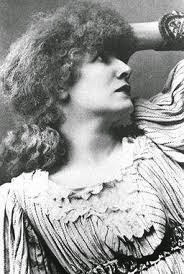
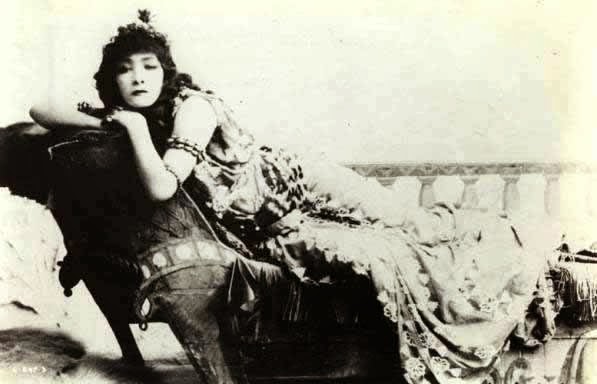
SARAH BERNHARDT: THE EARLY YEARS

For some reason the name Sarah Bernhardt has been sticking in my head. She was one of the first "superstars" of acting. I have never seen an early movie she made, but I did a little research to learn more about her.

Sarah Bernhardt was a French stage and early film actress, and was referred to as "the most famous actress the world has ever known." Bernhardt made her fame on the stages of France in the 1870s, at the beginning of the Belle Epoque period, and was soon in demand in Europe and the Americas. She developed a reputation as a serious dramatic actress, earning the nickname "The Divine Sarah."

Bernhardt was born on October 22, 1844 in Paris as Rosine Bernardt, the daughter of Julie Bernardt (1821, Amsterdam – 1876, Paris) and an unknown father. Julie was one of six children of an itinerant Jewish spectacle merchant, "vision specialist" and petty criminal, Moritz Baruch Bernardt, and Sara Hirsch (later known as Janetta Hartog; c. 1797–1829). Five weeks after his first wife's death in 1829, Julie's father married Sara Kinsbergen (1809–1878). He had abandoned his five daughters and one son with their stepmother by 1835. Julie, together with her younger sister Rosine, left for Paris, where she made a living as a courtesan and was known by the name "Youle." Julie had five daughters, including a twin who died in infancy in 1843.

Sarah Bernhardt changed her first name and added an "h" to her surname. Her birth records were lost in a fire in 1871. To prove French citizenship—necessary for Légion d'honneur eligibility—she created false birth records, in which she was the daughter of "Judith van Hard" and "Édouard Bernardt" from Le Havre, in later stories either a law student, accountant, naval cadet or naval officer.


When Sarah was young her mother sent her to Grandchamp, an Augustine convent school near Versailles. In 1860 she began attending the Conservatoire de Musique at Déclamation in Paris and eventually became a student at the Comédie Française where she would have her acting debut (11 August 1862) in the title role of Racine's Iphigénie to lackluster reviews. Her time there was short lived; she was asked to resign after slapping another actress across the face for shoving her younger sister during a birthday celebration for Molière.

Much of the uncertainty about Bernhardt's life arises because of her tendency to exaggerate and distort. Alexandre Dumas, fils, described her as a notorious liar...


Wednesday, April 1, 2015

THE THREE STOOGES: THE EARLY YEARS

It’s sufficient to say that the three Horwitz brothers, Moses, Jerome and Samuel (better known by their stage names as Moe, Curly and Shemp Howard), were nice, blue-collar Jewish boys from Brooklyn, born without an ounce of theatrical blood in their veins. Nevertheless, at an early age — and not unusually for working-class Jews around the turn of the century — both Moe and Shemp decided on a career in showbusiness. The pair had moderate success in a variety of burlesque shows before teaming up for the first time in 1916 to perform a blackface routine. They continued this until 1922, when they encountered an old friend from their Brooklyn days, comedian Ted Healy, then a rapidly rising star in vaudeville. Healy recruited them to be his sidekicks, and when Philadelphia musician and comedian Larry Fine was brought into the act, The Three Stooges were born.

As the Stooges’ stock continues to grow, Ted Healy has become an increasingly marginalised figure, remembered only for his poor treatment of his co-stars — who, history would have it, and have it incorrectly, outshone him from the get-go — and for the excessive drinking and wildly erratic behaviour that lead to his violent death. In fact, Healy was an enormously successful entertainer, one of the biggest stars of his era, who has been cited as a formative influence by such comedy legends as Red Skelton, Milton Berle and Bob Hope. As the young Stooges’ mentor, he practically invented the style of brutal slapstick that has made them legends, and if, along the way, he stiffed them out of their fair share of the proceeds, his pivotal role in their history deserves to be recognised. That said, there is no doubt that Healy was a terrible boss, not only tight with a buck, but an abusive, volatile drunk to boot.


In 1930, Ted Healy & His Stooges (they were never billed as The Three Stooges while they worked for Healy) appeared in the Fox Studios feature film Soup To Nuts. It was not a hit. Healy’s act, which relied heavily on ad libs and improvisation, never transferred successfully to film; neither was he exactly movie-star material, with a bulbous spud face and big boozer’s nose. The Stooges, on the other hand, impressed the Fox brass, and they were offered a contract without Healy. Furious, Healy immediately put the kibosh on this by claiming the Stooges were his employees. The offer was duly rescinded. When Larry, Moe and Shemp got word of this, they decided to cut Healy loose anyway and struck out on their own. True to form, Healy was incensed, forbidding them to use any of their old routines, which he considered his own copyrighted material, even threatening to bomb theatres if the Stooges dared to play them. In desperation, Healy made a failed attempt to salvage his act by hiring replacement Stooges.


Amazingly, in 1932, with Moe now the group’s business manager, Healy and his Stooges settled their differences and began working together again. It proved anything but a joyful reunion. Healy’s Jekyll and Hyde personality, exacerbated by his increasingly heavy drinking, so terrified the notoriously skittish Shemp that he left the act to go solo and was soon making comedy shorts for Vitaphone back in Brooklyn. This left the Stooges a man down. Shemp’s proposed solution was that Moe’s baby brother, Jerry, fill the gap. Healy was scathing. With all the foresight and perception that comes with drinking Wild Turkey for breakfast, he took one look at the future Curly Howard, the most beloved of all the Stooges, and dismissed him as not funny. Admittedly, Jerry did not much resemble his iconic alter ego at that point, sporting long red hair and a handlebar moustache. And, it must be said, neither Moe nor Larry had any confidence in Jerry’s comic abilities either. Moe stated flatly to Shemp that Jerry had “no talent whatsoever”. That changed abruptly when, at Shemp’s urging, Jerry ran on stage in the middle of a Stooges routine sporting a freshly shaved head, wearing a bathing suit and carrying a tiny bucket of water. This earned him a huge laugh from the crowd (vaudeville audiences were obviously a push-over), and one of the most gifted comic performers of the 20th century had officially arrived.

With Curly on board, Ted Healy & His Stooges signed a one-year contract with MGM to make five shorts and a couple of full-length features, none of which proved remarkable. The contract was not renewed, and in 1934 Healy and his Stooges finally went their separate ways...


SOURCE

Tuesday, March 17, 2015

PEGGY LEE: THE EARLY YEARS

One of my favorite vocalists to come out of the big band era was the great songbird Peggy Lee. Her voice was as audio aspirin to anyone who had the pleasure of hearing. She was one of the biggest recording artists at Capitol Records in the 1940s and Decca Records in the 1950s, but I wanted to profil some of her earlier and formative years.

Lee was born Norma Deloris Egstrom in Jamestown, North Dakota on May 26, 1920, the seventh of eight children of Marvin Olof Egstrom, a station agent for the Midland Continental Railroad, and his wife Selma Amelia (Anderson) Egstrom. She and her family were Lutherans.[Her father was Swedish American and her mother was Norwegian American.  Her mother died when Lee was just four years old. Afterward, her father married Min Schaumber, who treated her with great cruelty while her alcoholic father did little to stop it. Later, she developed her musical talent and took several part-time jobs so that she could be away from home.

Lee first sang professionally over KOVC radio in Valley City, North Dakota in the mid 1930s. . She later had her own series on a radio show sponsored by a local restaurant that paid her a salary in food. Both during and after her high school years, Lee sang for small sums on local radio stations. Radio personality Ken Kennedy, of WDAY in Fargo, North Dakota (the most widely heard station in North Dakota), changed her name from Norma to Peggy Lee.  Miss Lee left home and traveled to Los Angeles at the age of 17.

She returned to North Dakota for a tonsillectomy, and was noticed by hotel owner Frank Beringin while working at the Doll House in Palm Springs, California. It was here that she developed her trademark sultry purr – having decided to compete with the noisy crowd with subtlety rather than volume. Beringin offered her a gig at The Buttery Room, a nightclub in the Ambassador Hotel East in Chicago. There, she was noticed by bandleader Benny Goodman. According to Lee, "Benny's then-fiancée, Lady Alice Duckworth, came into The Buttery, and she was very impressed. So the next evening she brought Benny in, because they were looking for a replacement for Helen Forrest. And although I didn't know, I was it. He was looking at me strangely, I thought, but it was just his preoccupied way of looking. I thought that he didn't like me at first, but it just was that he was preoccupied with what he was hearing." She joined his band in 1941 and stayed for two years.


In 1942 Lee had her first No. 1 hit, "Somebody Else Is Taking My Place", followed by 1943's "Why Don't You Do Right?" (originally sung by Lil Green), which sold over a million copies and made her famous. She sang with Goodman's orchestra in two 1943 films, Stage Door Canteen and The Powers Girl.

In March 1943 Lee married Dave Barbour, a guitarist in Goodman's band. Peggy said, "David joined Benny's band and there was a ruling that no one should fraternize with the girl singer. But I fell in love with David the first time I heard him play, and so I married him. Benny then fired David, so I quit, too. Benny and I made up, although David didn't play with him anymore. Benny stuck to his rule. I think that's not too bad a rule, but you can't help falling in love with somebody."When Lee and Barbour left the band, the idea was that he would work in the studios and she would keep house and raise their daughter, Nicki. But she drifted back to songwriting and occasional recording sessions for the fledgling Capitol Records in 1947, for whom she produced a long string of hits, many of them with lyrics and music by Lee and Barbour, including "I Don't Know Enough About You" (1946) and "It's a Good Day" (1947). With the release of the US No. 1-selling record of 1948, "Mañana", her "retirement" was over.

Thankfully Peggy did not stick to her retirement. Her time with the big bands was relatively short, but her tenure with the Benny Goodman Orchestra saw her emerging as a formidable vocalist. Her early years performing showed that she definitely had the talent, and it paved the way for her super stardom as a singer and jazz vocalists for decades to come...

Monday, April 22, 2013

JOAN CRAWFORD: THE EARLY YEARS


Most film lovers are well aware of the career of Joan Crawford when she was Hollywood's darling. Many people still know about Crawford's final years as well as the years after her death which was tarnished by the "Mommie Dearest" book. However, I wanted to take a look at Joan Crawford's early years, before she became Joan Crawford. Back then she was only Lucille Fay LeSueur.

Crawford was born Lucille Fay LeSueur in San Antonio in 1905, the third child of Tennessee-born Thomas E. LeSueur (1868–1938), a laundry laborer of English, French Huguenot and Jersey ancestry, and Anna Bell Johnson (1884–1958), who was of Swedish and Irish descent. Her older siblings were Daisy LeSueur, who died very young, and Hal LeSueur. Thomas LeSueur abandoned the family a few months before Crawford's birth. He reappeared in Abilene, Texas in 1930 as a 62-year-old construction laborer on the George R. Davis House, built in Prairie School architecture.

Crawford's mother subsequently married Henry J. Cassin. The family lived in Lawton, Oklahoma, where Cassin ran a movie theater. Crawford was unaware that Cassin was not her birth father until her brother Hal told her. The 1910 federal census for Comanche County, Oklahoma, enumerated on April 20, showed Henry and Anna living at 910 "D" Street in Lawton. Crawford was listed as five years old, thus showing 1905 as her likely year of birth. However, the state of Texas did not require the filing of birth certificates until 1908, allowing Crawford to claim she was born in 1908.

Crawford preferred the nickname "Billie" as a child and she loved watching vaudeville acts perform on the stage of her stepfather's theater. The instability of her family life affected her education and her level of schooling never really progressed beyond the fourth grade. Her ambition was to be a dancer. However, in an attempt to escape piano lessons to run and play with friends, she leaped from the front porch of her home and cut her foot deeply on a broken milk bottle. Crawford had three operations and was unable to attend elementary school for a year and a half. She eventually fully recovered and returned to dancing.


Around 1916, Crawford's family moved to Kansas City, Missouri. Cassin was first listed in the City Directory in 1917, living at 403 East Ninth Street. While still in elementary school, Crawford was placed in St. Agnes Academy, a Catholic school in Kansas City. Later, after her mother and stepfather broke up, she stayed on at St. Agnes as a work student. She then went to Rockingham Academy, also as a work student. She later claimed the headmaster's wife there beat her and forged her grades to hide the fact that young Lucille spent far more time working, primarily cooking and cleaning, rather than being able to study academically. While attending Rockingham she began dating and had her first serious relationship, with a trumpet player named Ray Sterling. It was Sterling who reportedly inspired her to begin challenging herself academically. In 1922, she registered at Stephens College in Columbia, Missouri, giving her year of birth as 1906. Crawford attended Stephens for only four months before withdrawing after she realized she was not prepared for college.


Under the name Lucille LeSueur, Crawford began dancing in the choruses of traveling revues and was spotted dancing in Detroit by producer Jacob J. Shubert. Shubert put her in the chorus line for his 1924 show, Innocent Eyes, at the Winter Garden Theatre on Broadway in New York City. While appearing in Innocent Eyes Crawford met a saxophone player named James Welton. The two were allegedly married in 1924 and lived together for several months, although this supposed marriage was never mentioned in later life by Crawford.

She wanted additional work and approached Loews Theaters publicist Nils Granlund. Granlund secured a position for her with producer Harry Richmond's act and arranged for her to do a screen test which he sent to producer Harry Rapf in Hollywood. Stories have persisted that Crawford further supplemented her income by appearing in one or more stag, or soft-core pornographic, films, although this has been disputed Rapf notified Granlund on December 24, 1924 that Metro-Goldwyn-Mayer had offered Crawford a contract at $75 a week. Granlund immediately wired the 19-year-old LeSueur – who had returned to her mother's home in Kansas City – with the news; she borrowed $400 for travel expenses. The night after Christmas she left Kansas City and arrived in Culver City, California on January 1, 1925. That journey to California would be the beginnings of not only a movie career, but it would be the beginnings of a true legend - the legend that was Joan Crawford...


Monday, January 7, 2013

AL BOWLLY: THE EARLY YEARS

A lot of people in the United States do not know who Al Bowlly is. Most people born after the World War II generation do not even know who Al Bowlly is in general. He did not have the greatest voice, but his crooning style made him one of England's most popular singers of the 1930s. His recording output is huge and often compared to the output of Bing Crosby. You may find it strange but I compare Bowlly often to Billie Holiday, like Holiday he had a voice you either loved or hated. I am one of the people that absolutely love his voice. Hopefully this three part series on Al Bowlly will introduce more people to his music and talent.

Al Bowlly was born Albert Allick Bowlly on January 7th,1898 in Lourenço Marques in the then Portuguese colony of Mozambique, to Greek and Lebanese parents who met en route to Australia and moved to South Africa. He was brought up in Johannesburg, South Africa. After a series of odd jobs across South Africa in his youth, namely as a barber and jockey, he gained his musical experience singing for a dance band led by Edgar Adeler on a tour of South Africa, Rhodesia, India and Indonesia during the mid-1920s. However, he fell out with Adeler, throwing a cushion at his head as he played piano on stage and was fired whilst the band was in Surabaya, Indonesia.

After a spell with a Filipino band in Surabayo he was then employed by Jimmy Liquime in India (Calcutta) and Singapore (Raffles Hotel). Bowlly had to work his passage back home, through busking. Just one year after his 1927 debut recording date in Berlin, where he recorded Irving Berlin's "Blue Skies" with Edgar Adeler, Bowlly arrived in London for the first time as part of Fred Elizalde's orchestra, though he nearly didn't make it after foolishly frittering away the fare which was sent to him by Elizalde. That year, "If I Had You" became one of the first popular songs by an English jazz band to become well known in America as well, and Bowlly had gone out on his own by the beginning of the 1930s. First, however, the onset of the Great Depression in 1929 resulted in Bowlly being made redundant and returning to several months of busking to survive.

In the 1930s, he signed two contracts—one in May 1931 with Roy Fox, singing in his live band for the Monseigneur Restaurant in London, the other a record contract with Ray Noble's orchestra in November 1930.

During the next four years, he recorded over 500 songs. By 1933 Lew Stone had ousted Fox as bandleader, and Bowlly was singing Stone's arrangements with Stone's band. After much radio exposure and a successful UK tour with Stone, Bowlly was inundated with demands for personal appearances and gigs—including undertaking a subsequent solo UK tour—but continued to make the bulk of his recordings with Noble. There was considerable competition between Noble and Stone for Bowlly's time as, for much of the year, Bowlly would spend all day in the recording studio with Noble's band, rehearsing and recording, only then to spend the evening playing live at the Monseigneur with Stone's band...

TO BE CONTINUED...

Sunday, August 14, 2011

GLENN MILLER: THE EARLY YEARS

The official era of the Big Bands was less than ten years from 1936 to 1945, however the music that era created is remembered to this day. There are many talented musicians and leaders of that era, but I do not think any leader is remembered as much as Glenn Miller. Despite his death in 1944, his music is remembered some 70 years later.


Miller was born on a farm in Clarinda, Iowa on March 1, 1904, to Lewis Elmer Miller and Mattie Lou (née Cavender). He went to grade school in North Platte in western Nebraska. In 1915, Miller's family moved to Grant City, Missouri. Around this time, Miller had finally made enough money from milking cows to buy his first trombone and played in the town orchestra. In 1918, the Miller family moved again, this time to Fort Morgan, Colorado, where Miller went to high school. During his senior year, Miller became very interested in a new style of music called "dance band music." He was so taken with it that he formed his own band with some classmates. By the time Miller graduated from high school in 1921, he had decided he wanted to become a professional musician.

In 1923, Miller entered the University of Colorado at Boulder, where he joined Sigma Nu Fraternity, but spent most of his time away from school, attending auditions and playing any gigs he could get, most notably with Boyd Senter's band in Denver. He dropped out of school after failing three out of five classes one semester, and decided to concentrate on making a career as a professional musician. He later studied the Schillinger technique with Joseph Schillinger, under whose tutelage he composed what became his signature theme, "Moonlight Serenade". In 1926, Miller toured with several groups, eventually landing a good spot in Ben Pollack's group in Los Angeles. During his stint with Pollack, Miller wrote several musical arrangements of his own. He also co-wrote his first song, "Room 1411", written with Benny Goodman and released as a Brunswick 78, 4013, credited to Benny Goodman's Boys. In 1928, when the band arrived in New York City, he sent for and married his college sweetheart, Helen Burger. He was a member of Red Nichols's orchestra in 1930, and because of Nichols, Miller played in the pit bands of two Broadway shows, Strike Up the Band and Girl Crazy (where his bandmates included big band leaders Benny Goodman and Gene Krupa).


During the late 1920s and early 1930s, Miller managed to earn a living working as a freelance trombonist in several bands. On a March 21, 1928 Victor session Miller played alongside Tommy Dorsey, Benny Goodman, and Joe Venuti in the All-Star Orchestra, directed by Nat Shilkret. On November 14, 1929,an original vocalist named Red McKenzie hired Glenn to play on two records that are now considered to be jazz classics:"Hello, Lola" and "If I Could Be With You One Hour Tonight". Beside Glenn were clarinetist Pee Wee Russell, guitarist Eddie Condon, drummer Gene Krupa and Coleman Hawkins on tenor saxophone.

In the early-to-mid-1930s, Miller also worked as a trombonist and arranger in The Dorsey Brothers, first when they were a Brunswick studio group (under their own name and providing accompaniment for many of The Boswell Sisters sessions), and finally when they formed an ill-fated co-led touring and recording orchestra. Miller composed the song "Annie's Cousin Fanny" and "Dese Dem Dose" for the Dorsey Brothers Band in 1934 and 1935. In 1935, he assembled an American orchestra for British bandleader Ray Noble, developing the arrangement of lead clarinet over four saxophones that eventually became the sonic keynote of his own big band. Members of the Noble band included future bandleaders Claude Thornhill, Bud Freeman and Charlie Spivak.


Glenn Miller made his first movie appearance in the 1935 Paramount Pictures release The Big Broadcast of 1936 as a member of the Ray Noble Orchestra performing "Why Stars Come Out at Night". The Big Broadcast of 1936 starred Bing Crosby, George Burns, Gracie Allen, Ethel Merman, Jack Oakie, and Bill "Bojangles" Robinson and also featured other performances by Dorothy Dandridge and the Nicholas Brothers, who would appear with Miller again in two movies for Twentieth Century Fox in 1941 and 1942.

Glenn Miller compiled several musical arrangements and formed his first band in 1937. The band failed to distinguish itself from the many others of the era, and eventually broke up. Benny Goodman said in 1976, "In late 1937, before his band became popular, we were both playing in Dallas. Glenn was pretty dejected and came to see me. He asked, 'What do you do? How do you make it?' I said, 'I don't know, Glenn. You just stay with it."

TO BE CONTINUED...