Showing posts with label Ann Miller. Show all posts

Sunday, May 25, 2025

THE EARLY YEARS OF ANN MILLER

In 1941, Ann Miller was already a rising star in Hollywood, dazzling audiences with her extraordinary dancing skills and captivating screen presence. Known for her energetic tap dancing, Miller became a staple of the Golden Age of Hollywood musicals. Her journey to stardom began early; she signed her first contract with RKO Pictures at just 13 years old, after lying about her age. By 1941, she was signed to Columbia Pictures, where she appeared in films like Time Out for Rhythm and Reveille with Beverly. These films showcased not only her dancing prowess but also her vibrant personality, which made her an audience favorite. Ann Miller's ability to combine athleticism and grace in her performances helped redefine what it meant to be a female dancer in Hollywood during this era.

The early 1940s marked a transformative period in Hollywood, with Ann Miller contributing to a surge in musical films that lifted spirits during World War II. The genre provided escapism and joy, and stars like Miller were instrumental in its popularity. Known for her incredible speed—reportedly capable of executing 500 taps per minute—Miller brought an unmatched dynamism to the screen. She often performed in elaborate sequences that required not only technical skill but also an unyielding stamina. Alongside contemporaries like Ginger Rogers and Cyd Charisse, Miller became synonymous with the glamour and innovation of 1940s Hollywood musicals. Her appearances in films like Too Many Girls (1940) and Hit Parade of 1941 helped set the stage for her eventual work with MGM, where she would solidify her status as one of the great musical stars.

Ann Miller’s legacy is a testament to the enduring power of talent and determination during Hollywood’s Golden Age. By the late 1940s, she signed with MGM, where she starred in iconic musicals like Easter Parade (1948) and On the Town (1949), often partnering with legends like Gene Kelly and Fred Astaire. While her films are celebrated for their vibrant choreography and grand sets, Miller herself became a symbol of resilience, having overcome personal challenges, including a back injury she sustained as a child. Her contribution to the film industry extended beyond her performances; she was an advocate for the preservation of Hollywood’s history and a proud custodian of its traditions. Today, Ann Miller’s work remains a vital part of the classic Hollywood tapestry, celebrated for its artistry, energy, and undeniable charm...


Friday, April 7, 2023

PHOTOS OF THE DAY: HOLLYWOOD AND EASTER

Here are some great Easter photos of Hollywood celebrating this spring holiday just in time for the Easter bunny to be hopping its way into our homes...


Ann Miller


Jimmy Stewart


Shirley Temple


George Reeves


Doris Day


John Candy


Thursday, November 4, 2021

THE MOVIES OF KAY KYSER

Taken from the Kay Kyser website, this is a great rundown of the films that band leader Kay Kyser made. All of the band leaders of the time tried their hands at movies. Most of them were terrible actors, but at least Kyser had an image on radio than transferred nicely to movies...


1. THAT'S RIGHT-YOU'RE WRONG
(1939 RKO)
Kay Kyser Adolphe Menjou, Lucille Ball.

Kay and the band's radio show success brings a Hollywood movie offer in this movie-in-a-movie. It's fresh and entertaining with Menjou as the evil producer. Great songs, great energy. Ok, I'm biased.

2. YOU'LL FIND OUT
(1940 RKO)
Kay Kyser, Boris Karloff, Bela Lugosi, Peter Lorre, Helen Parrish, Dennis O'Keefe.

This, the 2nd KK film, is now a cult classic. People buy bootleg copies off EBAY all the time. But, a-ha! They're not restored copies. Kay and the band in a haunted house. Swing numbers one minute, Ish disappearing behind secret panels the next. The ONLY time (perk up, you experts) Karloff, Lugosi and Lorre appeared together in the same film. I love it, but Kay's a bit too over the top in first scene. Incredible songs! "Like The Fella Once Said", "You've Got Me This Way", "I'd Know You Anywhere", "One Track Mind", Ish's "Bad Humor Man (rumor has it that the song was to have been sung by the "3 Boogie Men"!! as print ads described them). A MUST for Halloween.

3. PLAYMATES
(1941 RKO)
Kay Kyser, John Barrymore, Lupe Velez, Ginny Simms.

Ginny gets co-star billing in her last film before leaving the band. Also known for being Barrymore's last film. (And yes, he did indeed read his lines off a sign or blackboard just off-camera). Publicity stunt goes awry, with Barrymore having to teach Kay to perform Shakespeare. Patsy Kelly, Peter Lind Hayes are memorable, JB cartoonish.


4. MY FAVORITE SPY
(1942 RKO)
Kay Kyser, Ellen Drew, Jane Wyman.

Not the Bob Hope film of the same name! Kay gets married and is drafted to become an American spy! Silly and funny. Gives you that goofy 40s feeling. Harry sings "Just Plain Lonesome", Sully sings "Got the Moon in My Pocket".


5. AROUND THE WORLD
(1943 RKO)
Kay Kyser, Joan Davis, Mischa Auer.

Kay and band fly around the world to entertain the troops. Band has now updated style to harder swing. Check out song "Roodle-ee-doo". Georgia Carroll and Harry Babbitt featured on "Candlelight and Wine".


6. SWING FEVER

(1943 MGM)
Kay Kyser, Marilyn Maxwell.

Kay plays Lowell Blackford, a hayseed composer in the big city w/ strange hypnotic power.. Gets mixed up w/ corrupt boxers and well, enough said. MGM had no clue what to do with him. Great posters, though! 


7. CAROLINA BLUES
(1944 Columbia)
Kay Kyser, Ann Miller, Victor Moore.

Kay and band can't stop turning down camp show requests even though they're overdue for a vacation. Moore trys to scam Kay into using Miller as singer when Georgia leaves band for matrimony. The last Kay Kyser feature. Rumor has it one was in development in 1949, but never appeared. Out of Kay's seven features, I rate this a seven.

Kay and his band also appeared in 2 other films:

Stage Door Canteen
(1943 UA) performing "A Rookie & His Rhythm".

Thousands Cheer
(1943 MGM) performing medley "I Dug a Ditch- Should I?". It's Kay and the gang in glorious color for the first (and only) time!

Kay and the band did several short subjects as well, the exact number not confirmed.

It should be noted that these were, in effect, pop movies of the time, and though they're certainly not Gone With The Wind, they are for the most part fun, funny and entertaining. It's also important to remember that the stories always revolved around Kay, unlike most bandleader's films of that time. For example, the two Glenn Miller movies, though entertaining, seldom feature Glenn for more than a line or two unless the band's performing...


Friday, October 29, 2021

PHOTOS OF THE DAY: A CLASSIC HOLLYWOOD HALLOWEEN

One of my favorite holidays is Halloween, and throughout my blog's history I have spotlighted some of the great costumes and poses that have been captured of classic Hollywood throughout the years. Here is another addition with some more great pics...

Bing Crosby

Alfred Hitchcock

Ann Miller
Pinky Tomlin & Rita Hayworth

Jackie Cooper

Elizabeth Montgomery

Past "A Classic Hollywood Halloween"...


Wednesday, October 7, 2020

RIP: TOMMY RALL

Gifted dancer Tommy Rall has died at the age of 90 of heart failure. Rall was born in Kansas City, Missouri and raised in Seattle. As a child he had a crossed eye which made it hard for him to read books, so his mother enrolled him in dancing classes. In his early years he performed a dance and acrobatic vaudeville act in Seattle theaters and attempted small acting roles.

His family moved to Los Angeles in the 1940s, and Rall began to appear in small movie roles. His first film appearance was a short MGM film called Vendetta. He began taking tap dancing lessons and became a member of the jitterbugging Jivin' Jacks and Jills at Universal Studios.

Rall joined Donald O'Connor, Peggy Ryan and Shirley Mills in several light wartime Andrews Sisters vehicles including Give Out, Sisters (1942), Get Hep to Love (1942) and others. He appeared in the films The North Star and Song of Russia (1944).

He was best known for his acrobatic dancing in several classic musical films of the 1950s, including Kiss Me, Kate as "Bill" (1953), Seven Brides for Seven Brothers as "Frank" (1954), Invitation to the Dance (1956), Merry Andrew as "Giacomo Gallini" (1958),and My Sister Eileen as "Chick" (1955).


Rall's film career waned as movie musicals went into decline. He had a role in the movie Funny Girl, as "The Prince" in a parody of the ballet Swan Lake. On Broadway he danced to acclaim as "Johnny" in Marc Blitzstein and Joseph Stein's 1959 musical Juno (based on Seán O'Casey's play Juno and the Paycock). Ken Mandelbaum wrote: "DeMille provided two fine ballets: her second act 'Johnny' in which Tommy Rall danced out Johnny's emotions...was the evening's highlight."

Rall was highly respected by his contemporaries—including dance greats Gene Kelly and Donald O'Connor—with the latter describing Rall as one of the “greatest dancers living...above Astaire and Kelly...


Monday, July 18, 2016

ANN MILLER: THE LATER YEARS

Ann Miller was one of the most celebrated dancers in the history of the American Musical. By the late 1950s though, as the era of Hollywood musicals waned, Miller's career in films declined. Following her appearance in Hit the Deck (1955), Miller left the movies behind to become a nightclub performer. Over the following decades she also made frequent appearances on television variety programs, including The Ed Sullivan Show and The Hollywood Palace, wearing bouffant brunette wigs and heavy eye makeup. This so-called Nefertiti look became Miller's trademark on- and offstage for many years and coincided with her growing interest in spirituality and reincarnation; she later expressed the belief that she had once been the ancient Egyptian queen Hatshepsut.

In 1969 Miller returned to the Broadway stage in the title role of Mame, a musical based on the film version of Patrick Dennis's semiautobiographical novel Auntie Mame. The role had been originated by Angela Lansbury to great acclaim, but Miller's performance, which featured singing as well as dancing, earned even more lavish praise from critics. Moreover it was credited with helping to spark a tap-dancing revival.

After Mame ended, Miller resumed her work in nightclubs and on television, interspersed with appearances in touring companies of Can-Can, Panama Hattie, and Hello, Dolly!, and a musical version of the Noël Coward play Blithe Spirit. She also appeared in a memorable television commercial in 1972, dancing on top of a giant Heinz soup can. Four years later she was discovered by a new generation of moviegoers when MGM released That's Entertainment, Part II, featuring clips of Miller and other dancers and singers in studio musicals of the past.


In 1979 Miller made a triumphant return to Broadway in the musical revue Sugar Babies, in which she costarred with Mickey Rooney. The show was an enormous hit with both audiences and critics; it played in New York for nearly three years and then toured the country. At age fifty-six Miller was delighted to find herself a glamorous Broadway showgirl both on- and offstage, experiencing at last a sustained stardom that had eluded her in Hollywood. Both Miller and Rooney earned Tony Award nominations in 1980 for their performances in Sugar Babies.


Miller returned briefly to the stage in 1998, when she performed in a revival of Stephen Sondheim's musical Follies at the Paper Mill Playhouse in Millburn, New Jersey. She made her last screen appearance in 2001, playing a dramatic role as the manager of an apartment complex in Mulholland Drive. Miller spent the final decades of her life at homes in Beverly Hills, California, and Sedona, Arizona. She died in Los Angeles after being hospitalized following a fall at her home in Beverly Hills. Shortly before her death she reportedly converted to Roman Catholicism.

Miller was married--briefly, in each case--three times: to Reese Milner (1946-1947), William Moss (1958-1961), and Arthur Cameron (1961-1962). Her first two marriages ended in divorce; the third was annulled. She and Milner had a daughter who was born prematurely and died shortly after birth; Miller later claimed that Milner had beaten her during her pregnancy, at one point pushing her down a flight of stairs and breaking her back. All three of Miller's husbands demanded that she give up her career as a condition of marriage, which may have accounted in part for the brevity of the unions. She was also romantically involved with the movie producer Louis B. Mayer and the hotel tycoon Conrad Hilton...


Monday, July 4, 2016

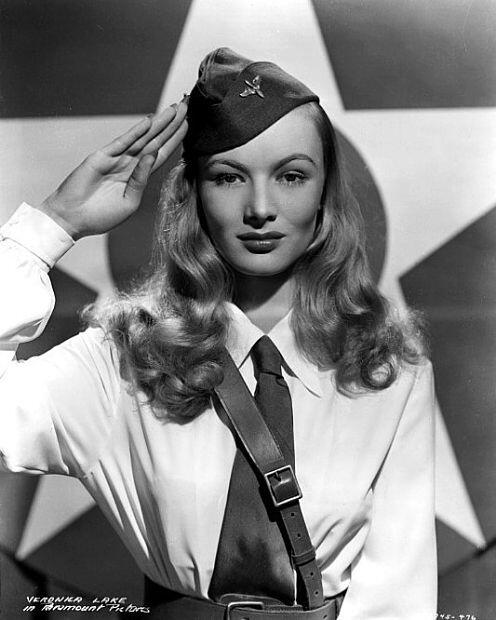
PHOTOS OF THE DAY: CLASSIC PATRIOTIC HOLLYWOOD

What present Hollywood is missing in its stars is a sense of patriotism. Classic Hollywood really rallied about the country, especially during World War II. On this 4th of July, I thought I would take a look at some of the patriotic pictures from classic Hollywood...

Ann Miller (1923-2004)

Ava Gardner (1922-1990)


Claudette Colbert (1903-1996)


Colleen Moore (1899-1988)


Cyd Charisse (1922-2008)

Veronica Lake (1922-1973)


Friday, May 10, 2013

PHOTOS OF THE DAY: STARS AND THEIR MOTHERS

Behind every great Hollywood star was probably a show business parent or two. To commemorate Mother's Day, I wanted to put together some interesting pictures of classic Hollywood stars and their dear old mothers...


JUDY GARLAND AND HER MOTHER


JIMMY STEWART AND HIS MOTHER


LINDA DARNELL AND HER MOTHER


FRED ASTAIRE AND HIS MOTHER


FRANK SINATRA AND HIS MOTHER


ANN MILLER AND HER MOTHER

Wednesday, July 20, 2011

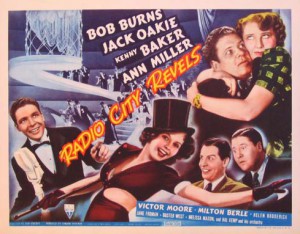
FORGOTTEN FILMS: RADIO CITY REVELS

It has been awhile since I started watching old movies. When I started my love of classic Hollywood, there was no TCM buy luckily I had a dinosaur called the video tape recorder. Before TCM entered the airwaves, its sister channel TNT used to show old movies. It was there that I saw a mediocre musical called Radio City Revels.

The movie deals with two out-of-work songwriters in New York City, Harry Miller (Jack Oakie) and Teddy (Milton Berle), who live next door to sisters Billie (Ann Miller) and Gertie (Helen Broderick) Shaw, who used to tour in vaudeville and have been left stranded and income-less by its demise. Miller’s and Teddy’s only source of income is a correspondence course in songwriting that they’ve sold to exactly one student, Arkansas hillbilly Lester Robin (played by rustic comedian Bob Burns, who had enough of a reputation in 1938 he’s actually given top billing).

Robin is frustrated because while he’s awake he can only come up with songs other people already wrote (like an hilariously fractured version of “My Bonnie Lies Over the Ocean”) but when he’s asleep he dreams the most beautiful — and original — melodies and lyrics, only to forget them when he wakes up. Miller and Teddy realize this unique talent and start transcribing Lester’s nocturnal emissions, peddling them as their own and becoming star songwriters for the company owned by Paul Plummer (Victor Moore, even more annoyingly whiny than usual). The premise is so weird that at least one critic summed it up by saying it seemed as if the film’s writers had been asleep when they came up with it.


The draw of the movie for me was the appearance of singer Jane Froman in a minor role. She played the vocalist for Hal Kemp's band. It is infortunate that she did not have a bigger role, it might have helped the movie. Froman never had much of a movie career, but her voice was wonderful. Kenny Baker was the male vocalist in this opus. Baker got his start as the comic foil for Jack Benny on his radio show, and he left the Benny organization to make his way in film. Like Froman, Baker did not have much of a movie career either.


RKO spent some serious money on this movie — at least two of the numbers, including “There’s a New Moon Over the Old Mill,” are staged on splendiferous sets (the “Old Mill” number takes place on a beautiful white, stylized art deco mill and features four mill maids desperately waiting for male mates. Great comic actors like Victor Moore and Helen Broderick were features as second bananas in the film, but with no major stars it was hard to see who they would be second banana to.


It is utterly baffling who they thought the audience for it would be, and as it turned out there wasn’t one: RKO spent $810,000 making Radio City Revels and lost $300,000 on it. The movie was not great, and it is mostly forgotten today, but the film is worth watching if it is just for the 1930s stars that the movie spotlighted...