Monday, July 18, 2011

GINGER ROGERS AT 100

Remembering Ginger Rogers on Her Centennial
by Whitney Hopler

On-screen, Ginger Rogers dances with Fred Astaire, gliding and swirling and leaping in joyful motion across their 10 films like Swing Time (1936) and Carefree (1938). She elicits laughs in the many comedies she made, inviting audiences to share her joy in adventures like disguising herself as a child aboard a train (The Major and the Minor, 1942), and cavorting with monkeys alongside Cary Grant (Monkey Business, 1952). And Rogers’ joy even shone through her dramatic films—such as her Oscar-winning role in Kitty Foyle (1940)—in the form of a serene sort of grace mixed with a flinty sense of confidence that she could do what’s right, no matter what.In 73 classic movies spanning Hollywood’s entire golden age, Ginger Rogers became known for her joyful spirit.

Rogers, who died in 1995, once said: “The most important thing in anyone’s life is to be giving something. The quality I can give is joy. This is my gift.” Now, as fans celebrate Rogers’ centennial (her 100th birthday would have been July 16, 2011), it’s a good time to remember the source of all that joy: her relationship to God.

“Her faith was what was most important to her,” said Rogers’ former personal secretary and close friend Roberta Olden in an interview with Crosswalk.com. “It taught her the truth with a capital T. As long as you know the truth about yourself and about God, you can do just about anything, because you reflect what he gives you. She knew that it was God’s gift of goodness that shone through [her performances].”
Offscreen, as well, Rogers became known as a clean-living movie star. She attended church regularly, modeled a strong work ethic, took care of her mother, refused to drink alcohol, and spent far more time on tennis courts than at Hollywood parties. She tried to set a good example of a healthy lifestyle while surrounded by many others who were caught in destructive lifestyles, Olden recalled. “If someone wanted to follow her example, she would be glad for that.”

However, Rogers’ joy in the midst of the Hollywood scene didn’t come easily. While her image lit up movie screens in darkened theaters for audiences, she sometimes struggled to fight the darkness of Hollywood’s pressures with the light of Christ in her own life.

“Although she had a glamorous Hollywood life, she also went through some struggles,” said Olden.

Hollywood fame ushered many pressures into Rogers’ life. She had to sacrifice privacy. Fame and fortune hunters tried to use her to achieve their own desires. People who were hostile to faith mocked her Christian beliefs. After her marriage to true love Lew Ayres (star of the popular Dr. Kildare movies) broke apart under the stress of their career demands, she endured several marriages to husbands who were unfaithful to her. She never had the children she’d hoped to have, since her work was so consuming.
The pressures got to be so intense that Rogers even had to fight off suicidal thoughts. “She said to me that if it hadn’t been for her faith, she probably would have jumped off the Hollywood sign because of the pressures,” Olden said. “She was very genuine; a straight-talker. She didn’t sugarcoat things.”

However, Rogers drew the strength she needed to overcome Hollywood’s pressures by asking God to renew her mind so she could think about each challenge from the right perspective, said Marcia Castle Durham, who attends the Christian Science church Rogers attended in Medford, Oregon, near where Rogers owned a ranch she escaped to for respite between movies and other work.

Rogers saw her churches in both Oregon and California as safe places to honestly express her struggles and seek Christ’s healing through prayer, Durham said, and Rogers often told people in the congregation how grateful she was for the freedom to do so in church. Rogers made going to church a high priority, seeking out a church to worship in even when she was traveling. “She went to church faithfully, wherever she was,” Durham said.
The movie characters Rogers played often struggled with discouragement or the temptation to sin, yet emerged from those struggles with the determination to move forward to do what’s right and enjoy the process. Rogers did the same herself in Hollywood, said Olden. “A lot of the ladies who she played onscreen struggled but were able to come out on the right side of those struggles. In her own life, Ginger relied heavily upon her faith and it saw her through a lot of hard times.”

Over the years, Rogers turned down a lot of roles in films that didn’t reflect the biblical values she wanted to portray onscreen. She looked for redemptive stories in scripts whenever possible. “She was not one to see something false portrayed,” Olden recalled. “She didn’t compromise herself. She understood that she did not want to portray any ugliness that she might have seen. She wanted to show goodness at work.”

By the 1960s, she had become so disillusioned with the types of roles she was being offered that she left Hollywood to focus mainly on stage roles, such as Hello, Dolly! on Broadway and Mame on the London stage. Rogers was outspoken about her concerns that Hollywood was making more and more movies that depicted unhealthy values. In a 1976 United Press International interview, she said: “I was privileged to have been a part of the Hollywood scene when it was understood that audiences wanted to know beauty and hope exist. There’s a sadness, a darkness today in entertainment.” However, she also praised films that did portray good values. In a 1982 Toledo Blade interview, she said the popularity of the movie E.T.: The Extra-Terrestrial “proves that audiences want to see clean, healthy movies.”
Though she made her last film in 1965, Rogers continued to give audiences the gift of joy through wholesome, positive entertainment on stage and sometimes on television until several years before her death. “It was very gratifying for her to know that what she was doing was pleasing to audiences,” said Olden.

SOURCE

Sunday, July 17, 2011

THE LAST DAYS OF EDDIE LANG

Not many people will deny that Eddie Lang is the father of the modern jazz guitar, and it is great to know that almost eighty years after his untimely death, he is still well remembered. Unfortunately that untimely death on March 26, 1933 is remembered as well.

Eddie Lang, the son of Italian immigrants and the youngest of 10 children, was born Salvatore Massaro in South Philadelphia on October 25, 1902. Before he was old enough to attend school, Salvatore was playing a homemade miniature guitar crafted from a cigar box by his father, a stringed-instrument maker. The stage name “Eddie Lang” was adopted from that of a basketball player Salvatore admired. Lang was a busy sideman in the 1920s and he participated in many of the top bands of the day including the popular band of Paul Whiteman. While with the Whiteman orchestra, Eddie met a young vocalist by the name of Bing Crosby, and they became fast friends. When Crosby left the Whiteman band in 1930, he brought Eddie Lang with him so they both could make their mark on Hollywood.

By 1931, Lang was working full time as Crosby’s personal accompanist on Crosby’s theater shows, nightly radio broadcasts, and recordings. When Crosby signed a $300,000 five-picture deal with Paramount Studios, he insisted Lang share the experience with him. Lang, playing guitar accompaniment, appeared with Crosby in their only Hollywood feature film together, The Big Broadcast in 1932.

For his next movie, College Humor, Crosby not only wanted Lang in the film, but also wanted him to have a speaking part. Lang, however, had been suffering with a chronically “low and hoarse” voice. 8 Despite Lang’s general mistrust of medicine and aversion to doctors (characteristics that Crosby attributed to Lang’s relative lack of education and immigrant background), Crosby finally talked Lang into seeking medical advice. In interviews later in life, Bing still felt the guilt of urging Lang to get medical treatment.
A tonsillectomy was performed the morning of Sunday, March 26, 1933, at Park West Hospital at 170 West 76th Street in Manhattan. Presumably,general anesthesia was used. Lang’s wife Kitty (a former Ziegfeld Follies dancer) was present in the hospital at the time of the operation. 8,9 In the immediate postoperative period, the operation appeared to have been a success. The surgeon reportedly left, stating that everything had gone well. Kitty Lang recalls being told by the doctor that Eddie had been given a sedative and would sleep for a while.

According to one published reference, Kitty left to get something to eat, and on her return found that Eddie Lang had died. However, in another source, Kitty claims that, despite the doctor telling her to go home and come back later, she remained at Eddie Lang’s bedside throughout the entire postoperative period, waiting for him to awaken and see her. Eddie Lang never woke up. According to Kitty, after a nurse checked Lang’s pulse around 5:00 pm, a doctor was rapidly called, and Kitty was escorted out of the room, being told soon thereafter that Eddie had died. Bing Crosby, who reportedly had been at the nearby Friar’s Club, rushed to the hospital after being notified of Lang’s death. According to Kitty, “when Bing found out, he cried in my arms like a baby.”
The mechanism of death is uncertain. In a 1992 interview of some of Eddie Lang’s living relatives by Italian jazz critic Adriano Mazzoletti, it was stated that Lang had “suffocated on his own blood.” One relative suggested that Lang was allowed to bleed to death because of inattention by the nursing staff. Yet another theory as to the cause of death centers around Kitty Lang’s claim that she had been told that Eddie had developed “a blood clot that formed in the lung.” However, the accuracy of such a diagnosis cannot be confirmed, as an autopsy was never performed. According to Kitty, “I didn’t want them to cut him up anymore. Whatever had gone wrong, I felt I didn’t want to know.”

Lang’s body was transported to his hometown of Philadelphia, where the funeral was held on Thursday, March 30,1933. The event, which drew more than 2000 guests, including many members of the jazz community, was documented by a small obituary in the Philadelphia Record. 10 Eddie Lang’s death drifted into distant memory as rapidly as Bing Crosby’s career rocketed toward uncharted heights. Because of Eddie Lang's death at such a young age, his full genuis has never been realized, but with his recordings at least we can sample at least a piece of it.

Saturday, July 16, 2011

PHOTOS OF THE DAY: STEVE MCQUEEN

Steven McQueen was one of the great icons of the movie industry in the 1960s and 1970s. While the generation before McQueen had more polished actors like Cary Grant and James Stewart, Steve McQueen's roughness made him a superstar with the younger audience. Not only was he captivating on the screen, but through these pictures you can tell the camera loved him...


Thursday, July 14, 2011

FORGOTTEN ONES: ANNETTE HANSHAW

The name of Annette Hanshaw may be pretty much forgotten in the world of popular music, but to classic jazz music fans Annette Hanshaw is still a great icon. Although her counterpart in singing, Ruth Etting, was more famous and recorded more, Hanshaw has a down home quality in her voice that showcased an optimistic note which listeners desperately needed during the Great Depression.

For many years it was believed that Annette had been born in 1910 and began her recording career shortly before her 16th birthday. However, it has recently come to light that she was in fact born nine years earlier, making her 24 at the time of her first commercial recording in September 1926. Her nephew, Frank W. Hanshaw III, has confirmed 1901 as the date on her birth certificate.

Her singing style was relaxed and suited to the new jazz-influenced pop music of the late 1920s. Although she had a low opinion of her own singing, she continued to have fans because she combined the voice of an ingenue with the spirit of a flapper. Hanshaw was known as "The Personality Girl," and her trademark was saying "That's all," in a cheery voice at the end of many of her records.


Between September 1926 and February 1934, she recorded prolifically. From 1926–28 she recorded for Pathe (her sides were released on both the Pathe and Perfect labels). Starting in June 1928, she recorded for Columbia; most of these were issued on their dime store labels Harmony, Diva, Clarion and Velvet Tone. A handful were also released on their regular price Columbia and OKeh. Although most were released under her own name, she was renamed Gay Ellis (for sentimental numbers) and Dot Dare or Patsy Young (for her Helen Kane impersonations). She recorded under a number of other pseudonyms which included Ethel Bingham, Marion Lee, Janet Shaw, and Lelia Sandford. Starting in August 1932, she began recording for the ARC with her recordings issued on their Melotone, Perfect, Conqueror, Oriole and Romeo. Her final session, February 3, 1934 was placed on ARC's Vocalion label.


At an age when women did not have much of a voice anywhere, let alone in the music industry, Hanshaw was very vocal in her opinions of recording operations and band orchestrations. One of her most famous recordings was "Happy Days Are Here Again" recorded on February 11, 1930. Reportedly, Annette was not happy with a crack she heard on her voice. She marched right up to bandleader Ben Selvin during the recording signaling him that she wanted a retake. As it was already take 3 he said 'no'. The result was, she walked out while the recording was still in progress.

Hanshaw made her one and only appearance on film in the 1933 Paramount short Captain Henry's Radio Show, "a picturization" of the popular Thursday evening radio program Maxwell House Show Boat, in which she starred from 1932 to 1934.

Having grown tired of show business, in the late 1930s Hanshaw retired and settled into married life with her husband, Pathé Records executive Herman "Wally" Rose. Later in life, in a would-be comeback, she recorded two demo records, but they were never released. In the mid 1970s, she gave a few radio interviews where she admitted that she hated the recordings she made for the most part. She died of cancer in 1985 at New York Hospital after a long illness; she was living in Manhattan at that time...

Wednesday, July 13, 2011

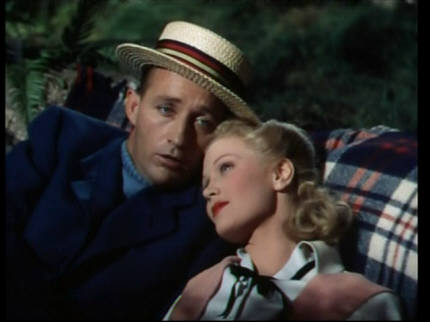
MOVIE SHOWCASE: BLUE SKIES

For over two decades, Bing Crosby was the number one star at Paramount. He successfully rescued the studio from bankruptcy in the early 1930s. Despite that, Paramount rarely put Bing in a technicolor movie. However, when the studio did put Bing in a big budget musical, the result was always out of this world. That was the result of 1946's Blue Skies.

As in Holiday Inn (1942), Blue Skies is designed to showcase the songs of Irving Berlin. The plot, which is presented in a series of flashbacks with Astaire as narrator, follows a similar formula of Crosby beating Astaire for the affections of a leading lady. Comedy is principally provided by Billy De Wolfe.

Joan Caulfield was the protege of Mark Sandrich - who directed many of the Astaire-Rogers musicals - and who was originally slated to direct this film. He died of a heart attack during pre-production and Stuart Heisler was drafted in to replace him. Heisler wanted Caulfield replaced, but Crosby - who was reportedly having an affair with Caulfield - protected her.

Tap dancer Paul Draper was the initial choice to partner Bing Crosby, however, during the first week of production Draper's speech impediment and his trenchant criticism of Caulfield's dance ability led Crosby to insist on his replacement by Astaire who, then forty-seven, had already decided that this would be his final film and that he would retire, having spent over forty years performing before the public. The film was billed as "Astaire's last picture" and its very strong performance at the box office pleased him greatly, as he had dearly wanted to go out on a high note.

The reasons for Astaire's (temporary) retirement remain a source of debate: his own view that he was "tired and running out of gas", the sudden collapse in 1945 of the market for Swing music which left many of his colleagues in jazz high and dry, a desire to devote time to establishing a chain of dancing schools, and a dissatisfaction with roles, as in this film, where he was relegated to playing second fiddle to the lead. Ironically, it is for his celebrated solo performance of "Puttin' On The Ritz," which featured Astaire leading an entire dance line of Astaires, that this film is most remembered today.


The story is told in a series of vignettes and musical numbers that serve to show events in flashback. Our narrative link is New York radio star Jed Potter, who once was a renowned Broadway hoofer. The conceit is that he is on the air, telling his life story... which does not yet have an ending. The tale starts just after World War I and centers around two men who became friends while serving in the Army: rising dancer Potter and the business-minded Johnny Adams. While young, hardworking Potter dreams of and works for stardom, the more laid-back and less disciplined Adams has hopes of becoming a successful nightclub owner.


In time, dancer Potter falls in love with a band singer, a "very pretty girl" named Mary O'Hara. He takes Mary to Adams' nightclub, and she takes a shine to Adams. Potter warns Mary that his old buddy is not the marrying kind. So, of course, she marries Adams. The union is not a happy one, despite the birth of a child. Adams' nightclub business is anything but a resounding success, and it turns out Potter was right: Adams is self-centered and unable to commit to his nightclubs, his marriage, or his daughter. The couple divorces, and Mary tries again with Potter. The two even become engaged. But Mary can't go through with the wedding and takes off. A devastated Potter turns to booze and subsequently suffers an accident that puts an end to his dancing career. He winds up behind a radio microphone, sharing his story with his audience, hoping that wherever Mary is, she can hear him.


Blue Skies was one of the biggest money makers of 1946. On a personal note, the film contains one of my favorite Bing songs "You Keep Coming Back Like A Song". The song was nominated for an Oscar for best song but lost. The movie also ranks as one of Bing Crosby's best movies for Paramount. If you are a Bing Crosby fan and/or a Fred Astaire fan, then this movie is for you. Blue Skies has got it all...

Tuesday, July 12, 2011

ROBERT OSBORNE TAKES MEDICAL LEAVE

Fans of Turner Classic Movie marathons will soon be facing a three-month void as the channel’s long-time host, Robert Osborne,79, is planning a leave of absence. TCM said in a statement Monday that Osborne will undergo minor surgery, without specifying a particular ailment. Osborne has held his hosting tenure since 1994, and will take a vacation after his surgery.

Fans of the iconic host were reminded that Osborne recently renewed his contract with the channel, so he will definitely return when the three months are up. In the meantime, viewers can look forward to guest hosts like Tippi Hedren, Jane Powell, and Robert Wagner to fill the void. TCM will also air pre-recorded segments with Osborne, including his weekly showings of must-see films, The Essentials.

Osborne was a columnist for The Hollywood Reporter from 1982 to 2009. In 2008, Abbeville Press published his book 80 Years of the Oscar: The Official History of the Academy Awards. Between 1986 and 1993, Osborne was an on-air host for The Movie Channel. In 1994, he moved to Turner Classic Movies, where he remains today.

For TCM, in addition to hosting four primetime movies seven days per week, he has also been the host of special one-on-one "Private Screening" interviews featuring many familiar actors and directors. Since 2006, he has also co-hosted TCM's The Essentials, with Molly Haskell from 2006 to 2007, with Carrie Fisher from 2007 to 2008, with Rose McGowan from 2008 to 2009, and currently with Alec Baldwin.

Osborne has also participated in events at the Paley Center for Media in New York City saluting the television careers of Lucille Ball and Cloris Leachman. He recently served as moderator at the Paley for an evening celebrating the 100th birthday of Academy Award-winning songwriter Johnny Mercer.
Osborne also hosts the annual Robert Osborne's Classic Film Festival in Athens, Georgia. It began in 2005. The non-profit event is held by the University of Georgia’s Grady College of Journalism and Mass Communication. In 2010 he hosted the very first TCM Classic Film Festival...

SOURCE

MISSED OBITS: TONY MARTIN JR.


When looking for stories about classic Hollywood, a lot of the stories appear for one day and get forgotten, or they get buried all together. I was saddened to just discover that tragedy has entered singer Tony Martin's life again.

The only son that Tony had with wife and dancer Cyd Charisse passed away at the age of 60 on April 10, 2011. Tony Martin Jr. was born on August 28, 1950 in Los Angeles, California to two of the most talented people in Hollywood. Tony Martin was a big band singer, live performer, and movie star since the mid 1930s. Cyd Charisse was one of the best dancers of Hollywood's golden age. She was a popular dancer in MGM musicals from 1946 to 1957.


Tony Martin Jr. was a musican, who married beauty starlet Liv Lindeland-Martin. Liv was originally from Norway and a popular Playboy playmate. It is not known if they had any children together.

I have not discovered the cause of death, but it was reported that Tony Martin Jr had been in ill health for years, and his parents had to pay most of the medical bills. It was also reported that Tony Jr was in a car accident in 2001, but I am not sure if that contributed to his death.

This is the second sad death that the elder Tony Martin, who is now 97, has had to deal with. Cyd Charisse passed away on June 17, 2008. Tony Martin Jr. is survived by his wife, his father, and his half brother Nico Charisse...