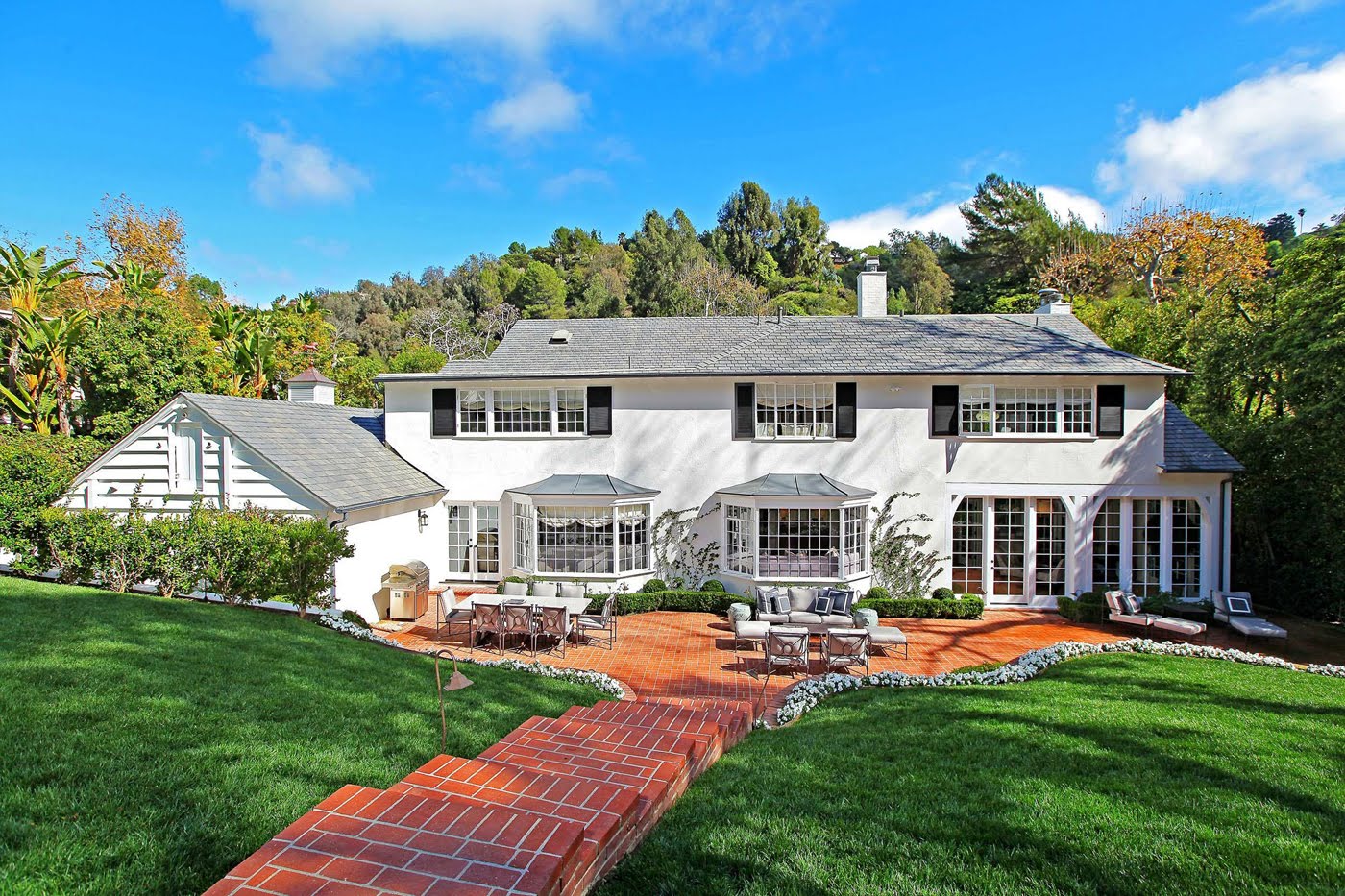
Her Kansas home in "The Wizard of Oz" flew through the air. Now a Bel-Air house that was home to a young Judy Garland has flipped, selling for the second time since last year for $6,772,669.
The Wallace Neff-designed house sold in 2011 for $5.2 million and was then updated and renovated.
The two-story traditional, built in 1938, sits on about 2.5 acres. The 5,513-square-foot house features dormer and bay windows, white columns, French doors, five bedrooms and 6 ½ bathrooms. Outdoor amenities include a swimming pool and a detached studio.
Garland, who played Dorothy in the 1939 classic, died in 1969 at 47. The actress and singer received an honorary Oscar in 1940 for her performances in "Oz" and "Babes in Arms" and was later nominated for her work in "A Star Is Born" (1954) and "Judgment at Nuremberg" (1961)...
SOURCE
Thursday, May 31, 2012
Tuesday, May 29, 2012
BORN ON THIS DAY: BEATRICE LILLIE
As any movie fan knows, Bob Hope was born on this day, May 29th in England. However, he was not the only naturalized Hollywood star that was born on the 29th of May. Beatrice Lillie was born on this day in 1894. Gladys "Bea" Lillie was an actress and comedic performer. Following her 1920 marriage to Sir Robert Peel in England, she was known in private life as Lady Peel.
Lillie was born in Toronto, where she performed, along with other Ontario towns as part of a family trio with her mother and older sister, Muriel. Eventually, her mother, Lucie, took the girls to London, England where she made her West End debut in the 1914 Not Likely. She was noted primarily for her stage work in revues, especially those staged by André Charlot, and light comedies, and was frequently paired with Gertrude Lawrence, Bert Lahr and Jack Haley.
In her revues, she utilized sketches, songs, and parody that won her lavish praise from the New York Times after her 1924 New York debut. In some of her best known bits, she would solemnly parody the flowery performing style of earlier decades, mining such songs as "There are Fairies at the Bottom of our Garden" and "Mother Told Me So" for every double entendre, while other numbers ("Get Yourself a Geisha" and "Snoops the Lawyer", for example) showcased her exquisite sense of the absurd. Her performing in such comedy routines as "One Double Dozen Double Damask Dinner Napkins", (in which an increasingly flummoxed matron attempts to purchase said napkins) earned her the frequently used sobriquet of "Funniest Woman in the World". She never performed the "Dinner Napkins" routine in Britain, because British audiences had already seen it performed by the Australian-born English revue performer Cicely Courtneidge, for whom it was written.
In 1926 she returned to New York city to perform. While there, she starred in her first film, Exit Smiling, opposite fellow Canadian Jack Pickford, the scandal-scarred younger brother of Mary Pickford. From then until the approach of World War II, Lillie repeatedly crisscrossed the Atlantic to perform on both continents. She was long associated with the works of Noël Coward (giving, for instance, the first ever public performance of "Mad Dogs and Englishmen"), though Cole Porter is among those who also wrote songs for her. She made few appearances on film, appearing in a cameo role as a revivalist in Around the World in Eighty Days and as "Mrs. Meers" (a white slaver) in Thoroughly Modern Millie.
She was married, on January 20, 1920, at the church of St. Paul, Drayton Bassett, Fazeley, Staffordshire, to Sir Robert Peel, 5th Baronet. She eventually separated from her husband (but the couple never divorced); he died in 1934. Their only child, Sir Robert Peel, 6th Baronet, was killed in action aboard HMS Tenedos in Colombo Harbour, Ceylon (present-day Sri Lanka) in 1942. During World War II, Lillie was an inveterate entertainer of the troops. Before she went on stage one day, she learned her son was killed in action. She refused to postpone the performance saying "I'll cry tomorrow."
She retired from the stage due to Alzheimer's disease and died on January 20, 1989. She was a funny lady who never let her personal problem or harships get in the way of a performance. She was a definite example of someone who believe that the show should always go on...
Lillie was born in Toronto, where she performed, along with other Ontario towns as part of a family trio with her mother and older sister, Muriel. Eventually, her mother, Lucie, took the girls to London, England where she made her West End debut in the 1914 Not Likely. She was noted primarily for her stage work in revues, especially those staged by André Charlot, and light comedies, and was frequently paired with Gertrude Lawrence, Bert Lahr and Jack Haley.
In her revues, she utilized sketches, songs, and parody that won her lavish praise from the New York Times after her 1924 New York debut. In some of her best known bits, she would solemnly parody the flowery performing style of earlier decades, mining such songs as "There are Fairies at the Bottom of our Garden" and "Mother Told Me So" for every double entendre, while other numbers ("Get Yourself a Geisha" and "Snoops the Lawyer", for example) showcased her exquisite sense of the absurd. Her performing in such comedy routines as "One Double Dozen Double Damask Dinner Napkins", (in which an increasingly flummoxed matron attempts to purchase said napkins) earned her the frequently used sobriquet of "Funniest Woman in the World". She never performed the "Dinner Napkins" routine in Britain, because British audiences had already seen it performed by the Australian-born English revue performer Cicely Courtneidge, for whom it was written.
In 1926 she returned to New York city to perform. While there, she starred in her first film, Exit Smiling, opposite fellow Canadian Jack Pickford, the scandal-scarred younger brother of Mary Pickford. From then until the approach of World War II, Lillie repeatedly crisscrossed the Atlantic to perform on both continents. She was long associated with the works of Noël Coward (giving, for instance, the first ever public performance of "Mad Dogs and Englishmen"), though Cole Porter is among those who also wrote songs for her. She made few appearances on film, appearing in a cameo role as a revivalist in Around the World in Eighty Days and as "Mrs. Meers" (a white slaver) in Thoroughly Modern Millie.
She was married, on January 20, 1920, at the church of St. Paul, Drayton Bassett, Fazeley, Staffordshire, to Sir Robert Peel, 5th Baronet. She eventually separated from her husband (but the couple never divorced); he died in 1934. Their only child, Sir Robert Peel, 6th Baronet, was killed in action aboard HMS Tenedos in Colombo Harbour, Ceylon (present-day Sri Lanka) in 1942. During World War II, Lillie was an inveterate entertainer of the troops. Before she went on stage one day, she learned her son was killed in action. She refused to postpone the performance saying "I'll cry tomorrow."
She retired from the stage due to Alzheimer's disease and died on January 20, 1989. She was a funny lady who never let her personal problem or harships get in the way of a performance. She was a definite example of someone who believe that the show should always go on...
Sunday, May 27, 2012
MOVIE REVIEW: RIDING HIGH
Growing up I never had a pet of any kind - not even a pet rock. I would never hurt a living creature, but I do not have a desire to have a pet. That being said, there has been some great animal movies out there. My favorites are the horse movies. One of the biggest champions of horses and the sport of horce racing was Bing Crosby. He founded the now famous Del Mar Racetrack in 1937, and he had a lifelong love of horses. It was only natural in his career that he would make at least one horse movie.
Riding High (1950) is a black and white musical racetrack film featuring Bing Crosby and directed by Frank Capra in which the songs were actually sung as the movie was being filmed instead of the customary lip-synching to previous recordings. The movie is a remake of an earlier Capra film called Broadway Bill (1934). While the film is generally a light musical comedy, it has an unexpected tragic turn in its story.
Frank Capra did not particularly like his film Broadway Bill. It's chief problem was that Warner Baxter did not like horses and it showed. He got to re-make it with a man who loved horses. Bing at the track was a natural fit. There is a great Van Heusen-Burke score. It was probably one of the last great scores they wrote for a Bing Crosby movie before moving on to Sinatra material. "Sunshine Cake" became one of Bing's million sellers, a great addition to his group of upbeat philosophical numbers. My favorite number however was his version of Stephen Foster's "De Camptown Races", sung while walking Broadway Bill to the track for the big race, accompanied by a gang of kids.
I was pleasantly surprised the way the Clarence Muse character was portrayed here. Yes, he was the exercise boy/groom for the horse, a subservient role to Bing Crosby as owner, but he was not portrayed negatively as many blacks were portrayed in such movies. He was an equal partner in the training of the horse - and sang equally well with Bing Crosby! No eye-rolling, silly cavorting as many of these movies show blacks (as in the Marx Brothers' "Day at the Races."). If you read Capra's autobiography, "The Name Above the Title", he addresses the performance of Clarence Muse as it regards racial stereotypes. He quotes one reviewer's harsh criticism of the role of Muse, and then in his defense he quotes a Black newspaper article which actually praises the importance of and respect shown to the character of Whitey. I also noticed that early on in the film Crosby's fiance, whom we are not supposed to like, arrives at his house and is greeted by Whitey. She disdainfully asks, "What IS your name anyway?" Muse replies, "Clarence White". This was obviously inserted for the purpose of explaining the nickname Whitey.
This film is Capra casting at its best. My favorites are Raymond Walburn and William Demarest. Demarest is one of the few of the replacement cast since Lynne Overman had died the year before. Also watch for Oliver Hardy, he has a bit that is short but very memorable. The movie is more than just a movie about horses. It is a story of a man's love for his horse. The plot is slight at times and dramatic at others, but I recommend RIDING HIGH to anyone who likes horses, Bing Crosby, or a good Frank Capra movie...
MY RATING: 8 out of 10
Riding High (1950) is a black and white musical racetrack film featuring Bing Crosby and directed by Frank Capra in which the songs were actually sung as the movie was being filmed instead of the customary lip-synching to previous recordings. The movie is a remake of an earlier Capra film called Broadway Bill (1934). While the film is generally a light musical comedy, it has an unexpected tragic turn in its story.
Frank Capra did not particularly like his film Broadway Bill. It's chief problem was that Warner Baxter did not like horses and it showed. He got to re-make it with a man who loved horses. Bing at the track was a natural fit. There is a great Van Heusen-Burke score. It was probably one of the last great scores they wrote for a Bing Crosby movie before moving on to Sinatra material. "Sunshine Cake" became one of Bing's million sellers, a great addition to his group of upbeat philosophical numbers. My favorite number however was his version of Stephen Foster's "De Camptown Races", sung while walking Broadway Bill to the track for the big race, accompanied by a gang of kids.
I was pleasantly surprised the way the Clarence Muse character was portrayed here. Yes, he was the exercise boy/groom for the horse, a subservient role to Bing Crosby as owner, but he was not portrayed negatively as many blacks were portrayed in such movies. He was an equal partner in the training of the horse - and sang equally well with Bing Crosby! No eye-rolling, silly cavorting as many of these movies show blacks (as in the Marx Brothers' "Day at the Races."). If you read Capra's autobiography, "The Name Above the Title", he addresses the performance of Clarence Muse as it regards racial stereotypes. He quotes one reviewer's harsh criticism of the role of Muse, and then in his defense he quotes a Black newspaper article which actually praises the importance of and respect shown to the character of Whitey. I also noticed that early on in the film Crosby's fiance, whom we are not supposed to like, arrives at his house and is greeted by Whitey. She disdainfully asks, "What IS your name anyway?" Muse replies, "Clarence White". This was obviously inserted for the purpose of explaining the nickname Whitey.
This film is Capra casting at its best. My favorites are Raymond Walburn and William Demarest. Demarest is one of the few of the replacement cast since Lynne Overman had died the year before. Also watch for Oliver Hardy, he has a bit that is short but very memorable. The movie is more than just a movie about horses. It is a story of a man's love for his horse. The plot is slight at times and dramatic at others, but I recommend RIDING HIGH to anyone who likes horses, Bing Crosby, or a good Frank Capra movie...
MY RATING: 8 out of 10
Labels:
Bing Crosby,
movie review,
musicals,
Riding High
Friday, May 25, 2012
FRED ASTAIRE VS GENE KELLY
I was on the phone with Liza Minnelli recently. I just felt like saying that.
It wouldn't be precisely accurate to add that I had no idea what I was doing on the phone with her: Ms. Minnelli is to be honored on June 4 with a Lifetime Achievement Award at the 30th Annual Fred and Adele Astaire Awards. It was more that I didn't believe my extremely limited knowledge of dance—which the awards celebrate on Broadway and in the movies, in the same way that the Oscars or Tonys do acting—made me worthy of speaking about the subject with the legendary performer. My appreciation for the art form, whether classical ballet or musical theater, is pretty much limited to admiring the dancers' legs.
However, I knew there had to be something dance-related that I had an opinion about, that I could discuss with passion. I finally figured out what that was: To me, Fred Astaire and fellow dancer Gene Kelly have always symbolized aspects of the human spirit. Kelly was the consummate athlete. Not to take anything away from Kelly, but in my humble opinion Astaire was something more. He had a touch of genius, a talent that showed the way to the stars.
Ms. Minnelli and I shot the breeze for a while before I popped the question. However, shooting the breeze could have gone on all day because the actress is disarmingly loquacious, and because, given her storied lineage and star-studded reference points, I could have listened all day.
For example, I assumed she currently lived in L.A. or maybe Vegas. With parents like Judy Garland and Vincente Minnelli, and with a high-kicking showbiz career, I took it for granted she had Hollywood running through her veins. Turns out she's almost a life-long New Yorker.
"I live on the Upper East Side," she reported matter-of-factly. "I walk my dogs."
I finally broached the Fred Astaire vs. Gene Kelly question. "I was on his TV show," Ms. Minnelli said, referring to Kelly. She sang a duet with him when she was 13. "He lived a couple of blocks away." She meant in L.A., where she grew up before she moved to New York a few years later. Her first address here, she said, was the Barbizon Hotel for Women at Lexington Avenue and 63rd Street.
"As a kid. I used to go watch his rehearsals when he was working at MGM," she went on. "My favorite place was always the dance rehearsal studio."
She also mentioned watching dancers Cyd Charisse and Gwen, meaning Gwen Verdon. "That's what I wanted to do. I wanted to dance."
By that point it almost felt tacky to ask her which of the men she preferred. "He danced so brilliantly," she said of Astaire. "He was all about a certain style and a certain line. And Kelly was about athletics."
Her preference? "Both great."
If my interview with Liza (based on our 10-minute phone conversation, I feel I've earned the privilege of calling her by her first name, and not just because everybody does) was marked by solid ignorance on my part, my meeting with Elena Roger last week at the Lambs Club, where the nominees for the Astaire awards were announced, evinced an even more profound lack of knowledge.
I had no idea that the personable Ms. Roger is currently starring on Broadway in "Evita." I saw the show many years ago, with Patti Lupone playing the lead. I certainly didn't remember the dance numbers.
"I have to dance like crazy," Ms. Roger informed me.
Now you understand why I came with that Astaire/Kelly question stuffed in my back pocket. I feared the "Evita" star was too young to know much about the legendary hoofers, but she said that wasn't true. She watched their movies on TV, growing up in Argentina.
"It's weird to say—it's a Fred Astaire award," she confided, "but my hero is Gene Kelly. There is something about the energy I like more."
SOURCE
Labels:
dancer,
Fred Astaire,
Gene Kelly,
Liza Minnelli,
musicals
Wednesday, May 23, 2012
MARY PICKFORD BIOPIC TO BE MADE
NEW YORK (TheWrap.com) - The late Hollywood legend Mary Pickford will return to the big screen in a film based on Eileen Whitfield's biography, "Pickford: The Woman Who Made Hollywood."
Poverty Row Entertainment and producer Said Zahraoui have acquired the rights to the book, which revisits the life of one of the industry's earliest and greatest stars.
"With no intention of creating a conventional biopic, we will use the language of film to hopscotch through time, in order to tell the story of a woman so ahead of her time who was living one of the most romantic love stories of all time," Julie Pacino and Jennifer DeLia, who run Poverty Row, said in a statement. "Mary Pickford's story is one of intense emotion, astute intuition, dedicated artistry, and about the creation of Hollywood."
For those who didn't major in Hollywood history, Pickford was famous both for her work in films like "Pollyanna" and "Rosita," as well as her marriage to Douglas Fairbanks, another star of silent cinema.
The iconic couple surreptitiously began a relationship while Pickford was still married to Owen Moore, later marrying and living at the famous "Pickfair" mansion. The couple eventually divorced.
DeLia will direct and Josh Fagin will adapt the book...
SOURCE
Poverty Row Entertainment and producer Said Zahraoui have acquired the rights to the book, which revisits the life of one of the industry's earliest and greatest stars.
"With no intention of creating a conventional biopic, we will use the language of film to hopscotch through time, in order to tell the story of a woman so ahead of her time who was living one of the most romantic love stories of all time," Julie Pacino and Jennifer DeLia, who run Poverty Row, said in a statement. "Mary Pickford's story is one of intense emotion, astute intuition, dedicated artistry, and about the creation of Hollywood."
For those who didn't major in Hollywood history, Pickford was famous both for her work in films like "Pollyanna" and "Rosita," as well as her marriage to Douglas Fairbanks, another star of silent cinema.
The iconic couple surreptitiously began a relationship while Pickford was still married to Owen Moore, later marrying and living at the famous "Pickfair" mansion. The couple eventually divorced.
DeLia will direct and Josh Fagin will adapt the book...
SOURCE
Monday, May 21, 2012
PAUL LYNDE: ALWAYS UNCLE ARTHUR
Looking back at the 1960s sitcom "Bewitched" I can't believe it was one of my favorite shows that I saw in reruns while growing up in the 1980s. I think it is pretty corny now except for two things - the beautiful Elizabeth Montgomery and the character of Uncle Charlie, played by Paul Lynde. I would see Lynde on other shows like Match Game and The Dean Martin Show, and his comic styles never stopped amusing me.
Paul Lynde was born in Mount Vernon, Ohio in 1926, and studied drama at Northwestern University in Evanston, Illinois, where his fellow students included Cloris Leachman, Charlotte Rae, Patricia Neal, Jeffrey Hunter and Claude Akins. At Northwestern, he joined the Upsilon chapter of Phi Kappa Sigma and is listed amongst the most famous members of the fraternity. He graduated in 1948 and moved to New York City, where he initially worked as a stand-up comic.
Lynde made his Broadway debut in the hit revue New Faces of 1952 in which he co-starred with fellow newcomers Eartha Kitt, Alice Ghostley, and Carol Lawrence. In his monologue from that revue, the "Trip of the Month Club," Lynde portrayed a man on crutches recounting his misadventures on the African safari he took with his late wife. The show was filmed and released as New Faces in 1954.
After the revue's run, Lynde co-starred in the short-lived 1956 sitcom Stanley opposite Buddy Hackett and Carol Burnett, both of whom were also starting out their careers in show business. That same year, he guest starred on NBC's The Martha Raye Show, a comedy/variety show.
In 1960, Lynde returned to Broadway when he was cast as "Harry MacAfee," the father in Bye Bye Birdie. He reprised the role in the play's film adaptation, which was released in 1963. That same year, he recorded a live album, Recently Released, issued as an LP record (no other formats are available). All six tracks were written by him. Once he could afford writers, he rarely used his own material until his tenure on Hollywood Squares years later.
Over the years, Lynde made regular appearances on sitcoms such as The Phil Silvers Show, The Munsters, and I Dream of Jeannie, and variety shows such as The Perry Como Show and The Dean Martin Show. Lynde first appeared in episode 26 of Bewitched, "Driving is the Only Way to Fly," as Samantha's driving instructor Harold Harold, before taking on the recurring role of Uncle Arthur, Endora's brother. He was also a frequent guest on the 1976-79 variety show, Donny and Marie.
Lynde also did extensive voice work on animated cartoons, particularly those of Hanna-Barbera Productions. His most notable roles included Sylvester Sneekly ("The Hooded Claw") in The Perils of Penelope Pitstop (though he was uncredited), Mildew Wolf from It's the Wolf (a segment of Cattanooga Cats), and Pertwee from Where's Huddles?. He also voiced the role of Templeton the gluttonous rat in the animated feature Charlotte's Web. Lynde's sardonic inflections added a dimension to such lines as the sly, drawn-out whine, "What's in it for meeee?" Lynde's distinctive voice is popular among impressionists.
In 1972, Lynde starred in the short-lived ABC sitcom, The Paul Lynde Show, playing an uptight attorney and father at odds with his liberal-minded son-in-law. The series, which was a contractual fulfillment to ABC in place of a final season of Bewitched, was canceled after only one season. The network, and producer William Asher, then "transferred" Lynde to another comedy series that had debuted in 1972, Temperatures Rising, for the 1973 season, but his presence in the cast did not help flagging ratings and this series, too, was not renewed and was replaced by Happy Days. The series’ failure reportedly exacerbated Lynde’s drinking problem, which led to numerous run-ins with the law and frequent arrests for public intoxication. According to Peter Marshall ("Florence Henderson Show", 2008) and Kaye Ballard ("E True Hollywood Story", 2000) the comedic actor would sometimes verbally ridicule his friends when inebriated.
Paul Lynde's sexual orientation was something of an open secret in Hollywood, although, in keeping with the prejudices and social mores of the time, it was not acknowledged or discussed in public.
In 1965, Lynde was involved in an accident in which a young actor, reputed to be his lover, fell to his death from the window of their hotel room in San Francisco's Sir Francis Drake Hotel. The two had been drinking for hours before 24-year-old James "Bing" Davidson slipped and fell eight stories, an event witnessed by two policemen, yet the event was largely kept out of the press, thus saving his career.
Despite his campy television persona, Lynde never publicly came out as being gay and the press generally went along with the deception. In 1976, a People magazine article on Lynde featured him and Stan Finesmith; the latter was dubbed Lynde's "suite mate" and “chauffeur-bodyguard.” In the 1970s, this was as close as the press would come to hinting at his sexuality.
In 1978, Lynde was arrested outside of a gay bar in Salt Lake City. As a result of the arrest, he lost his guest starring role on The Donny and Marie Show. Increasingly in the late 1970s, acting jobs became harder for him to find, although it is unclear if this was because of anti-gay prejudice or his substance abuse problems and noted eratic behavoir, which often made him difficult to work with. He had been arrested for drunk driving and, while under the influence of alcohol, he was known to make rude and racist public comments towards people. Lynde finally became sober and drug free in the early 1980s, shortly before his death. Lynde also suffered from weight control problems, and was honored in 1977 by Weight Watchers.
Lynde was found dead in his Beverly Hills, California, home by friend Paul Barresi on Monday, January 11, 1982. The coroner ruled the death a heart attack. Lynde's cremated remains are interred at Amity Cemetery, in Amity, Ohio, where he is buried next to his brother Johnny and sister Helen. Perhaps his sexual orientation is what caused his alcohol problems and even heart problems that led to his death. In the 1950s and 1960s and even to this present day it has got to be hard to be a homosexual in a heterosexual society. Whatever it is, the important thing is Paul Lynde made millions people laugh and laugh still to this day...
Paul Lynde was born in Mount Vernon, Ohio in 1926, and studied drama at Northwestern University in Evanston, Illinois, where his fellow students included Cloris Leachman, Charlotte Rae, Patricia Neal, Jeffrey Hunter and Claude Akins. At Northwestern, he joined the Upsilon chapter of Phi Kappa Sigma and is listed amongst the most famous members of the fraternity. He graduated in 1948 and moved to New York City, where he initially worked as a stand-up comic.
Lynde made his Broadway debut in the hit revue New Faces of 1952 in which he co-starred with fellow newcomers Eartha Kitt, Alice Ghostley, and Carol Lawrence. In his monologue from that revue, the "Trip of the Month Club," Lynde portrayed a man on crutches recounting his misadventures on the African safari he took with his late wife. The show was filmed and released as New Faces in 1954.
After the revue's run, Lynde co-starred in the short-lived 1956 sitcom Stanley opposite Buddy Hackett and Carol Burnett, both of whom were also starting out their careers in show business. That same year, he guest starred on NBC's The Martha Raye Show, a comedy/variety show.
In 1960, Lynde returned to Broadway when he was cast as "Harry MacAfee," the father in Bye Bye Birdie. He reprised the role in the play's film adaptation, which was released in 1963. That same year, he recorded a live album, Recently Released, issued as an LP record (no other formats are available). All six tracks were written by him. Once he could afford writers, he rarely used his own material until his tenure on Hollywood Squares years later.
Over the years, Lynde made regular appearances on sitcoms such as The Phil Silvers Show, The Munsters, and I Dream of Jeannie, and variety shows such as The Perry Como Show and The Dean Martin Show. Lynde first appeared in episode 26 of Bewitched, "Driving is the Only Way to Fly," as Samantha's driving instructor Harold Harold, before taking on the recurring role of Uncle Arthur, Endora's brother. He was also a frequent guest on the 1976-79 variety show, Donny and Marie.
Lynde also did extensive voice work on animated cartoons, particularly those of Hanna-Barbera Productions. His most notable roles included Sylvester Sneekly ("The Hooded Claw") in The Perils of Penelope Pitstop (though he was uncredited), Mildew Wolf from It's the Wolf (a segment of Cattanooga Cats), and Pertwee from Where's Huddles?. He also voiced the role of Templeton the gluttonous rat in the animated feature Charlotte's Web. Lynde's sardonic inflections added a dimension to such lines as the sly, drawn-out whine, "What's in it for meeee?" Lynde's distinctive voice is popular among impressionists.
In 1972, Lynde starred in the short-lived ABC sitcom, The Paul Lynde Show, playing an uptight attorney and father at odds with his liberal-minded son-in-law. The series, which was a contractual fulfillment to ABC in place of a final season of Bewitched, was canceled after only one season. The network, and producer William Asher, then "transferred" Lynde to another comedy series that had debuted in 1972, Temperatures Rising, for the 1973 season, but his presence in the cast did not help flagging ratings and this series, too, was not renewed and was replaced by Happy Days. The series’ failure reportedly exacerbated Lynde’s drinking problem, which led to numerous run-ins with the law and frequent arrests for public intoxication. According to Peter Marshall ("Florence Henderson Show", 2008) and Kaye Ballard ("E True Hollywood Story", 2000) the comedic actor would sometimes verbally ridicule his friends when inebriated.
Paul Lynde's sexual orientation was something of an open secret in Hollywood, although, in keeping with the prejudices and social mores of the time, it was not acknowledged or discussed in public.
In 1965, Lynde was involved in an accident in which a young actor, reputed to be his lover, fell to his death from the window of their hotel room in San Francisco's Sir Francis Drake Hotel. The two had been drinking for hours before 24-year-old James "Bing" Davidson slipped and fell eight stories, an event witnessed by two policemen, yet the event was largely kept out of the press, thus saving his career.
Despite his campy television persona, Lynde never publicly came out as being gay and the press generally went along with the deception. In 1976, a People magazine article on Lynde featured him and Stan Finesmith; the latter was dubbed Lynde's "suite mate" and “chauffeur-bodyguard.” In the 1970s, this was as close as the press would come to hinting at his sexuality.
In 1978, Lynde was arrested outside of a gay bar in Salt Lake City. As a result of the arrest, he lost his guest starring role on The Donny and Marie Show. Increasingly in the late 1970s, acting jobs became harder for him to find, although it is unclear if this was because of anti-gay prejudice or his substance abuse problems and noted eratic behavoir, which often made him difficult to work with. He had been arrested for drunk driving and, while under the influence of alcohol, he was known to make rude and racist public comments towards people. Lynde finally became sober and drug free in the early 1980s, shortly before his death. Lynde also suffered from weight control problems, and was honored in 1977 by Weight Watchers.
Lynde was found dead in his Beverly Hills, California, home by friend Paul Barresi on Monday, January 11, 1982. The coroner ruled the death a heart attack. Lynde's cremated remains are interred at Amity Cemetery, in Amity, Ohio, where he is buried next to his brother Johnny and sister Helen. Perhaps his sexual orientation is what caused his alcohol problems and even heart problems that led to his death. In the 1950s and 1960s and even to this present day it has got to be hard to be a homosexual in a heterosexual society. Whatever it is, the important thing is Paul Lynde made millions people laugh and laugh still to this day...
Labels:
comedian,
Elizabeth Montgomery,
Paul Lynde,
television
Saturday, May 19, 2012
RECENTLY VIEWED: HARRY AND TONTO
Like I have said in other posts, I am not an animal lover. I would never hurt an animal, but I shy away from movies like "Marley And Me", "National Velvet" and even "Lassie". However, I have always loved Art Carney. Carney was a much better actor than he was ever given credit. He was so much more than "Ed Norton". I recently caught Carney's Oscar winning performance in HARRY AND TONTO from 1974, and I have to admit I enjoyed the quirky movie.
A wonderful movie experience that speaks volumes with its quiet, methodical pace. The film is about a retired school teacher in his 70s, although Carney was only in his 50s at the time, who is forced to leave the only home he has ever known when his apartment in New York is demolished to make way for a parking garage. Possibly this will be no big deal as he and Tonto (his faithful cat) decide to go live with his son (Philip Burns). Quickly it is apparent though that the arrangement will not work and Carney decides that maybe it is time to see the nation he has never gotten a chance to see before by heading west (with a little luggage and his cat of course).
Along the way he meets back up with his daughter (Ellen Burstyn), has his grandson (Josh Mostel) follow him from New York, encounters a strange hitchhiker (Melanie Mayron) and even has a short jail stay with Chief Dan George. As the trip continues a fine line is developed between Carney's old ties and his new ones. Carney is one of those people who instantly appears to be everyone's life-long friend. The trip is an opportunity to meet new friends and sometimes, very sadly, say goodbye to old ones.
In the end Carney's journey does not only take him cross-country, it also takes him to new and sometimes forgotten emotional experiences that he desperately needed to have. HARRY AND TONTO is a simple film that did not rely on a big budget or trivial situations to tell its story. This is a human tale that speaks to anyone who is willing and able to listen.
Carney is a revelation. He is basically only known for his silly turn on television's "The Honeymooners", and he was always overshadowed by another genius Jackie Gleason. Carney was never known for his acting ability and in the end, Carney did win Oscar gold over such other names as Al Pacino ("The Godfather, Part II"), Jack Nicholson ("Chinatown"), Dustin Hoffman ("Lenny") and Albert Finney ("Murder on the Orient Express"). At the time, Carney noted that prior to his work in HARRY AND TONTO, he "never liked cats" but said he wound up getting along well with the cat in the film.
Even though this movie is about a man and his cat, as a non-pet owner, I feel the movie is more about an older man's emotional journey and learning to live his remaining years to the fullest. The movie does not make me want to buy a cat all of a sudden, but it does make me want to see more Art Carney roles than just Ed Norton...
MY RATING: 9 OUT OF 10
A wonderful movie experience that speaks volumes with its quiet, methodical pace. The film is about a retired school teacher in his 70s, although Carney was only in his 50s at the time, who is forced to leave the only home he has ever known when his apartment in New York is demolished to make way for a parking garage. Possibly this will be no big deal as he and Tonto (his faithful cat) decide to go live with his son (Philip Burns). Quickly it is apparent though that the arrangement will not work and Carney decides that maybe it is time to see the nation he has never gotten a chance to see before by heading west (with a little luggage and his cat of course).
Along the way he meets back up with his daughter (Ellen Burstyn), has his grandson (Josh Mostel) follow him from New York, encounters a strange hitchhiker (Melanie Mayron) and even has a short jail stay with Chief Dan George. As the trip continues a fine line is developed between Carney's old ties and his new ones. Carney is one of those people who instantly appears to be everyone's life-long friend. The trip is an opportunity to meet new friends and sometimes, very sadly, say goodbye to old ones.
In the end Carney's journey does not only take him cross-country, it also takes him to new and sometimes forgotten emotional experiences that he desperately needed to have. HARRY AND TONTO is a simple film that did not rely on a big budget or trivial situations to tell its story. This is a human tale that speaks to anyone who is willing and able to listen.
Carney is a revelation. He is basically only known for his silly turn on television's "The Honeymooners", and he was always overshadowed by another genius Jackie Gleason. Carney was never known for his acting ability and in the end, Carney did win Oscar gold over such other names as Al Pacino ("The Godfather, Part II"), Jack Nicholson ("Chinatown"), Dustin Hoffman ("Lenny") and Albert Finney ("Murder on the Orient Express"). At the time, Carney noted that prior to his work in HARRY AND TONTO, he "never liked cats" but said he wound up getting along well with the cat in the film.
Even though this movie is about a man and his cat, as a non-pet owner, I feel the movie is more about an older man's emotional journey and learning to live his remaining years to the fullest. The movie does not make me want to buy a cat all of a sudden, but it does make me want to see more Art Carney roles than just Ed Norton...
MY RATING: 9 OUT OF 10
Labels:
Art Carney,
drama,
Harry And Tonto,
movie review,
recently viewed
Subscribe to:
Posts (Atom)


