Saturday, July 30, 2011

MOE HOWARD: KING OF THE STOOGES

Growing up watching reruns of The Three Stooges, Moe Howard actually used to scare me. I felt bad how he treated his counterparts Larry and Curly. As I have aged though, I can now appreciate Moe Howard more. He was by far the king of The Stooges. Other Stooges came and went, but it was Moe that held the classic comedy team together. For nearly 40 years he presided over those knuckleheads, and he helped to make the Stooges a household name.

Moses Horwitz (aka Moe Howard)was born in Brooklyn, New York, neighborhood of Bensonhurst, to Solomon Horwitz and Jennie Gorovitz on June 19, 1897. He was the fourth of the five Horwitz brothers of Lithuanian Jewish ancestry. In his younger years, he got the nickname Moe and later adopted the name Harry. Although his parents were not involved in show business, Moe, his older brother Samuel and younger brother Jerome all eventually became world-famous as members of the Three Stooges.

Although his "bowl cut" hairstyle is now widely recognized, when he was a child his mother refused to cut his hair, letting it grow to shoulder length. One day, he could not take his classmates' years of teasing any longer, sneaked off to a shed in his parents' back yard, and with the help of a friend and a mixing bowl, cut his hair. Moe was so afraid his mother would be upset (she enjoyed curling his hair) that he hid under the house for several hours, causing a panic. He finally came out and his mother was so glad to see him that she did not even mention the hair.

Moe began to develop an interest in acting and, as a result, his schoolwork suffered. He began playing hooky from school in order to attend theater shows. Moe said, "I used to stand outside the theater knowing the truant officer was looking for me. I would stand there 'til someone came along and then ask them to buy my ticket. It was necessary for an adult to accompany a juvenile into the theater. When I succeeded I'd give him my ten cents — that's all it cost — and I'd go up to the top of the balcony where I'd put my chin on the rail and watch, spellbound, from the first act to the last. I would usually select the actor I liked the most and follow his performance throughout the play."

Despite his decreasing attendance, Moe graduated from P.S. 163 in Brooklyn, but he dropped out of Erasmus Hall High School after only two months. This was the end of his formal education. To mollify his parents he took a class in electric shop, but quit after a few months to pursue a career in show business.


Moe continued his attempts at gaining show business experience by singing in a bar with his older brother Shemp until their father put a stop to it, and in 1914 joining a performing troupe on a Mississippi River showboat for the next two summers. In 1921, he joined Lee Nash, who was now firmly established in show business as Ted Healy, in a vaudeville routine. In 1923, Moe spotted Shemp watching the show and yelled at him from the stage. Shemp and Moe heckled each other to a large positive response from the audience and Healy hired Shemp as a permanent part of the act. Next, Healy recruited a vaudeville violinist, Larry Fine, in 1925, to join the comedy troupe, which was billed as "Ted Healy and His Racketeers" (later changed to Ted Healy and His Stooges).

By 1930, Ted Healy and his Stooges were on the verge of "the big time," and made their first movie, Soup to Nuts — featuring Ted Healy, and his four Stooges (Moe (billed as "Harry Howard"), Shemp, Larry, and one-shot Stooge Fred Sanborn) — for Fox Films (later 20th Century Fox). Shemp had never seen eye-to-eye with the hard-drinking and sometimes belligerent Healy, and left the group shortly after filming in order to pursue a solo film career. After a short search for a replacement, Moe suggested his youngest brother, Jerome ("Jerry" to his friends, "Babe" to Moe and Shemp). Healy originally passed on Jerry (whom he disliked), but Jerry was so eager to join the act that he shaved off his luxuriant auburn mustache and hair and ran on stage during Healy's routine. Healy hired Jerry, who took the stage name of "Curly."


Healy and the Stooges were hired by Metro-Goldwyn-Mayer as "nut" comics, to liven up feature films and short subjects with their antics. After a number of appearances in MGM films, Healy was being groomed as a solo character comedian. With Healy pursuing his own career, his Stooges (now renamed The Three Stooges) signed with Columbia Pictures where they stayed until December 1959, making 190 short films.

With Healy's departure, Moe's character assumed Healy's previous role of the aggressive, take-charge leader of the Three Stooges: a short-tempered bully, prone to slapstick violence against the other two Stooges. However, despite his rather cruel demeanor towards his pals, Moe's character was also very loyal and protective of the other Stooges, keeping them from harm and, should it befall them, doing whatever it took to save them. In many ways, Moe's on-screen persona was the antithesis of his real personality; he was quiet, loving, and generous to his family. He was also a shrewd businessman, and invested the money made from his film career wisely. However, the Stooges got no subsequent royalties from any of their many shorts: they were paid a flat amount for each one and Columbia owned the rights (and profits) thereafter.


Moe sold real estate when his show-business life slowed down, although he still did minor roles and walk-on bits in movies (Don't Worry, We'll Think of a Title, Dr. Death: Seeker of Souls) and television appearances (Here's Hollywood, Toast of the Town, Masquerade Party, Truth or Consequences and several appearances on The Mike Douglas Show). In one episode of The Mike Douglas Show, Howard, his hair in a style popular at the time, made a surprise appearance during an interview of the writer of a "where-are-they-now" book. When the audience was given the chance to ask the writer about famous people, Howard asked "What ever happened to the Three Stooges?" Finally recognized by Douglas, he then combed his hair into his trademark style. The Stooges also made several appearances on late night television, particularly The Tonight Show.

The Stooges attempted to make a final film in 1969, Kook's Tour, which was essentially an early "reality TV" show of Moe, Larry and Curly-Joe, out of character, touring the country and interacting with fans. But production abruptly halted when on January 8, 1970, Larry suffered a major stroke during filming, paralyzing the left side of his body; he died on January 24, 1975 at age 72. Moe asked long-time Three Stooges supporting actor Emil Sitka to replace Larry, but this final lineup never recorded any material.

Moe was working on his autobiography, tentatively titled I Stooged to Conquer when he died of lung cancer on May 4, 1975, a month and a half shy of his 78th birthday. He was entombed in Culver City's Hillside Memorial Park Cemetery. His wife died of a heart attack in October 1975 and was entombed next to him. Moe's autobiography was released in 1977 as Moe Howard and the Three Stooges.


Despite being constantly rereun on television now, The Three Stooges never got a dime from the syndication. While Moe was alive he was asked about this and he said "When we were making the films we never thought about television or syndication. We were making the movies for the audiences that loved us. That was our payment." Now some 80 years after the Three Stooges first took the stage, they are still remembered fondly, and even though their slapstick could be violent at times, it is timeless as well...

Thursday, July 28, 2011

THE CHILDREN OF AL JOLSON

During his career, Al Jolson was often called "The World's Greatest Entertainer", and often he would be the first person to tell you. Jolson also was one of the busiest men in show business too - from his broadway debut in 1911 until his death in 1950. He had time to get married four times, but only one of the marriages worked. It was surprising that Jolson had time for anything personal, but in addition to his marriages, he adopted three children.


In 1935, Al Jolson and his third wife, Ruby Keeler, adopted a baby boy. This seven week old boy, of Jewish and Irish extraction, was named Al Jolson, Jr., although Al called him "Sonny Boy," and Ruby shortened that into "Sonny." According to Jolson biographers, Al Jr. seemed more attracted to Ruby than Al, as many children seem to prefer one parent over another. Jolson resented this and never really got close to the boy. After divorcing Al Jolson, Ruby Keeler married John Lowe, and at age 14 Sonny Boy became Albert Peter Lowe. After the divorce, Al Jr. never talked to Jolson again. He remained extremely close to his mother Ruby Keeler who died in 1993. Albert Peter Lowe passed away at age 72, in November, 2007.


With Erle Galbraith, Al Jolson's fourth wife, a six month old baby boy was adopted in late 1947. A proud father again, Al told reporters: “We’ll send him to a good school - and a hard one. Want no spoiling of the boy.” They hired a nurse though Erle enjoyed taking care of the baby herself. Naming him Asa Albert Jolson, Jr., Al and Erle became doting parents for the toddler. It was after Asa's adoption that Al bought the perfect home for his new family, buying the home he had built for Ruby and himself back from Don Ameche, it's current owner, at a loss.


In 1950, the Jolsons adopted a second baby, a girl they named Alicia. Not known at the time of adoption, she was later diagnosed as being mentally challenged. Jolson died before this was discovered, and Alicia eventually required institutional placement. Alicia died in 1982, at the age of about 32. She is buried in Forest Lawn, Hollywood Hills along with Erle, Norman Krasna, and members of the Galbraith family.


Known to his family as "Jolie," Albert Jolson is alive and well, living in Nashville, and pulled the cord to reveal the "Al Jolson Way" sign at the ceremony in New York in August, 2006. Albert Jolson also has owned a music studio for a number of years in Nashville. Albert and his wife Victoria had a daughter in 1983 that they named Kate. Kate Jolson was an all-star athlete in high school and college. UPDATE: Albert died in 2015.


With Al Jolson's huge personality, it is hard to believe he ever had children. As is often the case, none of his children rose to the heights that Jolson did during his career. I also would be interested in knowing if Jolson was the greatest father as much as he was the greatest entertainer. That story is yet to be fully told...

Tuesday, July 26, 2011

JUDY GARLAND: A STAR IS REBORN

On Big Screen and Small, a Star Is Reborn
By WILL FRIEDWALD

Judy Garland (1922-69) led a life of extremes: Her music contrasted of the exuberant joy of her happy songs with the depressive depths of her torch tunes. Likewise, her life was marked by pinnacles, valleys and triumphant comebacks.

To do justice to Garland, a film series would similarly have to go to extremes, and that is exactly what the Film Society of Lincoln Center is doing with "All Singin', All Dancin', All Judy," a two-week retrospective beginning Tuesday that includes all 31 of her starring roles in feature films. In addition, FLSC is partnering with the Paley Center for "Judy Garland: The Television Years," an equally comprehensive retrospective of her small-screen work.

Why Judy Garland? Why not Joan Crawford, Bing Crosby or Fred Astaire? For one thing, this years marks the 75th anniversary of Garland's feature-film debut, in 1936's "Pigskin Parade." According to Lincoln Center, no American theater has ever mounted a complete run of Hollywood's greatest musical leading lady. John Fricke, the author of six books on Garland and related subjects—including the new "Judy: A Legendary Film Career" (Running Press)—and a consultant for the combined retrospectives, answered with a question: "How many others can you name from her generation of film stars who still have her immediacy of impact? Whose work has proved to be timeless—even in films that were of their time? Whose legacy encompasses classic musical comedies, classic family films, classic musical dramas and standard dramas?"


Every show at both the Walter Reade Theater and the Paley Center is highly recommended. But if we had to pick four unmissable shining moments, we'd go with the following. (All are screening at the Walter Reade, with the exception of the first):

"The Judy Garland Show" (1962) and "Judy Garland and Her Guests, Phil Silvers and Robert Goulet" (1963) are the two "specials" that led directly to Garland's epochal 1963 CBS TV series, and represent her finest moments on television. Frank Sinatra and Dean Martin guest on the 1962 entry, and the romantic chemistry between Garland and Sinatra sizzles on the small screen.

"The Pirate" (1948) Under-appreciated in its day but since recognized as a classic, this zesty costume musical presents Garland, dancing leading-man Gene Kelly, songwriter Cole Porter and director Vincente Minnelli all at their creative peaks.


"A Star Is Born" (1954) The big-screen spectacle is Garland's personal epic, a major morality play of showbiz excess that seems more relevant than ever. It will be shown in a new, complete (three-hour) edition.

Short Films and Rarities Presented by John Fricke This one-shot presentation features rare early footage of Garland when she was still a member of the Gumm Sisters trio, as well as her "screen test," the 1936 "Every Sunday: A Tabloid Musical," in which she engages in a battle of "opera vs. jazz" (guess what side she's on?) against teen soprano Deanna Durbin...

SOURCE

Monday, July 25, 2011

THIS WEEK IN FILM HISTORY

Here are some more interesting events that happened in movie history during this week:

July 28, 1928: Encouraged by the response to the few minutes of sound in The Jazz Singer, Warner Bros. releases Lights of New York, the first all-talking picture.

July 28, 1948: Lon Chaney, Jr. and Bela Lugosi play the Wolf Man and Dracula, respectively, for the last time onscreen in Abbott and Costello Meet Frankenstein.


July 27, 1950: George Pal's Destination Moon, one of the first films to offer a serious look at space exploration, opens.

July 25, 1952: High Noon, the western that would garner Gary Cooper an Oscar for his performance as the retired sheriff faced with a fateful showdown, opens.

July 28, 1954: Seen by many as an answer to critics of his 1952 HUAC testimony, director Elia Kazan's "informer" drama On the Waterfront opens.

July 29, 1957: James Whale, director of the horror staples Frankenstein and The Invisible Man, is found drowned in his swimming pool at age 67.

July 26, 1960: Art director Cedric Gibbons, who took home the Oscar statuette (which he designed) 11 times, dies at the age of 67.

July 30, 1966: With all of the "BIFF! POW! SOCK!" of the campy TV show, Batman, starring Adam West, makes his first film appearance since 1943.

July 28, 1978: National Lampoon's Animal House, starring John Belushi, opens and quickly finds a huge youth audience.


July 27, 1983: Tom Cruise teaches audiences the fine art of dancing in one's underwear in the hit comedy Risky Business.

July 28, 1991: Paul Reubens, aka Pee-wee Herman, is arrested in Sarasota, Fla., for indecent behavior in an adult movie theater.

July 28, 1995: Star Kevin Costner's aquatic sci-fi tale Waterworld, reportedly the first $200 million film, opens to less than a flood of ticketbuyers.

July 24, 1998: Director Steven Spielberg and star Tom Hanks acquaint a new generation with the drama and sacrifice of World War II in Saving Private Ryan.

Sunday, July 24, 2011

REMEMBERING: AUDIO CASSETTES


My childhood in the 1980s and 1990s were filled with the joy of audio cassettes. I loved making mix tapes of music, sharing them with friends, and bonding with my grandfather as we shared a mutual love of music. Like so much in this fast paced world of 2011, cassettes have been forgotten and thrown in the pile of such other mediums as 78rpms and 8 track tapes.

When I was at the height of my taping and exchanging music in the 1990s, I had about 25 people I would exchange cassettes to on a regular basis. There also was a club I belonged to called TRACC (short for Tape Recording and Conversation Club). Life events happened, and I dropped out of the club, but I was overjoyed to discover they still existed!

Here is a little further explanation about what the club is from their website:

TAPE RECORDING AND CONVERSATION CLUB’S (called TRACC for short) sole purpose is to enable members to communicate with other members by letter, digital disk, cassette, or reel-to-reel; and to include in their communication whatever is mutually agreeable. It could be music, conversation, programs, or replays of old time radio shows. In recent years, members have exchanged home videos and e-mail boxes. The subject matter will vary with each taper.

-Active participation by many of its members makes TRACC a unique international club. It is a vibrant club. It is not a laid-back organization. It is a club whose members get to know each other as acquaintances and then friends. Our motto is: “We care-We share.”

-Participation is what makes TRACC different. TRACC has much to offer in the form of entertainment or just casual conversation. There are a number of programs called Sections. Individual members create the sections to make the club the most interesting and worthwhile taping club of its kind. Sections are available to suit a number of different tastes ranging from big band, jazz, and country… to stories in the science fiction field. Subjects also include western music, easy listening, hit tunes, old time radio, gospel and others. These programs are free except for the postage cost to forward them to the next person on a circuit. A few programs do not circulate outside of the country of origin. A number of members using audio cassettes exchange voice letters on a regular basis with one member or on Round Robins with three or more members. Sometimes music is included. There are some who exchange music (one-on-one) with little or no voice comments and bare minimum of written communication. The music library has about 250 cassettes.

-Seek and Sell is published every other month. Ads are free for members wanting to find others with similar interest, something to buy, sell, give away or fill special needs. Dealer ads are not allowed. Ads are a good way to get off to a fast start as a new club member. Members furnish postage and envelopes if they want copies.

-All members receive an annual membership directory and a quarterly bulletin. The directory provides names, addresses, hobbies and interest of members.

-We have special services, free of charge, for visually impaired persons (VIP’s). Club publications are available on cassette. VIP’s mail “Free Matter for the Blind or Handicapped” within their country and to foreign countries.

If anyone is interested further please contact Barbara Wear at clownlady61@yahoo.com. If you are one of the people in this world that still embraces the simple technology of the audio cassette, then this club is for you!


SOURCE

Friday, July 22, 2011

ELIZABETH TAYLOR AND LUCILLE BALL: AN APPRECIATION


TCM, continuing their efforts to issue great classic collections has done it again with more DVD issues. A pair of TCM Classic Legends releases brings together two leading Hollywood actresses who have more in common than meets the eye. Fame, influence, tabloid fodder, they shared these by-products of Hollywood success. Elizabeth Taylor and Lucille Ball were sisters in arms in the battle for box office bucks but they were also much more.

Elizabeth Taylor was considered the most beautiful woman in the world at the height of her fame. Those cool violet eyes and blue black hair were the stuff of art directors’ dreams. Taylor seemed slightly dangerous to men, and an anathema to suddenly single women.

Taylor was a man-trap, married eight times and as crazy about love when she died as when she raised eyebrows making out with her married Cleopatra co-star Richard Burton. She stole Eddie Fisher from America’s Sweetheart Debbie Reynolds, and Richard Burton from his wife Sybill. Taylor’s personal life was far juicier than any role she played.
Always the romantic, Taylor left nearly a $1M to her last ex-husband, Larry Fortensky, a much younger man – a construction worker – romance always! Taylor’s appetites were big – men, food, clothes, jewels, and at times, drink. She doted on her three children, one of whom she adopted on the set of Cleopatra.

But her turbulent relationship with Richard Burton was her romantic legacy, as much as they married twice and vowed eternal love they were apart some years when he died. In their heyday, they were dynamite, behaving scandalously in various corners of the world, buying up treasures wherever they went including the 33 carat Krupp diamond and the 69 carat “Taylor-Burton” diamond and showing off their chemistry at every opportunity. The “paparazzi”, the new breed of invasive celebrity photographers of the sixties, tracked their every move.
Lucille Ball was beautiful, not Taylor beautiful but warm, funny, down to earth and wide eyed beautiful. Art directors went to great pains to create color palettes that complemented her marmalade red hair, which was often feature as a bit in her TV series and in her movies, representing her fiery nature and her expensive dye habit.

Lucy wasn’t afraid to get gritty, and physical and look the fool. In fact, she relished it. Lucy’s showbiz savvy was her secret weapon; she knew all aspects of Hollywood and had strong business acumen. But onscreen is the payoff – apparently rather dour off-screen, she was insanely, unforgettably funny on.

Ball too had a long, headline grabbing and turbulent relationship. Desi Arnaz was her husband and business partner at Desilu Studio, and the pioneering, inventive mind behind the success of their TV shows. She was timing, acting skill and appeal.

Together they became wealthy, Hollywood moguls whose TV shows and films were seen all around the world. Through their partnership, he emerged from the far fringes of Hollywood to become one of its biggest power players and Ball found her niche as a comedienne after a long string of ho hum dramatic and romantic films. Together they were dynamite. Separate, not so much.
The Taylor DVD collection features a variety of Taylor moods – sexy, hungry and clingy in Cat on a Hot Tin Roof, enamored of her husband who can’t bear her. Taylor is a hooker In Butterflied 8, desperate to change her ways and win her mother’s approval and the love of a married man for keeps.

Taylor is gorgeously young and adorable in Father of the Bride as she embarks on the adventure of first love and marriage; not quite innocent, she’s teetering on the brink of womanhood. And The Sandpiper reunites Taylor and Burton as a married man in love with Taylor’s Big Sur artist; this time they are lovers in the autumn of their lives, pondering life’s Big Questions. This is an extremely well chosen set.

Ball is featured in all her Technicolor glory in DuBarry Was a Lady, which pretty much stars her hair and clothes, with Lucy and Red Skelton in second billing. The film was made to enhance her coloring, or so it seems. It’s pretty eye-popping. Forever Darling is one of two “getaway” films Lucy and Desi made together as husbands and wives embark on a trip, like fish out of water, and they bicker and fight funny. Here they go camping to test his bug spray formula.

They play a married couple honeymooning In Rockies in a super big mobile home in The Long, Long, Trailer. Harrowing scenes navigating narrow mountain trails are hilariously unbearable, and of course her rock collection doesn’t help. Ball’s long-time friendship with the Marx Brothers began in Room Service, a classic comedy in which she’s the straight girl. In 1938, she hadn’t quite found her way to comedy but it’s clear she had the greatest teachers available to any young aspiring actress...


SOURCE

Wednesday, July 20, 2011

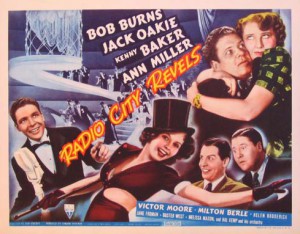
FORGOTTEN FILMS: RADIO CITY REVELS

It has been awhile since I started watching old movies. When I started my love of classic Hollywood, there was no TCM buy luckily I had a dinosaur called the video tape recorder. Before TCM entered the airwaves, its sister channel TNT used to show old movies. It was there that I saw a mediocre musical called Radio City Revels.

The movie deals with two out-of-work songwriters in New York City, Harry Miller (Jack Oakie) and Teddy (Milton Berle), who live next door to sisters Billie (Ann Miller) and Gertie (Helen Broderick) Shaw, who used to tour in vaudeville and have been left stranded and income-less by its demise. Miller’s and Teddy’s only source of income is a correspondence course in songwriting that they’ve sold to exactly one student, Arkansas hillbilly Lester Robin (played by rustic comedian Bob Burns, who had enough of a reputation in 1938 he’s actually given top billing).

Robin is frustrated because while he’s awake he can only come up with songs other people already wrote (like an hilariously fractured version of “My Bonnie Lies Over the Ocean”) but when he’s asleep he dreams the most beautiful — and original — melodies and lyrics, only to forget them when he wakes up. Miller and Teddy realize this unique talent and start transcribing Lester’s nocturnal emissions, peddling them as their own and becoming star songwriters for the company owned by Paul Plummer (Victor Moore, even more annoyingly whiny than usual). The premise is so weird that at least one critic summed it up by saying it seemed as if the film’s writers had been asleep when they came up with it.


The draw of the movie for me was the appearance of singer Jane Froman in a minor role. She played the vocalist for Hal Kemp's band. It is infortunate that she did not have a bigger role, it might have helped the movie. Froman never had much of a movie career, but her voice was wonderful. Kenny Baker was the male vocalist in this opus. Baker got his start as the comic foil for Jack Benny on his radio show, and he left the Benny organization to make his way in film. Like Froman, Baker did not have much of a movie career either.


RKO spent some serious money on this movie — at least two of the numbers, including “There’s a New Moon Over the Old Mill,” are staged on splendiferous sets (the “Old Mill” number takes place on a beautiful white, stylized art deco mill and features four mill maids desperately waiting for male mates. Great comic actors like Victor Moore and Helen Broderick were features as second bananas in the film, but with no major stars it was hard to see who they would be second banana to.


It is utterly baffling who they thought the audience for it would be, and as it turned out there wasn’t one: RKO spent $810,000 making Radio City Revels and lost $300,000 on it. The movie was not great, and it is mostly forgotten today, but the film is worth watching if it is just for the 1930s stars that the movie spotlighted...