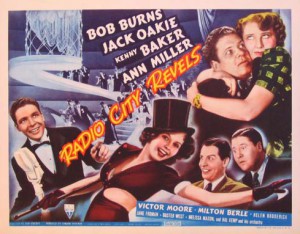
According to my wife, I like anything that was made before 1950. I guess to a degree, that is true. I do gravitate to anything nostalgic or sentimental, but there are some older stars that I just never really get. It's not that I do not like them, I just do not understand their appeal. One of those forgotten so-called nostalgic stars was radio comedian Bob Burns. Burns played a novelty musical instrument of his own invention, which he called a "bazooka". During World War II, the US Army's handheld anti-tank rocket launcher was nickamed the "bazooka".
He was born Robin Burn on August 2, 1890 in Greenwood, Arkansas. When he was three years old, his family moved to Van Buren, Arkansas. As a boy, Burns played trombone and cornet in the town's "Queen City Silver Cornet Band". At 13, he formed his own string band. Practicing in the back of Hayman's Plumbing Shop one night, he picked up a length of gas pipe and blew into it, creating an unusual sound. With modifications, this became a musical instrument he named a "bazooka" (after "bazoo", meaning a windy fellow, from the Dutch bazuin for "trumpet"). A photograph shows him playing his invention in the Silver Cornet Band. Functioning like a crude trombone, the musical bazooka had a narrow range, but this was intentional. Burns also studied civil engineering and worked as a peanut farmer, but by 1911 was primarily an entertainer.
During World War I Burns enlisted in the United States Marine Corps. He sailed to France with the Marine 11th Regiment. As a sergeant, he became the leader of the Marine Corps's jazz band in Europe. Burns made another "bazooka" from stove pipes and a whiskey funnel, which he sometimes played with the Corps band. After the war, Burns returned to the stage, often playing the bazooka as part of his act. He used it as a prop when telling hillbilly stories and jokes. Burns became known as The Arkansas Traveler and The Arkansas Philosopher. His stage persona was a self-effacing, rustic bumpkin with amusing stories about "the kinfolks" back home in Van Buren.
In 1930, Burns auditioned for a major Los Angeles radio station. He had prepared a 10 minute performance, but was asked to do 30 minutes, which he filled out with improvised stories and bazooka tunes. The managers did not care for his prepared material, but were impressed by his improvised material. Burns was hired. He appeared on an afternoon show, "The Fun Factory", as a character called "Soda Pop".
In 1935, on a visit to New York, Burns asked bandleader and radio star Paul Whiteman for an audition. Whiteman put Burns on his nightly show, the Kraft Music Hall, which was broadcast nationally; Burns was a big hit. Burns also became a regular on Rudy Vallee's show The Fleischmann Hour. Burns returned to Los Angeles in 1936, where Kraft Music Hall was now hosted by Bing Crosby. Burns was a regular, playing the bazooka and telling tall tales about his fictional hillbilly relatives, Uncle Fud and Aunt Doody.
Bob Burns was the host of The 10th Academy Awards held on March 10, 1938 at the Biltmore Hotel in Los Angeles, California. Originally scheduled to be held on March 3, 1938, the ceremony was postponed due to heavy flooding in Los Angeles. In 1941, Burns was given his own radio show, called The Arkansas Traveler (1941-43) and he followed that up with The Bob Burns Show (1943-47).
His last performance was on January 30, 1955, on The Ed Sullivan Show (then called Toast of the Town). Bob left show business in the earlt 1950s though. A wealthy man from his land investments, Burns spent his final years on his 200-acre model farm in Canoga Park, California. Married three times, Bob Burns also had three children. (At one time he was married to entertainer Judy Canova). Burns sadly died of kidney cancer in Encino, California on February 2, 1956, at the age of 65. He is not very well remembered today, but his homespun humor was part Will Rogers and part Jed Clampett. Even though I never thought he was overly funny, he was a popular fixture, especially in radio in the late 1930s and early 1940s...
Showing posts with label Bob Burns. Show all posts
Monday, May 13, 2013
Wednesday, July 20, 2011
FORGOTTEN FILMS: RADIO CITY REVELS
It has been awhile since I started watching old movies. When I started my love of classic Hollywood, there was no TCM buy luckily I had a dinosaur called the video tape recorder. Before TCM entered the airwaves, its sister channel TNT used to show old movies. It was there that I saw a mediocre musical called Radio City Revels.
The movie deals with two out-of-work songwriters in New York City, Harry Miller (Jack Oakie) and Teddy (Milton Berle), who live next door to sisters Billie (Ann Miller) and Gertie (Helen Broderick) Shaw, who used to tour in vaudeville and have been left stranded and income-less by its demise. Miller’s and Teddy’s only source of income is a correspondence course in songwriting that they’ve sold to exactly one student, Arkansas hillbilly Lester Robin (played by rustic comedian Bob Burns, who had enough of a reputation in 1938 he’s actually given top billing).
Robin is frustrated because while he’s awake he can only come up with songs other people already wrote (like an hilariously fractured version of “My Bonnie Lies Over the Ocean”) but when he’s asleep he dreams the most beautiful — and original — melodies and lyrics, only to forget them when he wakes up. Miller and Teddy realize this unique talent and start transcribing Lester’s nocturnal emissions, peddling them as their own and becoming star songwriters for the company owned by Paul Plummer (Victor Moore, even more annoyingly whiny than usual). The premise is so weird that at least one critic summed it up by saying it seemed as if the film’s writers had been asleep when they came up with it.
The draw of the movie for me was the appearance of singer Jane Froman in a minor role. She played the vocalist for Hal Kemp's band. It is infortunate that she did not have a bigger role, it might have helped the movie. Froman never had much of a movie career, but her voice was wonderful. Kenny Baker was the male vocalist in this opus. Baker got his start as the comic foil for Jack Benny on his radio show, and he left the Benny organization to make his way in film. Like Froman, Baker did not have much of a movie career either.
RKO spent some serious money on this movie — at least two of the numbers, including “There’s a New Moon Over the Old Mill,” are staged on splendiferous sets (the “Old Mill” number takes place on a beautiful white, stylized art deco mill and features four mill maids desperately waiting for male mates. Great comic actors like Victor Moore and Helen Broderick were features as second bananas in the film, but with no major stars it was hard to see who they would be second banana to.
It is utterly baffling who they thought the audience for it would be, and as it turned out there wasn’t one: RKO spent $810,000 making Radio City Revels and lost $300,000 on it. The movie was not great, and it is mostly forgotten today, but the film is worth watching if it is just for the 1930s stars that the movie spotlighted...
The movie deals with two out-of-work songwriters in New York City, Harry Miller (Jack Oakie) and Teddy (Milton Berle), who live next door to sisters Billie (Ann Miller) and Gertie (Helen Broderick) Shaw, who used to tour in vaudeville and have been left stranded and income-less by its demise. Miller’s and Teddy’s only source of income is a correspondence course in songwriting that they’ve sold to exactly one student, Arkansas hillbilly Lester Robin (played by rustic comedian Bob Burns, who had enough of a reputation in 1938 he’s actually given top billing).
Robin is frustrated because while he’s awake he can only come up with songs other people already wrote (like an hilariously fractured version of “My Bonnie Lies Over the Ocean”) but when he’s asleep he dreams the most beautiful — and original — melodies and lyrics, only to forget them when he wakes up. Miller and Teddy realize this unique talent and start transcribing Lester’s nocturnal emissions, peddling them as their own and becoming star songwriters for the company owned by Paul Plummer (Victor Moore, even more annoyingly whiny than usual). The premise is so weird that at least one critic summed it up by saying it seemed as if the film’s writers had been asleep when they came up with it.
The draw of the movie for me was the appearance of singer Jane Froman in a minor role. She played the vocalist for Hal Kemp's band. It is infortunate that she did not have a bigger role, it might have helped the movie. Froman never had much of a movie career, but her voice was wonderful. Kenny Baker was the male vocalist in this opus. Baker got his start as the comic foil for Jack Benny on his radio show, and he left the Benny organization to make his way in film. Like Froman, Baker did not have much of a movie career either.
RKO spent some serious money on this movie — at least two of the numbers, including “There’s a New Moon Over the Old Mill,” are staged on splendiferous sets (the “Old Mill” number takes place on a beautiful white, stylized art deco mill and features four mill maids desperately waiting for male mates. Great comic actors like Victor Moore and Helen Broderick were features as second bananas in the film, but with no major stars it was hard to see who they would be second banana to.
It is utterly baffling who they thought the audience for it would be, and as it turned out there wasn’t one: RKO spent $810,000 making Radio City Revels and lost $300,000 on it. The movie was not great, and it is mostly forgotten today, but the film is worth watching if it is just for the 1930s stars that the movie spotlighted...
Labels:
Ann Miller,
Bob Burns,
forgotten,
Jack Oakie,
Jane Froman,
Kenny Baker,
musicals,
Radio City Revels
Subscribe to:
Posts (Atom)