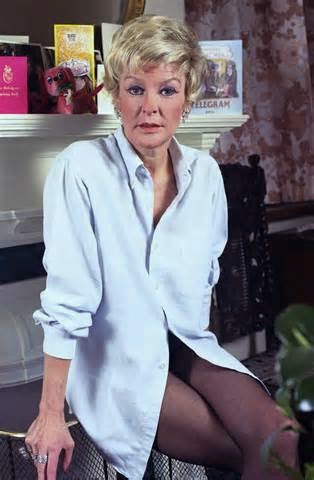
If only Elaine Stritch could have secretly attended her own funeral like Tom Sawyer, she would have witnessed a standing ovation.
In early 2013, the legendary Broadway star abandoned her longtime home of New York for Birmingham, Mich., where she underwent surgery a year later for stomach cancer, a diagnosis she never publicly revealed. After she died in July of 2014 at 89, she was buried at a small service in Chicago alongside her husband, the actor John Bay.
The priest delivered an unconventional eulogy, especially when he started to warble “I Feel Pretty,” one of her signature covers from “West Side Story.” He ended his remarks by asking the attendees to give Stritch a round of applause. “We stood up and clapped,” recalls Chiemi Karasawa, the director of “Elaine Stritch: Shoot Me,” who spent two years trailing—and later befriending—the grand dame. “He wanted us to acknowledge her as a performer, because that’s how she wanted to be acknowledged. I thought it was touching he picked up on that.”
The pastor learned all about Stritch, whose prolific career spanned the stage (“Sail Away,” “Company”), films (“Romance & Cigarettes,” “September”) and television (“One Life to Live,” “30 Rock”), by viewing the documentary on the plane ride to the service. “That’s how he got to know who she was,” Karasawa says over a recent lunch with Variety at New York’s Lambs Club. “And that’s something you wouldn’t expect—to go to a funeral and have the priest come over and congratulate you on your movie.”
During those final hours, Stritch had her TV tuned all day and night to Turner Classic Movies. With her eyes closed, she’d fire off her zingers. “Who is that, Garbo?” Stritch barked. “Great looking broad. [Beat] Boring as hell.” Even in her frail state, Stritch wanted another shot at show business. “I could not believe in her condition, she just wished she could be acting again,” Karasawa says. “She was never going to let go of her opportunity to perform.”
Karasawa once asked the Stritch what else she wanted from life. “I’d really like an award,” Stritch told her. For what? “I don’t know,” Stritch huffed. “I just want another award for something!” Appropriately enough, “Elaine Stritch: Shoot Me” is being campaigned this Oscar season in the best documentary category. The film has recently been screened at industry gatherings hosted by D.A. Pennebaker, John Turturro, R.J. Cutler, Chris Hegedus and Rachel Grady. “I loved the documentary,” says director George C. Wolfe, who is helping organize a Broadway tribute for Stritch next week. “I thought it was thrilling—it captured her ferocity and vulnerability.”
Karasawa, a seasoned script supervisor and Oscar-nominated doc producer (2008’s “The Betrayal”), had never directed a film when she set about making the movie in 2010. She got the idea from her midtown hairdresser, who also did Stritch’s hair, and started scheduling appointments at the same time so they’d bump into each other. It took four months of courting before Stritch called Karasawa’s office at 2 a.m.—“God knows what she was doing at 2 a.m.”—and left a message declaring, “I really want to get started and do this thing.”
It was Stritch’s suggestion for Karasawa to take the director’s chair. “I pitched this idea to Elaine, ‘We’re going to find a fancy director with some kind of success,’” Karasawa remembers. “She looked at me like I was an idiot, and asked, ‘Well, why don’t you do it?’” Stritch didn’t care about her lack of experience. “Surely you can pull this thing off,” Stritch told Karasawa. “Plus, I don’t want to meet anybody else. I’ve already gotten to know you.”
Funding for the documentary, which cost $500,000, was cobbled together by a string of private financiers. Karasawa shot Stritch for 300 hours, but after she maxed out her American Express card, she set up an Indiegogo campaign in early 2013 to raise funds for post-production. When Alec Baldwin, who played Stritch’s son on “30 Rock,” heard about their efforts, he donated $50,000 and invited the director over for an interview. The film also features testimonials about Stritch from Tina Fey, James Gandolfini, Cherry Jones and Hal Prince.
Despite the glowing reviews, Stritch wasn’t pleased the first time she saw “Elaine Stitch: Shoot Me.” Karasawa had the idea that she would sneak Stritch into a screening room at NYU, and let her secretly watch the movie with a small crowd. Of course, Stritch made so much of a racket when they rolled her in (“Hello gang!” and “I can’t see a goddamn thing!”) that everybody was aware of her presence, and suppressed their laughter, which Stritch mistook for them not liking the movie.
“She sat down and gave me this whole addendum for what I need to change—to make it better and funnier and more wardrobe,” Karasawa says, explaining that Stritch was mad that she wore the same fur coat for most of her scenes. “She basically criticized it from top to bottom. She had never experienced herself onscreen as anything but a performer. Here she was playing herself.”
It was a role that made her so uncomfortable, she briefly stopped talking to Karasawa. But all was forgiven following the film’s Tribeca Film Festival premiere in April 2013, where 500 enthusiastic New Yorkers erupted in applause. “As I’m walking her down to the front podium, Elaine said, ‘See the changes I suggested really worked!’” Karasawa says. “I hadn’t changed a thing.”
Karasawa has been in full Elaine mode the last few weeks, cutting clips for the Broadway memorial service on Nov. 17. When she misses her friend, she listens to the dozens of voice messages that Stritch left her. In one she plays over lunch, Stritch calls her up with a rant about wanting the documentary to sell for millions, a delayed membership to a country club and a caretaker who complains about giving her a bath. Then she ends her monologue with a kiss. “Love you,” Stritch says, sounding motherly.
Stritch used to say she was frightened by death. “She didn’t want to be alone,” Karasawa says. “She didn’t want there to be nothing.” But she was at peace when her time came. Karasawa leaned over and told her how much she would miss her. “I miss me too,” Stritch responded. It was her way of saying goodbye...
SOURCE
Showing posts with label Elaine Stritch. Show all posts
Sunday, April 19, 2015
Thursday, July 17, 2014
RIP: ELAINE STRITCH
Actress Elaine Stritch, star of Broadway hits including “Elaine Stritch at Liberty” and “Show Boat,” who was nominated for multiple Tonys and Emmys, winning three of the latter, has died. She was 89.
Stritch, an atypical star of stage and screen known for her association with Stephen Sondheim, quickly gained a reputation for the worldly, acerbic wit that often defined her characters. In her one-woman show “Elaine Stritch at Liberty,” Stritch talked candidly about battling the bottle and her colorful, albeit destructive, love life.
Her role as the drunk yet lucid Claire in “A Delicate Balance” earned her a 1996 Tony nomination for best actress. Roles in “Bus Stop,” “Sail Away” and “Company” snagged her three other noms while “Elaine Stritch at Liberty” won her the 2002 award for special theatrical event.
On television, Stritch was memorable late in her career for her recurring role on NBC’s “30 Rock” as the crusty, goofy mother to Alec Baldwin’s character, drawing five nominations for the role and winning in 2007. She was also impressive as a fierce but notably ethical defense attorney on two episodes of “Law & Order,” winning an Emmy for the role in 1993. A P.A. Pennebaker documentary of her “At Liberty” stage show won several Emmys in 2004, including for her the award for outstanding individual performance in a variety program.
Born in Detroit, Stritch ironically attended finishing school before landing the abrasive, tough-as-nails roles for which she became known. She studied acting at the New School’s Dramatic Workshop with Marlon Brando and once said of performing: “There are a lot of things I do that I don’t want to, but I have to. It’s truly an emotional need for me to perform.” This necessity was reflected in her career, which spanned several decades and two oceans, leading her to stages in London’s West End and dozens of appearances on the small and silver screen.
On TV, she racked up credits in the episodic anthologies of the 1950s, appeared on “The Ed Sullivan Show,” starred in a TV series version of “My Sister Eileen” in 1960-61, starred in the U.K. sitcom “Two’s Company” in the late ’70s and had a role on “The Ellen Burstyn Show” in 1986-87.
Film credits include the 1957 film adaptation of Ernest Hemingway’s “A Farewell to Arms,” Woody Allen’s 1987 film “September,” the Robin Williams comedy “Cadillac Man,” Allen’s “Small Time Crooks” and romancer “Autumn in New York.” She also starred alongside Jack Lemmon and Walter Matthau in 1997's "Out To Sea", and as Jane Fonda's mother in "Monster In Law" in 2005.
Stritch made her stage debut at New York’s New School in 1944. The actress understudied Ethel Merman for “Call Me Madam” while simultaneously appearing in the 1952 revival of “Pal Joey”; later she starred in the national tour of “Call Me Madam.”
Her professional relationship with Sondheim lasted decades. She made famous Sondheim’s sneeringly witty tune “The Ladies Who Lunch” in 1970’s “Company,” sang his enduring “I’m Still Here” in her 2002 solo show and performed in a 2010 revue of his tunes called “At Home at the Carlyle: Elaine Stritch Singin’ Sondheim…One Song at a Time.” The actress appeared in Garth Drabinsky’s smash hit “Show Boat” in 1994 and in Edward Albee’s play “A Delicate Balance” in 1996.
In 2010 Stritch replaced Angela Lansbury as Madame Armfeldt in “A Little Night Music” on Broadway. The actress was profiled in the 2013 feature documentary “Elaine Stritch: Shoot Me”...
Labels:
actress,
Alec Baldwin,
deaths,
Elaine Stritch,
news
Friday, October 18, 2013
HEALTHWATCH: ELAINE STRITCH
There is just something about Elaine Stritch that I always liked. Here is an article on her current status from the NY Times...
BIRMINGHAM, Mich. — Even at 88, and in what might be called spectacularly frail health, Elaine Stritch can still make a theatrical entrance.
Dinner is ready, in the condominium just next door to the one Ms. Stritch herself moved into last spring in this pristine Detroit suburb, near where she grew up and where much of her family resides.
The crab cakes have been baked, the corn on the cob boiled, the spinach steamed, the cocktails stirred. Still, no sign of Ms. Stritch.
The minutes tick by, with a small frisson of anxiety building. The dinner’s hosts, Kim and Henry Hagood, who have become Ms. Stritch’s friends since she moved next door, can’t seem to get a response, either to a phone call or a knock on the door. We all know she’s not been well lately.
Then, with little fanfare, there she is, a beaming smile on her face, a barking command to her caretaker on her lips. She is dressed with her usual, ahem, minimalism, in black tights, a Detroit Athletic Club T-shirt and not much else. Except for one new and unhappy accessory: a wheelchair.
Ms. Stritch would doubtless prefer a modest string of pearls, but the last several months have not been kind. Before making her dramatic entrance from New York — to theater lovers for whom Ms. Stritch is an ornery goddess, it was as if the Chrysler Building itself had picked up its skirts and skipped off to Detroit, of all preposterous places — Ms. Stritch took a bad fall one morning while leaving her longtime habitat, the Carlyle Hotel. Eye surgeries followed.
Not long after that, Ms. Stritch took a second tumble, breaking a hip. Recovery was under way, and Ms. Stritch was settling down in Birmingham when she leaned over to brush her teeth one night at the bathroom sink, somehow lost her balance, and hit the deck again, fracturing her pelvis. So for at least another month or six weeks, she won’t be up and about, although for someone used to striding about with a commanding gait in those tights and heels, she seems to be taking her tumble into infirmity with some measure of acceptance.
When asked what she’s been doing to keep herself occupied, the answer comes quickly: sleeping, often until 3 or 4 in the afternoon — late, even by the standards of showbiz folk. But she seems to relish this: “I’ve been preparing for this nap for a long time,” she says.
Black humor has always come naturally to Ms. Stritch, whose long career, on the New York and London stage, and, more recently, on the television series “30 Rock,” has made her a well-armored survivor. Asked how she has been adjusting to her new life away from the spotlight, Ms. Stritch says, “I don’t really know, I’ve been too busy falling down.
“It’s like a comedy,” she adds, “only a not so funny one.”
Shortly after arriving in Birmingham, Ms. Stritch gave an interview to the Vanity Fair Web site, in which she seemed grousy and regretful. Grousing has always come naturally to this scaldingly frank woman, but she’s never made much of a song and dance about woulda, coulda, shoulda.
“I’m thinking maybe I left a little early,” grumbled the woman once notorious for being the last to abandon any party. The gods apparently can’t take a joke, because for now, at least, even strolling next door is out of the picture for Ms. Stritch. And yet, perhaps because she’s been forced to settle down, her attitude toward her sudden bolt from the spotlight seems to be mellowing.
“One thing I’m proud of myself for doing is combating those feelings,” she says, when those professed second thoughts are mentioned. “I don’t want to be a sad sack who made a mistake. I gotta have a home, a base, a place where all my shoes are. I’m settled. When I first moved in here, I had good friends around me, but I kept thinking, ‘I can’t imagine being here alone.’ But then I was alone, and everything was fine. Now I’d kill to be alone,” she adds, referring to the full-time caretaking she now requires.
“I’ve come up against tougher things than this,” she adds. “I want to win at this decision.”
If that still doesn’t sound like a ringing affirmation of her happiness, so be it. Putting up a veneer of good cheer has never been Ms. Stritch’s stock in trade. Putting it all out there is much more her style, and in conversations over dinner and in her kitchen the following day, Ms. Stritch remains the same blunt, acerbic, unedited personality she always has been, even if the pain killers she takes sometimes find her beginning a story, only to lose its thread (“I guess I just won’t be giving you that jewel,” she says grimly), or asserting an opinion only to proffer another view a few minutes later...
Wednesday, April 3, 2013
ELAINE STRITCH AT 88
Ms. Stritch, the husky-voiced actress who, with a Tony Award and three Emmys to her credit, became a beloved cabaret star in recent years at the Carlyle Hotel, said on Wednesday that she was giving up her apartment there and returning to her home state, Michigan. But not before she performs one last show, “Elaine Stritch at the Carlyle: Movin’ Over and Out,” from April 2 to 6.
Mere mention of the word “retirement” drew a gasp and flat denial from Ms. Stritch, who is 88. “What actor would ever say they’re done?” she fairly shouted over the telephone.
Still, in fragile shape after two recent falls and a hip replacement, she said she knew it was the end of an era.
She arrived in New York 71 years ago from Detroit, eager to become a star, and enrolled in finishing school on the Upper East Side — not far from where she lives today — while studying acting. Within four years she was making her Broadway debut, in the 1946 flop play “Loco” and soon after appeared in her first Broadway musical, “Angel in the Wings.”
In the decades since, she became an interpreter of Stephen Sondheim, earning a Tony nomination for singing “The Ladies Who Lunch” in “Company,” and battled alcoholism and diabetes while embodying the grittiest of gritty broads on television (including on “30 Rock,” as the mother of Alec Baldwin’s character) and in her one-woman show “Elaine Stritch at Liberty.” Her last turn on Broadway was in 2010, as Madame Armfeldt in the revival of the Sondheim-Hugh Wheeler musical “A Little Night Music.” A film documentary on Stritch is also nearing completion.
“I loved being on Broadway, but performing has become exhausting, and I just don’t want to live in New York anymore,” Ms. Stritch said from her home of 10 years, Room 309 of the Carlyle. “I’m just sick of the competition in New York, the feeling that I always have to rehearse to keep up my performance. I don’t feel like rehearsing, even though it should be my favorite thing in the world to do.
“I just don’t have the energy, darling. I’m 88! I don’t look or always feel it, but I’m 88!”
Ms. Stritch has bought a three-bedroom condo in Birmingham, Mich., not far from where she grew up, and close to several nieces and nephews. Her two older sisters from Michigan have died; her husband, the writer and actor John Bay, died in 1982.
One published report said Ms. Stritch had paid $1.5 million for the condo, but on Wednesday she didn’t have the exact price on the tip of her tongue. “It’s much too expensive, much beyond my means, but who cares?” she said.
While Ms. Stritch’s previous engagements at CafĂ© Carlyle have been heavy on Sondheim and other standards, she said she hadn’t settled on a set list — and wasn’t sure how much she would sing during the hourlong act.
“Sondheim is a devil, with those lyrics to keep straight, and part of me just wants to tell stories,” Ms. Stritch said. “I’d love to just tell jokes that my dad kept in his wallet.”
In a warm review of her Carlyle show in 2011, Stephen Holden of The New York Times noted that “the obstacle facing Ms. Stritch is her failing memory for lyrics and for patter.” On Wednesday she said her memory had declined further; she hit her head and eye in one of her recent falls. She said the farewell show was a mutual decision by herself and the Carlyle...
SOURCE
Mere mention of the word “retirement” drew a gasp and flat denial from Ms. Stritch, who is 88. “What actor would ever say they’re done?” she fairly shouted over the telephone.
Still, in fragile shape after two recent falls and a hip replacement, she said she knew it was the end of an era.
She arrived in New York 71 years ago from Detroit, eager to become a star, and enrolled in finishing school on the Upper East Side — not far from where she lives today — while studying acting. Within four years she was making her Broadway debut, in the 1946 flop play “Loco” and soon after appeared in her first Broadway musical, “Angel in the Wings.”
In the decades since, she became an interpreter of Stephen Sondheim, earning a Tony nomination for singing “The Ladies Who Lunch” in “Company,” and battled alcoholism and diabetes while embodying the grittiest of gritty broads on television (including on “30 Rock,” as the mother of Alec Baldwin’s character) and in her one-woman show “Elaine Stritch at Liberty.” Her last turn on Broadway was in 2010, as Madame Armfeldt in the revival of the Sondheim-Hugh Wheeler musical “A Little Night Music.” A film documentary on Stritch is also nearing completion.
“I loved being on Broadway, but performing has become exhausting, and I just don’t want to live in New York anymore,” Ms. Stritch said from her home of 10 years, Room 309 of the Carlyle. “I’m just sick of the competition in New York, the feeling that I always have to rehearse to keep up my performance. I don’t feel like rehearsing, even though it should be my favorite thing in the world to do.
“I just don’t have the energy, darling. I’m 88! I don’t look or always feel it, but I’m 88!”
Ms. Stritch has bought a three-bedroom condo in Birmingham, Mich., not far from where she grew up, and close to several nieces and nephews. Her two older sisters from Michigan have died; her husband, the writer and actor John Bay, died in 1982.
One published report said Ms. Stritch had paid $1.5 million for the condo, but on Wednesday she didn’t have the exact price on the tip of her tongue. “It’s much too expensive, much beyond my means, but who cares?” she said.
While Ms. Stritch’s previous engagements at CafĂ© Carlyle have been heavy on Sondheim and other standards, she said she hadn’t settled on a set list — and wasn’t sure how much she would sing during the hourlong act.
“Sondheim is a devil, with those lyrics to keep straight, and part of me just wants to tell stories,” Ms. Stritch said. “I’d love to just tell jokes that my dad kept in his wallet.”
In a warm review of her Carlyle show in 2011, Stephen Holden of The New York Times noted that “the obstacle facing Ms. Stritch is her failing memory for lyrics and for patter.” On Wednesday she said her memory had declined further; she hit her head and eye in one of her recent falls. She said the farewell show was a mutual decision by herself and the Carlyle...
SOURCE
Friday, December 10, 2010
SPOTLIGHT ON ELAINE STRITCH

I never knew too much about Elaine Stritch until her role on the television show 30 ROCK, playing Alec Baldwin's mother. I caught up on the talented actress, and I never realized what a wonderful career she has had. Stritch was born in Detroit, Michigan in 1926, the daughter of Mildred (née Jobe), a homemaker, and George Joseph Stritch, an executive with B.F. Goodrich.Her family was wealthy and devoutly Roman Catholic. Stritch's father was of Irish descent and her mother was of Welsh descent.Stritch was a niece of Samuel Stritch, a former Cardinal Archbishop of Chicago.
Stritch trained at the Dramatic Workshop of The New School in New York City under Erwin Piscator;other students at the Dramatic Workshop at this time included Marlon Brando and Bea Arthur. She has appeared in numerous stage plays and musicals, feature films, and many television programs. She is known for her performance of "The Ladies Who Lunch" in Stephen Sondheim's 1970 musical Company, her 2001 one-woman show Elaine Stritch at Liberty, and recently for her role as Jack Donaghy's mother Colleen on NBC's 30 Rock. She has been nominated for the Tony Award four times in various categories, and won for Elaine Stritch at Liberty.
Her late husband, John Bay was part of the family that owns Bay's English Muffins, and Stritch sends English muffins as gifts to friends. Every Christmas, she still sends friends and family English muffins...
Labels:
actress,
Elaine Stritch,
entertainers,
spotlight
Tuesday, October 19, 2010
ELAINE STRITCH AT 85

NEW YORK – Elaine Stritch wants to tell an embarrassing story. And when Elaine Stritch wants to tell a story, you listen."I have no secrets," the 85-year-old Broadway legend says by way of introduction as she sits at a makeup table getting her eyes done a few hours before a performance of "A Little Night Music."
A few days ago, Stritch begins, she was at her Midtown hairdressers for a three-hour appointment before a show when she realized she'd forgotten her teeth. Stritch, who calls herself "a brittle diabetic," has two sets of dentures, one for the stage and one for regular life. She didn't have the ones for the theater. Stritch had no time to waste: She called over to the Carlyle Hotel, where she lives these days, to ask an assistant to find the stage teeth — they'd be in a little white container in the bathroom. She wanted them brought down to the front desk.
Then she tried to call her hired limo driver, who was idling outside the salon. But she didn't have his number, and there was no time to find the car service's number. So Stritch, in a bit of a panic by now, went out to find him."I run downstairs. I've got on the robe from the hairdressers," she says. And she leans into the window of the limo and bellows: "You've got to drive up to the Carlyle and pick up my teeth!"
"Suddenly, I'm standing in the middle of 57th Street. And there's about 20 people laughing," recalls Stritch with a sly smile. "Publicity stunt? No way! No way. You don't do publicity stunts like that. Not even I could do that unless it was really happening."
Spend an hour with Stritch and you'll get a lot of stories like that — funny, self-effacing and revealing. The woman seems to have an iron core: brassy and exacting and salty, but also accommodating and full of wit."I like anything I don't know about," she says at one point. "And I don't like most of the things I do." At another point, she offers this: "The most horrible line in the English language for me is, 'God, you haven't changed a bit.' It's the worst thing you can say to anybody."
Stritch has become a sort of shorthand for acting longevity since she made her Broadway debut in "Loco" in 1946. Since then, she's performed in both musicals and dramas, from Edward Albee to Noel Coward to Stephen Sondheim. She's also been in films such as "Monster-in-Law" and "Out to Sea," and on TV as the Emmy-winning mother of Alec Baldwin in "30 Rock." Her one-woman show "Elaine Stritch at Liberty" won her a Tony in 2002, and her cabaret shows at the Carlyle Hotel are legendary.
Each generation finds her relevant and hip. She was recently parodied on an episode of "The Simpsons" in which Lisa Simpson attends a fancy performing arts camp. One class was on making wallets with Elaine Stritch and Andrew Lloyd Webber.
Stritch lately has been getting standing ovations for her turn as Madame Armfeldt in a revival of Sondheim's musical, "A Little Night Music." She and Bernadette Peters replaced Angela Lansbury and Catherine Zeta-Jones, respectively, over the summer and have agreed to stay on until Jan. 9. Stritch plays a wheelchair-bound aristocrat who offers dry and hysterical pronouncements in her half-dozen scenes, and mourns the loss of standards in her big song "Liaisons," in which she looks back on her profitable sexual conquests of dukes and barons. "Where is skill?" she asks. "Where's passion in the art, where's craft?"
Stritch is at an age — and with such goodwill built up — that simply appearing on stage will earn her bursts of applause. But she still tries to earn it every time with a heart-tugging take on Madame Armfeldt. "It's a very hard part for me. Don't ask me why. I don't know why. Some parts just don't blow me away. This one did. There's a lot of new kind of emotions," she says. "You don't want to go into that because an actor talking about how they do their stuff is more boring than anything I can ever think of."
Stritch has one issue she'd love to leave as her legacy: reducing the standard eight-shows-a-week contract that performers sign. "I wish I could leave the building with that having been accomplished — seven shows a week. Eight shows gets to be too much," she says.
When producers of "A Little Night Music" asked her and the cast to do nine performances a week, Stritch had a fit. She gleefully displays a letter she wrote demanding a change: "Try to understand our physical, emotional, physiological desperation," it read. Producers soon backed down.
Stritch is already planning her future when this musical ends. She's considering doing an evening of just Elton John songs: "You don't know what I can do with those songs," she says. "It might be fun and unusual."
Subscribe to:
Posts (Atom)