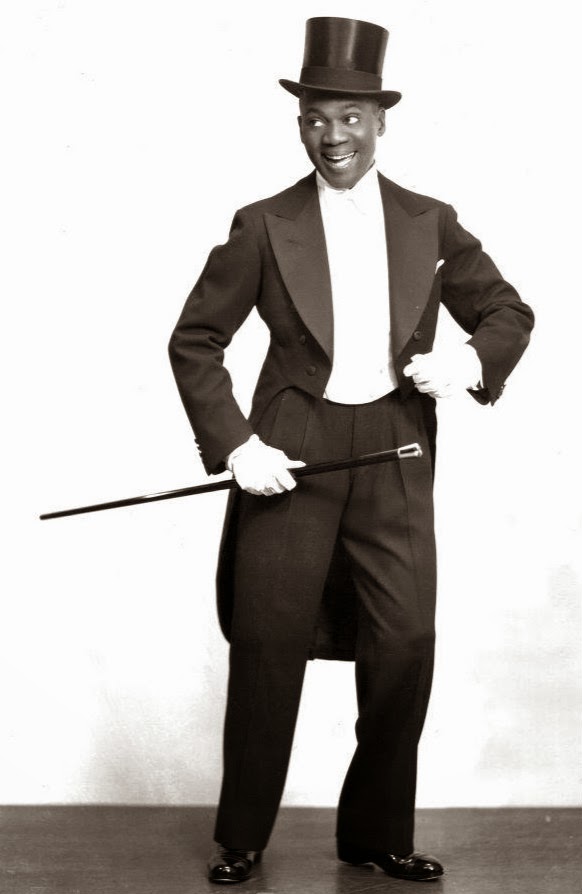
Many people do not truly know who Bill "Bojangles" Robinson was. He has
been dead 65 years now, and most of his film roles were dated by the 1950s.
However, Robinson was a gifted dancer, and like so many otherAfrican-American
performers, he deserved to have been given better roles in the musicals. His
long career though mirrored changes in American entertainment tastes and
technology, starting in the age of minstrel shows, moving to vaudeville,
Broadway, the recording industry, Hollywood radio, and television.
Robinson was born
in Richmond,
Virginia on May 25,
1878. His parents were Maxwell, a machine-shop worker, and Maria Robinson, a
choir singer. His grandmother raised him after both parents died in 1885 when
he was 7 years old—his father from chronic heart disease and his mother from
natural causes. Details of Robinson's early life are known only through legend,
much of it perpetuated by Robinson himself. He claimed he was christened
"Luther"—a name he did not like. He suggested to his younger brother
Bill that they should exchange names. Eventually, the exchange between the
names of both brothers was made. The brother subsequently adopted the name of
“Percy” and under that name achieved recognition as a musician.
In 1890, at the
age of 12, Robinson ran away to Washington, DC, where he did odd jobs at Benning Race
Track and worked
briefly as a jockey. He teamed up with a young Al Jolson, with Jolson singing while Robinson danced for pennies
or to sell newspapers. In 1891 he was hired by Whallen and Martel, touring with
Mayme Remington's troupe in a show titled The South Before the War,
performing again as a pickaninny, despite his
age. He traveled with the show for over a year before growing too mature to
play the role credibly.
In 1898 he
returned to Richmond where he joined an army unit as a drummer when the
Spanish–American War broke out. He received an accidental gunshot wound from a
second lieutenant who was cleaning his gun.
On March 30,
1900, Robinson entered a buck-and-wing dance contest at the Bijou Theater in Brooklyn, NY,
winning a gold medal and defeating Harry Swinton, star of the show In Old
Kentucky and considered the best dancer of his day. The resulting publicity
helped Robinson to get work in numerous traveling shows, sometimes in a troupe,
more frequently with a partner, though not always as a dancer (Robinson also
sang and performed two-man comedy.

When the U.S.
entered World War I, the War Department set up a series of Liberty Theaters
in the training camps. The Keith and Orpheum Circuits underwrote
vaudeville acts at reduced fees, but Robinson volunteered to perform gratis for
thousands of troops, in both black and white units of the Expeditionary Forces,
receiving a commendation from the War Department in 1918. Throughout the early
1920s, Robinson continued his career on the road as a solo vaudeville act,
touring throughout the country and most frequently visiting Chicago, where
Marty Forkins, his manager, lived. From 1919–1923 he was fully booked on the Orpheum Circuit, and was
signed full-time by the Keith in 1924 and 1925. In addition to being
booked for 50–52 weeks (an avid baseball fan, he took a week off for the World
Series), Robinson did multiple shows per night, frequently on two different
stages.
Robinson’s film
debut was in the RKO Pictures 1930 musical Dixiana. RKO was
formed in part by a merger of the Keith and Orpheum theater circuits, with whom
Robinson had performed as a headliner for many years. He was cast as a
specialty performer in a standalone scene. This practice, customary at the
time, permitted Southern theaters to remove scenes containing black performers
from their showings of the film. Dixiana was followed by Robinson’s
first starring role, in Harlem is Heaven (1932), the first film made with an
all-black cast. The movie was produced in New York and did not perform well
financially, leading Robinson to focus on Hollywood-produced movies after that.
The idea for
bringing a black dancer to Fox to star with Temple in The Little
Colonel was actually
first proposed by Fox head Winfield Sheehan after a discussion with D. W. Griffith. Sheehan set
his sights on Robinson, but unsure of his ability as an actor, arranged for a
contract that was void if Robinson failed the dramatic test. Robinson passed
the test and was brought in to both star with Temple and to teach her tap
dancing. They quickly hit it off, as Temple recounted years later:
“Robinson walked a step ahead of us,
but when he noticed me hurrying to catch up, he shortened his stride to
accommodate mine. I kept reaching up for his hand, but he hadn't looked down
and seemed unaware. Fannie called his attention to what I was doing, so he
stopped short, bent low over me, his eyes wide and rows of brilliant teeth
showing in a wide smile. When he took my hand in his, it felt large and cool.
For a few moments, we continued walking silence. "Can I call you Uncle
Billy?" I asked. "Why sure you can," he replied... "But
then I get to call you darlin.'" It was a deal. From then on, whenever we
walked together it was hand in hand, and I was always his "darlin."

Robinson and
Temple became the first interracial dance partners in Hollywood history. The
scene was controversial for its time, however, and was cut out in the south
along with all other scenes showing Temple and Robinson making physical
contact. Robinson and Temple became close friends as a result of his dance
coaching and acting with her. Robinson carried pictures of Temple with him
wherever he traveled, and Temple considered him a lifelong friend, saying in an
interview "Bill Robinson treated me as an equal, which was very important
to me. He didn't talk down to me, like to a little girl. And I liked people
like that. And Bill Robinson was the best of all.”
Robinson
appeared opposite Will Rogers in In Old Kentucky
(1935), the last movie Rogers made prior to his death in an airplane crash.
Robinson and Rogers were good friends, and after Rogers’ death, Robinson
refused to fly, instead travelling by train to Hollywood for his film work. Robinson’s
final film appearance was a starring role in the 1943 Fox musical Stormy
Weather. Lena Horne co-starred as
Robinson’s love interest, and the movie also featured Fats Waller in his final
movie appearance before his death, playing with Cab Calloway and his
orchestra,. The Nicholas
Brothers are featured
in the film’s final dance sequence, performing to Calloway’s "Jumpin' Jive,"
in what Fred Astaire called
"the greatest movie musical number he had ever seen".

Robinson’s
final public appearance in 1949, a few weeks before his death, was as a
surprise guest on a TV show, Ted Mack’s The
Original Amateur Hour, in which he emotionally embraced a competitor on the
show who had tap-danced for the audience. A friend remarked, “he was handing
over his crown, like him saying, 'this is my good-bye. '”
Despite being
the highest-paid black performer of the first half of the twentieth century,
earning more than US$2 million during his lifetime, Robinson died penniless on
November 25, 1949, at the age of 71 from heart failure. He was married
numerous times, but never had any children. His funeral was arranged and paid
for by longtime friend and television host Ed Sullivan, co-star
Shirley Temple, and fellow dancer Fred Astaire. Robinson's casket lay in state
at the 369th
Infantry Regiment Armory in Harlem, where an estimated 32,000 people filed past
his casket to pay their last respects. The schools in Harlem were closed for a
half-day so that children could attend or listen to the funeral, which was
broadcast over the radio. Bill Robinson might not have gotten the recognition
he deserved due to race relations in the 1930s and 1940s, but his dancing
inspired a generation and influenced countless dancers to this day…
 In 1931, Cab Calloway recorded his most famous song, "Minnie the Moocher". It is the first single song by an African American to sell a million records. The Old Man of the Mountain", "St. James Infirmary Blues", and "Minnie the Moocher" were performed in three Betty Boop cartoons: "Minnie the Moocher" (1932), "Snow White" (1933), and "The Old Man of the Mountain" (1933). Through rotoscoping, Calloway performed voice over for these cartoons, but his dance steps were the basis of the characters' movements. He scheduled concerts in some communities to coincide with the release of the films to take advantage of the publicity.
.jfif)