Friday, September 13, 2013

BORN ON THIS DAY: CLAUDETTE COLBERT

 
On this day, September 13th (Friday the 13th this year), one of the greatest actresses of classic Hollywood was born. Claudette Colbert was born on this day in 1903. She was born Émilie "Lily" Chauchoin (pronounced “show-shwa”) was in Saint-Mandé (an eastern suburb of Paris), France to Georges Claude Chauchoin (1867-1925) and Jeanne Marie (née Loew, 1877-1970). Despite being christened "Emilie", she was called "Lily", because she had an aunt living with her by the name of Emilie. The aunt was her maternal grandmother's adopted child, Emilie Loew (1878-1954), who wasn't a blood relative, worked as a dressmaker, and never married. Colbert's nickname "Lily" came from Jersey-born actress Lillie Langtry. Jeanne Chauchoin and Colbert's grandmother Marie Augustine Loew (1842-1930) were born in the Channel Islands in the British Isles, and they were already fluent English speakers before coming to the U.S., though French was spoken in the family circle. Colbert's brother, Charles Auguste Chauchoin (1898–1971), was also born in Jersey.


Jeanne held various occupations. While Georges Chauchoin had lost the sight in his right eye and hadn't settled into a profession, he was a pastry-shop owner in Paris and also worked in banking business but made some inappropriate investments. Marie Loew had already been to the U.S., and Georges' brother-in-law (surname Vedel) was already living in New York City. Marie was willing to help Georges financially but also encouraged him to try his luck in the U.S. After suffering business setbacks, in order to pursue more employment opportunities, her family including Marie and Emilie Loew emigrated into Manhattan in 1906. They lived in a fifth-floor walk-up at 53rd Street. Colbert stated that climbing those stairs to the fifth floor every day until 1922 made her legs beautiful. Her parents formally changed her real name to Lily Emilie Chauchoin. Georges Chauchoin worked as a minor official at First National City Bank. Colbert quickly learned English from her grandmother Marie Loew before entering public school and remained fluent in French. She had hoped to become a painter since she could first grasp a pencil. In 1912 her family was naturalized in the U.S. Colbert studied at Washington Irving High School (known for having a strong arts program), where her speech teacher, Alice Rossetter, encouraged her to audition for a play Rossetter had written.

In 1919, Colbert made her stage debut at the Provincetown Playhouse in The Widow's Veil at the age of 15. However, Colbert’s interest in the arts still leaned towards painting. Intending to become a fashion designer, she attended the Art Students League of New York, where she paid for her art education by working as a dress-shop employee. After attending a party with the writer Anne Morrison, Colbert was offered a bit part in Morrison's play and appeared on the Broadway stage in a small role in The Wild Westcotts (1923). Influenced by her father's middle name Claude, she had been using the name Claudette instead of her first name Lily since high school, and for her stage name she added her maternal grandmother's maiden name Colbert. She formally changed her real name to Lily Claudette Chauchoin. Her father Georges died in 1925 and her grandmother Marie Loew died in New York in 1930.


After signing a five-year contract with the producer Al Woods, Colbert played ingenue roles on Broadway from 1925 through 1929. During this period she disliked being typecast as a French maid. Colbert later said, "In the very beginning, they wanted to give me French roles … That’s why I used to say my name Col-bert just as it is spelled instead of Col-baire. I did not want to be typed as ‘that French girl’". She received critical acclaim on Broadway in the production of The Barker (1927) as a carnival snake charmer. She reprised this role for the play's run in London's West End. Colbert was noticed by the theatrical producer Leland Hayward, who suggested her for the heroine role in For the Love of Mike (1927), a silent film now believed to be lost. The film didn't fare well at the box office.

In 1928 Colbert signed a contract with Paramount Pictures, which was looking for stage actors who could handle dialogue in the new "talkies" medium. Colbert's skill as a speaker was one of her best assets, but at first she didn't like film acting. Her earliest films were produced in New York. During production of the 1929 film The Lady Lies, she was appearing nightly in the play See Naples and Die. In 1930 she starred opposite Maurice Chevalier in The Big Pond, which was filmed in both English and French. She co-starred with Fredric March in Manslaughter (1930), receiving critical acclaim for her performance as a woman charged with vehicular manslaughter. She was paired with March in four productions, including Honor Among Lovers (1931) with Ginger Rogers. While these films were box office successes, she also starred in Mysterious Mr. Parkes (1931), which was a French-language version of Slightly Scarlet for the European market, although it was also screened in the United States. She sang opposite Maurice Chevalier in the Ernst Lubitsch musical The Smiling Lieutenant (1931), which was a box office success. Decades of great roles and movies followed, and the rest is classic Hollywood history...


PHOTOS OF THE DAY: JERRY COLONNA AND FRIENDS

I am a huge fan of comedian Jerry Colonna, and it looks like other celebrities were as well. Jerry had one of the most charming personalities, so I thought it would be interesting to showcase some pictures of Jerry with his "friends"...


Jerry with Mickey Dolenz


Jerry with Louis Armstrong and Paul Whiteman


Jerry with Artie Shaw
 
 
Jerry with Ray Anthony and Mickey Rooney

 
Jerry with Patsy Kelly


Jerry with Bob Hope and President Lyndon Johnson


Wednesday, September 11, 2013

SINGER SPOTLIGHT: DICKIE VALENTINE

When I used to exchange music more with friends who liked the great music, I had a lot of friends in England. It was wonderful because I got introduced to some wonderful British singer that I would have never been exposed to otherwise. One such great singer, who died to young, was Dickie Valentine Valentine was born Richard Maxwell (his birth father was Dickie Maxwell) on November 4, 1929 in Marylebone, London. He was known as Richard Bryce, as his mother later married Bryce, and gave her young son that surname.

His first acting job was at age three, when he appeared in the Jack Hulbert/Cicely Courtneidge film Jack's the Boy. He first trained as a singer during his work as a child actor, and during that time developed a flexible vocal style and skills as an impersonator of famous singers. He was overheard singing by actor-singer Bill O'Connor while working as a call boy at Her Majesty's Theatre, and encouraged him to take lessons. Since he could not afford them, O'Connor paid for them.

He sang in clubs and learned stagecraft to help gain confidence and experience. While he was in his late teens, he was singing at the Panama Club one night when music publisher Sid Green saw him and brought him to the attention of Ted Heath. On Valentine's Day 1949, Valentine, who at the time was relatively unknown, was signed by Ted Heath to join his band, Ted Heath and his Music, as a singer to work alongside Lita Roza and Denis Lotis. He was voted the Top UK Male Vocalist in 1952 while singing with the Ted Heath Orchestra, the most successful of all British big bands, and again after going solo in 1954.

In November 1954, Valentine was invited to sing at the Royal Command Performance, and in February 1955 he was top billed at the London Palladium. Not only did he sing, he also did jokes and impersonated many people, including Johnnie Ray, Frankie Laine, Mario Lanza, and Billy Daniels. He recorded two number one hits, "Christmas Alphabet" and "Finger of Suspicion" (my favorite of his recordings). His first chart-topper came only two months after his marriage to Elizabeth Flynn at Caxton Hall, which caused scenes of hysteria and was widely expected to sound the death knell to his career. In fact, 1955 was by far his best chart year, with two number ones and three other Top Ten hits. While his second number one saw Valentine playing King Canute to Bill Haley's incoming tide of rock and roll, "Christmas Alphabet" marked the first time in the UK that a song created for the Christmas market hit number one. In April 1955, Valentine again topped the bill at the London Palladium for two weeks, a month after winning the male vocalist category in the NME poll. He went on to win this title consecutively from 1953 to 1957.


He married Elizabeth Flynn, a professional ice skater, in 1954. They had two children together, Richard and Kim, but divorced in 1967. Valentine married the actress Wendy Wayne in 1968.

In 1961, he had a television series Calling Dickie Valentine. In 1966 Valentine partnered with Peter Sellers on the ATV sketch show The Dickie Valentine Show, but it did not last long. Due to the rise of rock 'n' roll, Valentine's fame began to wane during the 1960s, he remained a popular live performer until his death.

Travelling to his next gig at the Double Diamond Club in Caerphilly, Wales, he was killed outright in a car crash on a single lane bridge at Glangrwyney, near Crickhowell, Wales on May 6, 1971, at the age of 41, together with pianist Sidney Boatman and drummer Dave Pearson, aged 42. The coroner's inquest revealed the car in which the three were travelling to have been driven in excess of 90 mph at time of impact, and that Valentine — who was driving his wife Wendy's Hillman Avenger, with which he was unfamiliar, (he was awaiting delivery of his new customised car) — had lost control of the vehicle while attempting to take a (clearly marked) dangerous bend. Valentine had travelled on that stretch of road many times and was familiar with the hazards. It was thought Valentine's attention might have been distracted by conversation with his friends, in addition to tiredness (the crash having happened at 4.20am). It was also noted that there was heavy fog at that time.

Like his American counterparts like Guy Mitchell and Johnnie Ray, the change in the music industry and society as a whole, caused Dickie Valentine's career to go downhill, but it did not stop him from making music, and it did not stop his fans from enjoying his records. Even with his sad young death, Valentine left behind great examples of his talents that are available on records and now even CDs...


Monday, September 9, 2013

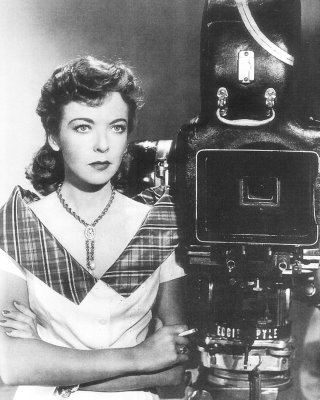
IDA LUPINIO: A PIONEER DIRECTOR

By the time the 1940’s and 1950’s arrived women directors were virtually unheard of in Hollywood. Those women who had influenced the film industry from its inception, and who were in fact responsible for much of film’s initial popularity, had names no one mentioned, remembered or recognized. Ida Lupino’s name was known but as it appeared in front of the camera. She had been a successful actress for years, having given strong.

With performances in films like High Sierra and They Drive by Night. But in the late 1940’s, Lupino wanted more creative control over her projects. The opportunity for this was never going to happen unless she started her own production company. She did so, The Filmakers, with her then husband, Collier Young. The Filmakers shot their films on location with small budgets and tackled subjects Hollywood didn’t want to go near – taboos at the time and even now to some degree – unwed motherhood and bigamy were two. After producing two films with her new production company, Lupino began production on a new script she had written called Not Wanted. Director Elmer Clifton had a heart attack on the 3rd day of shooting and Lupino took over and directed the entire picture. She declined directorial credit on the film but it was her first endeavor as director. Ida Lupino would go on to direct six movies for The Filmakers from 1949 through 1953. No other woman could boast a similar accomplishment.

After four "woman's" films about social issues – including Outrage (1950), a film about rape – Lupino directed her first hard-paced, fast-moving film, The Hitch-Hiker (1953), making her the first woman to direct a film noir. Femmes fatales, sure — these stories could scarcely exist without them — but women behind the camera? To add a layer of irony on top of the unlikeliness, The Hitch-hiker does away with any trace of overt womanly presence. By the time we get to know the film’s hapless protagonists, a couple of buddies who look and act like fresh-cut slabs of all-American blandness, they’ve already told their wives they’re off to a fishing trip, and they’ll get back when they get back. Bearing straight south down the open road, no sooner do they reach Mexico than they pick up a hitchhiker. By the time they come to understand that this black-clad, lumpy-featured fellow has killed before, may well kill again, and intends to mount a ceaseless campaign of psychological manipulation in order to get a ride to his freedom, we understand why hitchhiking has gone out of style.


Lupino’s film doesn’t just remove the women from the noir formula; it leaves aside most of the darkness implicit in the genre’s very name. Apart from a few tense nighttime scenes and a climactic chase through an after-hours shipyard, the bulk of The Hitch-hiker‘s action takes place under a harsh Mexican sun that bleaches out nearly everything but the jagged shadows cast by unearthly rock formations along the empty road. Though actually shot on the eastern slopes of the Sierra Nevada mountains, the movie takes its foreign setting seriously, offering several relatively extended sequences and exchanges conducted entirely in untranslated Spanish. By the standards of midcentury American genre film, this nearly counts as an act of radical artistic experimentation. Yes, The Hitch-hiker plays a bit broadly today and leans on a few tropes that must have seemed creaky even in 1953, but it remains an unusual enough entry in noir history to merit attention — and not just because of the sex of the director.

Her films are all emotional, affecting, melodramas despite their measly budgets. The outcome of Lupino’s films always seems neutral where even the person doing wrong is not blamed for it in the end – no judgment. Her protagonists are ordinary people so her films did not feature the glamour Hollywood wanted and expected at that time. I expect it was either a result of the difficulty of getting funds in order to produce more movies, or perhaps the lack of funds in order to compete in marketing her films given the competition at the time, or simply a lack of interest in a small budget film directed by a woman, but Lupino’s directing of feature films did not last. In order to continue her directing she moved on to the small screen and directed many, many episodes of popular television shows. Ida Lupino continued to direct in television well into the 1970’s and I would say, became a pioneer in that medium as well...


Friday, September 6, 2013

HEALTHWATCH: JACK NICHOLSON

I never thought I'd live to see a Hollywood scene with no Jack Nicolson. He’ll still sit court side at Los Angeles Lakers’ games, but Hollywood legend Jack Nicholson has quietly retired from the movie business, RadarOnline.com has exclusively learned. The 76-year-old icon has no plans to appear in films again after a career spanning five decades. “Jack has — without fanfare — retired,” a well-placed Hollywood film insider confirmed to Radar. “There is a simple reason behind his decision — it’s memory loss. Quite frankly, at 76, Jack has memory issues and can no longer remember the lines being asked of him. There is not word if the memory loss is due to dementia or other memory diseases. “His memory isn’t what it used to be.” The three-time Academy Award winner has not worked since How Do You Know in 2010 starring Reese Witherspoon, Paul Rudd and Owen Wilson.

Tellingly, producers for the forthcoming film Nebraska had wanted him to play the key role of an aging, booze-addled father who makes the trip from Montana to Nebraska with his estranged son in order to claim a million dollar Mega Sweepstakes Marketing prize. The role ultimately went to Bruce Dern, after Nicholson advised the filmmakers that he was not interested, the source said.

Nicholson began his Hollywood career in the 1950s, first working as a gofer for animation legends William Hanna and Joseph Barbera at the MGM cartoon studio. He left soon after to pursue his dream to star on screen. The New Jersey-native made his film debut in a low-budget teen drama The Cry Baby Killer, in 1958, playing the title role. He’s best remembered for his Academy Award winning roles as Best Actor for One Flew Over the Cuckoo’s Nest and for As Good as It Gets. He also won the Academy Award for Best Supporting Actor for the 1983 film Terms of Endearment. Nicholson has been nominated for a record-setting 12 Oscars, eight for Best Actor and four for Best Supporting Actor, making him the most nominated male actor in Academy Awards history. “Jack has no intention of retiring from the limelight,” said the source, who noted his regular appearances on the Hollywood party circuit, court side at his beloved Lakers and his co-presentation of the Academy Award for Best Picture with First Lady Michelle Obama, earlier this year. “He’s not retiring from public life, at all. He just doesn’t want a tribute,” added the insider. “He’s happy to tacitly join the retirees club like Sean Connery.”

Wednesday, September 4, 2013

RECENTLY VIEWED: CHAPLIN

I have to admit, I am a big fan of movie biographies. I even like so called film bios of the 1940s like Jolson Story (1946) - the life of Al Jolson and Words And Music (1948) - the life or Lorenz Hart and Richard Rodgers. However, I was excited to see my all-time favorite film bio again! The movie Chaplin (1992) I believe is by far the best so-called biography ever to be put on film. The movie is not perfect, but I think Robert Downey Jr was one of the few people able to capture the magic that was and is Charlie Chaplin.

The film was adapted by William Boyd, Bryan Forbes and William Goldman from the books "My Autobiography" by Chaplin and "Chaplin: His Life and Art" by film critic David Robinson. Associate producer Diana Hawkins got a story credit. The original music score was composed by John Barry. It was produced and directed bythe great Richard Attenborough.

The film is structured around lengthy flashbacks as the elderly Charlie Chaplin (Robert Downey Jr.) (now living in Switzerland) recollects moments from his life during a conversation with fictional character George Hayden (Anthony Hopkins), the editor of his autobiography. Chaplin's recollections begin with his childhood of extreme poverty, from which he escapes by immersing himself in the world of the London music halls, after which he relocates to the United States.

There are references to some of his many romantic episodes (including Hetty Kelly, Mildred Harris, Georgia Hale, Marion Davies, Edna Purviance, Lita Grey, Paulette Goddard, Joan Barry and Oona O'Neill), his professional collaboration with Mack Sennett and friendship with Douglas Fairbanks.

Downey was not the only great actor in the movie. Geraldine Chaplin, Charlie's daughter, played her own grandmother in the film, and she captured Charlie's mother's decent into insanity very convincingly. Kevin Kline was in great form as Charlie's swashbuckling friend Douglas Fairbanks Sr. Also rounding out the cast was the underrated Nancy Travis as Joan Berry - a troubled woman who accused Chaplin of having a child with her out of wedlock. The child was proven not to be Chaplin's but he was forced to support the child until the baby turned 21.


Although the film was criticized for taking dramatic licence with some aspects of Chaplin's life, Downey's performance as Chaplin won almost universal acclaim. Attenborough was sufficiently confident in Downey's performance to include historical footage of Chaplin himself at the end of the film. The film was lauded for its high production values, but many critics dismissed it as an overly glossy biopic. One critic wrote that the screenplay "endeavors to cover too much ground. The life of Charlie Chaplin was so vast and varied that a film is far too restrictive a format to give it justice.

My major complaint with the film was the make up for Robert Downey Jr that was used to age him to an 80 year old man at the end of the film. At the time of the film Downey was only 27, so to age him over fifty years was a daunting task. However, they made Downey look more like a burn victim than an elderly man. Maybe it is just me, but it does not look realistic. However, that barely takes away from the quality of the film and the portrayal of the subject. My wife is not a silent movie fan. I showed her this movie, and she wanted to watch a Charlie Chaplin movie after seeing it. Everytime I catch this movie on television, I am inspired by the film, by the superb acting of Robert Downey Jr, and by Chaplin himself - who I believe was one of the film industry's greatest geniuses...

MY RATING: 9 OUT OF 10

Monday, September 2, 2013

MY FIVE FAVORITE MALE SINGERS

Anyone that knows me, knows how obsessed with the music of the 1920s to 1950s I am. I try to collect it all, and it is music that has helped during the down times of my life, and it is the music that has been their during my happy high times. This top five will feature my five male singers of that era. There are other singers I like such as Johnny Cash from the country/western side or Billy Joel from the newer guys, but they belong on another list for another time...


5. BUDDY CLARK (1912-1949)
Buddy Clark has been gone almost 65 years, but his recordings were immensely popular to post war audiences of the 1940s. He started out as a band singer in the early 1930s, and even went to Hollywood to become a ghost singer. (He wasn't ugly, but his looks for more suited for records and radio). His biggest hit was "Linda", but he had numerous hits during his career. His career was sadly cut short when he died in an airplaine crash on November 1, 1949, and another one of his hits, "A Dreamer's Holiday" charted after his death. The name of Buddy Clark is not mentioned much anymore but should be.

4. AL JOLSON (1886-1950)
Jolson self proclaimed himself to be "the greatest entertainer", and no one could argue with that because he was. He started making records in 1911, which  was before the microphone was used in recording. His early records seem as old as the dinosaur now, but even those ancient records are worth listening to. Check out his superb recording of "I'd Climb The Highest Mountain" from 1926. He moved to movies in 1929, but within a decade he was out of vogue and supposedly washed up. The movie "Jolson Story" (1946) revived his career and from 1946 until his death in 1950 his voice never sounded better from his old chestnuts to new songs like "If I Only Had A Match" and "I Got Lucky In The Rain", Jolson's voice sounded better as he aged.


3. BOBBY DARIN (1936-1973)
When I listen to Bobby Darin it always sounds like he is singing like he was running out of town. Sadly, with a weakened heart - he pretty much was entertaining on borrowed time. He burst on to the scene in the late 1950s with the early rock hit "Splish Splash". However, he constantly fought record executives because he wanted to sing songs from the Great American Songbook like Bing Crosby and Frank Sinatra. Like Jolson, Darin could be full of himself. He told his manager one time that he would be "bigger than Sinatra", but his records demostrated he had a great talent. Some of my favorites by Darin include "Once Upon A Time" and "More", and he recorded a duet album with song writer Johnny Mercer in 1960 that I think is pretty much a masterpiece. He died on the operating table in 1973 during heart surgery, and it was way too soon.

2. DEAN MARTIN (1917-1995)
Like Bobby Darin, it seems like Dino never cared when he sang. There was never anything further from the truth. Dean cited Harry Mills (from the Mills Brothers) and Bing Crosby as two of his idols, and he emerged from the shadows of his comedy team with Jerry Lewis in 1956 to become one of the great recording stars of a generation. He was with Capitol Records from 1948 until his buddy Frank Sinatra started Reprise Records in 1962. I can never get tired listening to Dino's recording of "Ain't That A Kick In The Head" , and I lost track of how many movies it was in. People say that after 1964, he kind of gave up on his singing and became more of a comedian who sang, but I have a performance from 1978 of "Brother, Can You Spare A Dime" that Dean did that I would rank up there with one of the great interpretations of the song. It was a sad Christmas for me when Dean died on that day in 1995.


1. BING CROSBY (1903-1977)
In my humble opinion Bing was the father of all popular music. Because of him there was Sinatra, Dino, Tony Bennett, and a host of other singers who poked out through Bing's shadows. It was a huge shadow Bing cast because he was so popular in the 1930s and 1940s that it has been said that Bing's voice has been heard more times than any human being in the history of the world. I am not sure of that, but no other singer before or since was as popular as Bing was. In the 1930s, his voice soared to near operatic heights on recordings like: "Temptation", "Brother, Can You Spare A Dime", and "Black Moonlight". In the 1940s, his recordings followed the trend of popular songs of the time, and I highly recommend songs like "Humpty Dumpty Heart", "Moonlight Becomes You", and "You Keep Coming Back Like A Song" from this song. Bing retreated from popular music scene once rock took over, but he did make some later albums in the 1970s which were some of the best material he recorded in decades. His death in October of 1977 marked the end of an era for music which never will be duplicated.


Now I know everyone will have suggestions for my list and the other talented singers I left off. However this is just a top five list and people would be left off. However, here are a few runners up that deserve to be mentioned as honorable mentions: Dick Haymes (1918-1980), Al Bowlly (1899-1941) Nat King Cole (1919-1965), Perry Como (1912-2001) and Tony Martin (1912-2011).