Showing posts with label Bruce Kogan. Show all posts

Friday, May 8, 2026

GUEST REVIEW: HIGH SOCIETY

The late movie reviewer Bruce Krogan is back to our blog pages to review the nearly perfect musical High Society - which turns 70 years old this year...

MGM was pretty lucky to secure the talents of Bing Crosby, Frank Sinatra, Grace Kelly, Celeste Holm, and Louis Armstrong to get involved in this great musical adaption of The Philadelphia Story.

Cole Porter contributed a great original score for this film with songs very specifically written to suit the talents of High Society's players. I do wish Celeste Holm had been given more to do than just the duet with Frank Sinatra, Who Wants To Be a Millionaire. On Broadway Celeste Holm was a musical star with Oklahoma and Bloomer Girl to her credit, but MGM didn't want to recognize that.

For this film, the story is reset from Philadelphia to Newport, Rhode Island to bring in the famous Jazz Festival. Philip Barry's social commentary is toned down and a very partisan Greek Chorus is added in the person of Mr. Louis "Satchmo" Armstrong. Satchmo tells you right up front who he's pulling for to win Grace Kelly and he helps musically along the way.

Satch and Bing have that classic Now You Has Jazz duet, so successful was it that they did an album together a few years later. Bing Crosby during his life was crazy about jazz musicians and there was no one he liked better than Louis Armstrong. No one on the planet could resist that man's joy for living.


Grace Kelly got a chance to bat 1000 in the recording industry. She was no singer as she would have freely admitted, but Cole Porter wrote True Love specifically to accommodate her limited range and when she does the last two bars of True Love with Der Bingle she got a million selling record for her one and only platter. As for Bing he got his 20th Gold record and the only one not with Decca records.

True Love was nominated for Best Song at the Oscars but lost to Doris Day's Que Sera Sera which boomed all over the charts in 1956. It was sadly Cole Porter's last opportunity to win an Oscar for one of his movie songs.

Frank Sinatra got a couple of good ballads in You're Sensational and Mind If I Make Love to You, but what he's best remembered for is that classic Well Did You Evah duet with Bing. Today's fans can't possibly appreciate the screen meeting of the two best and best known singers for the previous generations. A musical summit conference.

High Society's tone is a lot lighter than the Philadelphia Story. The cast in terms of acting ability are not in the same league as Grant, Stewart, Hepburn, and Hussey. But folks it is a musical. I doubt those stars could have carried off the Cole Porter score.

You can't miss with a cast like this, in either film for that matter...

BRUCE's RATING: 10 out of 10
MY RATING: 10 OUT OF 10


Thursday, November 21, 2024

GUEST REVIEW: GOOD NEWS


We are spotlighting another great review that my late friend Bruce Kogan posted. His reviews were always thorough and well thought out. This time we spotlight his review of 1947's Good News...

Good News was the best musical from the Roaring Twenties from the premier songwriting team of DeSylva,Brown&Henderson. It ran on Broadway for 557 performances in the 1927-29 season and gave the team a number of song hits identified with them like the title song, Just Imagine, Lucky In Love, and The Best Things In Life Are Free. All of those songs made it as well as one of the great dance numbers of the Roaring Twenties, The Varsity Drag.

The musicals of that era had the lightweight nonsensical plots which also was taken from the Broadway show. Big man on campus, Peter Lawford, has to get a passing grade in French to stay eligible for the football squad. He gets mousy student librarian June Allyson assigned as a tutor and the inevitable happens as it does in these films. After that Lawford has to choose between mercenary coed Patricia Marshall and Allyson. It's a struggle, but you guess who he winds up with.


This film is strictly about the music and dance numbers and it offers a rare opportunity to see Joan McCracken singing and dancing which she mostly did on the Broadway stage. She introduces a song especially written for the film Pass That Peace Pipe which was a big hit in 1947 and won for Good News its only Academy Award nomination. Pass That Peace Pipe lost to Zip-A-Dee-Doo-Dah for Best Song. But the number is one of the best dance numbers ever to come from an Arthur Freed produced MGM musical. Joan McCracken died way too young as oddly enough her dancing partner Ray McDonald.

Good News presents an idealized version of the Roaring Twenties and is the quintessential college musical which flooded Hollywood mostly in the years before World War II. It holds up well as entertainment and the songs are still fabulous.

BRUCE RATING: 7 out of 10
MY RATING: 10 out of 10


Sunday, May 19, 2024

GUEST REVIEW: THE STATUE

Here is another guest review from the late Bruce Krogan. This time around he reviews a movie thar he absoluted hated. I have to admit, I have never seen it...

David Niven's career hit rock bottom when he signed on to do The Statue. For a man whose name on the screen stood for charm and sophistication what was Niven thinking when he signed for this?

Niven plays a Nobel Prize winner whose wife Virna Lisi is a sculptress and has done a larger than life statue of him. However she's given him some enhanced privates obviously inspired elsewhere and Niven spends the whole film looking for the inspiration.

The premise is also similar to Rouben Mamoulian's 'The Song of Songs' (1933). But the scandalous sculpture in that little gem was modelled by Marlene Dietrich and that film was a work of pre-code sauciness whereas this is just another garrulous Italian sex comedy which aimlessly wanders about Europe while cameraman Piero Portalupi zooms back & forth between the cast and composer Riz Ortolani potters about on the soundtrack.


David Niven has uplifted more films than any other actor by dint of his personality. But this one is just too heavy a lift. It's got all the element of a stag film without the prurient interest that would make one watch.

God only knows what Niven was thinking. The seventies was not a good decade for comedies.Censorship had been relaxed and film makers were determined to make up for lost time.As a result a lot of distinguished actors participated in films they wouldn't ever want to watch.The only waI to describe this is puerile rubbish...


BRUCE'S RATING: 2 OUT OF 10


Sunday, February 25, 2024

GUEST REVIEW: LARCENY

The later great Bruce Krogan is back with another great review. This time around he is reviewing a forgotten 1948 film noir...

Watching Larceny I thought the way the film was building toward the climax I was sure of a sentimental ending. But far from it with this film. What we get is a crackerjack and original realistic ending in this noir film.

John Payne plays a smooth talking confidence man who is part of a gang headed by Dan Duryea. Duryea has set up a big score and Payne has to romance war widow Joan Caulfield who thought her hero husband walked on water. The con involves swindling Caulfield ot of money to build a youth center for the town's young people and Payne poses as a GI buddy of the late husband.

Payne's working a few cons here. He's also going out with the sultry and possessive Shelley Winters who is two timing Duryea. In the end though he falls for Caulfield and that sets up the climax.


Shelley Winters also has one of her good career roles in Larceny. The kind of woman that ought to come with a warning label. And Duryea gives us one of his classic bad guy roles as well.

The script is a fine piece of writing and the director gets some great performances out of his ensemble cast. Do not miss this one, it's one of the best noirs out there.

BRUCE'S RATING: 8 out of 10


Saturday, November 11, 2023

GUEST REVIEW: LOVE ME OR LEAVE ME

The late great Bruce Kogan is back with another review for these pages...


Curiously enough after I viewed my VHS copy of Love Me or Leave Me, I went to the movies and saw Walk the Line. One of the things that struck me was that while Joaquin Phoenix had a much tougher job because Johnny Cash was performing almost up to the end and had a distinctive sound that I didn't think anyone could match, Phoenix did a very good job in capturing him.
On the other hand Ruth Etting had not been seen in films for over 20 years, nor had she made a record in that length of time either. She was living very quietly in retirement. So except with older members of the public, Doris Day did not have to compete with an image people had in their minds.

Also people left out of this story include Martin Snyder's first wife and his daughter from that marriage. Also the fact that Snyder was Jewish. My guess is that MGM did not want a false issue of anti-Semitism raised.


There sure were enough issues anyway. Ruth Etting, a girl from the sticks with lots of singing talent, is determined to succeed. So she latches on to a small time Chicago hood named Martin Snyder who gets her career started and in gear.

I remember reading that in her life with Snyder, Etting found it impossible to socialize due to Snyder's boorish behavior. One of the few other show business personalities that she did socialize with was her co-star in Kid Boots on Broadway, Eddie Cantor. Cantor who was brought up on the Lower East Side of New York, lived with guys like Snyder in his youth so he was used to it and put up with him. Very few others would.

Incidentally the title tune Love Me or Leave Me comes from the score of Kid Boots.


In Love Me or Leave Me, we don't have Doris doing an imitation of Ruth Etting, we have Doris singing like Doris which is just fine for me. She sings the songs that were identified with Etting very well. The album for this film sold very well for her.

James Cagney made his third and final trip to the Oscar Derby with his portrayal of Martin "the gimp" Snyder. In its way Snyder is as complex a role as Cagney's Cody Jarrett. He's an uneducated kid from the slums who made it in the rackets, but feels terribly inferior around all the show business creative types that his wife now by necessity has to associate with, where ironically due to his drive has pushed her there. Cagney lost the Oscar race to Ernest Borgnine for Marty. Ain't that a piece of irony itself.

Cameron Mitchell as Johnny Alderman (real first name Myrl) does very well as the man who eventually became her second husband as does the rest of the cast.

All three of the people that Day, Cagney, and Mitchell portray were still alive at the time that Love Me or Leave me was being filmed. All signed off on the picture, I assume all parties were satisfied with it.

And so should you...

BRUCE'S RATING: 8 out of 10
MY RATING: 10 out of 10


Wednesday, March 15, 2023

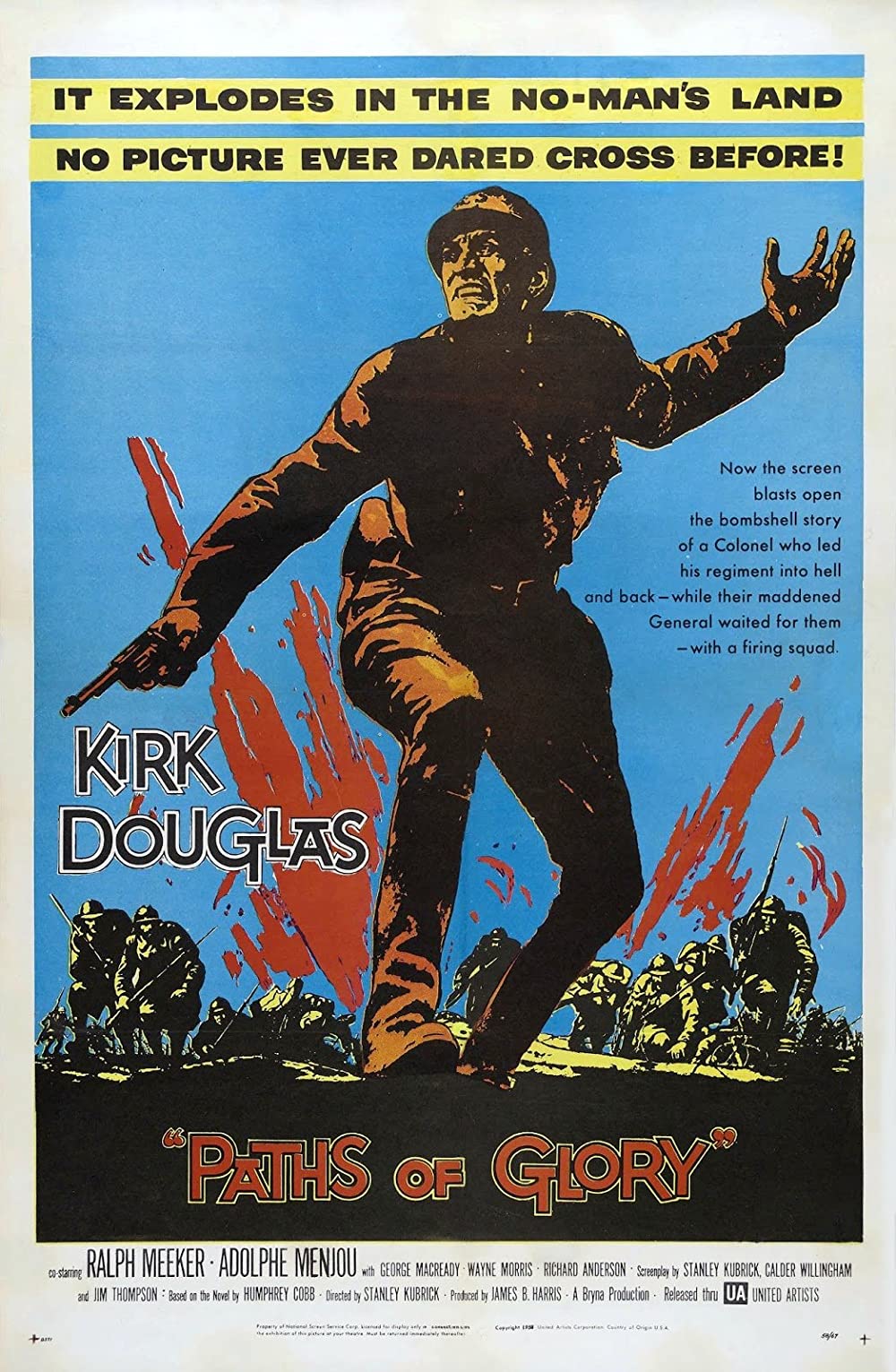
GUEST REVIEW: PATHS OF GLORY

Here is a review from Bruce Kogan's massive amount of movie reviews on the IMDB...

Almost one hundred years later the concept of that static war of the trenches that was the Western front of World War I is almost unfathomable. After the French army stopped the German offensive at the Battle of the Marne, the French and British armies faced the Germans in a line of trenches that stretched from Belgium to Switzerland. About a quarter of France was occupied for four years in that time. The casualties ran into the millions in that stalemate that gains were only measured in meters.

It was always just one more offensive over the top charging into automatic weapon fire that would break the other guy. Just such an offensive was planned one day in 1916 against a German stronghold dubbed the ant hill.

General George MacReady, promised a promotion by his superior Adolphe Menjou, orders a beaten and tired battalion to charge the ant hill. The attack flops and MacReady looks for scapegoats. He decides after coming down from shooting 100 men to a selected three drawn by lot. The unlucky three are Joseph Turkel, Ralph Meeker, and Timothy Carey.


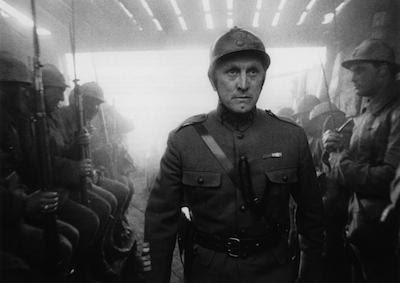
The commander of the three Kirk Douglas asks to serve as their counsel and he makes a good show of it at the kangaroo court martial they have. But the fix is definitely in.

Except for Spartacus, Kirk Douglas rarely plays straight up heroic types in film. Even his good guys have an edge to them, a dark side. But as Colonel Dax, Douglas is at his most heroic. He may be one dimensional here, but he's great. Especially in that last scene with Adolphe Menjou when he tells the man off in no uncertain terms, mainly because Menjou has misread Douglas's motives.


Menjou and Macready portray two different military types. The arrogant MacReady as versus the very sly Menjou. Not very admirable either of them. Menjou was not very popular at this time in Hollywood because of the blacklist. He favored it very much, his politics were of the extreme right wing. Nevertheless he was a brilliant actor and never better than in this film, one of his last.

The enlisted men are a good bunch also. They're kind of like the posse in The Oxbow Incident, just an ordinary group who become ennobled in martyrdom as they go to the firing squad for the sake of politics.

Paths of Glory is one of the best anti-war films ever made. It ranks right up there with All Quiet on the Western Front which showed the war from the German point of view. Both will be classics 200, 300, a thousand years from now...

BRUCE'S RATING: 10 out of 10
MY RATING: 9 out of 10


Sunday, March 5, 2023

GUEST REVIEW: ROUGHLY SPEAKING


The late Bruce Kogan returns to this blog with memories of this Rosalind Russell film that I never saw...

Based on a true story, someone had the genius over at the Brothers Warner to shell some bucks out for the services of Rosalind Russell for the lead. She really is so right for the part of Louise Randall Pierson a woman who through time and circumstance is forever reinventing herself. A little like Mame Dennis who lives to the fullest and like Molly Brown, she maybe down, but she ain't licked.

From Donald Woods she gets her four kids, but they are incompatible and divorce. She then marries Jack Carson who has ideas, but he's content to be a Vice President with his dad's flower nursery firm. Roz kick starts the ambition in him and their lives are quite the rollercoaster, but they are happy. And the kids are completely accepting of him

The image we have of Jack Carson in most of his roles is the lovable blowhard. But he had a really never appreciated talent for taking it down however many pegs necessary to achieve a great serious performances in a lot of serious roles. He and Russell work well together in Roughly Speaking.


There's a nice epic quality to Roughly Speaking. Coming out as it did at the nd of World War Ii it exudes a cheerful optimism about America and its people. The kind of stuff people wanted to hear in 1945.

It still holds up well as good entertainment...

BRUCE'S RATING: 7 OUT OF 10


Sunday, October 2, 2022

GUEST REVIEW: TWELVE ANGRY MEN

The late great movie reviewer Bruce Kogan returns to our blog with a look at the courtroom drama - Twelve Angry Men (1957). Kogan, being a political activist, was well aware of all facets of the judicial system...

When I was younger I thought 12 Angry Men was a near perfect ensemble film with a great group of male players. At that time in those sexist fifties women had an automatic out from jury duty. It was not unusual to have all male juries as we have here.

Then I served on a few juries and my concepts changed. One of the key scenes of the film is when Henry Fonda produces a switchblade knife exactly like the weapon the young perpetrator allegedly used in the stabbing death of his father. The second that Fonda produced that knife, someone should have yelled for a mistrial.

In all 50 states of the United States of America, a standard jury instruction is that the jury is to decide the guilt or innocence of a defendent on the evidence presented at trial. Jurors are free to come and go until they are sequestered for the verdict. But they are instructed not to go near the crime scene or gather ANY independent evidence.

I remember being on jury duty and assigned on a case where the crime took place in an apartment that was one block away from one of two routes to a BMT subway stop that took me to work. And those same subways also took me to downtown Brooklyn and the court house. I made it a point to take the IRT to court for the next two weeks while the trial went on to avoid the temptation of going over to the crime scene.


It was a great dramatic effect, but totally at odds with our legal system. I can't believe that something that elementary was left in a film that was purported to be a realistic look at jury deliberations.

The juries I was on did debate and in some cases quibble over all the points of the trial. They were a good cross section of the breed Brooklynus Americanus just as in 12 Angry Men. If you watch Law and Order you know how hard the prosecutors job is to get 12 people to convict.

Still it's a wonderful group of players that participated here. Henry Fonda and Lee J. Cobb are the biggest names in the cast. But others like Robert Webber, John Fiedler, Martin Balsam, and Jack Klugman got their first real notice in this film.

Jack Klugman's portrayal was a particular favorite of mine among the group. He's from the same slum background as the defendent and some of the knowledge he has from that environment makes for the most compelling argument for the defendent's innocence.

We should be thankful that Sidney Lumet assembled and directed the find cast he did...

 
BRUCE'S RATING: 6 out of 10
MY RATING: 7 out of 10


Sunday, March 27, 2022

GUEST REVIEW: BORN TO LOVE

 Last year the world lost a great man when Bruce Kogan died. He not only was a great political activist, but he was a move buff that reviewed many great and not so great movies for this blog. When wish to keep his memory alive by publishing some of his great reviews on these blog pages...

The first of four films Constance Bennett did with Joel McCrea was one that you'd better bring the bath towels to the theater if you saw it. I'm sure even the men had a tear or two seeing what Connie went through.

An American nurse in London during World War I Bennett has American ace Joel McCrea and stiff upper lip British major Paul Cavanaugh after her. She loves McCrea and can't see Cavanaugh.

But when McCrea gets shot down and goes missing in action she's very pregnant and the sympathetic Cavanaugh is ready to marry her and make her respectable.


The usual complications ensue after that and Bennett pays a heavy price for her romances.

Born To Love fits rater neatly into that category called women's pictures. Women who worried where the next meal might come from, plunked don their nickel and could sympathize with a woman like Bennett and her complicated romantic life.

For this type the film is OK, but I doubt we'll see a remake in this century.

BRUCE'S RATING: 5 out of 10


Saturday, December 4, 2021

GUEST REVIEW: MERRILY WE LIVE

The late film guru Bruce Kogan is back his review of a 1938 film that I have never seen. His review makes me want to check it out though...

This was a film I never thought I would see. Not out on DVD it apparently wasn't shown for years. That's a pity because any film with 5 Oscar nods including Best Supporting Actress for Billie Burke should not be lost.

If it looks familiar that's because producer Hal Roach took a lot of themes from My Man Godfrey. The Kilbournes here look a lot like the Bullocks there. Irascible father Clarence Kolb who likes a toot every now and then, scatterbrained mother Billie Burke and three spoiled children. Constance Bennett, Tom Brown, and Bonita Granville.

Brian Aherne is driving along one day and stops to get some water for an overheating engine and the brake slips and his vehicle plunges down a canyon. He walks and looks somewhat disheveled when he arrives at the Kilbourne country home looking for help.

Billie Burke who takes care of tramps as a hobby sizes up Aherne as one and hires him as a chauffeur. If you saw My Man Godfrey I think you have a fair idea where this is going.


Hal Roach impeccably cast this film and some additional ones here are Ann Dvorak as a predatory society girl, Alan Mowbray as a stuffy butler and Patsy Kelly as a down to earth maid. I'm in complete agreement with another reviewer when he says he was impressed by Clarence Kolb's gift for physical comedy.

Sadly the reason that this film was not shown on TV for years was Willie Best at his shufflebutt worst. It was really offensive...

BRUCE'S RATING: 7 OUT OF 10


Thursday, April 29, 2021

RIP: BRUCE KOGAN

Many of my fellow blog readers will be familiar with the name of Bruce Kogan. He did the guest reviews for this blog and many others. He has countless review on IMDB. Being a movie lover, as well as a music historian, Bruce had a wide knowledge of the great world of nostalgia. Bruce died on April 26th, after a long and brave battle with cancer. He was 73.

Bruce Kogan was a powerhouse. He came to Buffalo (from NYC) to RETIRE - which says multitudes about him right out of the gate. He was a pit bull for justice to all in the Empire State, but especially LGBTQ New Yorkers. He was an advocate in Buffalo and anywhere his help was needed. His insights into the mechanisms of government, including but not limited to Law Enforcement, the Crime Victims Board, and countless policy issues were uncanny. Once he was involved with a case, he just couldn't do enough for you. And he did it with compassion.

Born in Brooklyn, Bruce Kogan spent his life in the service of others. In the late 1990s, Bruce moved to Buffalo and became a part of our family. During his career at the NYS Crime Victims Board, and his lifetime spent as an advocate of equality and justice for all communities, especially the lesbian, gay, bisexual and transgender community, Bruce never gave up the fight. A former president of SDWNY who served our organization in many roles throughout the years, Bruce is forever an essential part of the work of SDNWY and all LGBTQ advocacy in WNY, across New York State and throughout our nation. With every meeting attended, lobby visit made and heart changed, Bruce helped bring about the monumental progress the LGBTQ community has made in the last decades. Whether LGBTQ youth protections, Marriage Equality, transgender civil rights and every issue that touched our community, Bruce was there. Every woman, man and child in our community is the better and more equal for Bruce and his life’s work.


A central passion of Bruce’s life was his advocacy for LGBTQ crime victims. Bruce never stopped being an advocate for those victims, and pressing the issue of their justice. Among his work on this issue, Bruce never stopped fighting for justice for Winthrop “Winkie” Bean, writing the play “Call Me Winkie,” which has been performed multiple times here in WNY. We commit now and every day to continuing that advocacy in Bruce’s name.

Our hearts and thoughts are heavy, are they are with Bruce, his family, friends and all who loved and knew him. There are no words that will ever properly thank Bruce Kogan for dedicating his life to making the world a better place, for more people than will ever be known. Thank you, Bruce. Happy trails.

I will miss you friend...


Monday, February 22, 2021

GUEST REVIEW: SOMEBODY LOVES ME

Our guest reviewer Bruce Kogan returns to take a look at the forgotten 1952 musical Somebody Love Me. I haven't seen this music in years!

For Betty Hutton's last film with Paramount and her next to last appearance on the big screen altogether she plays the fourth and last of four real people she was cast in her career as. Betty plays Blossom Seeley vaudeville and musical comedy star who was still performing when this film was made. Betty's other real life characters on screen were Annie Oakley, Pearl White, and Texas Guinan. However unlike Seeley, the other three women were deceased when films about them were made.

Not only was Seeley still around, but so was her husband Benny Fields who was in ill health pretty much at that time. And one guy who is not mentioned at all in the film is Hall of Fame baseball pitcher Rube Marquard. He was Blossom Seeley's second husband, she had two of them before she met Fields. That part of the story is not told, but her first husband was a gentleman named George Kane whom she left for Marquard. The notoriety of baseball and show business was equivalent to Joe DiMaggio and Marilyn Monroe in that time and Alex Rodriguez and Madonna in the present day. Marquard used to appear with her in vaudeville and he outlived both Blossom and Benny living to the ripe old age of 93 and dying in 1980.


But that was all in the past when most of this film's action takes place. Blossom is a big star who decides to expand the act by hiring a trio to perform with her that includes, Ralph Meeker, Sid Tomack, and Henry Slate. But Meeker wants to make it a duo.

Meeker's part as Benny Fields is poorly written and should have been played by a singer. It would have been great had Betty Hutton got Frank Sinatra as she wanted. Meeker's part is written as a heel, but Fields and Seeley were an established team still known in 1952. Sounds like the writers and director couldn't figure out how Meeker should come across. The unknown singer they got for Meeker sounded reasonably like Benny Fields.


And Blossom Seeley's style was as brassy as Betty Hutton's was so her casting was no stretch. In fact Betty and her numbers are the best thing about Somebody Loves Me. Starting with the title song, the score is made up of period standards plus three new songs by Jay Livingston and Ray Evans.

There is a short that Warner Brothers made of the two of them right around the time they were introducing The Jazz Singer. It's the only record of their act around and I did do a review of it. I remember as a lad watching the Ed Sullivan Show and seeing Blossom Seeley performing well into the Sixties. I appreciate now that I saw one of vaudeville's last remaining stars still performing in her seventies. You can also see Blossom in the Russ Columbo film, Broadway Through A Keyhole where she has a supporting role.

Though Rube Marquard was edited out of Blossom's life for this movie, probably at his request, and Ralph Meeker is miscast, Somebody Loves Me is definitely a film that Betty Hutton's fans will enjoy...

BRUCE'S RATING: 6 OUT OF 10
MY RATING: 6 OUT OF 10


Tuesday, October 27, 2020

GUEST REVIEW: THE UNDER-PUP

Bruce Kogan is back with his usual great review of a classic movie. This time around it is Gloria Jean's film debut!

I'm thinking that Deanna Durbin was busy on something else and also that Universal Pictures decided it needed a backup Durbin is the reason that Gloria Jean made her film debut in The Under-Pup. As good a reason as any for the film to be made and enjoyed. Not too much variation for Gloria Jean in the traditional Durbin little miss fix-it part.

Gloria gets a scholarship to go to a girl's summer camp that's reserved for the rich and snooty. Ann Gillis is the richest and snootiest there, a sort of greatest generation version of a Mean Girl, but Gloria overcomes and even gains a friend in the person of Virginia Weidler.

The place is run by Beulah Bondi with counselors Bob Cummings and Nan Grey to assist. The girls for dress wear these military outfits and the place has a marching theme which is John Philip Sousa's High School Cadets with some lyrics added.


Others in the cast are C. Aubrey Smith as Gloria's grandfather and Raymond Walburn as Gillis's father who has spoiled her rotten. Billy Gilbert is there as the cook for the camp with two bratty sons and Gilbert does his usual shtick.

The Under-Pup holds up pretty well with its two main assets, Gloria Jean's singing and the great cast Universal surrounded her with...

BRUCE'S RATING: 6 OUT OF 10
MY RATING: I have not yet seen the film


Wednesday, July 1, 2020

GUEST REVIEW: FEEL MY PULSE

Our guest reviewer Bruce Kogan is back for his usual excellent review. This time around he reviews a silent film...

Feel My Pulse casts Bebe Daniels. as a rich girl who because of her parents' fear of germs has been raised like a hothouse geranium. Howard Hughes or television's Adrian Monk has nothing on her.

Because of some 'excitement; it's decided that Daniels needs a rest cure and the family has endowed a sanitarium located on an an offshore island. But the mental health field just ain't that lucrative and the one they put in charge of the place has turned it over to William Powell and a gang of rum runners. Remember this is the time of Prohibition.

One of Powell's gang is roughneck Richard Arlen and while Daniels may have led a sheltered life she sure knows what she likes in men. Though the two don't hit it off at first she comes around.


The film is directed by Gregory LaCava and he would go on to direct William Powell in one of his greatest films My Man Godfrey. When he decides to play along with Daniels and treat her like a patient in her own sanitarium notice his body language. It really does look like Godfrey Park in My Man Godfrey.

The climax is hysterical as Daniels shrugs off all the inhibitions her hot house upbringing has given her. Can't say any more, you have to see it.

Glad this silent film has not been lost...

BRUCE'S RATING: 6 OUT OF 10


Monday, February 17, 2020

GUEST REVIEW: LET'S DANCE

The great film guru Bruce Kogan is back for a look at the forgotten 1950 musical Let's Dance..

Let's Dance finds Fred Astaire teamed with Betty Hutton professionally in an act. And the plot of the story revolves around Astaire trying to make it a romantic partnership as well.

In fact he announces to the audience at a USO show during World War II that he'd like to marry his partner. Small problem though Hutton tells Astaire in the dressing room. She's already slightly married some months earlier in a whirlwind romance. The act gets broken up as well.

Flash forward to five years later. Hutton is a war widow raising her young son Gregory Moffett in some affluent Boston surroundings presided over by her husband's mother Lucile Watson. Watson is a wealthy WASP dowager who's just about gotten used to the fact that her son married an entertainer, but she insists that her grand kid be raised as a proper Bostonian. Not for Betty who's bored stiff with polite society. She takes off with Moffett. In New York she hooks up again with Fred, but it's romantic rocky road with a couple of detours for Fred it's Ruth Warrick and for Betty, Sheppard Strudwick.


I don't think that there was any surprise that there was no demand for the return of the team of Astaire and Hutton. They perform their numbers well although I agree with other reviewers that the film is tilted for Betty from the gitgo. The fact that this was her home studio of Paramount no doubt helped there. I do agree that composer Frank Loesser having dealt with Betty before wrote for her. He had already given her I Wish I Didn't Love You So from The Perils of Pauline. Loesser himself was getting his songwriting career into high gear. He had just had a big Broadway smash in Where's Charley and would the following year have his biggest hit of all with Guys and Dolls.


Nothing here was nominated for an Academy Award. Can't Stop Talking About Him is Betty's best number, definitely in her style. Fred looks a little silly trying to keep up with her. He's shown to best advantage in the piano dance, dancing on a Steinway and in a hoedown western style dance number with Betty in Them Dudes Were Doing Our Dance.

Some interesting casting here. Two guys who usually were villains in films play good guys with Barton MacLane as the gruff, but kindly club owner where Astaire and Hutton are playing and George Zucco as the judge before whom the custody battle is fought. Lucile Watson is her usual imperious self and has a crack legal team at her disposal with Roland Young and Melville Cooper.

Let's Dance was a good film for Betty Hutton. It didn't do too much for Fred Astaire however...

BRUCE'S RATING: 6 OUT OF 10
MY RATING: 7 OUT OF 10


Monday, April 29, 2019

GUEST REVIEW: RAGTIME

Bruce Kogan is back with his guest review to end our month of Ragtime stories. This review is a look at the 1981 movie version of Ragtime. It's a great movie with a great review from Bruce...

Back in the day when Hollywood was grinding out B westerns it wasn't unusual at all to see famous folks of the west in stories that had absolutely nothing to do with their own lives or to see many famous people interacting when they never even met in real life.

Ragtime revives some of that dubious tradition in filming E.L. Doctorow's novel about the Teddy Roosevelt years of the first decade of the last century. Teddy figures into this briefly as does his Vice President Charles Fairbanks. Booker T. Washington is here too, as are the principals of the Stanford White murder, and New York City Police Commissioner Rhinelander Waldo.

It's quite a blend because Roosevelt and Fairbanks ran for re-election in 1904 as Fairbanks is shown delivering a campaign speech. He wasn't even Vice President then, just a Senator from Indiana. Fairbanks was running for Vice President because Roosevelt had no Vice President in his first term. He succeeded to the presidency when Willima McKinley was assassinated.

The Stanford White murder took place in 1906 and was then called the crime of the century. Many such murders right up to O.J. Simpson were given that dubious distinction. And Rhinelander Waldo was not NYPD Police Commissioner until 1910 and he was much younger than James Cagney. 


Still and all E.L. Doctorow's book is made into a fine film which got a whole bunch of Academy Award nominations including Best Picture, Best Director for Milos Forman and Supporting player nominations for Howard Rollins, Jr. and Elizabeth McGovern.

The main story is about Coalhouse Walker, Jr. a black ragtime pianist and his Sarah. She has his baby and they'd like to get married. But a whole lot of things, some of them peripherally connected to the true events and people previously mentioned that lead him and a gang to take possession of the Morgan Library and threaten to blow it up.


Howard Rollins was a real tragedy. This was a great start to a short, but brilliant career that included his long running role as Virgil Tibbs in the TV series In the Heat of the Night and the film A Soldier's Story. He died way too young from AIDS contracted from a lot of intravenous drug use.

Elizabeth McGovern is the famous Evelyn Nisbet, the girl on the red velvet swing which was the title of another film that dealt with the Stanford White murder. McGovern's performance is probably closer to the real Evelyn than Joan Collins was in that earlier film. She's basically a goldigger who juggled two men, her husband Harry K. Thaw and her upscale lover, society architect Stanford White. Her circus act led to White's death, Thaw's commitment to an insane asylum and a vaudeville career for her.

Ragtime was eagerly awaited because of the anticipated return of James Cagney to the screen after being off for 19 years. Cagney is clearly aged, but he gets through the role because unlike that television film Terrible Joe Moran, he's not the center of the film, though he's first billed. Note that he's sitting down during most of his performance and when he has to stand the camera is a discreet distance. It's nothing like the bouncing Cagney of old, but light years better than Terrible Joe Moran.


This was also the final joint appearance as it turned for the team that invented the buddy film, James Cagney and Pat O'Brien even though they have no scenes together. O'Brien is Harry K. Thaw's attorney and Mrs. O'Brien plays Thaw's mother under her maiden name of Eloise Taylor. She was an actress before she married Pat, but gave up her career to raise their four children.

Author Norman Mailer plays Stanford White, fulltime architect and hedonist and Robert Joy plays the demented millionaire Harry K. Thaw and both fit the parts perfectly. Maybe one day we will have a definitive film version just concentrating on the murder and it's aftermath for the three principals.

Milos Forman gave us a remarkable evocation of an exciting time in American history. It seemed that America had limitless possibilities then. I doubt they'll be saying that about the first decade of this century...

BRUCE RATING: 9 OUT OF 10
MY REVIEW: 10 OUT OF 10