Thursday, March 10, 2011

REMEMBERING: THE MUSIC OF THE 1940s

Music of the 40s
by Tyler Woods

I have met a wonderful friend when I interviewed Stan Blitz author of American Bandstand the Untold Story. Stan, much like me is a music connoisseur. Not only do we love music of the past, we understand and realize that much of the very roots of today’s rock music came from the 30s, and 40s. Stan recently told me he was doing a radio show of the music of the 40s and it got me thinking…

Oh how we forget such an important part of our past. Of course when I think of music of the 40s the first thing that comes to my mind is the sounds of jazz and the echo of big bands. This clearly sounded much better than the sounds of the atomic bomb that was dropped on Japan. The 40s was a very dramatic time and the music was also dramatic.

People such as Tommy Dorsey, Glenn Miller, Benny Goodman, Artie Shaw, Duke Ellington, Count Basie, were band leaders of some of America’s biggest bands and had people dancing and swinging on the dance floors. Soon singers who sang with these big bands became solo artists. Bing Crosby, Frank Sinatra, Dinah Shore, Rosemary Clooney, even Doris Day became the star attractions of the big band era.
As the big band era was blasting dance floors, Be-Bop and Rhythm and Blues and Jazz was sweeping the country. Charlie Parker, Dizzie Gillespie, Billy Holiday, and Ella Fitzgerald filled the airwaves and The Andrew Sisters, Perry Como, Frank Sinatra and the Mills Brothers were introducing us to what we now call pop music.

The music of the 40s was upbeat—and why not? TV dinners, Tupperware and aluminum foil was making life easier for women and they could enjoy songs like Rum and Coca-Cola by The Andrew Sisters, In the Mood by Glenn Miller, Don’t Fence Me where the Andrews Sisters teamed up with Bing Crosby, Sentimental Journey with Les Brown and Doris Day, and Some Enchanted Evening by Perry Como.

The 40s music scene might be best known for jazz greats like Ella Fitzgerald who’s first hit was A-Tisket, A-Tasket, Sarah Vaughan who recorded her first song Lover Man with Dizzy Gillespie and Charlie Parker, Billie Holiday who not only sang but co-wrote God Bless the Child, Don’t Explain, and Lady Sings the Blues.
Let’s not forget to mention country music. By 1939 the Grand Ole Opry had become the most popular music show on the radio and the 40s heard from Hank Williams, Roy Acuff, Gene Autry, Tennessee Ernie Ford, and Tex Ritter.

Just a little trivia I found fascinating was that almost 1/4 of the music that people listened to in 1940 was Glenn Miller. Well that was until Artie Shaw hired a singer named Frank Sinatra but he was making only 75 bucks a week so he ditched that band and found his fame with The Tommy Dorsey Orchestra where in one year, they recorded 40 songs. He soon became a crooning success.
The bottom line is I think we tend to ignore how much the 40s music shaped music history. We say the 50s was the beginning of rock and roll, but in my mind, some of these fine singers, were the core so much of the music we listen to today...

SOURCE

Wednesday, March 9, 2011

CLASSIC LEADING LADIES vs LEADING LADIES OF TODAY

Here is a very interesting article on the classic leading ladies of the golden age of Hollywood versus their modern counterparts...

Strong leading ladies don't make the cut today
by Katherine Monk

What happened? Here is a guide to some original screen heroines, and their modern incarnations...

THEN
Katharine Hepburn in Morning Glory (1933) (or any Kate movie, for that matter): In this early Kate movie (which won her the first Oscar in her collection), she plays an innocent but highly intelligent actress learning the ropes -- and conquering. The part was all about learning to become a professional, and earning the respect of her peers.

Bette Davis in All About Eve (1950): The hard-working veteran actress is pushed to her limit by the ambitious protege who fights dirty. Davis could have sharpened her nails for a cat fight, but she proves class goes further than crass, as she transcends the moment to emerge emotionally victorious.

Myrna Loy in The Best Years of Our Lives (1946): Loy plays the wife of a returning soldier in this glowing example of cinema for grown-ups. After being the head of the household for the duration, Loy must find a way to reconcile her husband's post-traumatic stress and existential doubt with her family's needs. This is a strong portrait of a wife and mother who isn't afraid to face down the truly tough issues.
Sigourney Weaver in Alien (1979): The role of Ripley may well mark the zenith of female empowerment (alongside Sarah Connor in The Terminator), right before the Reagan era began in 1980. Ripley is the sole survivor of an alien invasion that kills off the crew. She survives as a result of her compassion, intelligence and strength to make the tough call. In other words, she's a true leader.

Nine to Five (1980): Jane Fonda, Lily Tomlin and Dolly Parton play office workers who get even boss when they holboss when they hold him hostage d him hostagewith their sexist in this memorable girl-power comedy that made a lot of money, and celebrat ed women's leadership abilities.

Now
Rachel McAdams in Morning Glory (2010): The idea of the ingenue is revisited with McAdams playing the part of a TV producer, but her agenda is decidedly non-heroic as she seeks to soften hard news, and celebrate glam over substance.

Kristen Bell in Burlesque (2010): Bell's part is the latter-day Davis role, but it's unrecognizable here as the veteran is reduced to an alcohol-dependent joke. The destruction of strong characters with interesting things to say is just the beginning of the devolution. The whole movie endeavoured to make erotic dance appear empowering -because nothing says serious female power like a whip, thigh-high boots and jiggling boobs.

Rosemarie DeWitt in The Company Men (2010): DeWitt's character must deal with her recently unemployed husband (Ben Affleck) and his low self-esteem in the wake of downsizing. The role had great potential in DeWitt's hands, but all she does is stand at the side of the frame looking concerned or upset. The whole movie is handed over to the male characters.

Angelina Jolie in Salt, Milla Jovovich in Resident Evil, Noomi Rapace in The Girl Who Played With Fire: Even though all of these screen characters can fight physically, they're denied the ultimate power of a leadership role -and play action heroes in tight clothes. Some of these characters are sexually tortured (in graphic detail) as a source of motivation, but in the end, these people are just action-hero eye candy without being edifying role models.
For Colored Girls (2010); Sex and the City 2 (2010): These two films aren't exactly twin plots of Nine to Five, but, as movies with large female ensembles, they represent two films that tried to give women a big shout-out -and failed miserably. Tyler Perry's For Colored Girls was a depressing immersion in female victimization, while Sex nd the City 2 was a tacky attempt at making women look potent by making them fashion-obsessed nymphomaniacs who whine about everything.

SOURCE

Tuesday, March 8, 2011

BORN ON THIS DAY: CYD CHARISSE

One of the greatest dancers that movie musicals have ever know was born on this day - March 8th in 1922. Her name was Cyd Charisse. Charisse was born as Tula Ellice Finklea in Amarillo, Texas, the daughter of Lela (née Norwood) and Ernest Enos Finklea, Sr., who was a jeweler.Her nickname "Sid" was taken from a sibling trying to say "Sis".(It was later spelled "Cyd" at MGM to give her an air of mystery.) She was a sickly girl who started dancing lessons at six to build up her strength after a bout with polio. At 12, she studied ballet in Los Angeles with Adolph Bolm and Bronislava Nijinska, and at 14, she auditioned for and subsequently danced in the Ballet Russe de Monte Carlo as "Felia Siderova" and, later, "Maria Istomina".

The outbreak of World War II led to the break-up of the company, and when Charisse returned to Los Angeles, David Lichine offered her a dancing role in Gregory Ratoff's Something to Shout About. This brought her to the attention of choreographer Robert Alton — who had also discovered Gene Kelly — and soon she joined the Freed Unit at MGM, where she became the resident MGM ballet dancer.

Charisse was principally celebrated for her on-screen pairings with Fred Astaire and Gene Kelly. She first appeared with Astaire in a brief routine in Ziegfeld Follies (produced in 1944 and released in 1946). Her next appearance with him was as lead female role in The Band Wagon (1953), where she danced with Astaire in the acclaimed "Dancing in the Dark" and "Girl Hunt Ballet" routines. Another early role cast her opposite Judy Garland in the 1946 film The Harvey Girls.
Charisse and Gene Kelly in the "Broadway Melody Ballet" sequence from Singin' in the RainAs Debbie Reynolds was not a trained dancer, Gene Kelly chose Charisse to partner him in the celebrated "Broadway Melody" ballet finale from Singin' in the Rain (1952), and she co-starred with Kelly in 1954's Scottish-themed musical film Brigadoon. She again took the lead female role alongside Kelly in his penultimate MGM musical It's Always Fair Weather (1956).

In 1957, she rejoined Astaire in the film version of Silk Stockings, a musical remake of 1939's Ninotchka, with Charisse taking over Greta Garbo's role. In his autobiography, Astaire paid tribute to Charisse, calling her "beautiful dynamite" and writing: "That Cyd! When you've danced with her you stay danced with."
In her autobiography, Charisse reflected on her experience with Astaire and Kelly: "As one of the handful of girls who worked with both of those dance geniuses, I think I can give an honest comparison. In my opinion, Kelly is the more inventive choreographer of the two. Astaire, with Hermes Pan's help, creates fabulous numbers — for himself and his partner. But Kelly can create an entire number for somebody else ... I think, however, that Astaire's coordination is better than Kelly's ... his sense of rhythm is uncanny. Kelly, on the other hand, is the stronger of the two. When he lifts you, he lifts you! ... To sum it up, I'd say they were the two greatest dancing personalities who were ever on screen. But it's like comparing apples and oranges. They're both delicious."

After the decline of the Hollywood musical in the late 1950s, Charisse retired from dancing but continued to appear in film and TV productions from the 1960s through the 1990s. She had a supporting role in "Something's Got To Give", the last, unfinished film of Marilyn Monroe. She made cameo appearances in Blue Mercedes's "I Want To Be Your Property" (1987) and Janet Jackson's "Alright" (1990) music videos.

Her last film appearance was in 1994 in That's Entertainment! III as one of the onscreen narrators of a tribute to the great MGM musical films.

Charisse was married to singer Tony Martin from 1948 until her death. The marriage lasted 60 years. Cyd's first husband, whose surname she kept, was Nico Charisse (March 1906 - April 1970); they were married from 1939 to 1947.

She had two sons, Nico "Nicky" Charisse from her first marriage, and Tony Martin, Jr., born 1950, from her second. One of her daughters-in-law is Liv Lindeland, who was Playboy magazine's Playmate of the Year for 1972. A niece of hers by marriage is actress Nana Visitor.

Charisse wrote a joint biography with Martin (and Dick Kleiner) entitled The Two of Us (1976). She was featured in the 2001 Guinness Book of World Records under "Most Valuable Legs", since a $5 million insurance policy was reportedly accepted on her legs in 1952. MGM was reputed to have insured her legs for a million dollars each, but Charisse later revealed that that had been an invention of the MGM publicity machine.
In her eighties, Charisse made occasional public appearances and appeared frequently in documentaries spotlighting the golden age of Hollywood. She made her Broadway debut in 1992 in the musical version of Grand Hotel as the aging ballerina, Elizaveta Grushinskaya.

Charisse was admitted to Cedars-Sinai Medical Center in Los Angeles, California, on June 16, 2008 after suffering an apparent heart attack. She died the following day, aged 86. After her death she was cremated and her ashes were interred on June 22, 2008, at Hillside Memorial Park Cemetery, a Jewish cemetery in Culver City, California...

Monday, March 7, 2011

JEAN HARLOW: BEAUTY AND BRAINS

Jean Harlow: Beauty and brains in equal measure
By Susan King

Probably the most iconic Jean Harlow moment comes at the end of the 1933 classic MGM comedy-drama "Dinner at Eight," when Kitty, Harlow's uber-sexy dumb blond wife of a self-made tycoon, is talking to Carlotta, a high-society woman played by Marie Dressler.

Kitty: "I was reading a book the other day."

Carlotta (dumbstruck): "Reading a book?"

Kitty: "Yes. It's all about civilization or something. A nutty kind of book. Do you know that the guy says that machinery is going to take the place of every profession?"

Carlotta: "Oh, my dear. That's something you need never worry about."

Harlow stole that picture from the likes of Dressler, Wallace Beery, John Barrymore, Lionel Barrymore and Billie Burke — and for the next four years, she was one of the biggest stars at MGM.

And even though she died at age 26 in 1937 of uremic poisoning because of kidney failure — a bout of scarlet fever as a teenager compromised her kidneys — Harlow remains one of the most influential stars of Hollywood's Golden Era.

She was the first blond bombshell, and without her success, there may not have been a Lana Turner, a Marilyn Monroe, a Jayne Mansfield or a Mamie Van Doren.

"She is not only the blond bombshell, she's the blond bombshell with the heart of gold," says Cari Beauchamp, a film historian ("Without Lying Down: Frances Marion and the Powerful Women of Early Hollywood") and documentarian.

"And this is always key with me: She is a multidimensional bombshell. She is not wallpaper. She knew to give her characters layers. She gives them multidimensions."

"She definitely created the mold for that spectacular-looking blond who was sexy and humorous," says Darrell Rooney, who co-wrote (with Mark A. Vieira) "Harlow in Hollywood: The Blonde Bombshell in the Glamour Capital, 1928-1937," and supplied nearly all the evocative photographs and memorabilia in the new book. "She had a very winsome, childlike quality to her, a certain innocence that plays against the sexuality that is very unique and stops her from being one-note."

"I think of her and Carole Lombard, two gorgeous blonds who died way too young," says Beauchamp. "They were so good at what they did and brought such richness to their characters and also the intelligence beyond the eyes. There are times they are practically winking at the audience."

This year is the centenary for the platinum blond beauty who starred in such classic MGM comedies as 1932s "Red Dust" and "Red-Headed Woman" and 1936's "Libeled Lady." Never one to take herself too seriously on-screen, Harlow wasn't above poking fun at her image, as in 1933's Hollywood satire, "Bombshell."
Besides their book, Rooney and Vieira have joined with the Hollywood Museum for the exhibition "Harlow in Hollywood," which opened Thursday, which would have been the actress' 100th birthday. The exhibition features photographs, memorabilia and even her 1932 Packard Phaeton. The two will be at the Egyptian Theatre on Sunday to discuss Harlow and "Bombshell." And throughout March, Turner Classic Movies will be showcasing her films.

By all accounts, Harlow was one of the best-loved stars in Hollywood. "Everybody called her 'Baby,'" says Beauchamp. "The crews just adored her. They were so protective of her. That heart of gold she played on the screen was very real in the person that was Jean Harlow."

"We all heard that Jayne Mansfield had a genius IQ, but even when Harlow was playing a 'dumb character,' like in 'China Seas,' you know she is not a stupid woman," says Vieira. "She had this native intelligence, that innate wisdom and understanding of people. My big discovery in writing this is that she used to bring books to the sound stage to read, like 'The Forsyte Saga.' She was an autodidact."

But her short life was filled with sadness and drama, including an overbearing stage mother, Jean, to whom Harlow was slavishly devoted; three failed marriages — including to MGM executive Paul Bern, who committed suicide in 1932, two months after their wedding; and a highly publicized romance with fellow MGM star William Powell, who broke her heart because he wouldn't marry her.

Harlow died before completing the romantic comedy "Saratoga" with her frequent leading man, Clark Gable. Though MGM studio chief Louis B. Mayer thought of scrapping all of Harlow's scenes and replacing her with another actress, her fans demanded to see her final film. Mary Dees, who was her stand-in, doubled in certain scenes shot from behind and wearing oversized hats. Actress Paula Winslowe supplied Harlow's voice.

Though the result is a mess — Harlow looks hollow-eyed and puffy — audiences turned out in droves when it opened in late July. "Saratoga" became one of the biggest box office hits of 1937.

SOURCE

Friday, March 4, 2011

SPOTLIGHT ON BUSTER KEATON: THE LATER YEARS

Here is the final part of our three part series on the life and talent of the great Buster Keaton...

Keaton signed with MGM in 1928, a business decision that he would later call the worst of his life. He realized too late that the studio system MGM represented would severely limit his creative input. For instance, the studio refused his request to make his early project, Spite Marriage, as a sound film and after the studio converted, he was obliged to adhere to dialogue-laden scripts.

For the first time, Keaton was forced to use a stunt double during some of the more dangerous scenes, as MGM wanted badly to protect its investment. He also stopped directing, but continued to perform and made some of his most financially successful films for the studio. MGM tried teaming the laconic Keaton with the rambunctious Jimmy Durante in a series of films, The Passionate Plumber, Speak Easily, and What! No Beer? The latter would be Keaton's last starring feature. The films proved popular. (Thirty years later, both Keaton and Durante had cameo parts in It's a Mad Mad Mad Mad World.)

In the first Keaton pictures with sound, he and his fellow actors would shoot each scene three times: one in English, one in Spanish, and one in either French or German. The actors would phonetically memorize the foreign-language scripts a few lines at time and shoot immediately after. This is discussed in the TCM documentary Buster Keaton: So Funny it Hurt, with Keaton complaining about having to shoot lousy movies not just once, but three times. His stage name in Spanish markets was Pamplinas ("Nonsense"), and his nickname was Cara de palo ("Wooden face").

Behind the scenes, Keaton's world was in chaos, with divorce proceedings and alcoholism contributing to production delays and unpleasant incidents at the studio. Keaton was so depleted during the production of 1933's What! No Beer? that MGM released him after the filming was complete, despite the movie being a resounding hit. In 1934, Keaton accepted an offer to make an independent film in Paris, Le Roi des Champs-Élysées. During this period, he made one other film in Europe, The Invader (released in America as An Old Spanish Custom in 1936).

In 1939, Columbia Pictures hired Keaton to star in ten two-reel comedies, running for two years. The director was usually Jules White, whose emphasis on slapstick made most of these films resemble White's Three Stooges comedies. Keaton's personal favorite was the series' debut entry, Pest from the West, a shorter, tighter remake of Keaton's little-viewed 1935 feature The Invader; it was directed not by White but by Mack Sennett veteran Del Lord. Moviegoers and exhibitors welcomed Keaton's Columbia comedies, proving that the comedian had not lost his appeal. However, taken as a whole, Keaton's Columbia shorts rank as the worst comedies he made, an assessment he concurred with in his autobiography. The final entry was She's Oil Mine, and Keaton swore he would never again "make another crummy two-reeler." He stuck to his word, and the Columbia entries would be his final starring series for any movie studio.
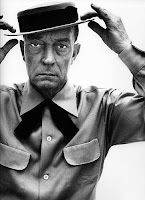
Keaton's personal life had stabilized with his 1940 marriage, and now he was taking life a little easier, abandoning Columbia for the less strenuous field of feature films. Throughout the 1940s, Keaton played character roles in both "A" and "B" features. Critics rediscovered Keaton in 1949 and producers occasionally hired him for bigger "prestige" pictures. He had cameos in such films as In the Good Old Summertime, Sunset Boulevard (1950), Around the World in Eighty Days, and It's a Mad, Mad, Mad, Mad World. Keaton was given more screen time in A Funny Thing Happened on the Way to the Forum (1966). He also appeared in a comedy routine about two inept stage musicians in Charlie Chaplin's Limelight (1952), recalling the vaudeville of The Playhouse. With the exception of Seeing Stars, a minor publicity film produced in 1922, Limelight was the only time in which the two would ever appear together on film.

In 1960, Keaton returned to MGM for the final time, playing a lion tamer in a 1960 adaptation of Mark Twain's The Adventures of Huckleberry Finn. Much of the film was shot on location on the Sacramento River, which doubled for the Mississippi River setting of Twain's original book.[31]

In 1961, he starred in The Twilight Zone episode "Once Upon a Time", which included both silent and sound sequences. Keaton played time traveler Mulligan, who traveled from 1890 to 1960, then back, by means of a special helmet.
Keaton also found steady work as an actor in TV commercials, including a popular series of silent ads for Simon Pure Beer in which he revisited some of the gags from his silent film days. In 1963, Keaton appeared in the episode "Think Mink" of ABC's Mr. Smith Goes to Washington sitcom, starring Fess Parker

In 1964, Keaton appeared with Joan Blondell and Joe E. Brown in the final episode of ABC's circus drama, The Greatest Show on Earth, starring Jack Palance. That same year, he appeared on Lucille Ball's CBS television show, The Lucy Show, in an episode ("A Day in the Park") filmed in color but initially televised in black and white; this featured him sitting on a park bench, reading a newspaper, which he gradually unfolded into a huge, single sheet. Harvey Korman played a policeman in the scene.

At the age of 70, Keaton suggested that, for his appearance in the 1965 film Sergeant Deadhead, he run past the end of a firehose into a six-foot-high flip and crash. When director Norman Taurog balked, expressing concerns for Keaton's health, Keaton said, "I won't hurt myself, Norm, I've done it for years!" Keaton also starred in three other movies for American International Pictures (Beach Blanket Bingo, Pajama Party, and How to Stuff a Wild Bikini).

Keaton starred in a short film called The Railrodder (1965) for the National Film Board of Canada. Wearing his traditional porkpie hat, he travelled from one end of Canada to the other on a motorized handcar, performing gags similar to those in films he made 50 years before. The film is also notable for being Keaton's last silent screen performance. The Railrodder was made in tandem with a behind-the-scenes documentary about Keaton's life and times, called Buster Keaton Rides Again, also made for the National Film Board. He played the central role in Samuel Beckett's Film (1965), directed by Alan Schneider. In 1966, he played a secondary role in Due Marines e un Generale in Italy. Keaton's last film appearance was in A Funny Thing Happened on the Way to the Forum (1966). He amazed the cast and crew by doing many of his own stunts, although Thames Television said his ill health did force the use of a stunt double for some scenes.

Keaton died of lung cancer on February 1, 1966, in Woodland Hills, California. Despite being diagnosed with the terminal illness in January 1966, he was never told that he was terminally ill, and thought that he had bronchitis. Confined to a hospital during his final days for treatment, Keaton was restless and paced the room endlessly. In a British television documentary on his career, his widow Eleanor told producers of Thames Television that Keaton was up out of bed and moving around, and even played cards with friends who came to visit at their house the day before he died. Eleanor Keaton died in 1998, from emphysema and lung cancer, aged 80.

Wednesday, March 2, 2011

MICKEY ROONEY GOES TO WASHINGTON

Mickey Rooney Takes Stand Against Elder Abuse
90-Year-Old Actor Testifies Before the Senate Committee on Aging
by Associated Press

Mickey Rooney spoke out against elder abuse before a senate committee on aging today. The 90-year-old actor has been the alleged victim of abuse at the hands of his own stepkids, according to court documents.

"Unfortunately, I'm testifying by the committee today not just as a concerned citizen, which we all should be, but as a victim of older abuse -- elder abuse, myself," Rooney said. "For years I suffered silently, unable to muster the courage to seek the help that I knew I needed. Even when I tried to speak up, I was silenced. It seemed like no one believed me. But I never gave up."

Rooney, 90, who has had one of the longest careers of any actor, filed a case against stepson Chris Aber and stepdaughter Christina Aber last month charging verbal, emotional and financial abuse, and alleging that they denied him such basic necessities as food and medicine.

"In my case, I was eventually and completely stripped of the ability to make even the most basic decisions -- where we go or what we do. Decisions that everyone likes to make over the course of time my daily life became... unbearable," Rooney said.
The goal of the senate hearing, entitled "Justice for All: Ending Elder Abuse, Neglect and Financial Exploitation," is to draw attention to the widely underreported problem and coordinate federal, state and local efforts to combat it.

"It's a really sad but important issue and Mr. Rooney is definitely lending his star power to it," committee spokesman Joe Bonfiglio said.

Rooney said he hopes his testimony will encourage other victims to stand up for themselves.

"To those seniors and especially elderly veterans -- Army, Navy, Marine -- you veterans like myself I want to tell you this: You're not alone and you have nothing nothing, ladies and gentlemen, to be ashamed of," Rooney said. "You deserve, yes you deserve better. You all have the right to control your own life."

The court documents say that both Chris and Christina Aber have been keeping Rooney as "effectively a prisoner in his own home" through the use of threats, intimidation and harassment. Christina Aber has also been accused of taking control over Rooney's finances, blocking access to his mail and forcing the actor into performances he does not wish to do.

"Sometimes the transition from being in control of your life to having absolutely no control is swift, but other times it is so gradual that you wonder exactly when it truly began," Rooney said. "In my case, I was eventually stripped of my ability to make even the most basic decisions in my own life."

Rooney was granted temporary restraining orders on Feb. 15, but will have to appear in court on April 5 if he wants them extended for three years. A Los Angeles Superior Court Judge also appointed a temporary conservator of Rooney's estate.

SOURCE

MOVIE SHOWCASE: WHITE HEAT

It is my humble opinion, which really means nothing in the academic world, I think that WHITE HEAT is one of the best movies ever made. It certainly is one of the greatest gangster films. WHITE HEAT, released in 1949, starred James Cagney, Virginia Mayo and Edmond O'Brien and featuring Margaret Wycherly, and Steve Cochran. Directed by Raoul Walsh from the Ivan Goff and Ben Roberts screenplay based on a story by Virginia Kellogg, it is considered one of the classic gangster films and was added to the National Film Registry in 2003.

Cody Jarrett (James Cagney) is the ruthless, deranged leader of a criminal gang. Although married to Verna (Virginia Mayo), Jarrett is overly attached to his equally crooked and determined mother, "Ma" Jarrett (Margaret Wycherly), his only real confidante. Cody suffers from debilitating headaches and his mother consoles him each time. Early in the film she sits him on her lap and gives him a shot of whiskey with the toast, "Top of the world." It is later revealed that Jarrett's father died in an insane asylum.

Jarrett and his gang rob a train, resulting in the deaths of four members of the train crew and a Jarrett accomplice, Zuckie (Ford Rainey). With the help of informants, the police close in and Jarrett shoots and injures US Treasury investigator Philip Evans (John Archer). Jarrett then confesses to a lesser crime, which was committed by an associate at the same time as the train robbery, thus providing Jarrett with an alibi. He is sentenced to one to three years.

Evans is not fooled. He plants undercover agent Hank Fallon (Edmond O'Brien) in Jarrett's cell; Fallon goes by the name Vic Pardo. His main task is to find the "Trader," a fence who launders stolen money for Jarrett.
On the outside, "Big Ed" Somers (Steve Cochran), Jarrett's ambitious right-hand man, has designs on both the leadership of Jarrett's gang and his treacherous wife Verna. He pays a convict, Roy Parker (Paul Guilfoyle), to kill Jarrett. In the prison workplace, Parker arranges to drop a heavy piece of machinery on Jarrett, but Pardo pushes him out of the way, saving his life. Ma visits and vows to take care of Big Ed herself, despite Jarrett's attempts to dissuade her. He begins to worry and decides to break out. Before he can, Jarrett learns that Ma is dead and goes berserk in the mess hall, being dragged away to the infirmary and diagnosed with psychosis.

Jarrett takes hostages and escapes, along with Pardo, their cellmates and Parker, who is locked in the trunk of the getaway car. Later, when Parker complains, "It's stuffy, I need some air," Jarrett replies, "Oh, stuffy, huh? I'll give ya a little air." He empties his gun into the trunk.

On hearing of Jarrett's escape, Big Ed nervously waits for him to show up. Verna tries to slip away, but she is caught by her husband. She convinces him that Big Ed murdered Ma (though it was really Verna who shot her in the back). Jarrett guns down Big Ed.

The gang welcomes the escapees, including Pardo, for whom Jarrett has developed a genuine liking. Jarrett insists on sharing the proceeds from their robberies with him, stating, "I split even with Ma, didn't I?"
A stranger shows up at the gang's isolated country hideout, asking to use the phone. Everybody expects the stranger to be murdered: "Looks like Big Ed's gonna have company." To Pardo's surprise, he is introduced by a trusting Jarrett to the Trader (Fred Clark), the fence he was to track down.

Jarrett intends to steal the payroll at a chemical plant in Long Beach, California by using a large gas truck as a Trojan Horse to hide inside. Pardo manages to get a message to Evans and an ambush is set up. The gang gets into the plant but the driver, Creel (Ian MacDonald), recognizes Pardo as Fallon.

The police surround the building and Evans calls on Jarrett to surrender. Jarrett decides to fight it out. When the police fire tear gas into the office, Fallon manages to escape. All of Jarrett's henchmen are shot by the police, or by Jarrett himself when they try to give themselves up (Verna is taken by the police). Jarrett then flees to the top of a gigantic, globe-shaped gas storage tank. When Fallon shoots Jarrett several times with a rifle, Jarrett starts firing into the tank and shouts, "Made it, Ma! Top of the world!" just before it goes up in a massive explosion.
The character of Cody Jarrett was based on New York murderer Francis Crowley, who engaged in a pitched battle with police in the spring of 1931 at the age of 19. Executed on January 21, 1932, his last words were: "Send my love to my mother." Another inspiration may have been Arthur Barker, a gangster of the 1930s, and a son of Ma Barker.

The train robbery which opens the film appears to have been closely based on the robbery of Southern Pacific's "Gold Special" by the D'Autremont brothers in 1923.

Jimmy Cagney should have won an Oscar for his role...