Showing posts with label Teresa Wright. Show all posts

Sunday, May 15, 2022

SHADOW OF A DOUBT: 1943 REVIEW

Here is the 1943 review of a Alfred Hitchcock classic as it appeared in the New York Times on January 13, 1943...

You've got to hand it to Alfred Hitchcock: when he sows the fearful seeds of mistrust in one of his motion pictures he can raise more goose pimples to the square inch of a customer's flesh than any other director of thrillers in Hollywood. He did it quite nicely in "Rebecca" and again in "Suspicion" about a year ago. And now he is bringing in another bumper crop of blue-ribbon shivers and chills in Jack Skirball's diverse production of "Shadow of a Doubt," which came to the Rivoli last night.Yes, the way Mr. Hitchcock folds suggestions very casually into the furrows of his film, the way he can make a torn newspaper or the sharpened inflection of a person's voice send ticklish roots down to the subsoil of a customer's anxiety, is a wondrous, invariable accomplishment. And the mental anguish he can thereby create, apparently in the minds of his characters but actually in the psyche of you, is of championship proportions and—being hokum, anyhow— a sheer delight.

But when Mr. Hitchcock and/or his writers start weaving allegories in his films or, worse still, neglect to spring surprises after the ground has apparently been prepared, the consequence is something less than cheering. And that is the principal fault—or rather, the sole disappointment—in "Shadow of a Doubt." For this one suggests tremendous promise when a sinister character—a gentleman called Uncle Charlie—goes to visit with relatives, a typical American family, in a quiet California town. The atmosphere is charged with electricity when the daughter of the family, Uncle Charlie's namesake, begins to grow strangely suspicious of this moody, cryptic guest in the house. And the story seems loaded for fireworks and a beautiful explosion of surprise when the scared girl discovers that Uncle Charlie is really a murderer of rich, fat widows, wanted back East.But from that point on the story takes a decidedly anticlimactic dip and becomes just a competent exercise in keeping a tightrope taut. It also becomes a bit too specious in making a moralistic show of the warmth of an American community toward an unsuspected rascal in its midst. We won't violate tradition to tell you how the story ends, but we will say that the moral is either anti-social or, at best, obscure. When Uncle Charlie's niece concludes quite cynically that the world is a horrible place and the young detective with whom she has romanced answers, "Some times it needs a lot of watching; seems to go crazy, every now and then, like Uncle Charlie," the bathos is enough to knock you down.However, there is sufficient sheer excitement and refreshing atmosphere in the film to compensate in large measure for its few disappointing faults.


Thornton Wilder, Sally Benson and Alma Reville have drawn a graphic and affectionate outline of a small-town American family which an excellent cast has brought to life and Mr. Hitchcock has manifest completely in his naturalistic style. Teresa Wright is aglow with maiden spirit and subsequent emotional distress as the namesake of Uncle Charlie, and Patricia Collinge gives amazing flexibility and depth to the role of the patient, hard-working, sentimental mother of the house. Henry Travers is amusing as the father, Edna May Wonacott is fearfully precocious as "the brat" and Hume Cronyn makes a modest comic masterpiece out of the character of a literal-minded friend.As the progressively less charming Uncle Charlie, Joseph Cotten plays with smooth, insinuating ease while injecting a harsh and bitter quality which nicely becomes villainy. He has obviously kept an eye on Orson Welles. And MacDonald Carey and Wallace Ford make an adequate pair of modern sleuths.The flavor and "feel" of a small town has been beautifully impressed in this film by the simple expedient of shooting most of it in Santa Rosa, Calif., which leads to the obvious observation that the story should be as reliable as the sets...


Sunday, April 17, 2011

SPOTLIGHT ON TERESA WRIGHT

Born on October 17, 1918 actress Teresa Wright was born Muriel Teresa Wright in Harlem, New York City, the daughter of Martha (née Espy) and Arthur Wright, who was an insurance agent. She grew up in Maplewood, New Jersey. During her years at Columbia High School, she became seriously interested in acting and spent her summers working in Provincetown theater productions. Following her high school graduation in 1938, she returned to New York and was hired to understudy the role of Emily (played by Dorothy McGuire and later Martha Scott) in Thornton Wilder's Our Town. She took over the role when Martha Scott went to Hollywood to make the film version of the play.

Wright was nominated for the Academy Award for Best Supporting Actress for her screen debut in The Little Foxes (1941). The following year, she was nominated again, this time for Best Actress for The Pride of the Yankees, in which she played opposite Gary Cooper as the wife of Lou Gehrig; that same year, she won Best Supporting Actress as the daughter-in-law of Greer Garson's character in Mrs. Miniver. No other actor has ever duplicated her feat of receiving an Oscar nomination for each of her first three films.
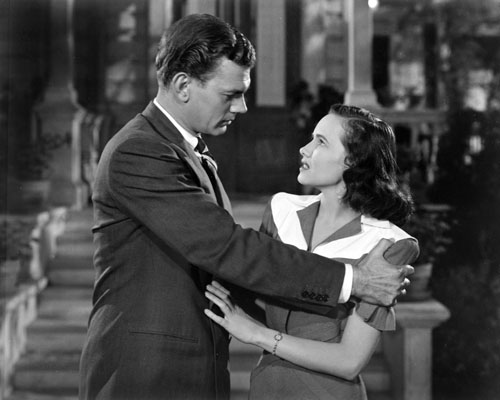
In 1943, Wright was loaned out by Goldwyn for the Universal film Shadow of a Doubt, directed by Alfred Hitchcock. She played an innocent young woman who discovers that her beloved uncle, played by Joseph Cotten, is a serial murderer. In my humble opinion it was her best work ever. Other notable films include The Best Years of Our Lives (1946), an award-winning film about the adjustments of servicemen returning home after World War II, and The Men (1950), another story of war veterans, which starred Marlon Brando.

Wright rebelled against the studio system of the time. When Samuel Goldwyn fired her, citing her refusal to publicize the film Enchantment (1948), she expressed no regret about losing her $5,000 per week contract. She said, "The type of contract between players and producers is, I feel, antiquated in form and abstract in concept... We have no privacies which producers cannot invade, they trade us like cattle, boss us like children." However, before a March 2006 screening of Enchantment on Turner Classic Movies, host Robert Osborne said that Wright did later have some regrets about leaving Goldwyn, since her salary per film went from $125,000 under Goldwyn to about $25,000 per film afterwards.

After 1959, she worked mainly in television and on the stage. She was nominated for Emmy Awards in 1957 for The Miracle Worker and in 1960 for The Margaret Bourke-White Story. She was in the 1975 Broadway revival of Death of a Salesman and the 1980 revival of Morning's at Seven, for which she won a Drama Desk Award as a member of the Outstanding Ensemble Performance.

Her later movie appearances included a major role in Somewhere in Time (1980) and the role of Miss Birdie in John Grisham's The Rainmaker (1997), directed by Francis Ford Coppola.On March 6, 2005 she died of a heart attack at Yale-New Haven Hospital in Connecticut at the age of 86...

Sunday, January 16, 2011

MOVIE REVIEW: SHADOW OF A DOUBT

When I first saw the classic SHADOW OF A DOUBT when I was younger, I did not realize it was an Alfred Hitchcock movie. The movie, made in 1943, was unlike any movie Hitchcock had done before or for that matter after. It was Hitchcock's only "purely American" movie, and the movie was years ahead of itself in suspense, intrigue, and dialogue. While many films of the day were musicals about how the boy gets the girl, SHADOW OF A DOUBT truly is a film that has not aged much. Some 67 years after its release the film is still quite watchable and the suspense is more riveting than any 3D or special effects movie.

Starring Joseph Cotten, Teresa Wright, and MacDonald Carey, SHADOW OF A DOUBT was one of Joseph Cotten's finest roles. Alfred Hitchcock appears about 15 minutes into the film, on the train to Santa Rosa, playing bridge with a man and a woman (Dr and Mrs. Harry). Charlie Oakley is traveling on the train under the assumed name of Otis. Mrs. Harry is eager to help Otis, who is feigning illness in order to avoid meeting fellow passengers, but Dr. Harry is not interested and keeps playing bridge. Hitchcock on his part seems surprised to see that he has somehow been dealt a full suite of spades, a Grand Slam bridge hand.

The plot centers around a bored teenager living in Santa Rosa, California, Charlotte "Charlie" Newton (Wright). She is frustrated because nothing seems to be happening in her life and that of her family. Then, she receives wonderful news: her uncle (for whom she was named), Charlie Oakley (Cotten), her mother's brother, is arriving for a visit.

Two men show up pretending to be photographers and journalists working on a national survey of the average American family. One of them speaks to Charlie privately, identifying himself as Detective Jack Graham (Macdonald Carey) and telling her that her uncle is one of two men who are suspected of being a serial killer known as the "Merry Widow Murderer". This murderer has a modus operandi of seducing, murdering and robbing wealthy widows.

Young Charlie at first refuses to even consider that her uncle could be a murderer, but she cannot help noticing him acting strangely on several occasions. She confirms her suspicions after seeing the initials on the engraving on the ring Uncle Charlie gave her match one of the recent victims of the killer. Particularly chilling is a family dinner conversation during which Uncle Charlie reveals his hatred of rich widows, comparing them to fat animals deserving of slaughter.

Young Charlie's growing suspicion soon becomes apparent to her uncle. He confronts her and admits that he is indeed the man the police are after. He begs her for help; she reluctantly agrees not to say anything, as long as he leaves soon, to avoid a horrible scandal in the town that would destroy her family, especially her mother, who idolizes her younger brother.

Then news breaks that the second suspect was killed fleeing from the police in Portland, Maine, and is assumed to have been the guilty one. The detective Graham leaves after telling Young Charlie that he loves her and would like to marry her someday. Uncle Charlie is delighted at first, until he remembers that Young Charlie fully knows his secret. Soon, the young woman has a couple of near fatal "accidents", falling down some very steep stairs at her home, and being trapped in a closed garage with a car spewing exhaust fumes.


Uncle Charlie soon announces that he is leaving by train for San Francisco, following what is presumably his next victim. As he departs, he contrives for young Charlie to stay on board, planning to kill her by pushing her off as soon as the train gets up to speed. Instead, in the ensuing struggle between them, he falls into the path of an oncoming train. At his funeral Uncle Charlie is highly honored by the townspeople of Santa Rosa, who know nothing of his crimes. Jack has come back to comfort Charlie; she tells him she had withheld from him information about her uncle which would have confirmed him as the murderer, but Jack already knows and accepts that, realizing her difficult situation. They become a couple, and resolve to keep Uncle Charlie's crimes a secret.

If you are looking for one of Alfred Hitchcock's greatest masterpieces, do yourself a favor and watch SHADOW OF A DOUBT. It was by far one of the best movies of 1943, and one of the best movies of all time...

MY RATING: 10 OUT OF 10

Wednesday, June 9, 2010

MOVIE TRAILER: SHADOW OF A DOUBT

Here is an earlier Alfred Hitchcock movie, but one of his best. The movie centers around a mysterious uncle played by Joseph Cotten, and his niece (Teresa Wright) that uncovers the truth about him. The suspense and the thrills are great. The movie came out in 1943, but sixty plus years later, it is still great...