Showing posts with label Olivia DeHavilland. Show all posts

Friday, July 31, 2020

THE GOLDEN ERA OF HOLLYWOOD IS OVER

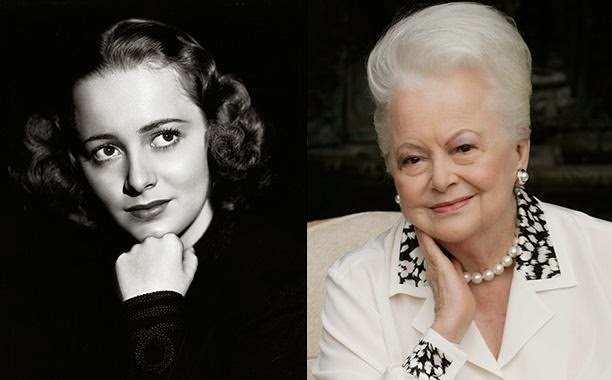
Yes, we will always have the films. But the stars are mostly gone — with due respect to the few who remain, de Havilland was our strongest surviving link to the Golden Age. The era has truly ended.

Of all that happened in her eventful life, Olivia de Havilland is best remembered for her role as Melanie Hamilton Wilkes in Gone With The Wind (1939). This is unfair for two reasons. Memorable as she is in GWTW, it is by no means her finest role. Her countless fans will point to the two roles that won her Academy Awards, the two others (besides the supporting role in GWTW) that won her nominations, and more. The second reason is that her legacy goes beyond her roles. Film historians, even law historians and labour activists, will point to the De Havilland Law.

De Havilland, who died this week at age 104, fought the system — and won. In 1943, when Hollywood’s powerful studios controlled the fate of actors, Warner Brothers refused to let her go at the end of their seven-year contract. The studio tagged extra time to the contract to compensate for periods when she had not been working. She sued in a California court, leading to the landmark 1944 ruling — informally known as the De Havilland Law — that the years in the contract mean calendar years. It loosened forever the studios’ grip on actors.

From her life, that is the biggest takeaway. From her death, the big takeaway is sobering: The Golden Age of Hollywood is slipping away. Yes, we will always have the films. But the stars are mostly gone — with due respect to the few who remain, de Havilland was our strongest surviving link to the Golden Age. The era has truly ended.


We are at that stage of history when this was inevitable. Actors who were old enough to play the lead when talking pictures arrived (not de Havilland, who was 11 when the first sound film released in 1927) would have been at least 110 today if it were possible to live that long (Greta Garbo, for example, would have turned 115 this year). Those old enough to have played the lead towards the end of the Golden Age (mid-1960s or thereabouts) will now be at least in their 70s, and more likely in their 80s or 90s. Or gone already.

Ingrid Bergman and Bette Davis, de Havilland’s closest friend in the industry, left in the 1980s. Barbara Stanwyck and Audrey Hepburn died in the 1990s, Gregory Peck and Katharine Hepburn in the 2000s, and Elizabeth Taylor and Lauren Bacall in the following decade. Then Kirk Douglas and now de Havilland have left in the very beginning of the 2020s — both of them past 100.

How many are still with us? An online search throws up long lists that bring a false sense of relief. Most of the names, it turns out, are of actors who played smaller roles, or who were child actors during the Golden Age. Indeed, every link is vital in a vanishing chain, including Mickey Kuhn, now 87, who played Melanie’s young son in GWTW 81 years ago. But it’s the stars we want to count.


I found about a dozen names more familiar than others. Two of the bigger ones are Angela Lansbury and Jane Powell, both in their 90s now. Five others will be familiar to fans of Alfred Hitchcock — six if you count his daughter Patricia, now 92, who appeared in three of his films. Vera Miles, 90, is Marion Crane’s sister from Psycho (1960) and Henry Fonda’s disturbed wife from The Wrong Man (1956). Shirley MacLaine, 86, made her debut in Hitchcock’s The Trouble With Harry (1955). Tippi Hedren of The Birds (1962) and Marnie (1964) is now 90. Kim Novak of Vertigo (1958) is 87.

The most important among them is Eva Marie Saint, who turned 96 on July 4, three days after de Havilland turned 104. Saint was in Hitchcock’s North by Northwest (1959) with Cary Grant (died 1986), and in Elia Kazan’s On the Waterfront (1954) with Marlon Brando (died 2004). We saw Saint at the Oscars in 2018, as a presenter. Cherish these moments, for a day will come, inevitably, when we will have only their films.

De Havilland never did a Hitchcock film. Her sister Joan Fontaine (died 2013 at age 96) did two, winning an Academy nomination for Rebecca (1940) and bagging the award for Suspicion (1942). They remain the only siblings to have each won one or more Academy Awards. Joan got there first, beating Olivia in the 1942 race, but this is not the time to reflect on their famed sibling rivalry. For today, we only have their films...

Monday, July 3, 2017

OLIVIA DEHAVILLAND AND A NEW LAWSUIT


Olivia de Havilland, who won two Oscars during Hollywood’s golden age, filed a lawsuit on Friday against FX Networks and Ryan Murphy Productions over her gossipy portrayal in the television show “Feud: Bette and Joan.”

“FX defendants misappropriated Olivia de Havilland’s name, likeness and identity without her permission and used them falsely in order to exploit their own commercial interests,” the lawsuit says. Ms. de Havilland, 101, is seeking damages for “emotional harm” and “harm to her reputation,” and is also pushing for an injunction against the use of her name and likeness.

“Feud: Bette and Joan” portrays the decades-long rivalry between Joan Crawford and Bette Davis, and is part of Mr. Murphy’s larger FX anthology series depicting feuds throughout history. Ms. de Havilland and Davis were close friends and starred in four films together, including “Hush … Hush, Sweet Charlotte.” In the series, Ms. de Havilland, played by Catherine Zeta-Jones, is an important character, appearing in six episodes as a confidante to Davis and an active participant in the Davis-Crawford drama.

The lawsuit rejects both the quotes attributed to Ms. de Havilland and the overall tone of the portrayal. “Olivia de Havilland has made efforts, spent time and money, protecting her well-defined public image as one who does not engage in gossip and other unkind, ill-mannered behavior,” the lawsuit reads.

Mr. Murphy, the creator of “Feud,” told the The Hollywood Reporter in April that he did not contact de Havilland about her portrayal in the series.

“I didn’t write Olivia because I didn’t want to be disrespectful and ask her, ‘Did this happen? Did that happen? What was your take on that?’” he said.


SOURCE

Monday, March 2, 2015

OLIVIA DE HAVILLAND AT 98

At 98, Olivia de Havilland is the last great star of Hollywood’s golden age, a woman who began her career during the rise of Technicolor in 1935, formed one of the most indelible screen couples of all time with Errol Flynn, and went on to work with James Cagney, Rita Hayworth, Montgomery Clift, Bette Davis, Richard Burton, Clark Gable, and Vivien Leigh. With her deep brown doe eyes and apple-cheeked smile, the two-time Best Actress winner excelled at playing heroines whose demure bearing belied a feisty core. The most famous of these great ladies was Melanie Hamilton, the tenderhearted foil to Leigh’s scheming Scarlett O’Hara in 1939’s Gone With the Wind. Based on Margaret Mitchell’s best-seller, the beloved epic has sold more tickets in its lifetime than any other film. And 75 years ago it cleaned up at the Academy Awards, winning eight of its 13 nominations.

Having outlived all of her costars (as well as the movie’s mad-genius producer, David O. Selznick, and the three directors he hired to steer the massive ship), de Havilland has been GWTW’s principal spokesperson for almost five decades, the sole bearer of the Tara torch. It’s a privilege she calls “rather wonderful,” as her affection for the film is genuine and deep. She’s seen GWTW “about 30 times,” she says, and still enjoys watching it for the emotional jolt it brings as she reconnects with those costars—Gable, Leigh, Hattie McDaniel, and Leslie Howard—who have long since passed on.

Her memory is enviable: She vividly recalls lying in her crib as a baby and hearing the clink-clink of her nanny preparing her bottle. And she is delightfully open about her age. While discussing her day-to-day life at the hotel, for instance, she gets a mischievous twinkle in her eye as she describes the handsome fellows from room service. “How many women in this world are served breakfast in bed every morning by a gorgeous young man? I am,” she says. “So how do I feel about older age? Crazy about it! Wouldn’t trade it for anything!”


When de Havilland moved to France in 1953 to marry her second husband, a Frenchman, she was all too happy to bid adieu to Hollywood, where television had begun to eclipse film. “The Golden Era…was dying and I knew that whatever replaced it would not be its equal,” she writes. So she focused on her children, Benjamin and Gisèle, took the occasional job by “commuting to Hollywood,” as her son once put it, and earned an Emmy nomination in 1987 for her role as a Russian empress in the NBC miniseries Anastasia: The Mystery of Anna. Even after her second divorce in 1979, living abroad afforded her a life of great privacy, which she continues to cherish. Tabloids frothed for years over her relationship with her sister, the actress Joan Fontaine, which was famously strained, at least according to Fontaine, who wrote about it in her 1978 autobiography. De Havilland, however, does not discuss it. (Fontaine died in 2013.)

Though she lives alone, de Havilland is far from lonely. She regularly speaks on the phone with Gisèle, who lives in California. (Benjamin passed away in 1991 from over-radiation following his treatment for cancer.) Depending on her energy level, she entertains about once a week. She is still a dues-paying member of the Academy and follows nomination season “with extreme interest,” but because of her declining eyesight, she no longer watches many films and does not vote. She can still do crossword puzzles, though, and in the coming months she hopes to make progress on the autobiography she began a few years ago. She’s written five chapters in the same buoyant style that she used in her charming 1962 book of essays, Every Frenchman Has One. A lover of words, she is enjoying mining her rich, long life for remembrances.

And if she has anything to do with it, she will collect many, many more. Because this formidable woman has every intention of celebrating her 100th birthday come July 1, 2016. “Oh, I can’t wait for it,” she says. “I’m certainly relishing the idea of living a century. Can you imagine that? What an achievement.”


Monday, July 2, 2012

OLIVIA AND JOAN: THE LONGEST FEUD

Two years ago, amid the formal splendour of the Élysée Palace in Paris, President Nicolas Sarkozy conferred France’s most prestigious accolade, the Légion d’honneur, on a little, silver-haired lady, then aged 94, with sparkling brown eyes and an impishly familiar smile. That bewitching smile and those amazing eyes once made Olivia de Havilland the queen of Hollywood and the winner of two Oscars. Today, she is the last surviving star of the most famous epic film ever brought to the screen, Gone With the Wind. Her daughter Gisele, and other members of her family, were at the Élysée to watch Miss de Havilland, a resident of Paris for almost 60 years, honoured.

But one member of her immediate family — and the one who has known her longer and better than anyone in this world — her only sibling, Joan Fontaine, then 92, herself an Oscar-winner of equally illustrious status as a legend of stage and screen, was conspicuous by her absence from the ceremony.

When the President placed the blood-red ribbon and star of the Légion d’honneur around Olivia’s neck, Joan was 6,000 miles away at her home in Carmel, California, studiously ignoring the occasion — just as she has ignored every aspect of her sister’s existence for decades.

These two formidable grandes dames of the screen have been at loggerheads for most of their lives. Both frankly confess that, even as children, they detested one another.

Of the two sisters, de Havilland was the first to become an actress; when Fontaine tried to follow her lead, their mother, who allegedly favored de Havilland, refused to let her use the family name. Subsequently, Fontaine was forced to invent a name, taking first Joan Burfield, and later Joan Fontaine. Biographer Charles Higham records that the sisters have always had an uneasy relationship, starting in early childhood when de Havilland would rip up the clothes Fontaine had to wear as hand-me-downs, forcing Fontaine to sew them back together. A large part of the resentment between the sisters allegedly stemmed from Fontaine's perception that de Havilland was their mother's favorite child.


Both de Havilland and Fontaine were nominated for an Academy Award for Best Actress in 1942. Fontaine won that year for her role in Alfred Hitchcock's Suspicion over de Havilland's performance in Hold Back the Dawn. Charles Higham states that Fontaine "felt guilty about winning given her lack of obsessive career drive...". Higham has described the events of the awards ceremony, stating that as Fontaine stepped forward to collect her award, she pointedly rejected de Havilland's attempts at congratulating her and that de Havilland was both offended and embarrassed by her behavior.

Several years later, de Havilland remembered the slight and exacted her own revenge by brushing past Fontaine, who was waiting with her hand extended, because de Havilland allegedly took offense at a comment Fontaine had made about de Havilland's husband. De Havilland's relationship with Fontaine continued to deteriorate after the two incidents. Charles Higham has stated that this was the near final straw for what became a lifelong feud, but the sisters did not completely stop speaking to each other until 1975. According to Fontaine, de Havilland did not invite her to a memorial service for their mother, who had recently died. De Havilland claims she informed Fontaine, but Fontaine brushed her off, claiming she was too busy to attend.


Charles Higham records that Fontaine has an estranged relationship with her own daughters as well, possibly because she discovered that they were secretly maintaining a relationship with de Havilland. Both sisters have refused to comment publicly about their feud and dysfunctional family relationships, though in an interview with John Kobal, Fontaine stated categorically that the so-called rivalry was a pure hoax, cooked up by the studio publicity hounds.

In a 1979 interview, Fontaine says the reason she stopped speaking with her sister was because Olivia wanted their mother (who was suffering from cancer) operated on at the age of 88. Joan also says that when their mother died, Olivia didn't even bother to phone to find out where she could be reached (Fontaine was on tour). Instead, Olivia sent a telegram, but it was delivered to Joan two weeks later at her next stop.

Whatever the reason, it does not look like Olivia DeHavilland and Joan Fontaine will ever mend the fences. This has to be one of the longest family feuds of all-time, and it is the stuff only Hollywood could dream up...


SOURCE

Saturday, September 11, 2010

OLIVIA DEHAVILLAND HONORED IN FRANCE


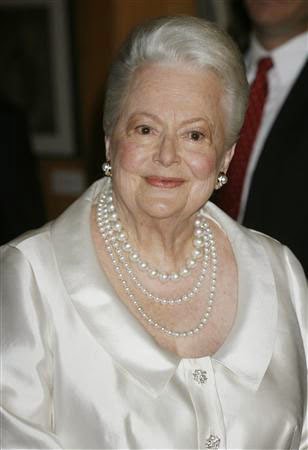
Olivia de Havilland, 94, looked radiant today as French President Nicolas Sarkozy pinned her with the Legion of Honor insignia at the presidential palace. Sarkozy told de Havilland, "You honor France for having chosen us." The American actress of British origin has lived in Paris since 1953, according to AP.

De Havilland played the role of fragile southern belle Melanie Wilkes in Gone With The Wind and is the last surviving major star of the 1939 classic.