Showing posts with label Joan Leslie. Show all posts

Sunday, March 17, 2019

PHOTOS OF THE DAY: MORE CLASSIC HOLLYWOOD ON ST. PATRICK'S DAY

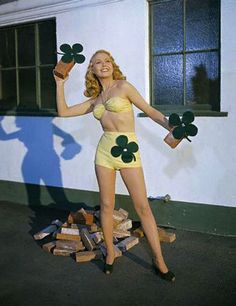
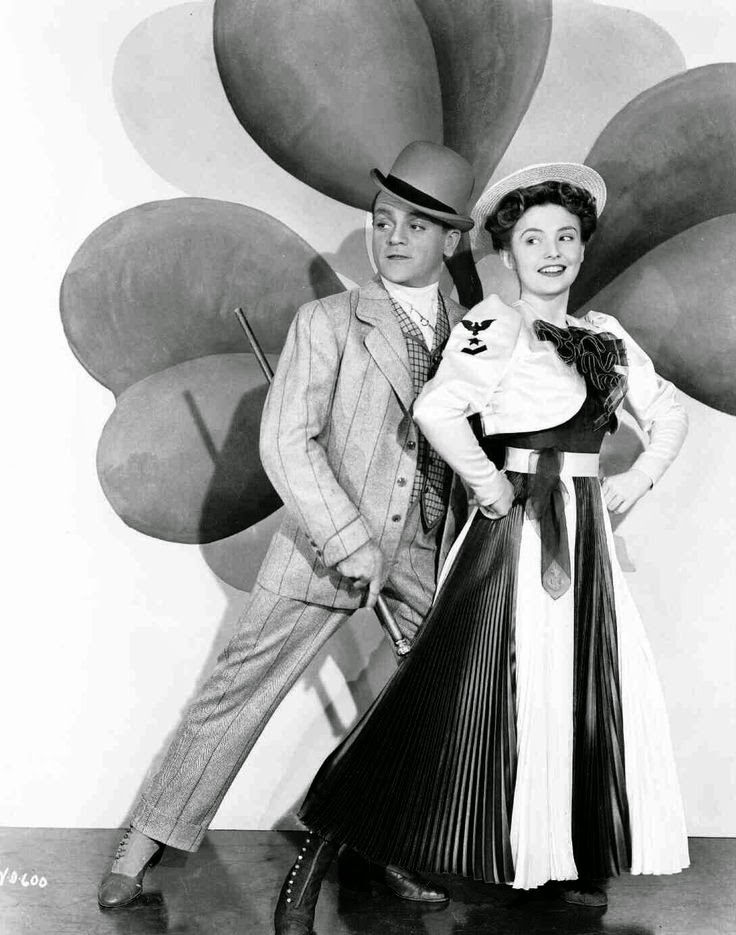
Everyone is Irish on St. Patrick's Day, and classic Hollywood is no different. Here are some pictures of some great St. Patrick's Day poses. I spotlighted some Irish inspired photos in 2017. You can see that photo gallery HERE. Here are some different great pics...


Maureen O' Hara

Fred Astaire

Adele Mara

Jimmy Cagney and Joan Leslie

Bobby "Wheezer" Hutchins and Mary Ann Jackson

Greer Garson


Wednesday, July 4, 2018

YANKEE DOODLE DANDY: A 1942 REVIEW

You know as of this writing I have never seen the film Yankee Doodle Dandy all the way through. I promise I will do that this year! With it being Independence Day, here is the original review of the film. This was written by Bosley Crowther and published in the NY Times on May 30, 1942...

"Yankee Doodle Dandy" rode into town last night on a whole lot more than a pony; it rode on the star-spangled crest of one of the fanciest build-ups that Broadway has ever known, not to mention the glowing reputation of one of "the Street's" most beloved sons. Folks who are looking for something propitious to decorate today would do well to try for a seat at the Hollywood Theatre. For there, at the scene of last night's "$5,000,000 première," you will find as warm and delightful a musical picture as has hit the screen in years, a corking good entertainment and as affectionate, if not as accurate, a film biography as has ever—yes, ever—been made.

No need to tell anybody who the subject of this sparkling picture is. The public has been well advised for months that Warner Brothers were filming the life of George M. Cohan, with all the old Cohan songs and bits from his memorable shows. And the fact that cocky James Cagney would play the leading role has been a matter of common knowledge and of joyous anticipation all around. So the only news this morning is that all has come out fine. The picture magnificently matches the theatrical brilliance of Mr. Cohan's career, packed as it is with vigorous humor and honest sentiment. And the performance of Mr. Cagney as the one and original Song-and-Dance Man is an unbelievably faithful characterization and a piece of playing that glows with energy.

True, Robert Buckner and Edmund Joseph, the script-writers, have taken some liberties with Mr. Cohan's life. They have juggled facts rather freely to construct a neat, dramatic story line, and they have let slip a few anachronisms which the wise ones will gleefully spot. But, as the late Sigmund Lubin once put it, they're yours at no extra cost. And, of course, Mr. Cohan had the last word. He said okay, let them go.


And the story as now presented is that of a lusty trouper, a showman who earned in the theatre a lasting place in our nation's Hall of Fame. Indeed, the picture begins with Cohan being called to Washington while playing the role of President Roosevelt in the musical show "I'd Rather Be Right." At the White House he meets the President (an unprecedented trick for the screen) and to him is told, in flashback, the wonderful story of this Yankee dandy's life.

And it is a hummer of a life! It starts on July 4, 1878, in Providence, R. I., when the red and squawling Georgie first hitched his wagon to the stars and stripes. And it follows the fortunes of the Cohan family—the famous Four Cohans, vaudeville specialists—through their picturesque trouping around the country, the first break of saucy George as "Peck's Bad Boy," his teaming with Sam H. Harris and the production of "Little Johnny Jones," and it traces his rising fortune to the World War and the writing of "Over There." Then it digresses pleasantly into the fictitious afternoon of the family's life, and takes up for a climax with Cohan receiving the Congressional Medal of Honor from President Roosevelt.


Without question, the most solidly entertaining portion of the film is that which has to do with Cohan's early bouts with the stage and the sumptuous reproductions of bits from his early shows. Here Mr. Cagney excels, both in characterization and jubilant song and dance. His handling of "Yankee Doodle Boy" and "Give My Regards to Broadway," from "Little Johnny Jones," must be—with all due respect—quite as buoyant as Mr. Cohan's own. And one priceless dialogue he plays with Eddie Foy Jr., representing the elder Foy, couldn't have been better if Mr. Cohan had played it—and written it—himself.

The abundance of further pleasures is endless. There is Irene Manning playing Fay Templeton and singing "Mary Is a Grand Old Name" and "So Long, Mary," fit to make any oldster cry. There are the excellent performances of Joan Leslie as Cohan's romantic prompter, Rosemary DeCamp as his mother, Richard Whorf as Sam H. Harris, and countless others, not to forget Captain Jack Young's tastefully restrained and surprisingly realistic impersonation of the President. Indeed, there is so much in this picture and so many persons that deserve their meed of praise that every one connected with it can stick a feather in his hat and take our word—it's dandy!

Thursday, December 31, 2015

THE PASSING SCENE OF 2015

It is hard to believe that the year 2015 is in the past now. As with every year, we have lost some great people in the entertainment world. Although this is not a complete list, I want to highlight some of the major people we lost this past year. They are gone but never forgotten...

Christopher Lee

Legendary actor Christopher Lee died of heart failure on June 7th at the age of 93. He was an English actor, singer and author. With a career spanning nearly 70 years, Lee initially portrayed villains and became best known for his role as Count Dracula in a sequence of Hammer Horror films. Lee's first film for Hammer was The Curse of Frankenstein (1957), in which he played Frankenstein's monster, with Peter Cushing as Baron Victor Frankenstein. It was the first film in which Lee and Cushing were co-stars, and ultimately appeared together in over twenty films and became close friends.His other film roles include Francisco Scaramanga in the James Bond film The Man with the Golden Gun (1974), Saruman in The Lord of the Rings film trilogy (2001–2003) and The Hobbit film trilogy (2012–2014), and Count Dooku/Darth Tyranus in the final two films of the Star Wars prequel trilogy (2002 and 2005) and Star Wars: The Clone Wars (2008).

Television actor Al Molinaro died on October 30th at the age of 96. He was known for his television sitcom roles as Al Delvecchio on Happy Days from 1974 to 1984 and Murray Greshler on The Odd Couple from 1970-1975. He also starred in TV commercials for On-Cor frozen dinners for 16 years.

Actor Rod Taylor died of a heart attack at the age of 84 on January 8th. Taylor's big breakthrough came with his starring turn in The Time Machine, director George Pal's 1960 adaptation of the H. G. Wells 1895 sci-fi classic.He also played the heroic Mitch Brenner in Alfred Hitchcock's 1963 classic The Birds, coming to the aid of Tippi Hedren, and he starred opposite Elizabeth Taylor and Richard Burton in another 1963 release, The V.I.P.s. Most recently, he played Winston Churchill in Quentin Tarantino's Inglorious Basterds (2009).

Television actress Marjorie Lord died on November 28th at the age of 97. She played Kathy "Clancy" Williams, opposite Danny Thomas's character on Make Room for Daddy from 1956 to 1964 and later Make Room for Granddaddy from 1970 to 1971.She also appeared sporadically in movies, and she played opposite Bob Hope in the comedy Boy, Did I Get A Wrong Number in 1966.

Leonard Nimoy

Actor Leonard Nimoy died of  chronic obstructive pulmonary disease on February 27th at the age of 83. In 1965, he made his first appearance in the rejected Star Trek pilot The Cage, and went on to play the character of Mr. Spock until 1969, followed by eight feature films and guest slots in the various spin-off series. More recently, he also had a recurring role in the science fiction series Fringe. He played the elder Spock in the 2009 Star Trek movie and reprised the role in a brief appearance in the 2013 sequel, Star Trek Into Darkness.

Actor Louis Jourdan died on February 14 at the age of 93. He was a French film and television actor. He was known for his suave roles in several Hollywood films, including The Paradine Case (1947), Letter from an Unknown Woman (1948), Gigi (1958), The Best of Everything (1959), The V.I.P.s (1963) and Octopussy (1983).

Television actress Donna Douglas died at the age of 81 on January 1st of pancreatic cancer. She was known for her role as Elly May Clampett in CBS's The Beverly Hillbillies (1962–1971). Following her acting career, Douglas became a real estate agent, a Gospel singer and inspirational speaker, and authored books for children and adults.

Director and writer Wes Craven died on August 30th at the age of 76. He was best known for creating the A Nightmare on Elm Street franchise featuring the Freddy Krueger character, directing the first installment and Wes Craven's New Nightmare, and co-writing A Nightmare on Elm Street 3: Dream Warriors with Bruce Wagner. Craven also directed all four films in the Scream series, and co-created the Ghostface character. Some of his other films include The Hills Have Eyes, The Last House on the Left, Red Eye and My Soul to Take.

Singer and actress Monica Lewis died at the age of 93 on June 12th. With the help of Benny Goodman she began to establish her career through nationally broadcast shows such as The Revere Camera Show and Beat the Band. In 1947 Lewis started providing the singing voice for "Miss Chiquita Banana," a cartoon television commercial character. In 1948 she appeared in the first ever Ed Sullivan Show, and she later appeared in some 1970s disaster films such as Earthquake (1974), Rollercoaster (1977), and both Airport '77 (1977) and The Concorde ... Airport '79 (1979).
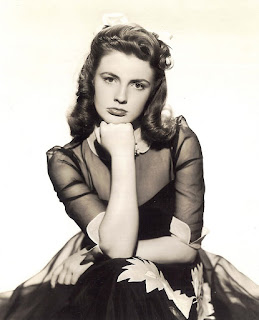
Joan Leslie

Actress Joan Leslie died on October 12, 2015 at the age of 90. She was a dancer and vaudevillian who, during the Hollywood Golden Age, appeared in such films as High Sierra (1941) , Sergeant York (1941) and Yankee Doodle Dandy (1942) - all before the age of 20. Her last film was The Revolt of Mamie Stover in 1956, but she remained active in appearances at various classic movie conventions.

Movie producer Samuel Goldwyn Jr. died of heart failure at the age of 88 on January 9th. Mr. Goldwyn was credited with giving Julia Roberts her big break in Mystic Pizza in 1988.  His final producing credit came in December of 2013 with the release of  The Secret Life of Walter Mitty, starring and directed by Ben Stiller, a remake of one of his father’s biggest hits. His father was studio mogul Samuel Goldwyn (1879-1974).

Singer Lesley Gore died of cancer on February 16th at the age of 68.  At the age of 16, in 1963, she recorded the pop hit "It's My Party", and followed it up with other hits including "Judy's Turn to Cry" and "You Don't Own Me". Gore also worked as an actress and composed songs with her brother Michael Gore for the 1980 film Fame, for which she was nominated for an Academy Award.

Actor James Best died of pneumonia at the age of 88 on April 6th. He was an American actor, who in six decades of television is best known for his starring role as bumbling Sheriff Rosco P. Coltrane in the CBS television series The Dukes of Hazzard from 1979 to 1985. He also worked as an acting coach, artist, college professor, and musician. His last role was in the TV movie, The Sweeter Side of Life in a 2013.

Sex symbol Anita Ekberg died of undisclosed causes on January 11th at the age of 83. Anita was a Swedish-born Italian actress, model, and sex symbol. She is best known for her role as Sylvia in the Federico Fellini film La Dolce Vita (The Sweet Life, 1960), which features a scene of her cavorting in Rome's Trevi Fountain alongside Marcello Mastroianni.

Actress Coleen Gray died on August 3rd at the age of 92. She was best known for her roles in the films Nightmare Alley (1947), Red River (1948), and Stanley Kubrick's The Killing (1956). A film noir beauty, she could also play light hearted roles like the role of Bing Crosby's love interest in the 1950 Frank Capra musical Riding High.

Actor Gary Owens died at the age of 80 on February 12th. He will be best remembered as the announcer for the TV series "Rowan and Martin's Laugh-In" from 1968 to 1973. His popularity and distinctive voice was suited well for animated TV programs such as "Space Ghost" (1966), "Yogi's Space Race" (1978), as well as many others.
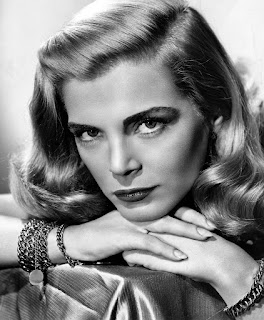
Lizabeth Scott

Actress Lizabeth Scott died of heart failure at the age of 92 on January 31st. Scott was known for her deep voice and smoky sensual looks. After performing the Sabina role in the first Broadway and Boston stage productions of The Skin of Our Teeth, she emerged internationally in such film noirs as The Strange Love of Martha Ivers (1946),  Dead Reckoning (1947)  Desert Fury (1948)  and Too Late for Tears (1949). No other actress has appeared in more film noir. Of her 22 feature films, she was leading lady in all but one. In addition to stage and radio, she appeared on television from the late 1940s to early 1970s.

Character actor Robert Loggia died on December 4th. He was nominated for the Academy Award for Best Supporting Actor for Jagged Edge (1985). Other notable appearances include An Officer and a Gentleman (1982), Scarface (1983), Prizzi's Honor (1985), Big (1988), Independence Day (1996), and Lost Highway (1997), as well as television series such as The Sopranos. Despite suffering from Alzheimer's Disease, Loggia continued to make movies through this year.

Actress Anne Meara died on May 23rd at the age of 85. Along with her husband Jerry Stiller, she was half of the Stiller and Meara comedy team. They gained national attention during the 1960s with the aid of numerous appearances on "The Ed Sullivan Show". Highly versatile, she experienced an extensive career on stage and was the recipient of an Obie Award for her performance in "Madchen in Uniform" (1955). She was the mother of actress Amy Stiller and actor Ben Stiller.

Actor Dean Jones died at the age of 84 on September 1st. Jones was an American actor best known for his light-hearted leading roles in several Walt Disney films between 1965 and 1977, such as The Love Bug (1968). Jones also originated the role of Bobby in Stephen Sondheim's Company. Jones also appeared in a small role as Director of Central Intelligence Judge Arthur Moore in the film adaptation of Tom Clancy's Clear and Present Danger (1994), which starred Harrison Ford.

Music producer and historian Ken Barnes died on August 4th at the age of 82. Ken produced a series of successful records that Bing Crosby made in the 1970s. In 1974, he convinced Johnny Mercer to record a two-disk collection of Mercer singing Mercer - with Johnny selecting his own favorites. These were the last recordings made by Mercer before his death in 1976. He was also the founder and CEO of The Laureate Company, a music and movie restoration company.

Maureen Stapleton

Actress Maureen O'Hara died at the age of 95 on October 24th. From an early age, she wanted to become an actress and took lessons. She was given a screen test, which was deemed unsatisfactory, but Charles Laughton saw something in her when he later saw it. He arranged for her to co-star with him in the Alfred Hitchcock 1939 British film Jamaica Inn. She also co-starred with him in the Hollywood production of The Hunchback of Notre Dame, released the same year.  She made a number of films with John Wayne – the actor with whom she is most closely associated – and director John Ford, often both together in the same production, including The Quiet Man (1952). She also starred in swashbucklers such as The Black Swan (1942), opposite Tyrone Power, and Sinbad the Sailor (1947), with Douglas Fairbanks, Jr., as well as the Christmas classic Miracle on 34th Street (1947), with John Payne, Natalie Wood, and Edmund Gwenn.

May these great entertainers and all of the people we have lost in 2015 rest in peace and may their contributions to the world never be forgotten...

Thursday, October 15, 2015

RIP: JOAN LESLIE

Joan Leslie, best known for a string of roles opposite some of the biggest stars of Hollywood’s golden age before her 18th birthday, died October 12 at age 90, her family announced today. Described in her time as projecting “sweet innocence without seeming too sugary,” among her most notable roles was the title character’s wife in Sergeant York, alongside Humphrey Bogart in High Sierra, in Yankee Doodle Dandy opposite James Cagney, and with Fred Astaire in The Sky’s the Limit.

Born Joan Agnes Theresa Sadie Brodel in 1925 in Detroit, she began her show business career during the great depression, playing vaudville alongside members of her family as a way of making ends meet. She and her sisters toured Canada and the Midwest as The Three Brodels, bypassing child labor laws by lying about their ages. (Leslie once claimed when she was only 9 years old that she was actually 16.) When her sister signed a modeling contract, the family moved to Burbank, and shortly after, at age 11, Leslie signed with MGM, for whom she appeared in several uncredited roles.


Her big break came in 1940 when she signed with Warner Bros, performing in her most famous roles during the period either for WB or other studios to whom she was lent out. Among her other films during this period were The Hard Way,This Is the Army, Thank Your Lucky Stars, and Cinderella Jones. Devoutly religious, she became dissatisfied with the roles made available to her for both professional and moral reasons, and sued Warner Bros in 1946 to get out of her contract. Though she was successful, her career suffered after this when, as she later revealed in interviews, she was blacklisted by Jack Warner and unable to find work at any other major studio.


She married William Caldwell, an obstetrician, in 1950 and after the couple had twin daughters slowed her acting career considerably to focus on her family. Her final film was the 1956 romantic drama The Revolt of Mamie Stover, which also starred Jane Russell, Richard Egan, Agnes Moorehead, and Michael Pate. In later years she made sporadic appearances on television, including episodes of Charlie’s Angels, The Incredible Hulk, and Murder, She Wrote. She retired from acting in 1991.

In addition to her acting career, she founded a line of clothing. She and her husband remained married until his death in 2000, after which she founded the Dr. William G. and Joan L. Caldwell Chair in Gynecologic Oncology for the University of Louisville. A funeral mass is scheduled for 10 AM on October 19, at Our Mother of Good Counsel Church in Los Angeles...


Wednesday, September 30, 2015

RECENTLY VIEWED: HOLLYWOOD CANTEEN

I just recently spent a pleasant morning watching one of the most charming and entertaining light hearted films of the war years. The film Hollywood Canteen is a time capsule of life and entertainment during World War II. Hollywood Canteen is a 1944 American musical romantic comedy film starring Joan Leslie, Robert Hutton, and Dane Clark and distributed by Warner Bros. The film was written and directed by Delmer Daves, and is notable for featuring many stars (appearing as themselves) in cameo roles. The film received three Academy Award nominations.

Two soldiers on leave spend three nights at the Hollywood Canteen before returning to active duty in the South Pacific. Slim Green (Robert Hutton) is the millionth G.I. to enjoy the Canteen, and consequently wins a date with Joan Leslie. The other G.I., Sergeant Nolan (Dane Clark) gets to dance with Joan Crawford. Canteen founders Bette Davis and John Garfield give talks on the history of the Canteen. The soldiers enjoy a variety of musical numbers performed by a host of Hollywood stars, and also comedians, such as Jack Benny and his violin.

The film's setting is the Hollywood Canteen, a free entertainment club open to servicemen. The Canteen was created as a G. I. morale-booster by movie stars Bette Davis and John Garfield during World War II. Many of the stars that provided cameos in the film had previously volunteered to work there or provide entertainment. They include: The Andrews Sisters, Jack Benny, Joe E. Brown, Eddie Cantor, Kitty Carlisle, Jack Carson, Joan Crawford, Faye Emerson, Sydney Greenstreet, Alan Hale, Sr., Paul Henreid, Joan Leslie, Peter Lorre, Ida Lupino, Dorothy Malone, Dennis Morgan, Janis Paige, Eleanor Parker, Roy Rogers (with Trigger), S.Z. Sakall, Zachary Scott, Alexis Smith, Barbara Stanwyck, Jane Wyman, Jimmy Dorsey and The Golden Gate Quartet.


The movie's plot is utterly preposterous, but that makes no difference. The chemistry between stars Joan Leslie and Robert Hutton is wonderful. Joan's role was originally to have been played by Ann Sheridan, but she turned it down because she, too, thought the idea of a soldier on leave falling in love with a movie star at the Canteen and actually getting a chance to spend some with her was ridiculous.

In my opinion, Joan turned out to be absolutely perfect. She was quite young when the movie was made (only 18 or 19), but one of Warner Brothers' most popular actresses of the early 1940s.


Formal reviews of Hollywood Canteen at the time it was released tended to pan the movie, even though it was a commercial success. But for today's audiences it's two hours of great fun. There are terrific song and dance numbers by some of Hollywood's best.

The great irony of this movie has to do with what happened to John Garfield. Declared 4-F because of a heart condition, Garfield repeatedly tried to enlist but was turned down. He gave tirelessly of himself, entertaining troops in USO shows stateside and in Europe. Even Bette Davis acknowledged that he was the driving force behind the Canteen. So it is inconceivable to me that someone who gave so much of himself to the war effort could have been blacklisted as a communist sympathizer. His career and his life were ruined, and he died suddenly in May, 1952.

If you want to remember "The Greatest Generation" and to remember what great entertainment was and should be, then this gem of a 1944 movie is for you...

MY RATING: 9 OUT OF 10


Saturday, March 7, 2015

HOLLYWOOD BEAUTY: JOAN LESLIE

Joan Leslie was never known as a great actress like Better Davis or Katherine Hepburn, which is unfortunate because she was a very capable actress. Leslie was a high point in many movies, especially Warner Brothers movies, throughout the 1940s. Personally, I think she was one of the most beautiful women of that era. Here are six reasons why I think so...


Friday, September 20, 2013

ASTAIRE'S FORGOTTEN DANCE PARTNERS

Fred Astaire danced with some of the most talented leading ladies from Ginger Rogers to Cyd Charisse. Many people would agree that he never danced with anyone better than Rogers, but Astaire danced with numerous leading ladies over his forty year career in Hollywood. Not every dancer Astaire made a movie with spelled success or are remembered as Ginger Rogers was. After Rogers, Fred Astaire made a lot of movies with different actresses in the early to mid 1940s.


After leaving RKO in 1939, Astaire made his way to Paramount Studios. The studio teamed Astaire with Bing Crosby, and since the men were the stars of 1942′s Holiday Inn, the studio could cast females who weren’t necessarily name above the title types. Thus Marjorie Reynolds (1917-1997) and Virginia Dale (1917-1994) got their chances to dance with the master. Rewatching the movie, Reynolds danced with Astaire better than Dale did. Virginia Dale's main number with the famed dancer was "You're Easy To Dance With". Dale looks like at the most she is making all of her steps, but she looks heavy footed. It is definitely not a comfortable or graceful pair. Astaire does much better with Marjorie Reynolds. Reynolds could not sing a lick, but her dancing is much better than Virginia Dale's attempted moves. Reynolds and Astaire's best number was "Be Careful It's My Heart". It is a graceful and elegant slow dance, I could have seen the dancing duo making another movie together but they never did. However, after this film both actress-dancers returned to B films and faded from public view — although Reynolds had a brief comeback on TV as the wife on the popular Fifties situation comedy, The Life of Riley, starring William Bendix as the bumbling Chester Riley.


At the age of 18, beautiful actress Joan Leslie (born 1925) was paired with Astaire in the film The Sky's The Limit. The score was written by Johnny Mercer, but not much greatness came out of the movie except for the song "One For My Baby". Astaire did a great job on the song, but it became the unofficial anthem of Frank Sinatra in the 1950s. All dances were choreographed by and credited to Astaire alone, another unusual departure for him, as he generally worked with collaborators. What is not unusual is the selection of dance routines, which is the standard Astaire formula of a comic partnered routine, a romantic partnered routine and a "sock" solo, each of which is seamlessly integrated into the plot. Joan Leslie is one of the most beautiful actresses in the 1940s, but she could sing as well as she could dance. The only good dance numbers were the ones that Astaire did on his own.


Lucille Bremer (1917-1996) was an accomplished dancer under contract to MGM. She was a former Radio City Hall Rockette who had been on Broadway, and after signing with the studio was given a big push. She was Judy Garland’s older sister in Meet Me in St. Louis, then given a starring part opposite Astaire in Yolanda and the Thief, released in 1945. She danced with him again in two sequences for The Ziegfeld Follies (1946). But then, after Til the Clouds Roll By, she seemed to fall out of favor with Mayer and producer Arthur Freed. In later years it was reported that after singer Ginny Simms turned down Louis B. Mayer's advances that he turned to Lucille Bremer who became his secret girlfriend for awhile. When she broke up with him, he basically made sure she would never be a huge star. I never thought she danced well with Astaire. Her best dance scene was with Van Johnson in Til The Clouds Roll By, but then again Bremer looked good dancing next to Johnson. In any event it was deemed that she hadn’t scored with the public. Her career languished. Whether it was the studio’s, or Bremer’s decision, her contract wasn’t renewed. She starred in a few non dancing roles, then retired.

After dancing with Joan Caulfield and Olga San Juan in another Bing Crosby film, Blue Skies (1946) Astaire retired from movies yet again. However, he was a work alcoholic and he was coaxed back to working by MGM and an injured Gene Kelly for Easter Parade (1948) with Judy Garland. Throughout the 1950s Fred Astaire kept dancing with new, younger partners. like Vera-Ellen, Jane Powell, Leslie Caron, Audrey Hepburn, and Cyd Charisse. No matter how big, or small their careers might be the women who danced with Fred Astaire on screen are in a class by themselves...


Sunday, February 3, 2013

RECENTLY VIEWED: THIS IS THE ARMY

The other day I was flipping through all of the channels we have - most of which has nothing worthwhile to see, but I stumbled upon a channel called Retro. I guess they screen old movies sometimes as well. I started watching This Is The Army, a patriotic movie at its most patriotic. I haven't seen this film in years. Unfortunately, the copy they showed on this channel looked like a fifth generation copy from an old Beta video recorder, but the movie was still watchable. (A couple of days later TCM showed the movie with a much better quality print.)

This Is the Army is a 1943 American wartime motion picture produced by Hal B. Wallis and Jack L. Warner, and directed by Michael Curtiz, and a wartime musical designed to boost morale in the U.S. during World War II, directed by Sgt. Ezra Stone. The screenplay by Casey Robinson and Claude Binyon was based on the 1942 Broadway musical by Irving Berlin, who also composed the film's 19 songs and broke screen protocol by singing one of them. The movie features a large ensemble cast, including George Murphy, Joan Leslie, Alan Hale, Sr., Rosemary DeCamp, and Lt. Ronald Reagan, while both the stage play and film included soldiers of the U.S. Army who were actors and performers in civilian life.

The title of the movie is from the well-known Berlin song that is featured in the movie, which is also the title of the musical-within-a-movie staged by the younger Jones. The movie features star appearances by Irving Berlin, Kate Smith, Frances Langford and Joe Louis as themselves. If Washington, D.C. officials did not like the idea of a musical/revue about the Army, playwright Irving Berlin was ready to call it This Is the Navy, or This Is the Air Corps. Smith's full-length rendition of Berlin's "God Bless America" is arguably the most famous cinematic rendition of the piece. Louis appears in a revue piece called "What the Well-Dressed Man in Harlem Will Wear", with James Cross (lead singer and dancer), William Wycoff (dancer in drag), Marion Brown (heavyset dancer), and a chorus of perhaps a dozen, the only spoken/sung scene that includes African-Americans. Louis also appears in two other scenes, one in a boxing match, and the second being the stage door canteen number (he did not speak in either scene).

One of the film's highlights is Irving Berlin himself singing his song "Oh! How I Hate to Get Up in the Morning." Berlin's natural singing voice was so soft that the recording volume had to be increased significantly in order to record acceptably.

The celebrity impersonation "hamburger" sequence includes accurate spoofs of Broadway stars Lynn Fontanne, Alfred Lunt and Ethel Barrymore, and film stars Charles Boyer and Herbert Marshall. The revue pieces also include acrobat routines, several comedy pieces, including one with Hale in drag, a minstrel show sketch (oftentimes removed from consumer videos and television broadcasts), and tributes to the Navy and the Air Corps.


Although the core of the movie consists of the musical numbers, the movie also contains a veneer of a plot involving the wartime love interests of both the father and the son. I have to laugh at the Hollywood casting for the father and son. George Murphy, born in 1902, played the father - and Ronald Reagan, born in 1911, played his son! Nine years separated the actors, but at the time Reagan looked so youthful, and George Murphy always looked older than his years. The two would be lifelong friends, and each would get involved in politics later in their careers. Reagan would warmly and jokingly refer to Murphy, who preceded him into politics by a couple of years, as "my John the Baptist."

The film is not a great movie by any stretch of the imagination, and it pales in comparison to Irving Berlin's other cinematic efforts. However, it was what it was for its time - a great piece of celluloid patriotism that the country and the world needed at the time. The musical numbers are worth seeing in the movie - Kate Smith's rendition of "God Bless America" is worth it alone. Like the Broadway version, Irving Berlin donated every penny he made off of the film. That alone makes it a great film for 1943...

MY RATING: 6 OUT OF 10


Friday, July 2, 2010

MOVIE TRAILER: YANKEE DOODLE DANDY

There is no movie more patriotic than the great YANKEE DOODLE DANDY(1942)which starred James Cagney and a young Joan Leslie. Cagney played a fictional version of George M. Cohan. No Independence is complete without this film...