Showing posts with label Frankenstein. Show all posts

Monday, October 22, 2018

FIVE THINGS YOU DIDN'T KNOW ABOUT BORIS KARLOFF

One of my favorite times of the year is Halloween. I love everything about the holiday, especially I love the Halloween movies. One of the best of the classic movie horror stars was Boris Karloff. A lot of people love his acting but don't know too much about the man...


1. No one really thought Frankenstein would be such a success and the studio never imagined that Karloff would emerge as its star. Another British actor, Colin (“It’s alive! It’s alive!”) Clive got top billing as Dr. Frankenstein – remember, Frankenstein is the creator, not the monster. Second billing went to the literal bride of Frankenstein, Mae Clarke, perhaps most well-known for being on the receiving end of James Cagney’s grapefruit in Public Enemy. The opening credits don’t even list Karloff’s name, just a question mark, a promotion gimmick certainly, but one the studio probably would not have used with a more famous actor.

2. There was no bad blood between Boris Karloff and Bela Lugosi. Daughter Sara Karloff told an interviewer that rumors of a rivalry between Karloff and Lugosi were simply untrue. The two worked together on many films, she said, and there was no “personal animosity or professional jealousy – that was all studio hype – and it worked – the studios fed on that, and it made for good box office.”


3. Boris Karloff was one of the founding members of the Screen Actor’s Guild. Karloff’s legendary performance in Frankenstein was also a grueling one, said Museum of the Moving Image curator David Schwartz. Although the role made his career, the hours of makeup were brutal and made him realize how important safe working conditions were to actors – leading him to become one of the founders of the Screen Actors Guild, said Schwartz.

4. Boris Karloff loved cricket and gardening – and all things British. Although he left England for Canada in 1909, he never gave up his British citizenship. He did, however, shed his name, perhaps to shield his family from the disdain they feared from having an actor in the family. Publicly, Karloff said that Pratt seemed like an unfortunate name for an actor, suggesting pratfalls.

5. Boris Karloff’s favorite actor was George Kennedy.When she was asked who her father’s favorite actors were, Sarah Karloff said the only performer whose craft he’d ever specifically mentioned to her was veteran American actor George Kennedy, who’s been in more 200 movies and TV shows and who won an Oscar for his performance in Cool Hand Luke...


Sunday, October 29, 2017

PHOTOS OF THE DAY: FACES OF THE FRANKENSTEIN MONSTER

During this Halloween season, I wanted to take a look at one of my favorite horror story characters and that is Frankenstein's Monster. Since 1931, he has been played on the screen numerous times, but here are some photos of the famous actors playing the unfortunate monster...


BORIS KARLOFF (1887-1969)


GLENN STRANGE (1899-1973)


BELA LUGOSI (1882-1956)


CHRISTOPHER LEE (1922-2015)


PETER BOYLE (1935-2006)


ROBERT DE NIRO (BORN 1943)

Saturday, December 15, 2012

MY FIVE FAVORITE MOVIES OF THE 1930S

The decade of the 1930s was a tough era in American History. The Great Depressed had paralyzed society, and millions of people were out of work. Still though, the movies were a great escape for people. The movies of that era kind of reflected  a lot of the fantasy and escapism that the country needed. Here are my five favorite movies of that decade:


5. FREAKS (1932)
It is one of the most bizarre films I have ever seen, but I can not stop watching it. The movie was unavailable for years, but it is widely available now and shown on TCM often. Directed and produced by Tod Browning and released by Metro-Goldwyn-Mayer, the cast was mostly composed of actual carnival (funfair) performers. The film was based on Tod Robbins' 1923 short story "Spurs". Director Browning took the exceptional step of casting real people with deformities as the eponymous sideshow "freaks," rather than using costumes and makeup. The film was panned when it was released in 1932, but beginning in the early 1960s, Freaks was rediscovered as a counterculture cult film, and throughout the 1970s and 1980s, the film was regularly shown at midnight movie screenings at several movie theaters in the United States.

4. CITY LIGHTS (1931)
Even though I have many Charlie Chaplin movies on my list of favorites, I think this silent film is actually one of the best the movie genius ever filmed. Although "talking" pictures were on the rise since 1928, City Lights was immediately popular. Today, it is thought of as one of the highest accomplishments of Chaplin's prolific career. Although classified as a comedy, City Lights has an ending widely regarded as one of the most moving in cinema history. The plot of City Lights gradually grew from this initial concept. Chaplin first thought of the film's famous final scene where the newly cured blind girl sees the Little Tramp for the first time. Chaplin wrote a highly detailed description of the scene and considered it to the the center of the entire film. Chaplin officially began pre-production of the film in May 1928 and hired Austrian art director Henry Clive to design the sets that summer. Chaplin eventually cast Clive in the role of the millionaire. Chaplin came up with the idea for the movie at the same time his mother passed away, and the viewer can see the tenderness and sadness in the movie.


3. THE WIZARD OF OZ (1939)
It is hard to write something new about The Wizard Of Oz. What more can you write about a movie that is this beloved and this written about. The film is mostly in Technicolor, but its opening and closing sequences are in sepia-tinted black-and-white, including all of the film's credits. It was directed primarily by Victor Fleming. Noel Langley, Florence Ryerson and Edgar Allan Woolf received credit for the screenplay, but there were uncredited contributions by others. The lyrics for the songs were written by E.Y. Harburg, the music by Harold Arlen. Incidental music, based largely on the songs, was by Herbert Stothart, with borrowings from classical composers. Although the film received largely positive reviews, it was not a huge box office success on its initial release, earning only $3,017,000 on a $2,000,000 budget. The film was MGM's most expensive production up to that time, but its initial release failed to recoup the studio's investment. Subsequent re-releases made up for that, however. It was nominated for six Academy Awards, including Best Picture. It lost that award to Gone with the Wind, but won two others, including Best Original Song for "Over the Rainbow". MGM wanted Shirley Temple to be their Dorothy, but Judy Garland ended up getting the role. I can not picture the movie without her.

2. FRANKENSTEIN (1931)
There has been many movie incarnations of Mary Shelly's famous 1818 novel, but I think this early talkie with Boris Karloff as the Monster is about the best. The 1931 film from Universal Pictures directed by James Whale and adapted from the play by Peggy Webling, which in turn is based on the novel of the same name by Mary Shelley. The film stars Colin Clive, Mae Clarke, John Boles and Boris Karloff and features Dwight Frye and Edward van Sloan. The Webling play was adapted by John L. Balderston and the screenplay written by Francis Edward Faragoh and Garrett Fort with uncredited contributions from Robert Florey and John Russell. The make-up artist was the great Jack Pierce. Even though the film was made in the pre-code era before 1934, many scenes were controversial for its time. The scene in which the monster throws the little girl into the lake and accidentally drowns her has long been controversial. Upon its original 1931 release, the second part of this scene was cut by state censorship boards in Massachusetts, Pennsylvania, and New York. Those states also objected to a line they considered blasphemous, one that occurred during Frankenstein's exuberance when he first learns that his creature is alive. The original line was: "It's alive! It's alive! In the name of God! Now I know what it feels like to be God!" Now 80 years after the movie's release, the short 71 minute movie is considered pretty tame, but it was ground breaking in 1931.


1. KING KONG (1933)
Another movie that has been remade countless times, King Kong is a Pre-Code 1933 Giant monster Adventure film directed and produced by Merian C. Cooper and Ernest B. Schoedsack. The screenplay was by Ruth Rose and James Ashmore Creelman from a story by Cooper and Edgar Wallace. It stars Fay Wray, Bruce Cabot and Robert Armstrong, and opened in New York City on March 2, 1933 to rave reviews. The film tells of a gigantic island-dwelling ape creature called Kong who dies in an attempt to possess a beautiful young woman. Kong is distinguished for its stop-motion animation by Willis O'Brien and its musical score by Max Steiner. Before King Kong hit the silver screen, a long tradition of jungle films existed, and, whether drama or documentary, such films generally adhered to a narrative pattern that followed an explorer or scientist into the jungle to test a theory only to discover some monstrous aberration in the undergrowth. In such films, scientific knowledge could be turned topsy-turvy at any time and it was this that provided the genre with its vitality, appeal, and endurance. Merian C. Cooper wanted King Kong to be more of an ape, but Willis O'Brien wanted King Kong to be more of a human being. A compromise was met with King Kong being made into an apeman. This was Brien's third time creating an apeman, as he had previously created an apeman for his short film The Dinosaur and the Missing Link: A Prehistoric Tragedy and The Lost World. The movie made actress Fay Wray a star, even though the real attraction was the ape. One of my favorite movie lines of all time in the line spoken by Robert Armstrong  at the end of the film after Kong was dead. He commented "Oh, no, it wasn't the airplanes...it was Beauty killed the Beast."


I never realized that the 1930s were such a prolific year for movie making. A lot of tremendous movies were made, and although Gone With The Wind (1939) is one of the most popular films of all time, it has never been a favorite movie of mine. Here are some of the honorable mentions for the 1930s: The Public Enemy (1931), 42nd Street (1933), Show Boat (1936), The Hunchback Of Notre Dame (1939), and Of Mice And Men (1939).

Monday, October 29, 2012

STORY BEHIND THE PHOTO: BORIS KARLOFF

Here are some amazing vintage photographs of the great Boris Karloff becoming one of cinemas most famous movie monsters, Frankenstein. Karloff was 45 when this photo was taken as the actor was waiting to begin the long process of becoming Frankenstein for 1935′s, “Bride of Frankenstein“. Karloff would spend up to four hours sitting while the make up was applied. I have never seen this pictures before and they are amazing...


Friday, October 19, 2012

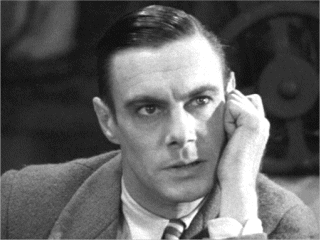
COLIN CLIVE: THE ORIGINAL DR. FRANKENSTEIN

In the 1931 film Frankenstein, Boris Karloff stole the movie as The Monster. Even though his name in the movie was just "The Monster", he was forever known as "Frankenstein".  The scientist who actually created the monster was Dr. Henry Frankenstein. Audiences got the scare factor from Karloff's monster, but Colin Clive - who played the insane scientist got the best lines in the movie, and he was as important to the film as Karloff.

Colin Clive was born in Saint-Malo, France in 1900, to an English colonel, and he attended Stonyhurst College and subsequently Royal Military Academy Sandhurst, where an injured knee disqualified him from military service and contributed to his becoming a stage actor. On stage, one of his roles was Steve Baker, the white husband of racially mixed Julie LaVerne, in the first London production of Show Boat. This production also featured Sir Cedric Hardwicke and Paul Robeson.

Clive first worked with James Whale in the Savoy Theatre production of Journey's End and subsequently joined the British community in Hollywood in the 1930s, repeating his stage role in the 1930 film version of Journey's End, which was directed by Whale.

Although Colin Clive made only three horror films, Whale's two Frankenstein films and Mad Love (1935), he is widely regarded as one of the essential stars of the genre by many film buffs. His portrayal of mad Dr. Frankenstein has proved inspiration and a launching pad for scores of other mad scientist performances in films over the years. When he screams "It's Alive!" as his creation comes to life, it is one of the cinema's best remembered lines.

Clive's first screen role, in Journey's End, was incidentally directed by James Whale. Clive played the alcoholic and tormented Captain Stanhope, a character that (much like Clive's other roles) tragically mirrored his personal life.

Clive was also an in-demand leading man for a number of major film actresses of the era, including Katharine Hepburn, Bette Davis, Corinne Griffith and Jean Arthur. He also starred as Edward Rochester in a 1934 adaptation of Jane Eyre opposite Virginia Bruce. He was related to Clive of India and appeared in a featured role in a film biography of his relative in 1935.


From June 1929 until his death, Clive was married to actress Jeanne de Casalis. Although she worked in films and on stage, her greatest success was as a comedienne on radio sitcoms in England, playing the dithering "Mrs. Feather". De Casalis did not accompany her husband to Hollywood. They never had any children.

Colin Clive suffered from severe chronic alcoholism and died from complications of tuberculosis in 1937 at age 37. Clive's alcoholism was very much apparent to his co-stars, as he was often seen napping on set and sometimes was so intoxicated that he had to be held upright for over-the-shoulder shots. Filming of Frankenstein had to be halted a few times to let Clive sober up enough to do his scenes.

Over 300 mourners turned out for the lonely soul that died alone. One of the pallbearers was Peter Lorre. His cenotaph is located at Chapel of the Pines Crematory, but his ashes were scattered at sea in 1978 after they spent over 40 years unclaimed in the basement of the funeral parlour where his body was brought after his death. His life was tragically short, but in the few movies Colin Clive made he left a lasting impression. His crazed scientist in one of the horror genre's most beloved films will live on for generations and generations to come. In a sense Colin Clive achieved what his mad scientist character dreamed of creating - everlasting life...


Friday, September 9, 2011

TOO MANY FRANKENSTEINS IN HOLLYWOOD

20th Century Fox recently announced that its film adaptation of the classic horror novel Frankenstein is moving forward to the pre-production phase, and will be fast-tracked for production with the newly brought on director Shawn Levy (who just finished up directing Real Steel).

The rush is obviously linked to the fact that their are three other studios with Frankenstein adaptations in the works, and the biggest returns will likely go to the film which is finished first.

In the original novel, Victor Frankenstein is a Doctor of Chemistry, and in his attempts to understand the nature of human life, he creates an artificial man out of the remains of dead men.

No real details are given as to how his technology worked, as they are described only as "the machines of life." Unlike in the later film adaptations, a bolt of lightning is not part of the experiment. It all seems to involve alchemy and surgery.

His experiment is successful, but the creature he animated is abysmally ugly, looking much worse than the Boris Karloff costume.

The story then mostly follows the creature, whose challenge is to survive in a world which turns him away because of his looks. Upon learning of his origin, he vows to deliver pain into Victor’s life. Hatred, pain, and a desire for revenge against his creator consume him. He frames Victor’s maid for murder, seeing her executed, and Victor flees the village in grief and despair.

When the monster finally finds him, he begs for the doctor to create a companion for him, but when Victor fails to do so, the creature murders Victor’s best friend and his fiancé in revenge. Victor and the creature die together in the frozen north.

Max Landis wrote the screenplay for the Fox adaptation, which is a sci-fi interpretation of the classic tale, taking place in future New Orleans. There is no title yet, nor have any actors been cast, but it is still the one most likely now to be finished first.

The closest competitor is Slasher Films with their recently announced Wake the Dead, based on the Steven Niles graphic novels about a pair of med students - one named Victor Franklin - who attempt to bring the dead to life. Haley Joel Osment is set to star in this one - his first starring role since the 2003 family film Secondhand Lions - with Director Jay Russell.

Ghost House Pictures is also working on The Casebook of Victor Frankenstein, which is based on the novel of the same name.

Finally, Colombia Pictures is also working on an adaptation with producer Matthew Tolmach, but we have no other details at this time.

None of these four films have release dates set yet, but I would expect the first of them to appear in the blockbuster summer season of 2013, and the rest to show up a few months later.

There is no comparing the original 1931 Frankenstein to these supposed remakes. Boris Karloff's monster was one of defining moments in early horror movies. Surprisingly, Robert DeNiro's take on the monster in 1994 was very good, and it was more faithful than any of the movies to the original novel. We'll just have to see if these new Frankenstein versions have any scare in them...


source