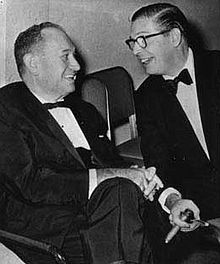
Jack Benny lived his entire professional life trying to convince people he was 39 years old. However, in real life we embraced his age, and he lived a vibrant life until he died in 1974 at the age of 80! Benny the man was nothing like Benny the comedian. I think that is what made Jack Benny such a good comedian, he played his role of a miser so perfectly. Jack Benny was born on this day February 14th in 1894.
Benny was born Benjamin Kubelsky on February 14, 1894, in Chicago, Illinois, and grew up in neighboring Waukegan, Illinois. He was the son of Meyer Kubelsky and Emma Sachs Kubelsky. Meyer was a Jewish saloon owner, later to become a haberdasher, who had emigrated to America from Poland. Emma had emigrated from Lithuania. Benny began studying the violin, an instrument that would become his trademark, when he was just six, with his parents' hopes that he would be a great classical violinist. He loved the violin, but hated practice. By age 14, he was playing in local dance bands as well as in his high school orchestra. Benny was a dreamer and a poor student and he was expelled from high school. He did equally badly in business school and at his father's trade. At age 17, he began playing the instrument in local vaudeville theaters for $7.50 a week. He was joined by Ned Miller, a young composer and singer, on the vaudeville circuit. They became life-long friends and Miller eventually joined the cast of The Jack Benny Program in the 1960s.
In 1911, Benny was playing in the same theater as the young Marx Brothers, whose mother Minnie was so enchanted with Benny's musicianship that she invited him to be their permanent accompanist. The plan was foiled by Benny's parents, who refused to let their son, then 17, go on the road, but it was the beginning of his long friendship with Zeppo Marx. Benny's future wife Mary Livingstone was a distant cousin of the Marx Brothers.
The following year, Benny formed a vaudeville musical duo with pianist Cora Salisbury, a buxom 45-year-old widow who needed a partner for her act. This provoked famous violinist Jan Kubelik, who thought that the young vaudeville entertainer with a similar name (Kubelsky) would damage his reputation. Under pressure from Kubelik's lawyer, Benjamin Kubelsky agreed to change his name to Ben K. Benny (sometimes spelled Bennie). When Salisbury left the act, Benny found a new pianist, Lyman Woods, and re-named the act "From Grand Opera to Ragtime". They worked together for five years and slowly added comedy elements to the show. They even reached the Palace Theater, the "Mecca of Vaudeville", but bombed. Benny left show business briefly in 1917 to join the U.S. Navy during World War I, and he often entertained the troops with his violin playing. One evening, his violin performance was booed by the troops, so with prompting from fellow sailor and actor Pat O'Brien, he ad-libbed his way out of the jam and left them laughing. He got more comedy spots in the revues and was a big hit, and earned himself a reputation as a comedian as well as a musician.
Shortly after the war, Benny started a one-man act, "Ben K. Benny: Fiddle Funology". But then he heard from another lawyer, this time that of Ben Bernie, another patter-and-fiddle performer who also threatened to sue. So Benny adopted the common sailor's nickname Jack. By 1921, the fiddle became more of a prop and the low-key comedy took over.
Benny had several romantic encounters, including one with a dancer, Mary Kelly, whose devoutly Catholic family forced her to turn down Benny's proposal because he was Jewish. Benny was introduced to Mary Kelly by Gracie Allen. Some years after their split, Kelly resurfaced as a dowdy fat girl and Jack gave her a part in an act of three girls: one homely, one fat and one who couldn't sing. This lasted until, at Mary Livingstone's request, Mary Kelly was let go.
In 1922, Jack accompanied Zeppo Marx to a Passover seder where he met Sadye (Sadie) Marks, whom he married in 1927 after meeting again on a double-date. She was working in the hosiery section of the Hollywood Boulevard branch of the May Company and Benny would court her there. Called on to fill in for the "dumb girl" part in one of Benny's routines, Sadie proved a natural comedienne and a big hit. Adopting Mary Livingstone as her stage name, Sadie became Benny's collaborator throughout most of his career. They later adopted a daughter, Joan.
In 1929, Benny's agent Sam Lyons convinced MGM's Irving Thalberg to catch Benny's act at the Orpheum Theatre in Los Angeles. Benny was signed to a five-year contract and his first film role was in The Hollywood Revue of 1929. His next movie, Chasing Rainbows, was a flop and after several months, Benny was released from his contract and returned to Broadway in Earl Carroll's Vanities. At first dubious about the viability of radio, Benny was eager to break into the new medium. In 1932, after a four-week nightclub run, he was invited onto Ed Sullivan's radio program, uttering his first radio spiel "This is Jack Benny talking. There will be a slight pause while you say, 'Who cares?'...". The rest as they say is entertainment history...
Tuesday, February 14, 2012
Sunday, February 12, 2012
MY FIVE FAVORITE JIMMY STEWART MOVIES
While I have always preferred Cary Grant as an actor, Jimmy Stewart had a down home quality in all of his movies. Grant was the typical good looking matinee idol while Stewart was your neighbor next door. Also, while Jimmy's most favorite movie is "It's A Wonderful Life" - the movie is not one of my favorites. Here are the movies that make did make the cut into the top five...
5. ZIEGFELD GIRL (1941)
While the musical "Ziegfeld Girl" is not a major Jimmy Stewart film but a collaboration of many acting talents, Stewart's role is one of my favorites in the film. Thankfully he does not sing in this movie (He did in 1936's "Born To Dance"), but he played the boy next door. In the film he is the sweetheart of Lana Turner. As their lives change and they grow apart, you can see the changes in Stewart's character. It is a really great musical to watch his acting ability in.
4. SPIRIT OF ST. LOUIS (1957)
If anyone could play Charles Lindbergh in a movie then Jimmy Stewart could. The screenplay was adapted by Charles Lederer, Wendell Mayes, and Billy Wilder from Lindbergh's 1953 autobiographical account of his historic flight, which won the Pulitzer Prize in 1954. Along with reminiscences of his early days in aviation, the film depicts Lindbergh's historic 33-hour transatlantic flight in the Spirit of St. Louis monoplane from his take off at Roosevelt Field to his landing at Le Bourget Field in Paris on May 21, 1927. Most of the movie is only Stewart in an airplane cockpit, and surprisingly the film works.
3. REAR WINDOW (1954)
Here is another movie with only one or two settings. This Alfred Hitchcock thriller stars Stewart as a man recovering from a broken leg. He is bored being stuck in his apartment, so he uses a telescope to spy on the neighbors. While spying, he witnesses a neighbor (Raymond Burr) murder his wife. The film is not only considered one of Hitchcock's best movies but one of Jimmy Stewart's as well. For most of the movie Stewart sits through the whole film. Despite that, again Stewart portrays the role in such a way that you lose yourself in his role.
2. HARVEY (1950)
"Harvey" is by far one of the most charming comedies of the 1950s. It is a 1950 film based on Mary Chase's play of the same name, directed by Henry Koster, and starring James Stewart and Josephine Hull. The story is about a man whose best friend is a pooka named Harvey—in the form of a six-foot, three-and-one-half-inch tall invisible rabbit. Most actors would not be able to play a man who sees a rabbit - they would come off as crazy. Again, with Stewart in this role he is charming and enjoyable. Stewart was nominated for an Oscar for his great portrayal, but unfortunately he did not win. What is interesting is Stewart also made a television version of the film in 1972 with Helen Hayes.
1. VERTIGO (1958)
While my wife prefers "Rear Window", I think "Vertigo" is Jimmy Stewart's best and darkest film role. It is the story of a retired police detective suffering from acrophobia who is hired as a private investigator to follow the wife of an acquaintance to uncover the mystery of her peculiar behavior.
The film received mixed reviews upon initial release, but has garnered acclaim since and is now frequently ranked among the greatest films ever made, and often cited as a classic Alfred Hitchcock film and one of the defining works of his career. Personally, I feel that the end of this movie has one of the best twist endings of any Hitchcock film. Jimmy Stewart is great as a man who goes from living a normal life, to having his life turned upside and descend into near madness. In my humble opinion, this was Jimmy Stewart's crowning achievement and another example of the ability that Stewart had in every film role...
5. ZIEGFELD GIRL (1941)
While the musical "Ziegfeld Girl" is not a major Jimmy Stewart film but a collaboration of many acting talents, Stewart's role is one of my favorites in the film. Thankfully he does not sing in this movie (He did in 1936's "Born To Dance"), but he played the boy next door. In the film he is the sweetheart of Lana Turner. As their lives change and they grow apart, you can see the changes in Stewart's character. It is a really great musical to watch his acting ability in.
4. SPIRIT OF ST. LOUIS (1957)
If anyone could play Charles Lindbergh in a movie then Jimmy Stewart could. The screenplay was adapted by Charles Lederer, Wendell Mayes, and Billy Wilder from Lindbergh's 1953 autobiographical account of his historic flight, which won the Pulitzer Prize in 1954. Along with reminiscences of his early days in aviation, the film depicts Lindbergh's historic 33-hour transatlantic flight in the Spirit of St. Louis monoplane from his take off at Roosevelt Field to his landing at Le Bourget Field in Paris on May 21, 1927. Most of the movie is only Stewart in an airplane cockpit, and surprisingly the film works.
3. REAR WINDOW (1954)
Here is another movie with only one or two settings. This Alfred Hitchcock thriller stars Stewart as a man recovering from a broken leg. He is bored being stuck in his apartment, so he uses a telescope to spy on the neighbors. While spying, he witnesses a neighbor (Raymond Burr) murder his wife. The film is not only considered one of Hitchcock's best movies but one of Jimmy Stewart's as well. For most of the movie Stewart sits through the whole film. Despite that, again Stewart portrays the role in such a way that you lose yourself in his role.
2. HARVEY (1950)
"Harvey" is by far one of the most charming comedies of the 1950s. It is a 1950 film based on Mary Chase's play of the same name, directed by Henry Koster, and starring James Stewart and Josephine Hull. The story is about a man whose best friend is a pooka named Harvey—in the form of a six-foot, three-and-one-half-inch tall invisible rabbit. Most actors would not be able to play a man who sees a rabbit - they would come off as crazy. Again, with Stewart in this role he is charming and enjoyable. Stewart was nominated for an Oscar for his great portrayal, but unfortunately he did not win. What is interesting is Stewart also made a television version of the film in 1972 with Helen Hayes.
1. VERTIGO (1958)
While my wife prefers "Rear Window", I think "Vertigo" is Jimmy Stewart's best and darkest film role. It is the story of a retired police detective suffering from acrophobia who is hired as a private investigator to follow the wife of an acquaintance to uncover the mystery of her peculiar behavior.
The film received mixed reviews upon initial release, but has garnered acclaim since and is now frequently ranked among the greatest films ever made, and often cited as a classic Alfred Hitchcock film and one of the defining works of his career. Personally, I feel that the end of this movie has one of the best twist endings of any Hitchcock film. Jimmy Stewart is great as a man who goes from living a normal life, to having his life turned upside and descend into near madness. In my humble opinion, this was Jimmy Stewart's crowning achievement and another example of the ability that Stewart had in every film role...
Labels:
actors,
favorites,
Harvey,
Jimmy Stewart,
Lana Turner,
Rear Window,
Spirit Of St.Louis,
Vertigo,
Ziegfeld Girl
Friday, February 10, 2012
WHERE ARE THEY NOW: MONA FREEMAN
The classic Hollywood of the 1940s and 1950s had more struggling actresses than I think ever before. There are so many old movies where you spot a pretty face and then wonder what ever became of that starlet. One such actress that I always was curious was Mona Freeman. The first movie I spotted her in was Mother Wore Tights, where she played Betty Grable's daughter. Within fifteen years of that role Mona Freeman basically turned away from Hollywood.
Freeman was born on June 9, 1926 in Baltimore, Maryland, of English, Irish and French descent, to Mr. and Mrs. Stuart Freeman. Her father was a general contractor that provided well for his family. In 1936, her family settles in Pelham, New York, where she attends high school. As a teenager Mona became a teenage model with the John Robert Powers modeling agency.
Billionaire Howard Hughes spots her photograph on a magazine cover and signs her to a personal two-year contract, without having met her in person. The second year Hughes sent her to Finch Junior College, but she goes only once. She also attended the Maryland Institute of Art, but is called to Hollywood by Hughes for a screen test. As Hughes isn't in town when she and her mother arrive, she scheduled an interview for herself with Paramount. The studio has to buy her contract from Hughes, after two hours of heated discussion between Hughes and Freeman.
At the age of 19, she married wealthy Hollywood automobile dealer Pat Nerney and got pregnant during the filming of Mother Wore Tights. Her daughter Monie was born on October 25, 1947.
Because of her diminutive size, she's cast opposite Alan Ladd in the upcoming Branded as a teenager. Next up she and her daughter had a cameo appearance in The Greatest Show on Earth (1952). Also that year she divorced her husband after five years of marriage. After her divorce she dates entertainment lawyer Greg Bautzer, hotel heir Nicky Hilton, and singers Vic Damone and Frank Sinatra. She also became real close with legendary singer Bing Crosby after the death of his wife Dixie Lee. They are expected to marry but won't due to their Catholic religion and her being divorced. They later broke up and Bing went on to marry Columbia starlet Kathryn Grant in 1957.
By the late 1950s, Mona's Hollywood career was beginning to fade, and her last major role was in 1957 is on a tour with Middle of the Night costarring Edward G. Robinson. In June of 1961 she married Los Angeles businessman H. Jack Ellis, who adopted her daughter Monie. Her last appearance was on the television series Perry Mason in 1965. By the 1970s, she was living a peaceful life in Hollywood asa devoted wife, mother, and artist. I looked high and low and can not find any updated pictures of Mona Freeman. She seemingly vanished from Hollywood, although her daughter did make a living for awhile as an actress in the 1970s. Mona Freeman knew her happiness was with her family and not the Hollywood scene...
UPDATE: SADLY. MONA FREEMAN DIED AFTER A LENGTHY ILLNESS ON JUNE 6, 2014. YOU CAN READ MORE ABOUT IT HERE: RIP: Mona Freeman
Freeman was born on June 9, 1926 in Baltimore, Maryland, of English, Irish and French descent, to Mr. and Mrs. Stuart Freeman. Her father was a general contractor that provided well for his family. In 1936, her family settles in Pelham, New York, where she attends high school. As a teenager Mona became a teenage model with the John Robert Powers modeling agency.
Billionaire Howard Hughes spots her photograph on a magazine cover and signs her to a personal two-year contract, without having met her in person. The second year Hughes sent her to Finch Junior College, but she goes only once. She also attended the Maryland Institute of Art, but is called to Hollywood by Hughes for a screen test. As Hughes isn't in town when she and her mother arrive, she scheduled an interview for herself with Paramount. The studio has to buy her contract from Hughes, after two hours of heated discussion between Hughes and Freeman.
At the age of 19, she married wealthy Hollywood automobile dealer Pat Nerney and got pregnant during the filming of Mother Wore Tights. Her daughter Monie was born on October 25, 1947.
Because of her diminutive size, she's cast opposite Alan Ladd in the upcoming Branded as a teenager. Next up she and her daughter had a cameo appearance in The Greatest Show on Earth (1952). Also that year she divorced her husband after five years of marriage. After her divorce she dates entertainment lawyer Greg Bautzer, hotel heir Nicky Hilton, and singers Vic Damone and Frank Sinatra. She also became real close with legendary singer Bing Crosby after the death of his wife Dixie Lee. They are expected to marry but won't due to their Catholic religion and her being divorced. They later broke up and Bing went on to marry Columbia starlet Kathryn Grant in 1957.
By the late 1950s, Mona's Hollywood career was beginning to fade, and her last major role was in 1957 is on a tour with Middle of the Night costarring Edward G. Robinson. In June of 1961 she married Los Angeles businessman H. Jack Ellis, who adopted her daughter Monie. Her last appearance was on the television series Perry Mason in 1965. By the 1970s, she was living a peaceful life in Hollywood asa devoted wife, mother, and artist. I looked high and low and can not find any updated pictures of Mona Freeman. She seemingly vanished from Hollywood, although her daughter did make a living for awhile as an actress in the 1970s. Mona Freeman knew her happiness was with her family and not the Hollywood scene...
UPDATE: SADLY. MONA FREEMAN DIED AFTER A LENGTHY ILLNESS ON JUNE 6, 2014. YOU CAN READ MORE ABOUT IT HERE: RIP: Mona Freeman
Wednesday, February 8, 2012
HOLLYWOOD TIDBITS: HARRY EINSTEIN
Harry Einstein (1904-1958) was an American comedian and writer, usually known by the name Harry Parke, but who was variously credited as Harry Einstein, Harold Einstein, Harry "Parkyakarkus" Einstein, Parkyakarkus and Parkyarkarkus. He became famous as the character Parkyakarkus (or Parkyarkarkus) — park your carcass; that is, sit down — who garbled Greek on Eddie Cantor's radio show and appeared in eleven films using this name from 1936 to 1945. Harry also was the father of actor Albert Brooks.
Any entertainer will say that they want to die on stage, and Harry nearly did that. Parke died from a heart attack at a Friar's Club Roast of Lucille Ball and Desi Arnaz on November 24, 1958 in Los Angeles, California. He had just finished his testimonal to a house full of laughter and Art Linkletter's remark, "How come anyone as funny as this isn't on the air?", when Parke slumped onto Milton Berle's lap at the event. Berle asked "Is there a doctor in the house?"; this remark was met with laughter, as the crowd was unaware that Berle was being serious. Emcee Art Linkletter then directed crooner Tony Martin to sing a song to divert the crowd's attention; Martin's unfortunate choice was "There's No Tomorrow." According to the Los Angeles Times account, Desi Arnaz said: "This offering meant so much to me. Now it means nothing. Please, everyone, pray to your God that he will be saved."
He was carried backstage where five specialists who were Friars Club members worked feverishly to save his life. One doctor used his pen knife to make an incision in Parke's chest for open heart massage. Another used the ends of an electric cord as a makeshift defibrillator to shock his heart back to life; only the left side responded with a feeble rhythm. The doctors continued the open heart massage while waiting for the rescue squad. Despite two hours of intense medical effort, Parke was pronounced dead at 1:20 AM local time...
Any entertainer will say that they want to die on stage, and Harry nearly did that. Parke died from a heart attack at a Friar's Club Roast of Lucille Ball and Desi Arnaz on November 24, 1958 in Los Angeles, California. He had just finished his testimonal to a house full of laughter and Art Linkletter's remark, "How come anyone as funny as this isn't on the air?", when Parke slumped onto Milton Berle's lap at the event. Berle asked "Is there a doctor in the house?"; this remark was met with laughter, as the crowd was unaware that Berle was being serious. Emcee Art Linkletter then directed crooner Tony Martin to sing a song to divert the crowd's attention; Martin's unfortunate choice was "There's No Tomorrow." According to the Los Angeles Times account, Desi Arnaz said: "This offering meant so much to me. Now it means nothing. Please, everyone, pray to your God that he will be saved."
He was carried backstage where five specialists who were Friars Club members worked feverishly to save his life. One doctor used his pen knife to make an incision in Parke's chest for open heart massage. Another used the ends of an electric cord as a makeshift defibrillator to shock his heart back to life; only the left side responded with a feeble rhythm. The doctors continued the open heart massage while waiting for the rescue squad. Despite two hours of intense medical effort, Parke was pronounced dead at 1:20 AM local time...
Labels:
Albert Brooks,
comedian,
Harry Einstein,
Milton Berle,
tidbits,
Tony Martin
Sunday, February 5, 2012
RECENTLY VIEWED: STRIKE UP THE BAND
Nothing is better on a Sunday when I have nothing to do or feel like doing than to watch an old movie. This past weekend TCM had on the Judy Garland-Mickey Rooney classic Strike Up The Band. I am not the biggest Garland fan, but when Judy was younger there was no one more talented. Even my two year old got into the act and was dancing up a storm during the "La Conga" number - which in my opinion was one of the best numbers Judy Garland and Mickey Rooney ever made.
The original taglines for the film were: "THEIR SUNNIEST, FUNNIEST, DOWN-TO-MIRTHIEST HIT!, IT BEATS THE BAND!, Melodious with WHITEMAN'S BAND and The merriest pair on the screen in a great new musical show!
After the success of Babes In Arms for MGM, Arthur Freed became the hottest producer on the lot and was granted his own famous Freed Unit to produce the best of the MGM musicals for the next 20 years almost. According to Hugh Fordin's book on Arthur Freed the next scheduled property was Good News, but that got shelved for several years when Louis B. Mayer decided that a patriotic type theme was in order and after all MGM had bought the screen rights to the Gershwin musical Strike Up The Band. Freed agreed, but in the Hollywood tradition only the title and the title song were retained for the screen.
That was enough because the Mickey and Judy formula was by now established with Babes In Arms. Here the two are a pair of talented musical kids and Mickey is the drummer in his high school band. But he's got other things on his mind besides doing John Philip Sousa. Even Sousa did more than Sousa when he was leading a band. Mickey is filled with the new jive rhythms of the day and he'd like to use the other kids in the school orchestra to form a real band. He's got Garland in mind for the vocals and the object is to get an audition from Paul Whiteman.
Whiteman in his day may have appropriated for himself the title of King Of Jazz, but certainly no one did more to popularize the new American art form among white audiences. His orchestra was the training ground for many of later big band leaders. Leaders like Tommy and Jimmy Dorsey and Glenn Miller all who were sidemen with Whiteman.
In keeping with MGM's practice of the time, the film soundtrack was recorded in stereophonic sound but released with conventional monaural sound. At least some of the original stereo recording has survived and been included in some home video releases, including the Mickey Rooney - Judy Garland Collection.
The puppet orchestra made of fruit that comes to life playing instruments for Mickey Rooney and Judy Garland on a kitchen table, was the work of animator George Pal. He had just arrived in Hollywood from Europe via New York and this was among his first projects. Pal's work was relatively unknown by American audiences, thus he was uncredited. The idea for the sequence was that of another New York-to-Hollywood transfer: Vincente Minnelli.
The original camera negative was destroyed in May 1978 during a nitrate film fire in the George Eastman House archives. The fire also destroyed 328 other films' original camera negatives.
A tearjerker dating back to 1913, "The Curse of an Aching Heart" (music by Al Piantadosi, lyrics by Henry Fink), intended for Judy Garland in the "Nell of New Rochelle" sequence, was cut from the release print. Miss Garland's prerecording is featured on "Mickey & Judy," a CD box set from Rhino.
The 1930 Broadway production of "Strike Up the Band", with music and lyrics by George Gershwin and Ira Gershwin, had no relation to the story of this film. That was a political satire that had trouble getting to Broadway, and when it did, it had only a short run of 191 performances. However, the title song became very popular and is included in this film.
I really listened to Mickey Rooney's vocalizing on "Our Love Affair", and I was amazed and surprised by his range and depth on this ballad. I have never thought of Rooney much as a singer. Filmed a year after The Wizard Of Oz, Judy looked bright and healthy in this film, but whenever I see her young in the movie, I am haunted by what was to happen to her only a few decades later. Strike Up The Band is not the best Garland-Rooney movie, but it's a great movie with great stars and excellent musical numbers that you just don't see anymore. My two year old gave it his thumb of approval...
my rating: 10 out of 10
The original taglines for the film were: "THEIR SUNNIEST, FUNNIEST, DOWN-TO-MIRTHIEST HIT!, IT BEATS THE BAND!, Melodious with WHITEMAN'S BAND and The merriest pair on the screen in a great new musical show!
After the success of Babes In Arms for MGM, Arthur Freed became the hottest producer on the lot and was granted his own famous Freed Unit to produce the best of the MGM musicals for the next 20 years almost. According to Hugh Fordin's book on Arthur Freed the next scheduled property was Good News, but that got shelved for several years when Louis B. Mayer decided that a patriotic type theme was in order and after all MGM had bought the screen rights to the Gershwin musical Strike Up The Band. Freed agreed, but in the Hollywood tradition only the title and the title song were retained for the screen.
That was enough because the Mickey and Judy formula was by now established with Babes In Arms. Here the two are a pair of talented musical kids and Mickey is the drummer in his high school band. But he's got other things on his mind besides doing John Philip Sousa. Even Sousa did more than Sousa when he was leading a band. Mickey is filled with the new jive rhythms of the day and he'd like to use the other kids in the school orchestra to form a real band. He's got Garland in mind for the vocals and the object is to get an audition from Paul Whiteman.
Whiteman in his day may have appropriated for himself the title of King Of Jazz, but certainly no one did more to popularize the new American art form among white audiences. His orchestra was the training ground for many of later big band leaders. Leaders like Tommy and Jimmy Dorsey and Glenn Miller all who were sidemen with Whiteman.
In keeping with MGM's practice of the time, the film soundtrack was recorded in stereophonic sound but released with conventional monaural sound. At least some of the original stereo recording has survived and been included in some home video releases, including the Mickey Rooney - Judy Garland Collection.
The puppet orchestra made of fruit that comes to life playing instruments for Mickey Rooney and Judy Garland on a kitchen table, was the work of animator George Pal. He had just arrived in Hollywood from Europe via New York and this was among his first projects. Pal's work was relatively unknown by American audiences, thus he was uncredited. The idea for the sequence was that of another New York-to-Hollywood transfer: Vincente Minnelli.
The original camera negative was destroyed in May 1978 during a nitrate film fire in the George Eastman House archives. The fire also destroyed 328 other films' original camera negatives.
A tearjerker dating back to 1913, "The Curse of an Aching Heart" (music by Al Piantadosi, lyrics by Henry Fink), intended for Judy Garland in the "Nell of New Rochelle" sequence, was cut from the release print. Miss Garland's prerecording is featured on "Mickey & Judy," a CD box set from Rhino.
The 1930 Broadway production of "Strike Up the Band", with music and lyrics by George Gershwin and Ira Gershwin, had no relation to the story of this film. That was a political satire that had trouble getting to Broadway, and when it did, it had only a short run of 191 performances. However, the title song became very popular and is included in this film.
I really listened to Mickey Rooney's vocalizing on "Our Love Affair", and I was amazed and surprised by his range and depth on this ballad. I have never thought of Rooney much as a singer. Filmed a year after The Wizard Of Oz, Judy looked bright and healthy in this film, but whenever I see her young in the movie, I am haunted by what was to happen to her only a few decades later. Strike Up The Band is not the best Garland-Rooney movie, but it's a great movie with great stars and excellent musical numbers that you just don't see anymore. My two year old gave it his thumb of approval...
my rating: 10 out of 10
Friday, February 3, 2012
THE DARK SIDE OF ARTHUR GODFREY
If you think of major television stars in 2012, I guess names that would come to mind would be Simon Cowell, Jerry Seinfeld, or Ryan Seachrest. They have made their mark on what is considered television in 2012. However, in the 1950s there was one man who not only dominated television but he owned it - Arthur Godfrey. Godfrey, born in 1903, appeared to television audiences as a likeable folksy host, but behind the scenes he was a strict task master, and that dark side lead to his demise.
Behind Godfrey's on-air warmth was a volatile and controlling personality. He insisted his "Little Godfreys" attend dance and singing classes, believing all should be versatile performers regardless of whether they possessed the aptitude for those disciplines. In meetings with the cast and his staff, he could be abusive and intimidating. In spite of his ability to bring in profits, CBS executives who respected Godfrey professionally were not fond of him personally, since he often baited them on and off the air.
Godfrey's attitude was controlling prior to having hip surgery, but upon his return, he added more air time to his morning shows and became critical of a number of aspects of the broadcasts. One night, he substituted a shortened, hastily-arranged version of his Wednesday night variety show in place of the scheduled "Talent Scouts" presentation, feeling that none of the talent was up to standards. He also began casting a critical eye on others in the cast, particularly LaRosa, whose popularity continued to grow.
Like many men of his generation, Julius LaRosa thought dance lessons to be somewhat effeminate—and chafed when Godfrey ordered them for his entire performing crew. CBS historian Robert Metz, in CBS: Reflections in a Bloodshot Eye, suggested that Godfrey instituted the practice because his own physical limitations made him sensitive to the need for coordination on camera. "Godfrey," Metz wrote, "was concerned about his cast in his paternalistic way."
Godfrey and LaRosa had a dispute when LaRosa missed a dance lesson due to a family emergency. He claimed he'd advised Godfrey, but was nonetheless barred from the show for a day in retaliation, via a notice placed on a cast bulletin board. At that point, LaRosa retained topnotch manager Tommy Rockwell to renegotiate his contract with Godfrey or, failing that, to receive an outright release. However, such talks had yet to occur.
LaRosa was also signed to Cadence Records, owned by Godfrey's musical director Archie Bleyer, who produced Eh, Cumpari, the best-selling hit of LaRosa's musical career. LaRosa admitted the record's success had made him a little cocky. But after Godfrey discovered that LaRosa hired a manager in the wake of the dance lesson reprimand, Godfrey immediately consulted with CBS President Dr. Frank Stanton, who noted that Godfrey had hired LaRosa on-air (after his initial appearance on Talent Scouts) and suggested firing him the same way. Whether Stanton intended this to occur after Godfrey spoke with LaRosa and his managers about the singer's future on the show, or whether Stanton suggested Godfrey actually fire LaRosa on air with no warning, remains lost to history.
On October 19, 1953, near the end of his morning radio show (deliberately waiting until after the TV portion had ended), after lavishing praise on LaRosa in introducing the singer's performance of "Manhattan," Godfrey thanked him and then announced that this was LaRosa's "swan song" with the show, adding, "He goes now, out on his own — as his own star — soon to be seen on his own programs, and I know you'll wish him godspeed as much as I do". Godfrey then signed off for the day saying, "This is the CBS Radio Network".
LaRosa, who had to be told what the phrase "swan song" meant, was dumbfounded, since he had not been informed beforehand of his departure and contract renegotiations had yet to happen. Stanton later admitted the idea may have been "a mistake." In perhaps a further illumination of the ego that Godfrey had formerly kept hidden, radio historian Gerald Nachman, in Raised on Radio, claims that what really miffed Godfrey about his now-former protege was that LaRosa's fan mail had come to outnumber Godfrey's. It is likely that a combination of these factors led to Godfrey's decision to discharge LaRosa. It is not likely Godfrey expected the public outcry that ensued.
In any event, the LaRosa incident opened an era of controversy that swirled around Godfrey and, little by little, dismantled his just-folks image. LaRosa was beloved enough by Godfrey's fans that they saved their harshest criticism for Godfrey himself. After a press conference was held by LaRosa and his agent, Godfrey further complicated the matter by hosting a press conference of his own where he responded that LaRosa had lost his "humility." The charge, given Godfrey's sudden baring of his own ego beneath the facade of warmth, brought more mockery from the public and press. Almost instantly, Godfrey and the phrase "no humility" became the butt of many comedians' jokes. Later, he claimed he had, with the firing, essentially given LaRosa a release from his contract that the singer requested. Godfrey, however, provided no evidence to support that contention.
Godfrey would fire others among his regulars, including bandleader Archie Bleyer, within days of LaRosa's public "execution." Bleyer had formed his own label, Cadence Records, which recorded LaRosa. Bleyer married one of The Chordettes, and that group also broke away from Godfrey; Godfrey replaced them with The McGuire Sisters. Godfrey was also angered that Bleyer had produced a spoken-word record by Godfrey's Chicago counterpart Don McNeill. McNeill hosted The Breakfast Club, which had been Godfrey's direct competition on the NBC Blue Network (later ABC) since Godfrey's days at WJSV. Despite the McNeill show's far more modest following, Godfrey was unduly offended, even paranoid, at what he felt was disloyalty on Bleyer's part. Bleyer simply shrugged off the dismissal and focused on developing Cadence, which went on to even greater fame in later years with classic hit records by the Everly Brothers and Andy Williams.
Apparently, Godfrey intended to teach his regulars a lesson by dismissing them from his show and curtailing their network-television exposure. The plan backfired somewhat when they continued to perform for his substitute host, Robert Q. Lewis, who by now had his own midday show on CBS.
Occasionally, a crotchety Godfrey snapped at cast members on the air. A significant number of other "Little Godfreys," including the Mariners and Haleloke, were dismissed from 1953 to 1959 without explanation. Other performers, most notably Pat Boone and Patsy Cline (briefly), stepped in as "Little Godfreys."
Godfrey's problems with the media and public feuds with newspaper columnists such as Jack O'Brian and newspaperman turned CBS variety show host Ed Sullivan were duly documented by the media, which began running critical exposé articles linking him to several female "Little Godfreys." Godfrey's anger at Sullivan stemmed from the variety show impresario's featuring of fired "Little Godfreys" on his Sunday night show, including LaRosa.
Despite an intense desire to remain in the public eye, Godfrey's presence ebbed considerably over the next ten years, notwithstanding an HBO special and an appearance on a PBS salute to the 1950s. A 1981 attempt to reconcile him with LaRosa for a Godfrey show reunion record album, bringing together Godfrey and a number of the "Little Godfreys," collapsed. At an initially amicable meeting, Godfrey reasserted that LaRosa wanted out of his contract and asked why he hadn't explained that instead of insisting he was fired without warning. When LaRosa began reminding him of the dance lesson controversy, Godfrey, then in his late seventies, exploded and the meeting ended in shambles. Godfrey died forgotten and seemingly alone in 1983...
Behind Godfrey's on-air warmth was a volatile and controlling personality. He insisted his "Little Godfreys" attend dance and singing classes, believing all should be versatile performers regardless of whether they possessed the aptitude for those disciplines. In meetings with the cast and his staff, he could be abusive and intimidating. In spite of his ability to bring in profits, CBS executives who respected Godfrey professionally were not fond of him personally, since he often baited them on and off the air.
Godfrey's attitude was controlling prior to having hip surgery, but upon his return, he added more air time to his morning shows and became critical of a number of aspects of the broadcasts. One night, he substituted a shortened, hastily-arranged version of his Wednesday night variety show in place of the scheduled "Talent Scouts" presentation, feeling that none of the talent was up to standards. He also began casting a critical eye on others in the cast, particularly LaRosa, whose popularity continued to grow.
Like many men of his generation, Julius LaRosa thought dance lessons to be somewhat effeminate—and chafed when Godfrey ordered them for his entire performing crew. CBS historian Robert Metz, in CBS: Reflections in a Bloodshot Eye, suggested that Godfrey instituted the practice because his own physical limitations made him sensitive to the need for coordination on camera. "Godfrey," Metz wrote, "was concerned about his cast in his paternalistic way."
Godfrey and LaRosa had a dispute when LaRosa missed a dance lesson due to a family emergency. He claimed he'd advised Godfrey, but was nonetheless barred from the show for a day in retaliation, via a notice placed on a cast bulletin board. At that point, LaRosa retained topnotch manager Tommy Rockwell to renegotiate his contract with Godfrey or, failing that, to receive an outright release. However, such talks had yet to occur.
LaRosa was also signed to Cadence Records, owned by Godfrey's musical director Archie Bleyer, who produced Eh, Cumpari, the best-selling hit of LaRosa's musical career. LaRosa admitted the record's success had made him a little cocky. But after Godfrey discovered that LaRosa hired a manager in the wake of the dance lesson reprimand, Godfrey immediately consulted with CBS President Dr. Frank Stanton, who noted that Godfrey had hired LaRosa on-air (after his initial appearance on Talent Scouts) and suggested firing him the same way. Whether Stanton intended this to occur after Godfrey spoke with LaRosa and his managers about the singer's future on the show, or whether Stanton suggested Godfrey actually fire LaRosa on air with no warning, remains lost to history.
On October 19, 1953, near the end of his morning radio show (deliberately waiting until after the TV portion had ended), after lavishing praise on LaRosa in introducing the singer's performance of "Manhattan," Godfrey thanked him and then announced that this was LaRosa's "swan song" with the show, adding, "He goes now, out on his own — as his own star — soon to be seen on his own programs, and I know you'll wish him godspeed as much as I do". Godfrey then signed off for the day saying, "This is the CBS Radio Network".
LaRosa, who had to be told what the phrase "swan song" meant, was dumbfounded, since he had not been informed beforehand of his departure and contract renegotiations had yet to happen. Stanton later admitted the idea may have been "a mistake." In perhaps a further illumination of the ego that Godfrey had formerly kept hidden, radio historian Gerald Nachman, in Raised on Radio, claims that what really miffed Godfrey about his now-former protege was that LaRosa's fan mail had come to outnumber Godfrey's. It is likely that a combination of these factors led to Godfrey's decision to discharge LaRosa. It is not likely Godfrey expected the public outcry that ensued.
In any event, the LaRosa incident opened an era of controversy that swirled around Godfrey and, little by little, dismantled his just-folks image. LaRosa was beloved enough by Godfrey's fans that they saved their harshest criticism for Godfrey himself. After a press conference was held by LaRosa and his agent, Godfrey further complicated the matter by hosting a press conference of his own where he responded that LaRosa had lost his "humility." The charge, given Godfrey's sudden baring of his own ego beneath the facade of warmth, brought more mockery from the public and press. Almost instantly, Godfrey and the phrase "no humility" became the butt of many comedians' jokes. Later, he claimed he had, with the firing, essentially given LaRosa a release from his contract that the singer requested. Godfrey, however, provided no evidence to support that contention.
Godfrey would fire others among his regulars, including bandleader Archie Bleyer, within days of LaRosa's public "execution." Bleyer had formed his own label, Cadence Records, which recorded LaRosa. Bleyer married one of The Chordettes, and that group also broke away from Godfrey; Godfrey replaced them with The McGuire Sisters. Godfrey was also angered that Bleyer had produced a spoken-word record by Godfrey's Chicago counterpart Don McNeill. McNeill hosted The Breakfast Club, which had been Godfrey's direct competition on the NBC Blue Network (later ABC) since Godfrey's days at WJSV. Despite the McNeill show's far more modest following, Godfrey was unduly offended, even paranoid, at what he felt was disloyalty on Bleyer's part. Bleyer simply shrugged off the dismissal and focused on developing Cadence, which went on to even greater fame in later years with classic hit records by the Everly Brothers and Andy Williams.
Apparently, Godfrey intended to teach his regulars a lesson by dismissing them from his show and curtailing their network-television exposure. The plan backfired somewhat when they continued to perform for his substitute host, Robert Q. Lewis, who by now had his own midday show on CBS.
Occasionally, a crotchety Godfrey snapped at cast members on the air. A significant number of other "Little Godfreys," including the Mariners and Haleloke, were dismissed from 1953 to 1959 without explanation. Other performers, most notably Pat Boone and Patsy Cline (briefly), stepped in as "Little Godfreys."
Godfrey's problems with the media and public feuds with newspaper columnists such as Jack O'Brian and newspaperman turned CBS variety show host Ed Sullivan were duly documented by the media, which began running critical exposé articles linking him to several female "Little Godfreys." Godfrey's anger at Sullivan stemmed from the variety show impresario's featuring of fired "Little Godfreys" on his Sunday night show, including LaRosa.
Despite an intense desire to remain in the public eye, Godfrey's presence ebbed considerably over the next ten years, notwithstanding an HBO special and an appearance on a PBS salute to the 1950s. A 1981 attempt to reconcile him with LaRosa for a Godfrey show reunion record album, bringing together Godfrey and a number of the "Little Godfreys," collapsed. At an initially amicable meeting, Godfrey reasserted that LaRosa wanted out of his contract and asked why he hadn't explained that instead of insisting he was fired without warning. When LaRosa began reminding him of the dance lesson controversy, Godfrey, then in his late seventies, exploded and the meeting ended in shambles. Godfrey died forgotten and seemingly alone in 1983...
Labels:
Arthur Godfrey,
Julius LaRosa,
singers,
television
Wednesday, February 1, 2012
PIONEERING BLACK ACTORS HELPED PAVE THE WAY
By Susan King, Los Angeles Times
It's been a long, difficult road for African Americans in achieving equality in all aspects of American life, and Hollywood is no exception.
Long relegated to stereotyped roles, black actors struggled for decades to get bigger and better parts that more honestly reflected the black experience. Such early actors helped pave the way for Oscar-winning performers like Sidney Poitier, Denzel Washington, Halle Berry and this year's Oscar nominees from "The Help," Viola Davis and Octavia Spencer.
Three of those pioneers — Ethel Waters, James Baskett and James Edwards — created memorable characters despite being horribly confined by the racism of the industry at that time. With Black History Month kicking off this month, we look at these three breakthrough artists.
Ethel Waters (1896-1977)
The legendary jazz, blues and gospel singer had a difficult start in life. Her mother, Louise Anderson, was 13 when she gave birth to Ethel. Louise had been raped at knifepoint by Ethel's father. "I was never a child," Waters would later say. "I was never cuddled, or liked, or understood by my family."
At age 15, Waters sang at a club in Philadelphia on amateur night. She so impressed the management that she was given a job and billed as "Sweet Mama Stringbean." In 1921, she began recording and four years later became the main attraction at Sam Salvin's Plantation Club in Harlem, where she introduced one of her signature tunes, "Dinah."
By 1927, she was on Broadway, and in 1929, she appeared in the Warner Bros. early talkie "On With the Show!," where she performed "Am I Blue?" In 1933, she introduced the song "Stormy Weather" at the Cotton Club in Harlem. She was back on Broadway in 1933 in the musical "As Thousands Cheer," marking the first time a black performer worked with a white cast. Waters spread her wings on Broadway, going dramatic in 1939's"Mamba's Daughters." The following year, she appeared in the musical fantasy "Cabin in the Sky," which she reprised for the 1943 film version.
Waters became the second African American actress to earn a supporting Oscar nomination, for 1949's "Pinky," as the loving grandmother of a light-skinned woman passing for white. She earned raves as the maid in the 1950 Broadway drama, "The Member of the Wedding," which she reprised in the 1952 film version. She took on the role of the sassy maid in 1950 in the TV series "Beulah" but left because she despised how the series depicted blacks. Her last film was 1959's "The Sound and the Fury."
"I sang them [the blues] out of the depths of the private fire in which I was brought up," Waters said. "Only those who are being burned know what fire is like."
James Baskett (1904-48)
The actor, who introduced the Oscar-winning tune "Zip-a-Dee-Doo-Dah" in Disney's 1946 live action-animated "Song of the South," is the first African American male to win an Academy Award. He won an honorary award for "his able and heart-warming characterization of Uncle Remus, friend and storyteller to the children of the world." (Poitier was the first black male to win a competitive acting Oscar, for 1963's "Lilies of the Field.") He didn't attend the premiere in Atlanta because the city was racially segregated and he wouldn't have been able to participate in the events.
But he's all but forgotten because "Song of the South," based on the Uncle Remus stories by Joel Chandler Harris, has not been available for several decades because of its portrayals of blacks, which later generations decried as stereotypical.
James Edwards (1918-70)
A year before Poitier made his film debut in 1950's "No Way Out," Edwards starred in the racially charged World War II drama "Home of the Brave," based on Arthur Laurents' play. Produced by Stanley Kramer and directed by Mark Robson, the film revolved around the harsh prejudice that a young black private endures while serving with a white unit in the South Pacific.
The Indiana native earned a degree in drama from Northwestern but put acting on hold while serving in World War II. He received massive facial injuries during the war, and his face had to be reconstructed. It was suggested that he take elocution lessons to help with his speech after the surgery. The lessons renewed his love of acting.
The tall, handsome and athletic Edwards eventually ended up in New York, where he made his debut in 1945 in the play "Deep are the Roots," in which his character has an interracial love affair. He made his film debut in a small role in 1949's "The Set-Up" before "Home of the Brave."
Despite his presence and his dignified strong performances, Edwards never became a star. But he continued to get interesting roles with such stellar directors as Sam Fuller ("The Steel Helmet"), Fred Zinnemann ("The Member of the Wedding"), Stanley Kubrick ("The Killing"), John Frankenheimer ("The Manchurian Candidate") and Franklin Schaffner ("Patton").
SOURCE
It's been a long, difficult road for African Americans in achieving equality in all aspects of American life, and Hollywood is no exception.
Long relegated to stereotyped roles, black actors struggled for decades to get bigger and better parts that more honestly reflected the black experience. Such early actors helped pave the way for Oscar-winning performers like Sidney Poitier, Denzel Washington, Halle Berry and this year's Oscar nominees from "The Help," Viola Davis and Octavia Spencer.
Three of those pioneers — Ethel Waters, James Baskett and James Edwards — created memorable characters despite being horribly confined by the racism of the industry at that time. With Black History Month kicking off this month, we look at these three breakthrough artists.
Ethel Waters (1896-1977)
The legendary jazz, blues and gospel singer had a difficult start in life. Her mother, Louise Anderson, was 13 when she gave birth to Ethel. Louise had been raped at knifepoint by Ethel's father. "I was never a child," Waters would later say. "I was never cuddled, or liked, or understood by my family."
At age 15, Waters sang at a club in Philadelphia on amateur night. She so impressed the management that she was given a job and billed as "Sweet Mama Stringbean." In 1921, she began recording and four years later became the main attraction at Sam Salvin's Plantation Club in Harlem, where she introduced one of her signature tunes, "Dinah."
By 1927, she was on Broadway, and in 1929, she appeared in the Warner Bros. early talkie "On With the Show!," where she performed "Am I Blue?" In 1933, she introduced the song "Stormy Weather" at the Cotton Club in Harlem. She was back on Broadway in 1933 in the musical "As Thousands Cheer," marking the first time a black performer worked with a white cast. Waters spread her wings on Broadway, going dramatic in 1939's"Mamba's Daughters." The following year, she appeared in the musical fantasy "Cabin in the Sky," which she reprised for the 1943 film version.
Waters became the second African American actress to earn a supporting Oscar nomination, for 1949's "Pinky," as the loving grandmother of a light-skinned woman passing for white. She earned raves as the maid in the 1950 Broadway drama, "The Member of the Wedding," which she reprised in the 1952 film version. She took on the role of the sassy maid in 1950 in the TV series "Beulah" but left because she despised how the series depicted blacks. Her last film was 1959's "The Sound and the Fury."
"I sang them [the blues] out of the depths of the private fire in which I was brought up," Waters said. "Only those who are being burned know what fire is like."
James Baskett (1904-48)
The actor, who introduced the Oscar-winning tune "Zip-a-Dee-Doo-Dah" in Disney's 1946 live action-animated "Song of the South," is the first African American male to win an Academy Award. He won an honorary award for "his able and heart-warming characterization of Uncle Remus, friend and storyteller to the children of the world." (Poitier was the first black male to win a competitive acting Oscar, for 1963's "Lilies of the Field.") He didn't attend the premiere in Atlanta because the city was racially segregated and he wouldn't have been able to participate in the events.
But he's all but forgotten because "Song of the South," based on the Uncle Remus stories by Joel Chandler Harris, has not been available for several decades because of its portrayals of blacks, which later generations decried as stereotypical.
James Edwards (1918-70)
A year before Poitier made his film debut in 1950's "No Way Out," Edwards starred in the racially charged World War II drama "Home of the Brave," based on Arthur Laurents' play. Produced by Stanley Kramer and directed by Mark Robson, the film revolved around the harsh prejudice that a young black private endures while serving with a white unit in the South Pacific.
The Indiana native earned a degree in drama from Northwestern but put acting on hold while serving in World War II. He received massive facial injuries during the war, and his face had to be reconstructed. It was suggested that he take elocution lessons to help with his speech after the surgery. The lessons renewed his love of acting.
The tall, handsome and athletic Edwards eventually ended up in New York, where he made his debut in 1945 in the play "Deep are the Roots," in which his character has an interracial love affair. He made his film debut in a small role in 1949's "The Set-Up" before "Home of the Brave."
Despite his presence and his dignified strong performances, Edwards never became a star. But he continued to get interesting roles with such stellar directors as Sam Fuller ("The Steel Helmet"), Fred Zinnemann ("The Member of the Wedding"), Stanley Kubrick ("The Killing"), John Frankenheimer ("The Manchurian Candidate") and Franklin Schaffner ("Patton").
SOURCE
Labels:
actors,
actress,
Ethel Waters,
James Baskett,
James Edwards
Subscribe to:
Posts (Atom)