Showing posts with label Stuart Erwin. Show all posts

Wednesday, May 3, 2017

GUEST REVIEW: THE BIG BROADCAST

Guest reviewer Bruce Kogan is back with his usual in-depth look at his favorite cinematic gems. Here he is reviewing Bing Crosby's first feature film, The Big Broadcast (1932)...

Paramount made the first of its Big Broadcast films, the first and best of them. This first one gave Bing Crosby his first role in a feature film, previously he had done guest appearances and also short subjects for Mack Sennett. Not wanting to mislead anyone about who was numero uno in this film, Paramount had him play a radio crooner named Bing Crosby. Eleven years later Frank Sinatra would make his feature film debut as Frank Sinatra.

Bing's the star attraction of this one horse town radio station, appearing for Griptight Girdles on the Griptight Girdle Hour. That is when he can get to the studio. His job is being threatened and he's also coming between Stu Erwin who buys the station and Leila Hyams who's manager George Burns's secretary.


It's a thin plot, but nicely done and it's to show off some of radio's greatest talents of that year. In addition to Bing Crosby, appearing are Kate Smith, Arthur Tracy, the Boswell Sisters, Burns and Allen, Cab Calloway and Vincent Lopez with their respective orchestras, the Mills Brothers and tenor Donald Novis.

Bing gets to sing three numbers, Please and Here Lies Love which were written for this film and Dinah. Crosby made a classic recording of Dinah with the Mills Brothers and I wish they'd reprised that for the movie. Instead it's done with a black shoeshine boy giving him a beat with the rag while Bing is scatting like Ella Fitzgerald. Bing was great, but the staging is something that black people would find offensive. Please became a great early hit for him.

Here Lies Love is sung by Crosby, but he reprises it after it's been introduced by Arthur Tracy. Tracy, a Jewish immigrant from Russia, was billed as the Street Singer and had an almost operatic quality to his voice. He rivaled Crosby, Russ Columbo, Rudy Vallee, and Morton Downey in popularity as a radio singer, but American movie audiences didn't take to him. He went to Great Britain in the mid-30s and there he became a movie star. He went back to the US after World War II and only appeared sporadically after that. Tracy was fabulously wealthy due to good investments and lived to the age of 97. He did a cameo appearance in Crossing Delancey, you'll see him briefly discussing issues of the day over the pickle barrel there.


For Kate Smith, radio was a godsend. That beautiful and powerful voice was also trapped in an elephantine body like a Wagnerian opera soprano. She was never going to be a film star. But she was radio's most popular female vocalist, no one else was ever even close and she sings a great rendition of It Was So Beautiful in The Big Broadcast.

Burns and Allen did surreal comedy that was probably only equaled by Monty Python years later. Gracie Allen was in her own world and the ever patient George gave up trying to deal with her reasoning. They did some great guest bits in films like this one and two more with Bing Crosby. But they never really carried a film by themselves with the exception of Here Comes Cookie. I did a review of that and it's the best example of their work.


Donald Novis was a popular radio tenor, totally forgotten now. He also was on the Broadway stage and in Rodgers & Hart's Jumbo introduced their classic, The Most Beautiful Girl in the World. They give him Trees to sing, Joyce Kilmer's poem put to music. I wish he'd sung something more popular.

With all these radio stars it's hard to remember that the nominal star of the film is Stu Erwin. Erwin did a fabulous job in creating some great milquetoast characters from the early talkies. The climax of the film involves a long running gag with him trying to get a recording of Bing singing Please to the studio to substitute for Crosby who's AWOL. It's done almost without dialog and it is interspersed with several of the stars previously mentioned. It's a hilarious bit of slapstick.

The Big Broadcast
is enjoyable nostalgic fun and a piece of history since it's the feature film debut of America's greatest entertainer, Bing Crosby...

BRUCE'S RATING: 7 OUT OF 10 STARS
MY RATING: 8 OUT OF 10 STARS


Thursday, October 20, 2016

HOLLYWOOD ON HOLLYWOOD BLOGATHON: GOING HOLLYWOOD

Many people love films about Hollywood like Sunset Boulevard (1950) and Singin In The Rain (1952) and rightfully so. However, there are some hidden film gems about Hollywood that I really love to watch. One such film is a 1933 offering from MGM - Going Hollywood.

Going Hollywood was primarily a starring vehicle for rising crooner Bing Crosby. Bing had become a superstar a year earlier with a popular radio show and his first feature film for Paramount Studios, The Big Broadcast (1932). However, the studio was still unsure what to do with their instantly hot product. Was Bing a singer who acted or an actor that could sing? Paramount loaned Bing to MGM, which is something they would really not do much in the future. This film would be Bing's first film for MGM studios, which at the time was the biggest film studio in the world. Bing would not make another film at MGM for 20 years and the only other movies he made for the studio would be: High Society (1956), Man On Fire (1957), and That's Entertainment (1974).


Back to Going Hollywood, the film was also a vehicle for actress Marion Davies. Despite a lifelong relationship with paper tycoon William Randolph Hearst, Davies was a star who was becoming more famous for her relationship with Hearst than for her movies. This film did little for Davies' career, but she did look beautiful in the film. Rounding out the cast were great supporting stars as Stuart Erwin, Fifi D'Orsay, Ned Sparks, and Patsy Kelly. 

The plot of the movie has Bing basically playing Bing Crosby. He is a crooner going to Hollywood for his first starring role. Fifi D'Orsay is his girlfriend and uptight French leading lady. When I first saw the movie as a teenager I really hated her, but that is a sign of a good actress. Her role in the film was to make you hate her. Marion Davies, basically plays a stalker. She plays a school teacher at an uptight private girl's school who dreams of a relationship with the crooner. When she quits the school, she hitches a train to Hollywood to meet Crosby. She gets a small role in the film Bing is working on with D'Orsay, and as the relationship between Bing and Fifi disintegrates, the career and love life of Marion Davies looks up as she makes Bing realize that she is the woman of his dreams. 


Despite a great opening in Grand Central Station, not much of the "real" Hollywood is used, which is unfortunate. The music is written by the great Nacio Herb Brown and Arthur Freed, and the film shows the debut of the popular torch song "Temptation". Other musical highlights include Bing singing "Beautiful Girl" to a young Sterling Holloway (of Winnie The Pooh fame), the bizarre Busby Berkeley-like number "We'll Make Hay While The Sun Shines", and the underrated "Our Big Love Scene". Bing and Marion Davies both looked great in the movie, and the film holds up well 72 years after it was made.

The Hollywood plot of stars going to Hollywood for fame and fortune is a plot line that is still used to do this day. Also the storyline about a failing production, an out of touch director (Ned Sparks), a naive producer (Stuart Erwin), and an uptight prima donna (Fifi D'Orsay) is again something that is a part of modern Hollywood as well as this vintage 1933 Hollywood. The movie is about Hollywood, but like in many movies, the personality of Bing Crosby overshadows the whole film...


Saturday, January 10, 2015

MY FIVE FAVORITE BING CROSBY MOVIES NOT ON DVD

With new mammoth Universal box release of some twenty Bing Crosby movies on DVD in late 2014, you would think that the loyal allegiance of Bing Crosby fans would be clamoring to buy the expensive and yet seemingly extensive collection of Bing films. However, I do not think it will be the case, because all of these films have already been issued on DVD – sometimes for the fifth and sixth time. It got me thinking of the countless Bing Crosby movies that have never seen the light of day. Here are five films that in my opinion deserve to be released:


1. THE BIG BROADCAST (1932)
It is really shocking that this early musical is not on DVD yet. It was never even been issued on video. It not only was Bing’s first feature film for Paramount Studios, but it also had a huge cast of radio superstars in addition to Bing like: George Burns, Gracie Allen, Kate Smith, The Boswell Sisters, and The Mills Brothers just to name a few. Bing gets so sing some great standards as well like: “Please”, “Here Lies Love”, and “Dinah”. The old days of radio may seem outdated these days, but it is fun to see how the most important medium of 1932 worked.

2. THE STAR MAKER (1939)
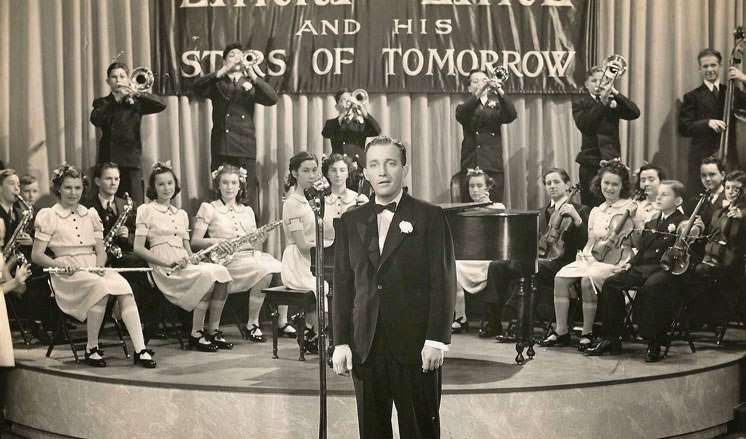
This forgotten film was Bing’s first movie where he played a character based on a real person. Bing played entertainer Gus Edwards (1879-1945). Edwards did not want his life made into a movie, so they changed Bing’s name in the movie to Larry Earl. The movie did not really touch upon the songwriting ability of Gus Edwards but more about his work as a child show producer. Bing sings some great vintage numbers like “I Wonder Who’s Kissing Her Now” and “School Days” as well as singing some new songs like “An Apple For The Teacher” and “Still The Blue Birds Sing”. Again, it amazes me that such a cheerful and fun movie has not even been released on video, let alone DVD.


3. DIXIE (1943)
I do not think the film Dixie will ever see the light of day because of how racist blackface is viewed as. It is an outdated and sort of embarrassing genre of entertainment, but I believe it is a part of American history no matter how it is perceived now. Bing again played a real person, songwriter Dan Emmett (1815-1904) who wrote the popular song “Dixie”. This film was important because it was Bing’s first movie in color, and the story is actually pretty good. Aside from Bing trying to make it as a song writer and performer he had an interesting love triangle with Marjorie Reynolds and Dorothy Lamour. A nicely remastered version of this Technicolor film would be great to see.


4. MR. MUSIC (1950)
Of the five Bing films I put on this list, Mr. Music is the only film that was released on video. So it is a shame it is not on DVD. The movie is not great, and unfortunately the songs are not that memorable either, but Bing was in great voice. The film is the charming story of a lazy songwriter (another songwriting role) who is facing financial ruin if he does not start writing again. The cast included guest appearances by Groucho Marx, Peggy Lee, and Dorothy Kirsten to name a few. Bing and Kirsten duet on “Accidents Will Happen”, which is a sleeper favorite of mine, and Bing is great on the number “And You’ll Be Home”. The movie was no Holiday Inn, but it is a breezy fun movie in my opinion.


5. MAN ON FIRE (1957)
Man On Fire was one of the four films Bing made at MGM Studios. The other three were Going Hollywood (1933), High Society (1956), and That’s Entertainment (1974). This 1957 film is distinctive because it was one of the few movies Bing did not sing it. The film is a tense drama about a husband divorcing his wife and fighting for the custody of his only son. Many people do not like this dramatic side of Bing Crosby’s movie career, but I enjoy the film. TCM plays the movie from time to time, but it has yet to be released on DVD. Viewing this movie even makes me wish Bing would have done more dramas.


All five of these films are worthy to be released on DVD. Maybe in time they will be. Fortunately I have been able to get bootleg copies of all five movies, but again they deserve an official studio release…

Thursday, December 18, 2014

RIP: STUART ERWIN JR

Stuart Philip Erwin Jr., a development executive at Universal Studios, among other companies, who was instrumental in bringing shows including “Hill Street Blues,” “Remington Steele” and “St. Elsewhere” to television, died on November 22 after a brief illness at his home in Solana Beach, Calif. He was 82.

Erwin had a long, successful career in the entertainment industry, beginning
as an assistant director on “The Ed Sullivan Show” in New York City, running the advertising division at Ralston Purina in St. Louis, then moving on to long stints as a development executive at Universal Studios, MTM Enterprises and GTG Entertainment.

Erwin was born in Los Angeles, the son of actors Stuart Erwin (1903-1967) and June Collyer (1906-1968). His parents were married for thirty six years. When his father died of a sudden heart attack in 1967, his mother never recovered, and she died of pneumonia a few months later.

After attending Brown University, Stuart Jr served as a lieutenant in the Navy.

During his retirement he remained very active at Brown University and was always a big supporter of the arts.

Stuart Erwin Jr was married to actress Julie Sommars from 1971-1980.

He is survived by his 3rd wife, Diane; his five children; and his six grandchildren. He is also survived by a younger sister Judy Erwin...


Friday, November 14, 2014

LEARN TO CROON: BING CROSBY'S 1930s SONGBOOK

Many movie goers these days consider the movie musical to be nothing more than fluff and fantasy. Most people in real life do not break out in song. That is true, but for moviegoers of the 1930s and 1940s the movie musical was an escape. It was an escape from the pain of poverty during the Great Depression, and it was an escape from the horrors of World War II. Of all the stars during that era, it was Bing Crosby that introduced the most standards. He was the voice of the times.

Bing started out as a singer with the Rhythm Boys in Paul Whiteman’s Orchestra, and then he moved on to making a series of film shorts for Mack Sennett. Those shorts were corny and really were only used to spotlight Bing’s singing, but it got him more popular exposure. Not only did he become a star on radio, but he was also signed to a long term contract with Paramount Studios. He would remain at the studio for almost 25 years.

The first movie Bing made for the studio was The Big Broadcast in 1932. The film was basically a spotlight of the popular radio stars of the day with a light plotline in between the songs. Crosby got to introduce some great songs like “Dinah”, “Please”, and the underrated torch song “Here Lies Love”. Bing basically played himself, and he did not really stretch his acting chops in this film. My favorite role in the movie was Bing’s friend, played by comedian Stuart Erwin. The movie catapulted Bing to movie stardom, and he followed it up with a more forgettable movie – 1933’s College Humor. The film was not bad, but even a young 30 year old Bing could not pass for a college student. He did get to sing the great song “Learn To Croon”, which became Bing’s unofficial anthem in those early years. More flimsy films followed in the 1930s, but he introduced a great standard in each of them. In She Loves Me Not (1934), Bing introduced “Love In Bloom”, in Here In My Heart (1935), Bing sang “June In January”, and in Two For Tonight (1935) Bing introduced “Without A Word Of Warning”.

Going back to Bing’s third movie in 1933, he was loaned to MGM Studios for the splashy musical Going Hollywood. It would be one of the best of the earlier Bing films. He was reunited with Stuart Erwin, his love interest was the older Marion Davies, and he got to sing some wonderful Nacio Herb Brown and Arthur Freed tunes like: “Temptation”, “Our Big Love Scene”, and “Beautiful Girl”. Bing would not return to the studio until 1956, and it was the first of only four movies Bing made for the studio. With Bing Crosby being such a big and rising star, I am really surprised Paramount Studios loaned him out in the 1930s as much as they did.


 The movie roles remained forgettable until Bing was loaned out again to Columbia Studios in 1936. For the movie Pennies From Heaven, Bing had his most dramatic role yet as an ex-convict who “adopted” a young child of another convict. It was still not Citizen Kane, but Bing had a lot more to do in this movie than just sing and play a crooner. He also introduced the title song, and a few other great songs like “So Do I”, and “Let’s Call A Heart A Heart”. When Bing went back to Paramount though, he went back to the flimsy musicals, which were quite popular with movie audiences.

Fast forwarding to 1939, Bing made a favorite movie of mine to end the decade. He played real life songwriter and kid show producer Gus Edwards in the movie “biography” The Star Maker. Bing sang some vintage songs, even vintage for 1939, like “School Days” and “I Wonder Who’s Kissing Her Now”, while he got to sing the new song “Still The Bluebirds Sing”. The film was another example that Bing was feeling more sure of himself as an actor and could play roles other than a carefree crooner. By making movies like Pennies From Heaven and The Star Maker, Bing was paving the way for meatier roles in the 1940s and even roles that would recognized by the Academy Awards. Bing never could have imagined that back when he was making movies playing a 30 year old college co-ed…