Liza Minnelli's rumored "controlling" best friend Michael Feinstein is allegedly ruling over her decisions, as he wants to be included in all of the legend's projects.
It seems like every part of the stage and screen star's life is apparently at the hand of her longtime friend, leaving pals anxious that she might not even realize it.
Friends are reportedly worried about Minnelli after noticing her 'controlling' friend has been making decisions in her life. In a recent chat with Interview magazine, the legendary EGOT winner made a surprising request: To have the interview conducted by none other than Michael.
Sources told us that Minnelli "didn’t care about the usual demands like control over the photographer or makeup team."
Feinstein was previously put under fire when fans noticed he had Minnelli's father's Oscar in his house.
An insider said: "To get Liza, you have to put up with Michael," adding the piano player "now controls every aspect of Minnelli’s life." Friends of the Cabaret star are reportedly "concerned about her well-being," questioning if she’s even aware of the demands he’s making on her behalf.
However, concerns over Feinstein’s behavior are nothing new.
In 2019, fans questioned seeing Minnelli’s beloved Oscar, awarded to her father Vincente Minnelli in 1959 for Gigi, on display at Feinstein’s house — he posted a photo of the statuette and claimed Vincente gave it to him.
The post stirred worries among her inner circle, with many doubting she would ever part with such a cherished keepsake.
Billy Stritch, Minnelli’s frequent accompanist, sarcastically commented on the post to ask Feinstein why the Oscar had previously been in Minnelli's apartment if it belonged to him. Stritch later deleted his comment, which left eagle-eyed fans even more puzzled. Feinstein eventually blamed his assistant for the "misinformation" and edited his post to clarify the situation.
The EGOT winner described the importance of taking care of her physical health in a new interview after sparking conce rns earlier this year.
Mitzi Gaynor, Showbiz Dynamo and Star of ‘South Pacific,’ Dies at 93
The singer, dancer and actress was a movie-musical legend, Las Vegas headliner and centerpiece of annual TV specials. Mitzi Gaynor, the leggy entertainer whose saucy vitality and blond beauty graced the big screen in South Pacific and on Las Vegas stages and in spectacular TV specials, has died. She was 93.
Gaynor, who received top billing over The Beatles on The Ed Sullivan Show on Feb. 16, 1964, and was famed costume designer Bob Mackie‘s first celebrity client, died Oct. 17 of natural causes, her team announced in a statement.
With her hazel eyes, tight curls and exuberant singing and dancing, the feisty Gaynor stood out in such movies as My Blue Heaven (1950) with Betty Grable and Dan Dailey; in Irving Berlin’s There’s No Business Like Show Business (1954), opposite Ethel Merman and Marilyn Monroe, her eventual successor at 20th Century Fox; and in the Cole Porter MGM musical Les Girls (1957) with Gene Kelly.
Gaynor also starred in Anything Goes (1956) with Bing Crosby and Donald O’Connor, The Joker Is Wild (1957) with Frank Sinatra and Happy Anniversary (1959) with David Niven and Patty Duke.
In 1957, Gaynor was involved in a fierce competition to win the role of Navy nurse Nellie Forbush in Joshua Logan’s South Pacific, the long-awaited adaptation of the sensational Rodgers & Hammerstein Broadway musical.
“I was filming The Joker Is Wild with Frank Sinatra and got the call that I’d be auditioning for Oscar Hammerstein at the Beverly Hills Hotel ballroom for South Pacific,” she told Michael Phillips of the Chicago Tribune in 2013. “I did ‘Honey Bun,’ I did ‘A Cockeyed Optimist.’ I did everything but strip.
“Oscar’s way, way at the other side of the ballroom. Why? I don’t know. But he walked over afterward. … You know when you do good? You feel like, ‘Well, at least I didn’t make a fool of myself.’ Oscar took my hand and said: ‘Thank you very much, Miss Gaynor. You’ve been a wonderful sport.”
She went on to famously sing “I’m Gonna Wash That Man Right Outa My Hair” and “Some Enchanted Evening” in the 1958 film, and the exotic World War II-set musical became the third highest-grossing movie ($17.5 million, or $147 million today) of the year. She also was nominated for a Golden Globe for best actress (comedy or musical).
Gaynor made her last noteworthy film appearance in Stanley Donen‘s Surprise Package (1960), a musical comedy that also starred Yul Brenner. With the Hollywood musical fading into obscurity, she retired from the movies after just one more film, the Kirk Douglas-starring For Love or Money (1963). She was in her early 30s.
Partnered with husband/manager Jack Bean, she smartly trained her sights on Las Vegas. Dressed in glittery Mackie costumes and accompanied by a team of handsome male dancers, she began singing, dancing and telling jokes in Vegas in 1961 and eventually acquired a stake in the Flamingo Hotel.
After what the Catholic Church called a “lascivious” 13-minute performance of her act on the Sullivan show — she was introduced as “Hollywood’s Mitzi Gaynor!!!” — the Beatles requested her autograph. (During rehearsals, they also asked to borrow her hair dryer.) They were all on the show broadcast from a Miami hotel, seen by 70 million viewers; a week earlier, Sullivan had introduced the Fab Four to America for the first time.
In 1968, Gaynor reportedly was earning $45,000 a week in Vegas. Also that year, she starred on her first TV special, Mitzi, for NBC. Five years later, she headlined the first of her six annual specials for CBS, including Mitzi and a Hundred Guys; Mitzi … A Tribute to the American Housewife; Mitzi … Zings Into Spring; and Mitzi … What’s Hot, What’s Not.
Gaynor said she regularly was approached to star in a weekly network variety show but refused. “Gene Kelly once told me, ‘Only do event television,'” she said.
After all her years working on TV, she finally won an Emmy in 2008, for her PBS special Mitzi Gaynor: Razzle Dazzle! The Special Years.
She was born Francesca Marlene de Czanyi von Gerber in Chicago on Sept. 4, 1931. Her mother was a dancer and her father a cellist, and she took her first dance class at age 8. An only child, she and her parents moved to Elgin, Illinois, then to Detroit and finally to L.A. when she was 11, to follow her dance teacher. At age 13, then known as Mitzi Gerber, she convinced Edwin Lester, the impresario of the Los Angeles Civic Light Opera, that she was 16 and landed a role in the musical Song Without Words.
While in The Great Waltz, she was spotted by a Fox producer, signed to a contract by studio chief Darryl F. Zanuck and had her last name changed to Gaynor. In My Blue Heaven, she stood out in several send-ups of TV commercials in the film. Fox was grooming her to be the next Grable, and in quick succession, she starred in the Jeanne Crain sorority story Take Care of My Little Girl (1951); Golden Girl (1951), set amid the California Gold Rush; the comedy We’re Not Married! (1952) with Monroe; Bloodhounds of Broadway (1952); Down Among the Sheltering Palms (1953); The I Don’t Care Girl (1953); Three Young Texans (1954); and The Birds and the Bees (1956)‚ an RKO remake of The Lady Eve.
In September 2022, she received a Legacy Award from the Cinecon Classic Film Festival in Hollywood.
She was married to Bean, who started out as a public relations executive at MCA, from 1954 until his death in 2006...
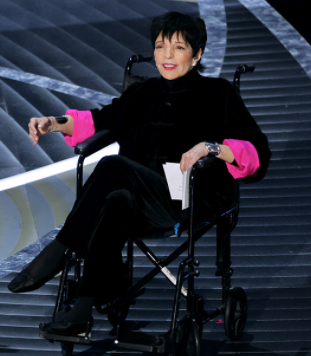
Lady Gaga and Liza Minnelli brought the chaotic 2022 Oscars to a close last month when they appeared together to present the award for Best Picture to “CODA.”
Not long after the March 27 ceremony was thrown into disarray when Will Smith slapped Chris Rock onstage, Gaga and Minnelli’s joint appearance drew praise from entertainment outlets. Minnelli was greeted with a standing ovation.
But a collaborator and friend now claims the “Cabaret” star was “very disappointed” by the experience.
“She was sabotaged,” singer Michael Feinstein said in an appearance on SirusXM’s “The Jess Cagle Show” that aired Tuesday.
“That’s a terrible word to use, but she only agreed to appear on the Oscars if she would be in a director’s chair, because she’s been having back trouble. She said, ‘I don’t want people to see me limping out there.’ She said, ‘You know, I want to look good. I don’t want people to worry about me.’”
Lady Gaga and Liza Minnelli at the 2022 Academy Awards in March. (Photo: Neilson Barnard via Getty Images)
Lady Gaga and Liza Minnelli at the 2022 Academy Awards in March. (Photo: Neilson Barnard via Getty Images)
Plans for the setup changed at the last minute, Feinstein said, in part because organizers had been “shaken up” by Smith’s actions earlier that night. According to the singer, a stage manager informed Minnelli she’d be seated in a wheelchair instead of in a director’s chair just minutes before she was due to appear onstage.
“She was nervous, and it made her look like she was out of it,” he said. “Can you imagine being suddenly forced to be seen by millions of people the way you don’t want to be seen? That’s what happened to her.”
Minnelli’s representative did not immediately respond to HuffPost’s request for confirmation of Feinstein’s account.
A representative for the Academy of Motion Picture Arts and Sciences declined to comment on his remarks.
A five-time Grammy nominee, Feinstein has performed alongside Minnelli on numerous occasions. Earlier this year, the pair recorded the jazz standard “Embraceable You” as a duet for Feinstein’s latest album, “Gershwin Country.”
Last month, Minnelli’s former publicist Scott Gorenstein told People that Gaga had personally requested that Minnelli be her Oscars night co-presenter. The two stars have enjoyed a friendly relationship for about a decade. In 2011, Gaga invited Minnelli to attend one of her concerts at New York’s Madison Square Garden, later citing her as a personal inspiration during the show...
LOS ANGELES – Michael Feinstein knows that "Love Is Here to Stay" is an enchanting song with a sad story, its lyrics a tribute from Ira Gershwin to his brother and musical partner, George, who died at age 38.
It's the sort of tidbit that Feinstein tosses off as deftly as he performs the tunes of the Gershwins, Irving Berlin, Cole Porter and other composers whose work collectively is known as the "Great American Songbook."
That makes him an ideal tour guide to the music, as demonstrated in PBS' three-part series, "Michael Feinstein's American Songbook," which debuts this week and airs on consecutive Wednesdays (check local listings for times).
The program documents Feinstein's role as an artist as well as historian and protector, searching out and preserving rare recordings, sheet music and anything else he can get his hands on related to the classic music he loves and those who performed it.
Frank Sinatra, Rosemary Clooney, Nat "King" Cole, Ethel Waters and Margaret Whiting are among the vocalists celebrated in the series, even as singer-pianist Feinstein (a five-time Grammy nominee) demonstrates his own impeccable grasp of why the songs endure.
Feinstein is the "perfect conduit for a series about popular American music. You just hitch a ride with him as he goes through his life," said producer and director Amber Edwards. "He really does spend every waking moment of his life involved in music in some way."
The series' focus is on "what we call the golden age," Feinstein said, roughly from the early to the mid-20th century. But his definition of the American songbook is elastic enough to include relatively recent composers or those from abroad, and he cites such respective examples as Burt Bacharach and the Beatles.
"Anything that resonated with the American populace and affected and changed our lives is part of the fabric" of the songbook, said Feinstein.
The series' first episode, "Putting on the Tailfins," explores the 1950s and 1960s conflict between classic songs and the rock 'n' roll newcomers. Feinstein, shown in performance with a big band, orchestra and jazz combo, explains how Sinatra and others reinvented pop standards for changing tastes.
"Best Band in the Land," the second chapter, focuses on the morale-building role of music during World War II and the 1940s big bands that played it. "A New Step Every Day," about the jazz age and the rise of movies, radio and the recording industry in the 1920s and 1930s, concludes the series.
Feinstein's soul mates — the other passionate collectors and musicians keeping the era's spirit alive — are featured in the episode. The series also provides a view of Feinstein's borderline frenetic life, which his New York City cabaret as well as a busy tour schedule and unending search for memorabilia.
His personal life is briefly sketched in scenes with his parents, Ed and Mazie Feinstein, and his partner, Terrence Flannery.
There isn't much in today's popular music that he admires, said Feinstein, who saw genius firsthand when he worked for Ira Gershwin in the final years of the lyricist's life.
But good music is being created and someday may be appreciated widely, Feinstein said.
"There's a lot of people who are working in New York and on Broadway and writing songs that are heard in clubs that are not being heard mainstream," he said. "And the thing that's amazing about a song is that you never know how or when it's going to get picked up. Something may be created where suddenly it has a life years after it's written."
That's reason for hope, which for Feinstein, 54, is buoyed by the Internet.
"Kids today can discover things that they never could have discovered before. You can hear the name Ethel Waters, and you can go online, and you can read about her and hear her recordings — stuff that I couldn't have possibly done when I was a kid," he said...