Showing posts with label George Jessel. Show all posts

Saturday, September 26, 2026

THE EULOGY OF AL JOLSON

Comedian George Jessel gave the eulogy for Al Jolson's funeral in October of 1950. They were lifelong friends, and Jessel's words were well said...


A BREEZE FROM San Francisco Bay and the life of the greatest minstrel that America has ever known is in the balance. A turn of a card -- a telling of a gag -- and within a few moments, a wife, a legion of friends, and a nation are broken-hearted. So it was and so, alas, it is the passing from this earthly scene of Al Jolson. And the voice that once put majesty into the American popular song must from now on come from a disc instead of the heart, from whence it came.

Oh, my friends, I know it is the purpose of the speaker at times like these to voice lofty phrases of consolation about a life full lived and a happy conclusion to a great career. But I, contemporary of Al's, find myself too shocked and torn within to say that all is well, and I dare not lie from this sacred platform to say that I, and we, must rejoice in the fact that now he is at peace. It would be far from the truth, and I would need the spiritual strength of a rabbi, a minister, and a priest combined to do so. The human flesh and the frailty of human nature seem to be the sad order of the day as far as I am concerned.

It will take a long time for the people in my business who have been wounded by this event to become reconciled that this dynamic bundle of energy with its God-given talent that called itself Al Jolson is at peace. The very humanly emotional heart of the theatrical business does not heal so easily, and the tears that must fall from the eyes of the many who miss him already cannot be halted by the spoken word. No, the word will not take the place of his song.


And not only has the entertainment world lost its king, but we cannot cry, "The King is dead -- long live the King!" For there is no one to hold his scepter. Those of us who tarry behind are but pale imitations, mere princelings. And American Jewry suffers as well and I must psychologically inform you of the great inspiration that Al was to the Jewish people in the last forty years. For in 1910 the Jewish people who emigrated from Europe to come here were a sad lot. Their humor came out of their own troubles. Men of thirty-five seemed to take on the attitude of their fathers and grandfathers, they walked with stooped shoulders. When they sang, they sang with lament in their hearts and their voices, always as if they were pleading for help from above, And the older they got, the more they prayed for the return to Jerusalem. Or yearned for the simple little villages where they spent their childhood. And the actors, even the great ones, came on the stage also playing characters like their fathers. Vaudeville and the variety and the musical-comedy stage and the legitimate theater had Ben Welch and Joe Welch, monologists with beards and shabby clothes telling humorous stories that had a tear behind them. Likewise did this happen in legitimate theater. David Warfield in The Auctioneer and many others in plays bewailing the misfortunes that had happened to the Jew. And then there came on the scene a young man, vibrantly pulsing with life and courage, who marched on the stage, head high with the authority of a Roman emperor, with a gaiety that was militant, uninhibited, and unafraid, and told the world that the Jew in America did not only have to sing in sorrow but could shout happily about Dixie, about the Night Boat to Albany, about coming to California, about a girl in Avalon. And when he cried "Mammy" it was in appreciation, not in lament. Jolson is the happiest portrait that can ever be painted about an American of the Jewish faith. Jolson was synonymous with victory at the race track, at the ball game, at anything that he participated in, he would say, "I had the winner, ha, ha, why didn't you ask me?" This was not in bravado alone: this was the quintessence of optimism. Whatever you're in, whatever game you play, feel like you are the winner.

The history of the world does not say enough about how important the song and the singer have been, from the days of old when a man first sang "Yankee Doodle" on the streets of Boston or the soldier in France who first sang "The Marseillaise." But history must record the name Jolson, who in the twilight of his life sang his heart out in a foreign land, to the wounded and to the valiant. I am proud to have basked in the sunlight of his greatness, to have been part of his time, and to have only a few days ago -- this last Sunday night -- hugged him and said, "Good night, Asa, take care of yourself." And now, my friends, I find my faith in good coming back to me. I feel strengthened in heart and mind -- and I would lay my sackcloth and ashes aside and therefore say to my fellow mourners and the little lady who bears Al's name that I am thankful to God that there was and there is an Al Jolson. And I have faith that he will never die in the hearts of people. No, no. No such blot will ever fall on the fair charter of American memories. Baruch adenoi. Praise the Lord. Good night, Al.


Saturday, July 12, 2014

PHOTOS OF THE DAY: EVEN MORE ODD PAIRINGS

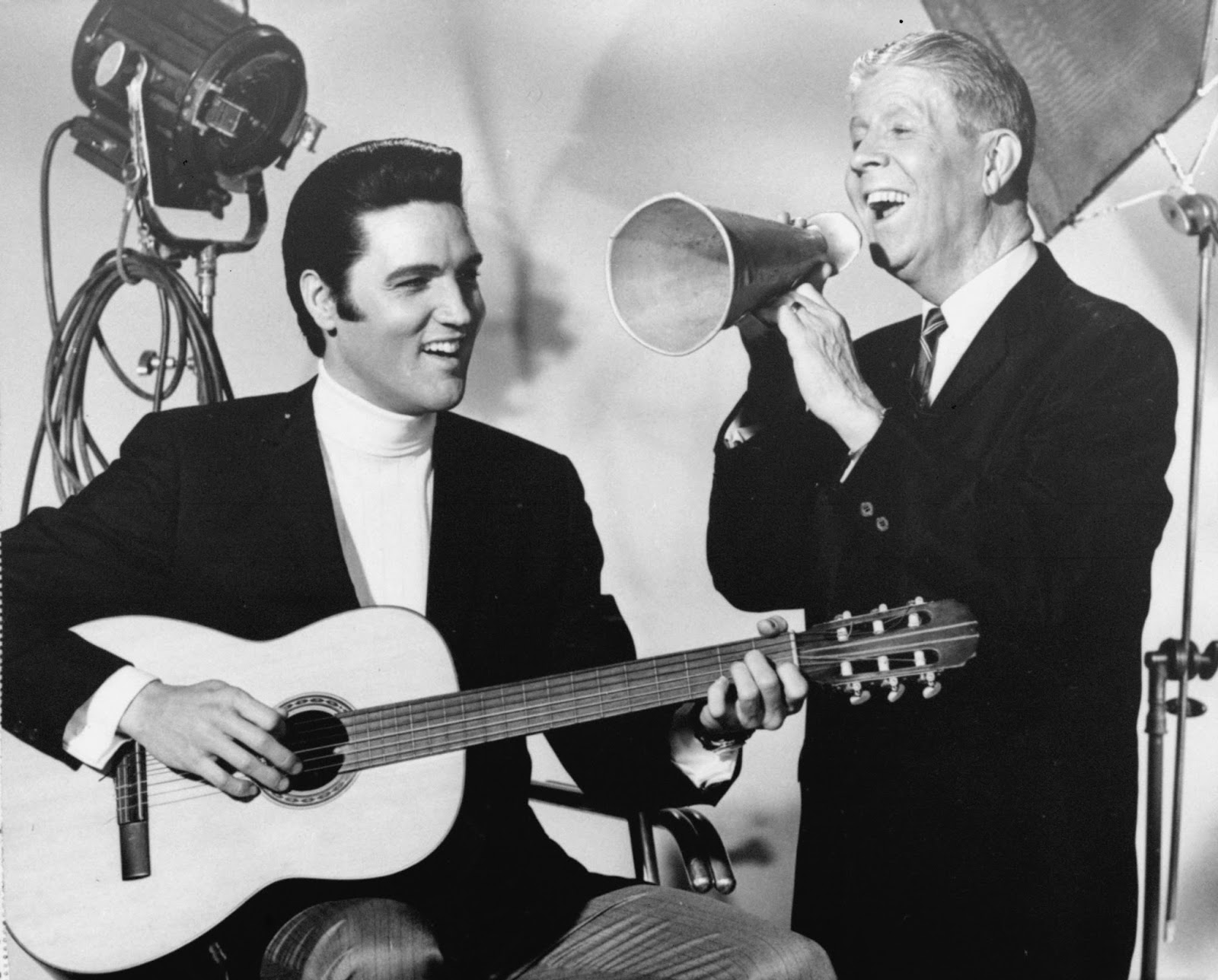
This is the third addition of this series. I love featuring different pairings of movie stars in pictures that you are used to seeing together. There always seems to be different photos that I discover:


ELVIS PRESLEY and RUDY VALLEE

CHARLIE CHAPLIN and AL JOLSON


MICHAEL JACKSON and FRED ASTAIRE


EDDIE CANTOR, JUDY GARLAND, GEORGE JESSEL

MARY TYLER MOORE and JIMMY DURANTE

GROUCHO MARX and JAYNE MANSFIELD


Wednesday, October 19, 2011

PHOTOS OF THE DAY: LEGENDS OF VAUDVILLE

Does anyone in this American Idol generation even know what vaudville was? It was the X Factor of its day, except with real talent. Vaudville pretty much died with the coming of radio and television, but the legends it produced should be remembered. Here are some great pictures with a few true legends of vaudville...


GEORGE JESSEL(1898-1981), GEORGE BURNS(1896-1996), EDDIE CANTOR(1892-1964), JACK BENNY(1894-1974)


AL JOLSON(1886-1950)


SOPHIE TUCKER(1886-1966)


JIMMY DURANTE(1893-1981)


FANNY BRICE(1891-1951)


THE MARX BROTHERS

GROUCHO(1890-1977), HARPO(1888-1964), CHICO(1887-1961), ZEPPO(1901-1979)

Saturday, June 11, 2011

FORGOTTEN ONES: GEORGE JESSEL


George Jessel. The name is buring among the ruins of 1920s vaudville, and many people will not even remember what George Jessel was famous for. Jessel, along with Al Jolson and Eddie Cantor, made up a trio of vaudville and broadway stars that not only made up a part of entertainment in those early years, but they were entertainment.

George Jessel, born on April 3, 1898 was an American illustrated song "model," actor, singer, songwriter, and Academy Award-winning movie producer. He was famous in his lifetime as a multitalented comedic entertainer, achieving a level of recognition that transcended his limited roles in movies. He was widely known by his nickname, the "Toastmaster General of the United States" for his frequent role as the master of ceremonies at political and entertainment gatherings.

His most famous comedy skit was called "Hello Mama" or "Phone Call from Mama", which portrayed a one-sided telephone conversation. In 1919 he produced his own solo show, "George Jessel's Troubles" and appeared in his first motion picture, the silent movie The Other Man's Wife. He co-wrote the lyrics for a hit tune, "Oh How I Laugh When I Think How I Cried About You", and performed in several successful comedy stage shows in the early 1920s. In 1921 he recorded a hit single, "The Toastmaster". He sometimes appeared in blackface in his vaudeville shows.


In 1925, he emerged as one of the most popular leading men on Broadway with the starring role in the stage production of The Jazz Singer. The success of the show prompted Warner Bros. -- after their success with Don Juan (1926) with music and sound effects only—to adapt the The Jazz Singer as the first "talkie" with dialogue and to cast Jessel in the lead role. However, when the studio refused his salary demands, Jessel turned down the movie role, which was eventually played by Al Jolson. According to Jessel during an interview around 1980, Warners still owed Jessel money for earlier roles and lacked enough funds to produce this movie with a leading star. Jolson, the biographical inspiration for the movie, became the movie's main financial backer.

His next movie role was in 1926 in Private Izzy Murphy. Whereas Jolson's film career skyrocketed after the 1927 release of The Jazz Singer, Jessel remained in smaller movie roles, often intended for audiences fond of Jewish and other "ethnic" humor.

In the middle 1940s, he began producing musicals for 20th Century Fox, producing 24 films in all in a career that lasted through the 1950s and 1960s. At the same time he became known as a host on the banquet circuit, famous for his good-natured wit aimed at his fellow celebrities. In 1946, he was one of the founding members of the California branch of the Friars Club. (A recording exists of an example of his "blue" work in front of a stag audience, although it was actually recorded at a roast hosted by the Friars' rival, the Masquers Club.) He also traveled widely overseas with the USO entertaining troops. As he grew older, he wrote eulogies for many of his contemporaries in Hollywood. He wrote three volumes of memoirs, So Help Me (1943), This Way, Miss (1955), and The World I Lived In (1975).

In the early 1950s he performed on the radio in The George Jessel Show, which became a television show of the same name from 1953 to 1954.

Jessel was the emcee on the short-lived The Comeback Story, a 1954 reality show on ABC in which mostly celebrities shared stories of having overcome adversities in their personal lives. He was replaced as emcee by Arlene Francis, but the program soon folded.

Thereafter, Jessel guest starred on NBC's The Jimmy Durante Show. In 1968 he starred in Here Come The Stars, a syndicated variety show. Jessel also appeared as himself in Valley of the Dolls in 1968. His attempt to extend his career was undermined, however, by a perception that his style of comedy was outdated, as well as by his outspoken support of the American entry into the Vietnam War and of conservative political causes.

On the other hand, he often crossed the era's stereotypical political lines with his support for the Civil Rights movement and criticism of racism and anti-Semitism.[citation needed] His outspokenness regarding his political opinions could sometimes get him into trouble. In 1971, while being interviewed by Edwin Newman on The Today Show on NBC, he repeatedly referred to The New York Times as "Pravda", the house organ of the Communist Party in the Soviet Union, and was ejected from the show.


Famous in his youth for his affairs with starlets, he also became known for keeping company with a wide assortment of younger show girls, even into his old age. By the late 1960s he had gained a reputation as being overly self-indulgent in reminiscing about former companions who were little known by younger audiences. Walter Winchell once said of him, "That son of a bitch started to reminisce when he was eight years old." In response, Jessel stated that "I have a funeral speech ready for Winchell. I hope it starts in fifteen minutes." He had achieved a somewhat iconic status, representing a Hollywood of yore, such that he extended his career by playing himself, rather than characters, as in the camp movie version of Valley of the Dolls (1968).

His last movie role was in Diary of a Young Comic in 1979. He also appeared as himself as an interviewed witness in the 1981 movie Reds. He entertained American military forces in Europe in 1972.

Jessel died of a heart attack on May 23, 1981 at the age of 83 in Los Angeles and was interred in the Hillside Memorial Park Cemetery in Culver City, California...