Thursday, July 30, 2015

COOKING WITH THE STARS: JOAN CRAWFORD
Today, Joan Crawford (1905-1977) is mostly known for "supposedly" beating her adopted daughter after the young girl used a wire hanger. However, what is not known is Joan enjoyed cooking and knew her way around a kitchen.

Here is one of Joan's recipes:
Joan Crawford’s Pork Chops with Red Onions and Apple Rings
(for four to six)
6 loin pork chops, one inch thick
¼ pound margarine or butter
2 large Italian red onions, sliced
1 cup flour
Lawry’s Seasoned Salt
Salt chops on both sides. Dip lightly in flour. Place chops in ¼ pound melted butter or margarine in skillet. Add sliced onions and cook till golden. When onions are cooked, place on top of chops. Brown chops on one side, then turn, replacing onions on the top side.
Place chops in skillet in preheated 250° oven. Cover. Cook 15 minutes. Then reduce oven heat to 200° and bake for an additional 25 minutes. Top each chop with 2 fried apple rings...

SOURCE
Here is one of Joan's recipes:
Joan Crawford’s Pork Chops with Red Onions and Apple Rings
(for four to six)
6 loin pork chops, one inch thick
¼ pound margarine or butter
2 large Italian red onions, sliced
1 cup flour
Lawry’s Seasoned Salt
Salt chops on both sides. Dip lightly in flour. Place chops in ¼ pound melted butter or margarine in skillet. Add sliced onions and cook till golden. When onions are cooked, place on top of chops. Brown chops on one side, then turn, replacing onions on the top side.
Place chops in skillet in preheated 250° oven. Cover. Cook 15 minutes. Then reduce oven heat to 200° and bake for an additional 25 minutes. Top each chop with 2 fried apple rings...
SOURCE
Monday, July 27, 2015
THE LAST DAYS OF SARAH BERNHARDT

Bernhardt's close friends included several artists, most notably Gustave Doré and Georges Clairin, and actors Mounet-Sully and Lou Tellegen, as well as the famous French author Victor Hugo. Alphonse Mucha based several of his iconic Art Nouveau works on her. Her friendship with Louise Abbéma (1853–1927), a French impressionist painter, some nine years her junior, was so close and passionate that the two women were rumored to be lovers. In 1990, a painting by Abbéma, depicting the two on a boat ride on the lake in the bois de Boulogne, was donated to the Comédie-Française. The accompanying letter stated that the painting was "Peint par Louise Abbéma, le jour anniversaire de leur liaison amoureuse" (loosely translated: "Painted by Louise Abbéma on the anniversary of their love affair.")

In 1905, while performing in Victorien Sardou's La Tosca in Teatro Lírico do Rio de Janeiro, Bernhardt injured her right knee when jumping off the parapet in the final scene. The leg never healed properly. By 1915, gangrene set in and her entire right leg was amputated; she was required to use a wheelchair for several months. Bernhardt reportedly refused a $10,000 offer by a showman to display her amputated leg as a medical curiosity. (While P.T. Barnum is usually cited as the one to have made the offer, he had been dead since 1891.)
She continued her career, sometimes without using a wooden prosthetic limb, which she did not like. She carried out a successful tour of America in 1915, and on returning to France she played in her own productions almost continuously until her death. Later successes included Daniel (1920), La Gloire (1921), and Régine Armand (1922). According to Arthur Croxton, the manager of London's Coliseum, the amputation was not apparent during her performances, which were done with the use of an artificial limb. Her physical condition may have limited her mobility on the stage, but the charm of her voice, which had altered little with age, ensured her triumphs.
Sarah Bernhardt died from uremia following kidney failure in 1923. Newspaper reports stated she died "peacefully, without suffering, in the arms of her son." She is believed to have been 78 years old. She was the Meryl Streep of her generation even before Meryl Streep was even a thought...

Saturday, July 25, 2015
SINGER SPOTLIGHT: ART LUND

Born Arthur London on April 1, 1915 in Salt Lake City, Utah. Lund was a popular baritone of the Big Band era whose recording of "Blue Skies" was an enduring hit throughout the 1940s. At 6 feet, 4 inches and with rugged good looks under a mop of blond hair, Lund also had a dramatic career in films, stage and television.
He was a graduate of Eastern Kentucky University, and received his master's degree from the United States Naval Academy in aerological engineering. Lund was a high school math teacher in Kentucky who worked as a musician on the side. He left teaching to tour with Jimmy Ray and his band. He originally billed himself as Art London.
His recordings of "Blue Skies," "My Blue Heaven" and "Mam'selle" became the foundation of a career that began in the late 1930s with the Benny Goodman band. One of my favorite recordings Lund made during the big band era was the song "If You Build A Better Mousetrap" in 1941, a duet with fellow Goodman vocalist Peggy Lee. The song was taken from the Paramount movie The Fleet's In.

Lund was on Broadway first in the early 1950s in a musical adaptation of "Of Mice and Men" and later in "The Wayward Stork." He was seen across the country in touring companies of "Fiorello," "No Strings" and "Destry Rides Again." "The Most Happy Fella," the Frank Loesser adaptation of "They Knew What They Wanted," was one of Broadway's biggest hits of the 1950s.
In 1968, Lund moved into films as Frazier, biggest of "The Molly Maguires" in the picture about the Irish rebel miners. His other movies included "Ten Days Till Tomorrow," "Decisions, Decisions," "Bucktown" and "The Last American Hero."
On TV he was a frequent guest on "Gunsmoke," "Police Story," "The Rockford Files," "Little House on the Prairie" and "Daniel Boone."
Lund was still singing the 1980s. He was a frequent guest at Big Band nights in Southern California, toured with the Harry James ghost band and recently sang in Australia.
Art Lund died May 31, 1990 of liver cancer in Holladay, Utah...not far from where he was born.

Thursday, July 23, 2015
FINAL RESTING PLACES: FRED ASTAIRE

Though that evaluation of Fred Astaire's first screen test may be more Hollywood legend than fact, Astaire proved them wrong by acting, singing and dancing his way through some of the best-loved and most memorable musicals ever made. (And he wore a toupee, so he overcame that "balding" problem, too.)
The son of an Austrian immigrant, Astaire started in show business in vaudeville and on Broadway, dancing with his sister, Adele. From 1917 to 1932, the Astaires were a successful Broadway dance team, appearing in such musicals as "Over the Top," "Lady Be Good," and "Funny Face." After Adele retired from the act in 1932 to marry Lord Charles Cavendish, Astaire headed to Hollywood. After his first film, "Dancing Lady" (1933), Astaire appeared in "Flying Down to Rio" (1933), which was his first pairing with Ginger Rogers. Astaire and Rogers made 10 films together, usually light comedies with even lighter plots which followed a standard format. But the slim plots were just an excuse for Astaire and Rogers to do what they do best - him in top hat, white tie and tails; her in a flowing, feathery gown, combining the elements of ballroom, tap and other dance styles in a seamless picture of grace and elegance. Most fans agree that "Top Hat" (1935) was their best film together.

Astaire danced with many other partners in his film career, including Eleanor Powell in "Broadway Melody of 1940," Rita Hayworth in "You'll Never Get Rich" (1941), Judy Garland in "Easter Parade" (1948), Cyd Charisse in "Silk Stockings" (1957) and Audrey Hepburn in "Funny Face" (1957). Taking nothing away from his human partners, but Astaire could even make the coat rack he danced with in "Royal Wedding" (1951) seem graceful and elegant. Altogether, Astaire appeared in 54 films. In 1975, he was nominated for an Academy Award for Best Supporting Actor for his performance in "The Towering Inferno." Astaire was awarded an honorary Academy Award in 1950, "for his unique artistry and his contributions to the technique of musical pictures." He was also a three-time Emmy winner.
Astaire married his first wife, Phyllis, in 1933, and had two children, Fred Jr. and Ava. Phyllis also had another child, Peter, from a previous marriage. Phyllis died in 1954. In 1980, the 81-year-old Astaire married jockey Robyn Smith -- who, at 35, was younger than both of his children.

Astaire's gravestone is as you might expect it to be, simple and elegant: "Fred Astaire, I Will Always Love You My Darling, Thank You." And, for an entertainer with endless and timeless talent, it does not include the dates of his birth or death.
Throughout his life, Astaire was generally known as a very private person who kept close ties to his family. So it's natural that he is surrounded by the people he loved most. Buried near Astaire is his sister Adele Astaire Douglas (1897 - 1981) -- after her first husband died, she married Kingman Douglas. Next to Adele is Ann Astaire (1878 - 1975), Fred and Adele's mother. Next to Ann Astaire is Phyllis Livingston Astaire (1908 - 1954), Fred's first wife. Next to Phyllis are the graves of her aunt and uncle, Henry Worthington Bull (1874 - 1958) and Maud Livingston Bull (1875 - 1962). Fred had known Henry Bull for several years before he met Phyllis, due to their mutual interest in horse racing, and the two couples remained close throughout their lives.
In his will, which was signed less than two years before he died, Astaire requested "that my funeral be private and that there be no memorial service."
Astaire was born Frederick Austerlitz on May 10, 1899, in Omaha, NE. He died on June 22, 1987, in Los Angeles, CA. Fred was buried in Oakwood Memorial Park in California...

Monday, July 20, 2015
SARAH BERNHARDT: THE RISE TO FAME
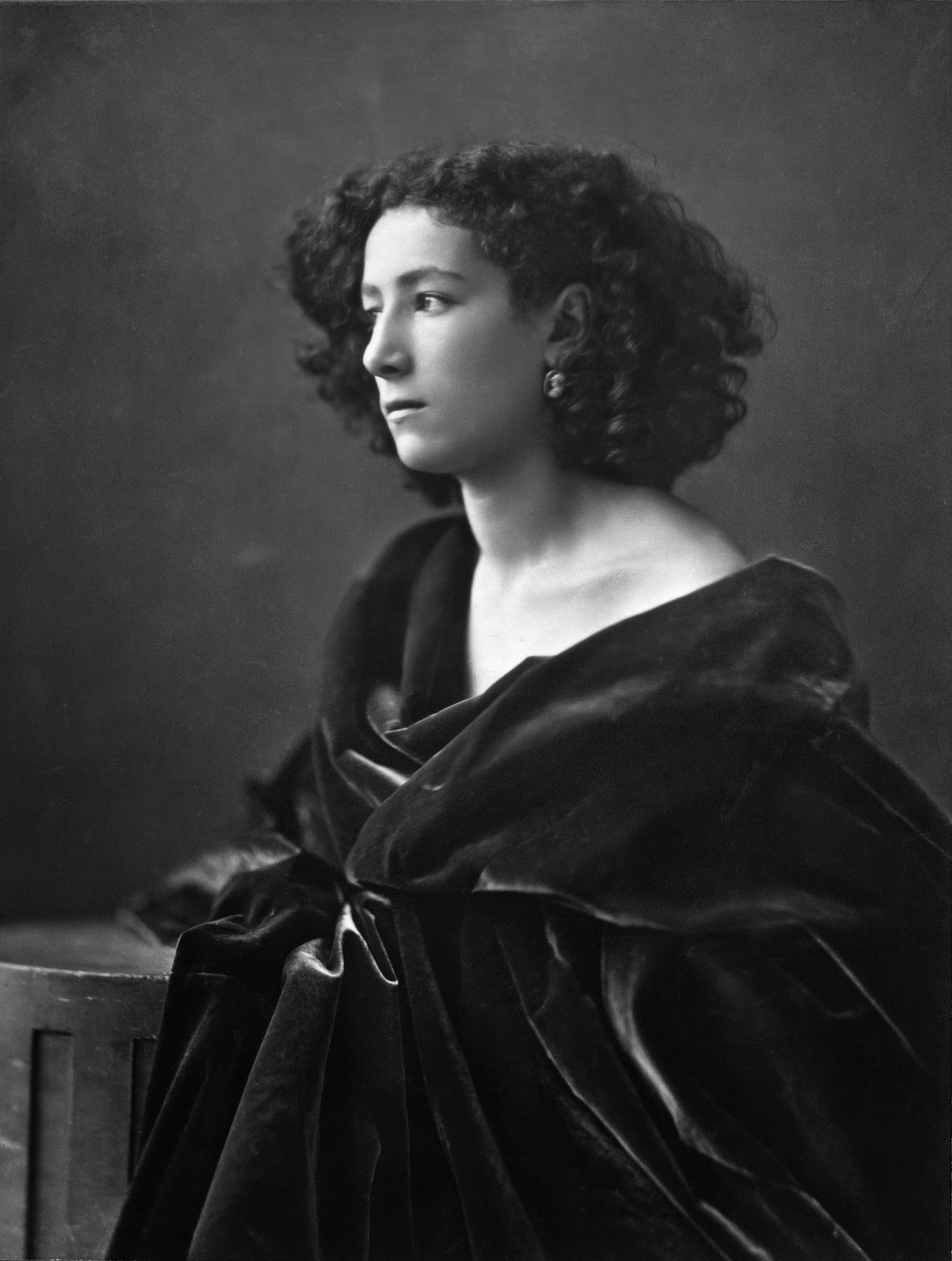
After being expelled from the Comédie Française, she resumed the life of courtesan to which her mother had introduced her at a young age, and made considerable money during that period (1862–65). During this time she acquired her famous coffin, in which she often slept in lieu of a bed – claiming that doing so helped her understand her many tragic roles.
Bernhardt then reverted to the theater, securing a contract at the Théâtre de L’Odéon where she began performing in 1866. Her most famous performance there was her travesty performance as the Florentine minstrel in François Coppé's Le Passant (January 1869). With the outbreak of the Franco-Prussian war performances were stopped and Bernhardt converted the theatre into a makeshift hospital where she took care of the soldiers wounded on the battlefield. She made her fame on the stages of Europe in the 1870s and was soon in demand all over Europe and in New York. In between tours Bernhardt took over the lease of the Théâtre de la Renaissance, which she ran as producer-director-star from 1893 to 1899.
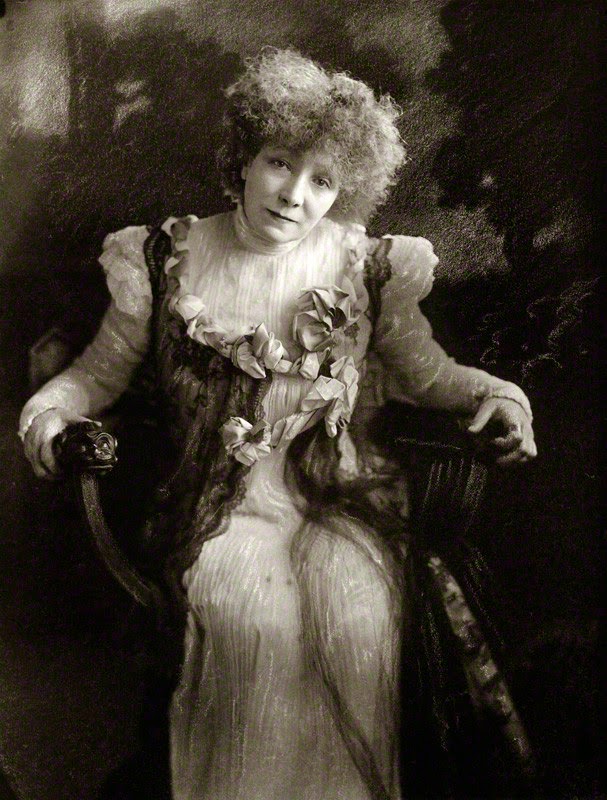
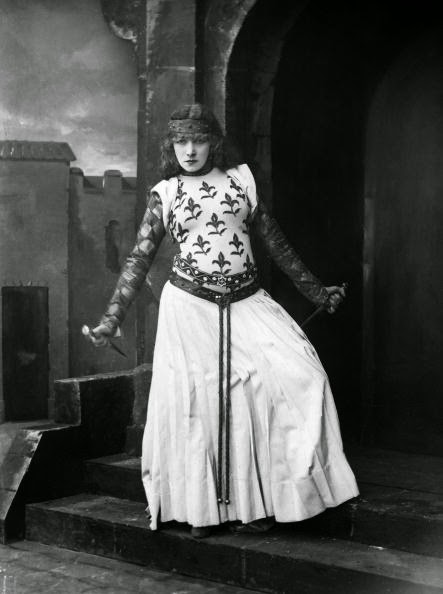
In 1899 Bernhardt took over the former Théâtre des Nations on the Place du Châtelet, renaming it the Théâtre Sarah-Bernhardt and opening on 21 January in one of her most admired parts, the title role in Victorien Sardou's La Tosca. This was followed by revivals of Racine's Phèdre (24 February), Octave Feuillet's Dalila (8 March), Gaston de Wailly's Patron Bénic (14 March), Edmond Rostand's La Samaritaine (25 March), and Alexandre Dumas fils's La Dame aux Camélias on 9 April. On 20 May, she premiered her most controversial part, the title role in Shakespeare's Hamlet, in a prose adaptation which she had commissioned from Eugène Morand and Marcel Schwob. The play was greeted with rave reviews despite its running time of four hours. She developed a reputation as a serious dramatic actress, earning the title "The Divine Sarah"; arguably, she was the most famous actress of the 19th century.
Bernhardt also participated in scandalous productions such as John Wesley De Kay's "Judas." It performed in New York’s Globe Theatre for only one night in December 1910 before it was banned there, as well as in Boston and Philadelphia. In New York’s art scene of 1910 the story line of the play was nothing short of scandalous. Mary Magdalene, who at first became a lover of Pontius Pilate, then of Judas Iscariot, got involved with Jesus. Judas, after realizing that Mary Magdalene had given herself to Jesus, decided to betray his friend to the Romans. To top the provocation of New York’s theater lovers, Judas was played by the voluptuous Sarah Bernhardt.
In Paris, Bernhardt continued to direct the Théâtre Sarah-Bernhardt until her death, when her son Maurice took over. After his death in 1928, the theatre retained the name Sarah Bernhardt until the Occupation by the Germans in World War II, when the name was changed to Théâtre de la Cité because of Bernhardt's Jewish ancestry...
Saturday, July 18, 2015
CELEBRITY ADS: GINGERS ROGERS
Here is a great print ad featuring the beautiful Ginger Rogers (1911-1995). I never knew she was a model for Max Factor. This is a 1943 ad that also mentions the "new" Ginger Rogers movie Lady In The Dark...

Subscribe to:
Posts (Atom)