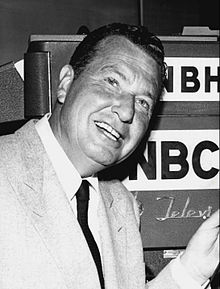
Showing posts with label Phil Harris. Show all posts

Saturday, June 24, 2023

BORN ON THIS DAY: PHIL HARRIS

Phil Harris was many things in Hollywood. He was a singer, comedian, actor, band leader, and just an all around fun guy. He was born on this day in 1904. Harris was born in Linton, Indiana, but grew up in Nashville, Tennessee, and identified himself as a Southerner. His hallmark song was "That's What I Like About the South." He had a trace of a Southern accent and in later years made self-deprecating jokes over the air about his heritage. His parents were circus performers. His father, a tent bandleader, gave him his first job as a drummer with the circus' band.

Phil Harris began his music career as a drummer in San Francisco, in the mid-1920s playing drums in the Henry Halstead Big Band Orchestra. He formed an orchestra with Carol Lofner in the latter 1920s and started a long engagement at the St. Francis Hotel. In the 1930s, Lofner-Harris recorded swing music for Victor, Columbia, Decca, and Vocalion. The partnership ended by 1932, and Harris led a band in Los Angeles for which he was the singer and bandleader. In 1936, Harris became musical director of The Jell-O Program Starring Jack Benny singing and leading his band, with Mahlon Merrick writing much of the show's music. When Harris exhibited a knack for snappy one-liners, he joined the cast, portraying himself as a hip, hard-drinking Southerner whose good nature superseded his ego. He gave the others nicknames, such as "Jackson" for Jack Benny. (Addressing a man as "Jackson" or sometimes "Mr. Jackson" became popular slang in the early 1940s.) His signature song was "That's What I Like About the South." Many of his vocal recordings were comic novelty "talking blues," similar to the songs of Bert Williams, which are sometimes considered a precursor to rap. He remained on the Jack Benny program until 1952. He also starred in his own radio show with his wife Alice Faye from 1946 to 1954.


In 1956, Harris appeared in the film Good-bye, My Lady. He made numerous guest appearances on 1960s and 1970s television series, including The Steve Allen Show, the Kraft Music Hall, Burke's Law, F Troop, The Dean Martin Show, The Hollywood Palace, and other musical variety programs. He appeared on The American Sportsman which took celebrities on hunting and fishing trips around the world.

Harris worked as a voice actor for animated films, providing the voice of Baloo the bear in The Jungle Book (1967), Thomas O'Malley in The Aristocats (1970), and Little John in Robin Hood (1973). In 1989, he reprised his role as Baloo for the cartoon series TaleSpin, but after a few recording sessions he was replaced by Ed Gilbert. Harris's final film role was in Rock-a-Doodle (1991).

Harris spent time in the 1970s and early 1980s leading a band that appeared often in Las Vegas, often on the same bill with bandleader Harry James.This "man of the south" led a full life and died at the age of 91 in 1995...


Monday, July 13, 2020

THE RADIO LEGACY OF PHIL HARRIS AND ALICE FAYE

By the end of the Second World War, subtle radio comedy was becoming as hard to find as an unfurnished apartment, a new pair of nylons, or a porterhouse steak. The war years had brought with them a bold, brassy style of humor that asked no questions and took no prisoners — with a machine-gun tempo and a Sherman Tank aggressiveness, the radio comics of the early postwar era beat their listeners over the ears with jokes and gags and made them like it.

The comedy characters who emerged from this era were every bit as outrageous as the material itself, wild, exaggerated caricatures of every possible human frailty — the cartoonish, vaudevillian denizens of Allen’s Alley, the flyspecked habitués of Duffy’s Tavern, the screaming pop-eyed stooges who surrounded Bob Hope and Eddie Cantor and Abbott and Costello. There was nothing realistic or nuanced about these characters — they had no grounding in the real world. They were caricatures, pure and simple, and the audiences of the time understood them as such, existing only for the sake of laughs. And perhaps no program of the era captured this zeitgeist of unrestrained lunacy quite so well as The Phil Harris-Alice Faye Show.


By the time bandleader Phil Harris and his recently-retired movie star wife Alice Faye converted the long-running Sunday night Fitch Bandwagon program from a musical variety format to a situation comedy, Phil had been playing a zany comic caricature for nearly a decade as a member of Jack Benny’s troupe. Here was the conceited, hard-drinking curly-haired pretty-boy entertainer in all his glory, traits painted in such broad strokes that audiences genuinely believed Phil Harris to be an irredeemable reprobate of the first water — except he never touched anything so pedestrian as water.

But adapting this caricature to a situation comedy format posed a problem. Harris and Faye proposed to do a family comedy, presenting themselves as a real-life married couple, with two young children. And with kids in the picture, Harris’s zany booze-fueled antics suddenly didn’t seem so funny. Writers Joe Connelly and Bob Mosher solved the problem by turning Phil into the straight man for an even more outrageous caricature — the shiftless, scheming, childishly-irresponsible left-handed guitar player Frankie Remley.

Remley was a real man, a real member of the Harris orchestra and a close personal friend of Jack Benny, who began dropping random Remley gags into his program in the late 1930’s. These jokes, accumulating over several years, sketched a basic outline which Connelly and Mosher used as the foundation for a fully-developed character, brought to vivid life by the brilliant Elliot Lewis. As developed by Connelly and Mosher, and as expanded upon by the subsequent writing team of Ray Singer and Dick Chevillait, Frankie Remley wasn’t just a lazy, shiftless, no-account bum — he was the laziest, most shiftless, most no-account bum who ever lived. Lewis’s full-tilt performance in the role perfectly captured the characterization in the scripts — bringing Remley to life as a man who ricocheted from one mishap to another, all the while blissfully oblivious to the chaos he left in his wake. And next to a creature of such barbarous habits, even Phil Harris seemed just a bit more responsible, and thus more believable and acceptable as a parent of young children. It was a master stroke of character development that perfectly fit the mood of the times, and which created some of radio’s most hilarious moments.


The supporting characters who populated the Harris-Faye program were just as broadly drawn as the central figures. Three prominent adversaries stood in the path of whatever mayhem Phil and Frankie might be scheming up in any given week — and each of those characters was exaggerated to the extreme. The most prominent of these characters, the malevolent grocery boy Julius Abruzzio, was a sassy, vest-pocket delinquent who viciously and methodically tormented Phil and Frankie for the sheer joy it brought to his otherwise tedious life. He needed no other motive, he displayed no other traits. Actor Walter Tetley had made an entire career out of playing smart-mouthed kids, but with Julius he raised the stereotype to its ultimate degree. In keeping with the usual Harris-Faye Show pattern, he wasn’t just another brat, he was The Worst Brat Who Ever Lived, and audiences invariably screamed with delight as he made his weekly entrance.

Continuing along those same lines, the second great adversary on the program was Willie, Alice’s brother, who served as her business manager and general factotum — and who never missed an opportunity to look down his nose at Phil and Frankie and their nonsense of the week. Portrayed by Broadway character actor Robert North, and later by film comedian John Hubbard, as a mincing, officious Franklin Pangbornesque flibbertigibbet, Willie was the ultimate caricature of the irritating, meddling, live-in brother-in-law.


These were the basic ingredients, a volatile blend of exaggerated personality types destined for comic conflict, and each week they were plunged into plotlines every bit as outrageous. What happens when Frankie tries to beat the meat shortage by buying his own cow? How about Phil and Frankie deciding to develop new drugs for Rexall with a kitchen-table chemistry set? Or when Frankie becomes the manager of a hard-boiled lady wrestler? Or when Phil replaces the blower motor on the furnace with a war-surplus wind tunnel? Or when Phil and Frankie try to cook a fifty-four pound turkey for Thanksgiving? What if Phil and Frankie buy an old trunk with a dead body in it? No subtlety here, no heartwarming special moments, just raw, untamed, wide-open comedy — just what postwar America wanted most. When Singer and Chevillait took over the program in 1948, it reached its zenith, with each episode more unpredictable than the one before. The writers were given free rein, with minimal editorial control by Harris and Faye, who were perfectly willing to engage in whatever nonsense they cooked up each week.

The sort of comedy the Harris-Faye Show specialized in couldn’t last. It was too wild, too undisciplined to sustain itself over the long term, especially with the shift in the national mood during the early 1950’s. Zaniness faded from favor, and warm, lovable families were back in vogue. Security and responsibility and gentle chuckles were coming back in style — and a world like that had no place for Phil and Frankie, their friends, and their enemies. By 1954, the series was on its last legs, and it never had a chance of moving to television.

But the Harris-Faye Show lives on today, a consistent favorite among old-time-radio enthusiasts. While many radio comedy programs seem corny or dated to present-day listeners, the Harris-Faye style of comedy stands out as startlingly modern — sardonic, self-referential, and self-aware, as much a sharp parody of the conventions of family comedy as it is an actual family comedy. What made it the perfect expression of its own era makes it equally appealing to audiences six decades later....

Wednesday, April 30, 2014

THE SON OF PHIL HARRIS

Comedian and bandleader Phil Harris had a long and happy marriage to screen beauty Alice Faye for over fifty years. That marriage produced two daughters as well, but did you know Phil Harris was married before, and he had an adopted son? Here is the brief and forgotten story of Phil Harris Jr.

In 1927, Phil Harris was an up and coming bandleader. The son of two circus performers, Harris's first work as a drummer came when his father, as tent bandleader, hired him to play with the circus band. Harris began his music career as a drummer in San Francisco, forming an orchestra with Carol Lofner in the latter 1920s and starting a long engagement at the St. Francis Hotel. The partnership ended by 1932, and Harris led and sang with his own band, now based in Los Angeles. Phil Harris also played drums in the Henry Halstead Big Band Orchestra during the mid-1920s. Phil met and married Austrailan actress Marcia Ralston in 1927. He was 23 and she was 21. Eight years into the marriage they adopted a newborn son. Ralston was unable to have children. The newborn son, born on March 18,1935,they named Phil Jr did not help the marriage, and they divorced three years later in 1940.

Not much else is known about Phil Harris Jr, and supposedly he went to live with his mother and rarely saw his father. Alice Regan, the daughter of Phil and Alice Faye, said that Phil Jr was a troubled child and adolescence while growing up, and he did not straighten up until he got older.

There is a story I discovered about Phil Jr from September 5, 1950 when he was 15. Phil Jr. was picked up in the lobby of a San Francisco hotel at 3 a.m. after he disappeared from St. Mary’s College High School in Albany. Although he disappeared from school late Monday, news of the disappearance was not made public until the boy was found in the lobby of the Sir Francis Drake Hotel in San Francisco by San Francisco police and juvenile officers. According to Upton, Harris Sr, enrolled his son in the school at Hopkins Court and Albina Avenue Monday and the two then went to see the sights in San Francisco. They returned to the school late in the afternoon and had dinner. Harris then returned to San Francisco. A short time after he arrived at the Sir Francis Drake Hotel, school authorities notified him his son had disappeared. The father notified Oakland and Berkeley authorities and decided to remain in San Francisco to await news. When his son had not been found yesterday, he surmised that the boy may have decided to go back to Southern California and took a train for his home in Encino. Upton said young Harris told him he ran away “just on an impulse,” and had gone to movies and slept in hotel lobbies since he disappeared. He had about $5 in change in his pockets when officers found him in the morning.


I also came in contact with someone that worked with Phil Harris Jr while I was doing my research. He had this to say about the forgotten offspring: "I worked with Phil Harris Junior for many years. He was an Air Traffic Controller. I know he worked at Denver, but I worked with him for many years at the Fort Worth Air Route Traffic Control Center. He was a manager there, then worked with new systems. We worked many project together till all hours and used to eat together. I enjoyed working with him, but he was a character. Then he went to be the assistant manager at New York, but later returned to Fort Worth and I once again worked with him. He didn't talk about his father ever, but did mention being with his mother when he was pretty young. She was doing a part and everyone brought him ice cream and other goodies. He had two children, both girls. He married a second time, then retired. He died while on vacation. I think he was is Ireland at the time. I was glad he was happily married and enjoying himeself. He could be hard to work with at times, but we worked well together and I miss him."

Phil Harris Jr's mother Marcia Ralston died in 1988 at the age of 82. Phil Sr died in 1995 at the age of 91. Phil Jr himself died in on March 13 2001, five days before his 66th birthday of a sudden heart attack. Survivors included his wife, Joan C. Harris; daughters and sons-in-law,Catherine and Keith Kupiec of Carrollton and Deborah and BrentAnderson of Fort Worth; sisters, Phyllis Middleton of Arcadia, Mo.and Alice Reagan of New Orleans, La.; and grandchildren, Tiffany and Sean Kupiec and Danielle Anderson.

At the time, as an employee of the FAA, he was working on a joint project with NASA building a research center near DFW Airport in the Dallas-Fort Worth area. That building was completed and has been dedicated to the memory of Phil Harris, Jr! His wife Joan and his daughters were at the dedication in 2004.

Hopefully even though Phil Jr was forgotten to the public, hopefully in his private life he found peace, success, and prosperity that every offspring of a child deserves...

WRITER'S NOTE: I tried for months to find a picture of Phil Harris Jr, but I have had no luck. If someone finds a picture, please send it on to me. Thanks!


Sunday, March 14, 2010

UNUSUAL DUETS: PHIL HARRIS AND JOHNNY CASH

Here is another feature where we highlight unusual duets by some of the greats. This one is a duet between Phil Harris(1904-1995) and Johnny Cash(1932-2003). This is from Johnny Cash's show...