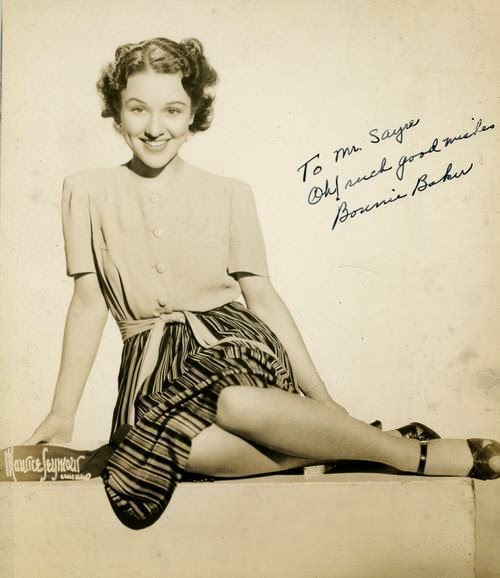
She was born in Orange, Texas on April 1, 1917; most sources give her birth name as Evelyn Nelson although, at the time of her death, her family gave it as Evelyn Underhill. She joined Orrin Tucker's band as a vocalist in 1936, after Louis Armstrong suggested that Tucker recruit her. Tucker gave her the stage name "Wee" Bonnie Baker on account of her height, about 4 foot 11 inches; she later changed her name legally to Bonnie Baker. Her girlish voice, described as "like a tiny silver bell, soft but tonally true", was used on a version of the 1917 song "Oh Johnny, Oh!", written by Abe Olman and Ed Rose. Released on Columbia Records, it became hugely popular in 1940, reaching no. 2 on the pop chart, and reportedly selling over a million copies. She also had success with the songs "You'd Be Surprised", "Billy", "Would Ja Mind", and "Especially For You".
Showing posts with label Orrin Tucker. Show all posts
Wednesday, December 21, 2011
WHERE ARE THEY NOW: WEE BONNIE BAKER
The big band era is just a distant memory now. The bandleaders of that era are all gone, as well as a good bit of the singers. One singer that was pretty much different than all the rest was Wee Bonnie Baker. Bonnie Baker was an American jazz and popular music singer, often credited as Wee Bonnie Baker. Her biggest hit was "Oh Johnny, Oh!" which she recorded with the Orrin Tucker Orchestra in 1939.
She was born in Orange, Texas on April 1, 1917; most sources give her birth name as Evelyn Nelson although, at the time of her death, her family gave it as Evelyn Underhill. She joined Orrin Tucker's band as a vocalist in 1936, after Louis Armstrong suggested that Tucker recruit her. Tucker gave her the stage name "Wee" Bonnie Baker on account of her height, about 4 foot 11 inches; she later changed her name legally to Bonnie Baker. Her girlish voice, described as "like a tiny silver bell, soft but tonally true", was used on a version of the 1917 song "Oh Johnny, Oh!", written by Abe Olman and Ed Rose. Released on Columbia Records, it became hugely popular in 1940, reaching no. 2 on the pop chart, and reportedly selling over a million copies. She also had success with the songs "You'd Be Surprised", "Billy", "Would Ja Mind", and "Especially For You".
After leaving the Tucker orchestra in 1942, she continued with a solo career, singing with the USO (United Service Organizations) during World War II, and appearing regularly on the radio show Your Hit Parade. She also sang with other bands, and married jazz guitarist Bill Gailey. In 1948, she recorded a novelty song, "That's All Folks!", as a duet with Mel Blanc playing the character Daffy Duck. She also voiced the cartoon character Chilly Willy in the 1950s. She released an album, Oh Johnny!, with orchestra conducted by Wilbur Hatch, on Warner Bros. Records in 1956. After moving to Florida in 1958, she continued to sing in clubs with her husband, until she suffered a heart attack in 1965.
She died in Fort Lauderdale, Florida in August 11, 1990 at the age of 73. Band leader Orrin Tucker outlived his famous vocalists by over 20 years. Tucker died on April 9, 2011 at the age of 100...
She was born in Orange, Texas on April 1, 1917; most sources give her birth name as Evelyn Nelson although, at the time of her death, her family gave it as Evelyn Underhill. She joined Orrin Tucker's band as a vocalist in 1936, after Louis Armstrong suggested that Tucker recruit her. Tucker gave her the stage name "Wee" Bonnie Baker on account of her height, about 4 foot 11 inches; she later changed her name legally to Bonnie Baker. Her girlish voice, described as "like a tiny silver bell, soft but tonally true", was used on a version of the 1917 song "Oh Johnny, Oh!", written by Abe Olman and Ed Rose. Released on Columbia Records, it became hugely popular in 1940, reaching no. 2 on the pop chart, and reportedly selling over a million copies. She also had success with the songs "You'd Be Surprised", "Billy", "Would Ja Mind", and "Especially For You".
Labels:
big band,
Orrin Tucker,
singers,
Wee Bonnie Baker
Friday, April 22, 2011
RIP: ORRIN TUCKER
Orrin Tucker was one of the last living big band leaders. I also exchanged music with him back in the late 1990s. He had a long and wonderful life, even though he was an underrated big band leader...
Orrin Tucker, big band leader, dies at 100
by Adam Bernstein,
Orrin Tucker, who led a “sweet” big band for nearly a half-century and was best remembered for a coyly suggestive 1939 recording of “Oh Johnny, Oh Johnny, Oh!” that featured the baby-voiced singer “Wee” Bonnie Baker, died April 9 near Los Angeles. He was 100, and the cause of death was not reported.
The handsome and personable Tucker enjoyed a remarkably long musical career that began when he formed his orchestra in 1933 and continued through the 1980s as owner of a Hollywood ballroom.
The late jazz critic and historian George T. Simon described Mr. Tucker, a onetime pre-med student who sang and played saxophone, as a “friendly and intelligent” musician who “maintained his equilibrium” after “Oh Johnny” catapulted him to prominence.
“Orrin knew his music, his public and his own limitations,” Simon wrote, “and so, a generation after most of the big bands had faded away, he was still around, still playing his pleasant music in some of the country’s smarter spots.”
Playing the light, undemanding jazz style called sweet, which played down improvisation, Mr. Tucker’s band crested along for decades, recording such tunes as “Billy,” “Would Ja Mind?” and his theme, “Drifting and Dreaming.”
He helped establish Columbia Records as a powerhouse when he dusted off “Oh Johnny,” a song of World War I vintage, and his “girl singer” Bonnie Baker spruced it up with sex appeal.
Emitting mischievous sighs between lyrics, Baker sang of a boy of dubious looks (“You’re not handsome, it’s true”) who more than made up for it in other ways.
Time magazine reported: “So melting and cajoling were diminutive Bonnie’s ‘Oh’s’ (Chicago jitterbugs quickly changed the text to ‘Oh Bonnie, Oh!’) that her record was soon jerking juke-box nickels faster than the fading ‘Beer Barrel Polka.’ ”
After Navy service in World War II, Mr. Tucker formed a new band and tried to change his sound to a brassier style of swing — only to hear from “hotel managers [who] threatened to cancel any return bookings if we didn’t go back to the old sound, which I did,” he said.
After playing himself in the 1975 TV movie “Queen of the Stardust Ballroom,” Mr. Tucker plunged into a new business venture by taking a defunct skating rink and transforming it into the Stardust Ballroom on Sunset Boulevard.
He broadened his repertoire to include songs such as “Bad, Bad Leroy Brown,” but he knew his days as a performer were nearing an end. He shut down the ballroom in 1982 and worked in the real estate business in Palm Springs, Calif.
“Orrin Tucker’s death is probably more notable for the longevity that preceded it, as well as for ‘Wee’ Bonnie Baker’s contribution to the band’s success,” said Rob Bamberger, the host of WAMU-FM’s “Hot Jazz Saturday Night” program.
“The wispy sound of the ‘sweet’ bands has not stood up well with time,” Bamberger added, “but Tucker’s band was certainly among the best of its sort.”
Robert Orrin Tucker was born Feb. 17, 1911, in St. Louis, and grew up in Wheaton, Ill. He had an early ambition toward medicine but also was drawn to music as a child when he saw a picture of a shiny saxophone in a Sears Roebuck mail-order catalog.
He moonlighted as a musician while attending North Central College in Naperville, Ill., and found himself in such demand that he formed his own band. He hired singer Evelyn Nelson on trumpeter Louis Armstrong’s recommendation.
“He told me that she sings with a cute voice and that if I wrote cute songs for her, I could make her a star,” Mr. Tucker told the publication Jazz Connection.
He changed her name to Bonnie Baker, which he considered a “name with confidence.” She barely reached 5 feet, prompting Mr. Tucker to introduce her as “Wee” Bonnie Baker.
Mr. Tucker’s first marriage, to fashion model Jill Powell, ended in divorce. In 1975, he married the former Aline Cameron. Besides his wife, survivors include a daughter and a grandson.
“There were so many musicians that said, regardless what the public wants, I’ll play the way I want to play,” Mr. Tucker once reflected. “I’ve always tried to play the music people are fond of and play it the way they want to hear and the way it is easy to dance to. I made it a point to know what the public liked and did my best to please them.”
SOURCE
Labels:
big band,
Bonnie Baker,
deaths,
news,
Orrin Tucker
Thursday, February 17, 2011
BORN ON THIS DAY: ORRIN TUCKER
Orrin Tucker is one of the last surviving big band members. He may not be as famous as Benny Goodman or Artie Shaw, but he is the last one left! Today he turns 100 years old! Tucker was born in St. Louis, Missouri on February 17, 1911. Though he had studied to be a doctor, Orrin Tucker ended up as a singer and a bandleader. He was leading a successful, though not well-known, orchestra in 1939 when his female vocalist, Wee Bonnie Baker, recorded an old WWI tune called ''Oh, Johnny, Oh, Johnny, Oh!''
With the help of her sexy sighs and coos, Tucker found himself with a hit record and one of the hottest bands in the country. Tucker, though, didn't let fame go to his head. He realized his limitations and knew his orchestra's strength, and that strength was in playing dance music for the middle-aged crowd. That he continued to do, very successfully, long after many of his contemporaries had called it quits.
After graduating from high school in 1929, Tucker learned that Northwestern University's School of Speech offered one one-year scholarship per year to an Illinois resident interested in studying theater arts. He figured once enrolled, he could then take pre-med courses. After completing his freshman year, he transferred to North Central College in Naperville, which was closer to Wheaton. To help meet college expenses, Tucker formed a band to play at the Spanish Tearoom in Naperville. The band was so good that it drew patrons from as far away as Chicago. Noting his success, a local agent booked Tucker and his band for a three-week engagement at a New Orleans hotel during Mardi Gras. The band faired well at the "Crescent City" engagement which inspired Tucker to then focus all his energies full time to band leading. "That did it for me," Tucker said. "Staying in music what was what I wanted to do. From then on, there was no turning back."
In 1933, Tucker organized his first full-time band, opting to stay in the Chicago area. Two years later, the band began a long stay at the Troutdale Hotel in Evergreen, CO, with a successful engagement at the "Windy City's" Edgewater Beach Hotel the following year. The clientele at the Edgewater Beach Hotel loved Tucker's music so much that the band returned for a six-month stay at the posh resort in October 1937. By March 1938, the Tucker band found itself playing in the "Big Apple," at the famed Roosevelt Hotel.
Orrin Tucker himself was a pleasant enough singer and his band was gaining popularity. However, when he hired Bonnie Baker as his girl singer in February 1938, the band's popularity increased. "We were in Kansas City at the time and I received a telephone call from Louis Armstrong telling me about this singer named Evelyn Nelson who was singing at the Claridge Hotel in St. Louis," Tucker said. "He told me that she sings with a cute voice and that if I wrote cute songs for her, I could make her a star." Tucker went to check out the five-foot charmer from Orange, TX. He was pleased with what he heard. "It wasn't easy, but I talked her into joining the band," Tucker said. "I also talked her into changing her name. I'm very much in favor for a person's name to begin with consonants. I thought 'Bonnie Baker' was a strong name with confidence. It turned out to be true."
During the early years Tucker was sole vocalist until Louis Armstrong pointed him to Bonnie Baker. Baker's cute voice was just the thing to help push the group over the top. Columbia Records signed them in 1939. ''Oh Johnny, Oh Johnny, Oh!'' was one of songs in their first recording session. It remained their most popular number, reaching the number two spot on the pop charts. Other vocalists over the years included Helen Lee and Scottee Marsh.
During WWII Tucker served in the Navy as a Lieutenant, Junior Grade. He remained active in the music business until health problems forced him to slow down during the 1990s. In 1997, a fire destroyed all of his record and music collection. Reportedly, Tucker has since moved into an assisted living facility, but he was still giving interviews as recent as 2005.
Subscribe to:
Posts (Atom)