One of the singing icons of the big band era has died. Songbird Bea Wain died on August 20th at the age of 100. Bea Wain wasborn Beatrice Weinsier on April 30, 1917 in the Bronx, New York City. She had a number of hits with Larry Clinton and his Orchestra. After her marriage she and her husband became involved in radio.
On a 1937 recording with Artie Shaw, she was credited as Beatrice Wayne, which led some to assume that was her real name. On record labels, her name was shortened (without her permission) to "Bea" by the record company, ostensibly for space considerations. As she explained, "They cut it to 'Bea' Wain. They cut the 'Beatrice' out to 'Bea.' I was just a little old girl singer, but that's the truth. So that's how my name became 'Bea Wain'."
Wain made her debut on radio at age six as a "featured performer" on the NBC Children's Hour. Wain had four No. 1 hits: "Cry, Baby, Cry", "Deep Purple", "Heart and Soul", and her signature song, "My Reverie".
On May 1, 1938, Wain married radio announcer André Baruch. Their honeymoon in Bermuda was cut short when Fred Allen called Baruch asking him to return to New York to substitute for his ailing announcer, Harry von Zell. They were married for 53 years. Baruch died in 1991. The couple had two children, Bonnie and Wayne.
Following her musical career, the couple worked as a husband-and-wife disc jockey team in New York on WMCA, where they were billed as "Mr. and Mrs. Music". In 1973, the couple moved to Palm Beach, Florida, where for nine years they had a top-rated daily four-hour talk show from 2 pm - 6 pm on WPBR before relocating to Beverly Hills. During the early 1980s, the pair hosted a syndicated version of Your Hit Parade, reconstructing the list of hits of selected weeks in the 1940s and playing the original recordings.
In a 2004 interview with Christopher Popa, Wain reflected: "Actually, I've had a wonderful life, a wonderful career. And I'm still singing, and I'm still singing pretty good. This past December, I did a series of shows in Palm Springs, California, and the review said, "Bea Wain is still a giant." It's something called Musical Chairs. I did six shows in six different venues, and I was a smash. And I really got a kick out of it."...
Monday, August 21, 2017
Sunday, August 20, 2017
RIP: JERRY LEWIS
Jerry Lewis, the comedian and filmmaker who was adored by many, disdained by others, but unquestionably a defining figure of American entertainment in the 20th century, died on Sunday morning at his home in Las Vegas. He was 91.
His death was confirmed by his publicist, Candi Cazau.
Mr. Lewis knew success in movies, on television, in nightclubs, on the Broadway stage and in the university lecture hall. His career had its ups and downs, but when it was at its zenith there were few stars any bigger. And he got there remarkably quickly.
Barely out of his teens, he shot to fame shortly after World War II with a nightclub act in which the rakish, imperturbable Dean Martin crooned and the skinny, hyperactive Mr. Lewis capered around the stage, a dangerously volatile id to Mr. Martin’s supremely relaxed ego.
Jerry Lewis was born on March 16, 1926, in Newark. Most sources, including his 1982 autobiography, “Jerry Lewis: In Person,” give his birth name as Joseph Levitch. But Shawn Levy, author of the exhaustive 1996 biography “King of Comedy: The Life and Art of Jerry Lewis,” unearthed a birth record that gave his first name as Jerome.
His parents, Danny and Rae Levitch, were entertainers — his father a song-and-dance man, his mother a pianist — who used the name Lewis when they appeared in small-time vaudeville and at Catskills resort hotels. The Levitches were frequently on the road and often left Joey, as he was called, in the care of Rae’s mother and her sisters. The experience of being passed from home to home left Mr. Lewis with an enduring sense of insecurity and, as he observed, a desperate need for attention and affection.
An often bored student at Union Avenue School in Irvington, N.J., he began organizing amateur shows with and for his classmates, while yearning to join his parents on tour. During the winter of 1938-39, his father landed an extended engagement at the Hotel Arthur in Lakewood, N.J., and Joey was allowed to go along. Working with the daughter of the hotel’s owners, he created a comedy act in which they lip-synced to popular recordings.
By his 16th birthday, Joey had dropped out of Irvington High and was aggressively looking for work, having adopted the professional name Jerry Lewis to avoid confusion with the nightclub comic Joe E. Lewis. He performed his “record act” solo between features at movie theaters in northern New Jersey, and soon moved on to burlesque and vaudeville.
In 1944 — a 4F classification kept him out of the war — he was performing at the Downtown Theater in Detroit when he met Patti Palmer, a 23-year-old singer. Three months later they were married, and on July 31, 1945, while Patti was living with Jerry’s parents in Newark and he was performing at a Baltimore nightclub, she gave birth to the first of the couple’s six sons, Gary, who in the 1960s had a series of hit records with his band Gary Lewis and the Playboys. The couple divorced in 1980.
Between his first date with Ms. Palmer and the birth of his first son, Mr. Lewis had met Dean Martin, a promising young crooner from Steubenville, Ohio. Appearing on the same bill at the Glass Hat nightclub in Manhattan, the skinny kid from New Jersey was dazzled by the sleepy-eyed singer, who seemed to be everything he was not: handsome, self-assured and deeply, unshakably cool.
When they found themselves on the same bill again at another Manhattan nightclub, the Havana-Madrid, in March 1946, they started fooling around in impromptu sessions after the evening’s last show. Their antics earned the notice of Billboard magazine, whose reviewer wrote, “Martin and Lewis do an afterpiece that has all the makings of a sock act,” using showbiz slang for a successful show.
Mr. Lewis must have remembered those words when he was booked that summer at the 500 Club in Atlantic City. When the singer on the program dropped out, he pushed the club’s owner to hire Mr. Martin to fill the spot. Mr. Lewis and Mr. Martin cobbled together a routine based on their after-hours high jinks at the Havana-Madrid, with Mr. Lewis as a bumbling busboy who kept breaking in on Mr. Martin — dropping trays, hurling food, cavorting like a monkey — without ever ruffling the singer’s sang-froid.
The act was a success. Before the week’s end, they were drawing crowds and winning mentions from Broadway columnists. That September, they returned to the Havana-Madrid in triumph.
Bookings at bigger and better clubs in New York and Chicago followed, and by the summer of 1948 they had reached the pinnacle, headlining at the Copacabana on the Upper East Side of Manhattan while playing one show a night at the 6,000-seat Roxy Theater in Times Square.
The phenomenal rise of Martin and Lewis was like nothing show business had seen before. Partly this was because of the rise of mass media after the war, when newspapers, radio and the emerging medium of television came together to create a new kind of instant celebrity. And partly it was because four years of war and its difficult aftermath were finally lifting, allowing America to indulge a long-suppressed taste for silliness. But primarily it was the unusual chemical reaction that occurred when Martin and Lewis were side by side.
Mr. Lewis’s shorthand definition for their relationship was “sex and slapstick.” But much more was going on: a dialectic between adult and infant, assurance and anxiety, bitter experience and wide-eyed innocence that generated a powerful image of postwar America, a gangly young country suddenly dominant on the world stage.
Among the audience members at the Copacabana was the producer Hal Wallis, who had a distribution deal through Paramount Pictures. Other studios were interested — more so after Martin and Lewis began appearing on live television — but it was Mr. Wallis who signed them to a five-year contract.
“That’s My Boy” (1951), “The Stooge” (1953) and “The Caddy” (1953) approached psychological drama with their forbidding father figures and suggestions of sibling rivalry; Mr. Lewis had a hand in the writing of each. “Artists and Models” (1955) and “Hollywood or Bust” (1956) were broadly satirical looks at American popular culture under the authorial hand of the director Frank Tashlin, who brought a bold graphic style and a flair for wild sight gags to his work. For Mr. Tashlin, Mr. Lewis became a live-action extension of the anarchic characters, like Bugs Bunny and Daffy Duck, he had worked with as a director of Warner Bros. cartoons.
Mr. Tashlin also functioned as a mentor to Mr. Lewis, who was fascinated with the technical side of filmmaking. Mr. Lewis made 16-millimeter sound home movies and by 1949 was enlisting celebrity friends for short comedies with titles like “How to Smuggle a Hernia Across the Border.” These were amateur efforts, but Mr. Lewis was soon confident enough to advise veteran directors like George Marshall (“Money From Home”) and Norman Taurog (“Living It Up”) on questions of staging. With Mr. Tashlin, he found a director both sympathetic to his style of comedy and technically adept.
But as his artistic aspirations grew and his control over the films in which he appeared increased, Mr. Lewis’s relationship with Mr. Martin became strained. As wildly popular as the team remained, Mr. Martin had come to resent Mr. Lewis’s dominant role in shaping their work and spoke of reviving his solo career as a singer. Mr. Lewis felt betrayed by the man he still worshiped as a role model, and by the time filming began on “Hollywood or Bust” they were barely speaking.
After a farewell performance at the Copacabana on July 25, 1956, 10 years to the day after they had first appeared together in Atlantic City, Mr. Martin and Mr. Lewis went their separate ways.
For Mr. Lewis, an unexpected success mitigated the trauma of the breakup. His recording of “Rock-a-Bye Your Baby With a Dixie Melody,” belted in a style that suggested Al Jolson, became a Top 10 hit, and the album on which it appeared, “Jerry Lewis Just Sings,” climbed to No. 3 on the Billboard chart, outselling anything his former partner had released.
Reassured that his public still loved him, Mr. Lewis returned to filmmaking with the low-budget, semidramatic “The Delicate Delinquent” and then shifted into overdrive for a series of personal appearances, beginning at the Sands in Las Vegas and culminating with a four-week engagement at the Palace in New York. He signed a contract with NBC for a series of specials and renewed his relationship with the Muscular Dystrophy Association — a charity that he and Mr. Martin had long supported — by hosting a 19-hour telethon.
Mr. Lewis made three uninspired films to complete his obligation to Hal Wallis. He saved his creative energies for the films he produced himself. The first three of those films — “Rock-a-Bye Baby” (1958), “The Geisha Boy” (1958) and “Cinderfella” (1960) — were directed by Mr. Tashlin. After that, finally ready to assume complete control, Mr. Lewis persuaded Paramount to take a chance on “The Bellboy” (1960), a virtually plotless hommage to silent-film comedy that he wrote, directed and starred in, playing a hapless employee of the Fontainebleau Hotel in Miami Beach.
It was the beginning of Mr. Lewis’s most creative period. During the next five years, he directed five more films of remarkable stylistic assurance, including “The Ladies Man” (1961), with its huge multistory set of a women’s boardinghouse, and, most notably, “The Nutty Professor” (1963), a variation on “Dr. Jekyll and Mr. Hyde,” in which Mr. Lewis appeared as a painfully shy chemistry professor and his dark alter ego, a swaggering nightclub singer.
He seemed more himself in the multi-role chase comedy “The Big Mouth” (1967) and the World War II farce “Which Way to the Front?” (1970). But his blend of physical comedy and pathos was quickly going out of style in a Hollywood defined by the countercultural irony of “The Graduate” and “MASH.” After “The Day the Clown Cried,” his audacious attempt to direct a comedy-drama set in a Nazi concentration amp, collapsed in litigation in 1972, Mr. Lewis was absent from films for eight years. In that dark period, he struggled with an addiction to the pain killer Percodan.
“Hardly Working,” an independent production that Mr. Lewis directed in Florida, was released in Europe in 1980 and in the United States in 1981. It referred to Mr. Lewis’s marginalized position by casting him as an unemployed circus clown who finds fulfillment in a mundane job with the post office. For Roger Ebert, writing in The Chicago Sun-Times, “Hardly Working” was “one of the worst movies ever to achieve commercial release in this country,” but the film found moderate success in the United States and Europe and has since earned passionate defenders.
A follow-up in 1983, “Smorgasbord” (also known as “Cracking Up”), proved a misfire, and Mr. Lewis never directed another feature film. He did, however, enjoy a revival as an actor, thanks largely to his powerful performance in a dramatic role in Martin Scorsese’s “The King of Comedy” (1982) as a talk-show host kidnapped by an aspiring comedian (Robert De Niro) desperate to become a celebrity. He appeared in the television series “Wiseguy” in 1988 and 1989 as a garment manufacturer threatened by the mob, and was memorable in character roles in Emir Kusturica’s “Arizona Dream” (1993) and Peter Chelsom’s “Funny Bones” (1995). Mr. Lewis played Mr. Applegate (a.k.a. the Devil) in a Broadway revival of the musical “Damn Yankees” in 1995 and later took the show on an international tour.
Although he retained a preternaturally youthful appearance for many years, Mr. Lewis had a series of serious illnesses in his later life, including prostate cancer, pulmonary fibrosis and two heart attacks. Drug treatments caused his weight to balloon alarmingly, though he recovered enough to continue performing well into the new millennium. He was appearing in one-man shows as recently as 2016...
His death was confirmed by his publicist, Candi Cazau.
Mr. Lewis knew success in movies, on television, in nightclubs, on the Broadway stage and in the university lecture hall. His career had its ups and downs, but when it was at its zenith there were few stars any bigger. And he got there remarkably quickly.
Barely out of his teens, he shot to fame shortly after World War II with a nightclub act in which the rakish, imperturbable Dean Martin crooned and the skinny, hyperactive Mr. Lewis capered around the stage, a dangerously volatile id to Mr. Martin’s supremely relaxed ego.
Jerry Lewis was born on March 16, 1926, in Newark. Most sources, including his 1982 autobiography, “Jerry Lewis: In Person,” give his birth name as Joseph Levitch. But Shawn Levy, author of the exhaustive 1996 biography “King of Comedy: The Life and Art of Jerry Lewis,” unearthed a birth record that gave his first name as Jerome.
His parents, Danny and Rae Levitch, were entertainers — his father a song-and-dance man, his mother a pianist — who used the name Lewis when they appeared in small-time vaudeville and at Catskills resort hotels. The Levitches were frequently on the road and often left Joey, as he was called, in the care of Rae’s mother and her sisters. The experience of being passed from home to home left Mr. Lewis with an enduring sense of insecurity and, as he observed, a desperate need for attention and affection.
An often bored student at Union Avenue School in Irvington, N.J., he began organizing amateur shows with and for his classmates, while yearning to join his parents on tour. During the winter of 1938-39, his father landed an extended engagement at the Hotel Arthur in Lakewood, N.J., and Joey was allowed to go along. Working with the daughter of the hotel’s owners, he created a comedy act in which they lip-synced to popular recordings.
By his 16th birthday, Joey had dropped out of Irvington High and was aggressively looking for work, having adopted the professional name Jerry Lewis to avoid confusion with the nightclub comic Joe E. Lewis. He performed his “record act” solo between features at movie theaters in northern New Jersey, and soon moved on to burlesque and vaudeville.
In 1944 — a 4F classification kept him out of the war — he was performing at the Downtown Theater in Detroit when he met Patti Palmer, a 23-year-old singer. Three months later they were married, and on July 31, 1945, while Patti was living with Jerry’s parents in Newark and he was performing at a Baltimore nightclub, she gave birth to the first of the couple’s six sons, Gary, who in the 1960s had a series of hit records with his band Gary Lewis and the Playboys. The couple divorced in 1980.
Between his first date with Ms. Palmer and the birth of his first son, Mr. Lewis had met Dean Martin, a promising young crooner from Steubenville, Ohio. Appearing on the same bill at the Glass Hat nightclub in Manhattan, the skinny kid from New Jersey was dazzled by the sleepy-eyed singer, who seemed to be everything he was not: handsome, self-assured and deeply, unshakably cool.
When they found themselves on the same bill again at another Manhattan nightclub, the Havana-Madrid, in March 1946, they started fooling around in impromptu sessions after the evening’s last show. Their antics earned the notice of Billboard magazine, whose reviewer wrote, “Martin and Lewis do an afterpiece that has all the makings of a sock act,” using showbiz slang for a successful show.
Mr. Lewis must have remembered those words when he was booked that summer at the 500 Club in Atlantic City. When the singer on the program dropped out, he pushed the club’s owner to hire Mr. Martin to fill the spot. Mr. Lewis and Mr. Martin cobbled together a routine based on their after-hours high jinks at the Havana-Madrid, with Mr. Lewis as a bumbling busboy who kept breaking in on Mr. Martin — dropping trays, hurling food, cavorting like a monkey — without ever ruffling the singer’s sang-froid.
The act was a success. Before the week’s end, they were drawing crowds and winning mentions from Broadway columnists. That September, they returned to the Havana-Madrid in triumph.
Bookings at bigger and better clubs in New York and Chicago followed, and by the summer of 1948 they had reached the pinnacle, headlining at the Copacabana on the Upper East Side of Manhattan while playing one show a night at the 6,000-seat Roxy Theater in Times Square.
The phenomenal rise of Martin and Lewis was like nothing show business had seen before. Partly this was because of the rise of mass media after the war, when newspapers, radio and the emerging medium of television came together to create a new kind of instant celebrity. And partly it was because four years of war and its difficult aftermath were finally lifting, allowing America to indulge a long-suppressed taste for silliness. But primarily it was the unusual chemical reaction that occurred when Martin and Lewis were side by side.
Mr. Lewis’s shorthand definition for their relationship was “sex and slapstick.” But much more was going on: a dialectic between adult and infant, assurance and anxiety, bitter experience and wide-eyed innocence that generated a powerful image of postwar America, a gangly young country suddenly dominant on the world stage.
Among the audience members at the Copacabana was the producer Hal Wallis, who had a distribution deal through Paramount Pictures. Other studios were interested — more so after Martin and Lewis began appearing on live television — but it was Mr. Wallis who signed them to a five-year contract.
“That’s My Boy” (1951), “The Stooge” (1953) and “The Caddy” (1953) approached psychological drama with their forbidding father figures and suggestions of sibling rivalry; Mr. Lewis had a hand in the writing of each. “Artists and Models” (1955) and “Hollywood or Bust” (1956) were broadly satirical looks at American popular culture under the authorial hand of the director Frank Tashlin, who brought a bold graphic style and a flair for wild sight gags to his work. For Mr. Tashlin, Mr. Lewis became a live-action extension of the anarchic characters, like Bugs Bunny and Daffy Duck, he had worked with as a director of Warner Bros. cartoons.
Mr. Tashlin also functioned as a mentor to Mr. Lewis, who was fascinated with the technical side of filmmaking. Mr. Lewis made 16-millimeter sound home movies and by 1949 was enlisting celebrity friends for short comedies with titles like “How to Smuggle a Hernia Across the Border.” These were amateur efforts, but Mr. Lewis was soon confident enough to advise veteran directors like George Marshall (“Money From Home”) and Norman Taurog (“Living It Up”) on questions of staging. With Mr. Tashlin, he found a director both sympathetic to his style of comedy and technically adept.
But as his artistic aspirations grew and his control over the films in which he appeared increased, Mr. Lewis’s relationship with Mr. Martin became strained. As wildly popular as the team remained, Mr. Martin had come to resent Mr. Lewis’s dominant role in shaping their work and spoke of reviving his solo career as a singer. Mr. Lewis felt betrayed by the man he still worshiped as a role model, and by the time filming began on “Hollywood or Bust” they were barely speaking.
After a farewell performance at the Copacabana on July 25, 1956, 10 years to the day after they had first appeared together in Atlantic City, Mr. Martin and Mr. Lewis went their separate ways.
For Mr. Lewis, an unexpected success mitigated the trauma of the breakup. His recording of “Rock-a-Bye Your Baby With a Dixie Melody,” belted in a style that suggested Al Jolson, became a Top 10 hit, and the album on which it appeared, “Jerry Lewis Just Sings,” climbed to No. 3 on the Billboard chart, outselling anything his former partner had released.
Reassured that his public still loved him, Mr. Lewis returned to filmmaking with the low-budget, semidramatic “The Delicate Delinquent” and then shifted into overdrive for a series of personal appearances, beginning at the Sands in Las Vegas and culminating with a four-week engagement at the Palace in New York. He signed a contract with NBC for a series of specials and renewed his relationship with the Muscular Dystrophy Association — a charity that he and Mr. Martin had long supported — by hosting a 19-hour telethon.
Mr. Lewis made three uninspired films to complete his obligation to Hal Wallis. He saved his creative energies for the films he produced himself. The first three of those films — “Rock-a-Bye Baby” (1958), “The Geisha Boy” (1958) and “Cinderfella” (1960) — were directed by Mr. Tashlin. After that, finally ready to assume complete control, Mr. Lewis persuaded Paramount to take a chance on “The Bellboy” (1960), a virtually plotless hommage to silent-film comedy that he wrote, directed and starred in, playing a hapless employee of the Fontainebleau Hotel in Miami Beach.
It was the beginning of Mr. Lewis’s most creative period. During the next five years, he directed five more films of remarkable stylistic assurance, including “The Ladies Man” (1961), with its huge multistory set of a women’s boardinghouse, and, most notably, “The Nutty Professor” (1963), a variation on “Dr. Jekyll and Mr. Hyde,” in which Mr. Lewis appeared as a painfully shy chemistry professor and his dark alter ego, a swaggering nightclub singer.
He seemed more himself in the multi-role chase comedy “The Big Mouth” (1967) and the World War II farce “Which Way to the Front?” (1970). But his blend of physical comedy and pathos was quickly going out of style in a Hollywood defined by the countercultural irony of “The Graduate” and “MASH.” After “The Day the Clown Cried,” his audacious attempt to direct a comedy-drama set in a Nazi concentration amp, collapsed in litigation in 1972, Mr. Lewis was absent from films for eight years. In that dark period, he struggled with an addiction to the pain killer Percodan.
“Hardly Working,” an independent production that Mr. Lewis directed in Florida, was released in Europe in 1980 and in the United States in 1981. It referred to Mr. Lewis’s marginalized position by casting him as an unemployed circus clown who finds fulfillment in a mundane job with the post office. For Roger Ebert, writing in The Chicago Sun-Times, “Hardly Working” was “one of the worst movies ever to achieve commercial release in this country,” but the film found moderate success in the United States and Europe and has since earned passionate defenders.
A follow-up in 1983, “Smorgasbord” (also known as “Cracking Up”), proved a misfire, and Mr. Lewis never directed another feature film. He did, however, enjoy a revival as an actor, thanks largely to his powerful performance in a dramatic role in Martin Scorsese’s “The King of Comedy” (1982) as a talk-show host kidnapped by an aspiring comedian (Robert De Niro) desperate to become a celebrity. He appeared in the television series “Wiseguy” in 1988 and 1989 as a garment manufacturer threatened by the mob, and was memorable in character roles in Emir Kusturica’s “Arizona Dream” (1993) and Peter Chelsom’s “Funny Bones” (1995). Mr. Lewis played Mr. Applegate (a.k.a. the Devil) in a Broadway revival of the musical “Damn Yankees” in 1995 and later took the show on an international tour.
Although he retained a preternaturally youthful appearance for many years, Mr. Lewis had a series of serious illnesses in his later life, including prostate cancer, pulmonary fibrosis and two heart attacks. Drug treatments caused his weight to balloon alarmingly, though he recovered enough to continue performing well into the new millennium. He was appearing in one-man shows as recently as 2016...
Labels:
actors,
comedian,
Dean Martin,
deaths,
director,
Jerry Lewis,
news
Monday, August 14, 2017
THE LAST DAYS OF MARLENE DIETRICH
The great Marlene Dietrich was a cinema icon for decades. She also tried to create an illusion of being young even as she entered her 70s. Her final years were marked with sadness but also is showed how mentally active she stayed until the end. Dietrich's show business career largely ended on September 29, 1975, when she fell off the stage and broke her thigh during a performance in Sydney, Australia. The following year, her husband, Rudolf Sieber, died of cancer on June 24, 1976 Dietrich's final on-camera film appearance was a cameo role in Just a Gigolo (1979), starring David Bowie and directed by David Hemmings, in which she sang the title song.
An alcoholic dependent on painkillers, Dietrich withdrew to her apartment at 12 Avenue Montaigne in Paris. She spent the final 11 years of her life mostly bedridden, allowing only a select few—including family and employees—to enter the apartment. During this time, she was a prolific letter-writer and phone-caller. Her autobiography, Nehmt nur mein Leben (Take Just My Life), was published in 1979.
In 1982, Dietrich agreed to participate in a documentary film about her life, Marlene (1984), but refused to be filmed. The film's director, Maximilian Schell, was allowed only to record her voice. He used his interviews with her as the basis for the film, set to a collage of film clips from her career. The final film won several European film prizes and received an Academy Award nomination for Best Documentary in 1984. Newsweek named it "a unique film, perhaps the most fascinating and affecting documentary ever made about a great movie star".
In 1988, Dietrich recorded spoken introductions to songs for a nostalgia album by Udo Lindenberg. In an interview with the German magazine Der Spiegel in November 2005, Dietrich's daughter and grandson claim that Dietrich was politically active during these years. She kept in contact with world leaders by telephone, including Ronald Reagan and Mikhail Gorbachev, running up a monthly bill of over US$3,000. In 1989, her appeal to save the Babelsberg studios from closure was broadcast on BBC Radio, and she spoke on television via telephone on the occasion of the fall of the Berlin Wall later that year.
On 6 May 1992, Dietrich died of renal failure at her flat in Paris at age 90. Her funeral ceremony was conducted at La Madeleine in Paris, a Roman Catholic church on 14 May 1992. Dietrich's funeral service was attended by approximately 1,500 mourners in the church itself—including several ambassadors from Germany, Russia, the US, the UK and other countries—with thousands more outside. Her closed coffin rested beneath the altar draped in the French flag and adorned with a simple bouquet of white wildflowers and roses from the French President, François Mitterrand. Three medals, including France's Legion of Honour and the US Medal of Freedom, were displayed at the foot of the coffin, military style, for a ceremony symbolising the sense of duty Dietrich embodied in her career as an actress, and in her personal fight against Nazism. The officiating priest remarked: "Everyone knew her life as an artist of film and song, and everyone knew her tough stands... She lived like a soldier and would like to be buried like a soldier". By a coincidence of fate her picture was used in the Cannes Film Festival poster that year which was currently pasted up all over Paris.
After the fall of the Berlin Wall, Dietrich instructed in her will that she was to be buried in her birthplace, Berlin, near her family; on 16 May her body was flown there to fulfill her wish. Dietrich was interred at the Städtischer Friedhof III, Berlin-Schöneberg, next to the grave of her mother, Josefine von Losch, and near the house where she was born.
Tuesday, August 1, 2017
COOKING WITH THE STARS: JUDY GARLAND
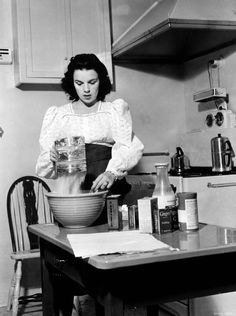
I am not sure how much Judy Garland cooked in the kitchen. I have heard from some accounts that she liked to cook, but with all of her constant need to perform, I picture Judy not having the ambition to relax in the kitchen. Nevertheless, here's a recipe I found for her pancakes...
Judy Garland's Savory Pancakes
Four ounces plain flour
1 egg
12 tablespoons milk
pinch salt
1 finely chopped onion
mixed herbs
parsley
pepper
Sift flour and salt into a large, cool basin; make a well in the center and break in the egg; gently stir the flour into the egg, then gradually the milk, and when half the milk has been added ail the flour should be moistened; it should then be beaten thoroughly to remove any lumps; add the rest of the milk, mixing in evenly; strain and stand for one hour; then add onion, parsley, herbs and pepper; melt a little butter in a small frying pan; pour in enough batter to cover the bottom of the pan thinly; fry until a golden brown on both sides; toss or turn with a knife; roll up and serve very hot, garnished with parsley.
Judy Garland's Savory Pancakes
Four ounces plain flour
1 egg
12 tablespoons milk
pinch salt
1 finely chopped onion
mixed herbs
parsley
pepper
Sift flour and salt into a large, cool basin; make a well in the center and break in the egg; gently stir the flour into the egg, then gradually the milk, and when half the milk has been added ail the flour should be moistened; it should then be beaten thoroughly to remove any lumps; add the rest of the milk, mixing in evenly; strain and stand for one hour; then add onion, parsley, herbs and pepper; melt a little butter in a small frying pan; pour in enough batter to cover the bottom of the pan thinly; fry until a golden brown on both sides; toss or turn with a knife; roll up and serve very hot, garnished with parsley.
Tuesday, July 25, 2017
RIP: BARBARA SINATRA
Barbara Sinatra, the wife of late-singer Frank Sinatra, died Tuesday morning at her Rancho Mirage, California, home, a family spokesman told Fox News. She was 90.
The Barbara Sinatra Children’s Center director John Thoresen told Fox News Sinatra died of natural causes, and she was "comfortably surrounded by family and friends" at the time of her death.
Born Barbara Blakeley, the Bosworth, Missouri, native began her modeling career at 18 after her family moved to Long Beach, California.
Shortly after her move, she married Robert Oliver, but they divorced, and she then married Zeppo Marx in 1959. After she and Marx divorced, she went on to marry Frank Sinatra who was previously married three times.
Barbara and Frank Sinatra wed in 1976 in a private ceremony at the Annenberg Estate in Rancho Mirage. She and the "Come Fly With Me" singer remained married until Frank Sinatra's death in 1998.
Barbara Sinatra became famous in her own right for her work battling child abuse. She founded the Barbara Sinatra Children's Center to help children who were victims of abuse.
She is survived by her son from a previous marriage Robert Oliver Marx, his wife Hillary Roberts and her granddaughter Carina Blakeley Marx...
The Barbara Sinatra Children’s Center director John Thoresen told Fox News Sinatra died of natural causes, and she was "comfortably surrounded by family and friends" at the time of her death.
Born Barbara Blakeley, the Bosworth, Missouri, native began her modeling career at 18 after her family moved to Long Beach, California.
Shortly after her move, she married Robert Oliver, but they divorced, and she then married Zeppo Marx in 1959. After she and Marx divorced, she went on to marry Frank Sinatra who was previously married three times.
Barbara and Frank Sinatra wed in 1976 in a private ceremony at the Annenberg Estate in Rancho Mirage. She and the "Come Fly With Me" singer remained married until Frank Sinatra's death in 1998.
Barbara Sinatra became famous in her own right for her work battling child abuse. She founded the Barbara Sinatra Children's Center to help children who were victims of abuse.
She is survived by her son from a previous marriage Robert Oliver Marx, his wife Hillary Roberts and her granddaughter Carina Blakeley Marx...
Labels:
Barbara Sinatra,
deaths,
Frank Sinatra,
news
Monday, July 17, 2017
MARTIN LANDAU AS BELA LUGOSI
With the death of Martin Landau this past week, I was reminded of my favorite role he did - that of Bela Lugosi in Ed Wood (1994). To remember this remarkable actor, I dug up a review of his performance. Scott Schuldt wrote this piece and it appeared around October 7, 1994 in newspapers and magazines...
NEW YORK - The first time the audience sees Martin Landau in "Ed Wood," he's lying in a store's display coffin, complaining about its lack of elbow room.
What's interesting is that if you didn't know in advance it was Landau playing Bela Lugosi, you might not recognize him at all.Rick Baker's makeup transforms his features. With his real voice hidden by a Hungarian accent, Martin Landau the actor disappears and Lugosi, the long dead actor who played "Dracula" in 1931 comes vividly back to life.
The Lugosi of "Ed Wood" is not a happy one. He's in his 70s, debilitated not just by his age but by 20 years of morphine addiction. He's also out of work, an "ex-bogeyman" as he refers to himself, who finds work again, even if it is in the monumentally awful films of Edward D. Wood Jr. Landau was made available to the press for interviews during a recent promotional trip for the movie "Ed Wood," paid for by Touchstone Pictures.
While Landau's choice to play Lugosi was an inspired one that should hopefully land him his third Oscar nomination since 1988, the actor was surprised director Tim Burton chose him.
"I'm amazed that Tim thought of me. Well, in the sense that I'd never met Tim," Landau said.
"I liked his work a lot ... He was one of those guys I said, 'Gee, I would like to work with that guy. ' I got a call and he said, 'You are my first and only choice for this. ' " What Burton saw in Landau is clear from the performance he gives as Lugosi, whose relationship with Wood, played by Johnny Depp, is at the heart of the film.
You might also be interested in...
"I met Johnny and loved him immediately. ... We became friends.
Generation gaps - nonsense. I mean, Lugosi and Ed Wood, there was a lot of years between them. Johnny became - and is - my pal," Landau said.
It's the rapport that develops between the two actors that deepens the movie.
"There is a sweetness in (the relationship between Wood and Lugosi), yet it's got layers ... It's an interesting relationship.
You don't see that a lot in film. These are two guys who needed each other and they're two really weird, strange guys. " Landau credits his co-star for the screen relationship's success.
"I love an actor who comes in, ready to work. It's like a good tennis player. They hit the ball where you don't expect it and it's great," Landau said.
"Ed Wood" marks the latest in a series of notable roles that have marked a resurgence in Landau's career. Following "Tuc-ker: The Man and His Dream" in 1988 and "Crimes and Misdemeanors" in 1989, both of which earned him Oscar nominations, Landau finds himself more in demand than ever.
"The more complicated the character, the better I am. It's the one-dimensional crap that I had to do for years that drove me crazy," he said.
"If you are in a meaningless, mindless movie playing a one-dimensional character, don't get too clever, because you're only going to dig a hole for yourself ... It's good writing and complicated stuff. When I got 'Tucker,' and there had been a dearth of that stuff coming my way, I said, 'My God, this is a part. ' " He certainly welcomes the praise and Oscar buzz he's receiving for his work as Lugosi, saying it's much better than hearing nothing.
"I'd rather hear this talk than the alternative. I've walked off the stage and people have said, 'That was really great. You look really nice in that suit. ' It's looks and feelings that you get.
People never say, 'Jeez, you were awful. " In many interviews, Landau has referred to his work in "Ed Wood" as a love letter to Lugosi, with whom the 60-year-old Landau had a formative film experience.
"I saw (Lugosi) when I was a kid and he scared the life out of me. I literally didn't sleep for days," Landau said. The 63-year-old film's power hasn't diminished in Landau's mind.
"It was a revival of 'Dracula. ' I was maybe 8 or 9 years old and there was this incredible creature on the screen. Look at it again...
NEW YORK - The first time the audience sees Martin Landau in "Ed Wood," he's lying in a store's display coffin, complaining about its lack of elbow room.
What's interesting is that if you didn't know in advance it was Landau playing Bela Lugosi, you might not recognize him at all.Rick Baker's makeup transforms his features. With his real voice hidden by a Hungarian accent, Martin Landau the actor disappears and Lugosi, the long dead actor who played "Dracula" in 1931 comes vividly back to life.
The Lugosi of "Ed Wood" is not a happy one. He's in his 70s, debilitated not just by his age but by 20 years of morphine addiction. He's also out of work, an "ex-bogeyman" as he refers to himself, who finds work again, even if it is in the monumentally awful films of Edward D. Wood Jr. Landau was made available to the press for interviews during a recent promotional trip for the movie "Ed Wood," paid for by Touchstone Pictures.
While Landau's choice to play Lugosi was an inspired one that should hopefully land him his third Oscar nomination since 1988, the actor was surprised director Tim Burton chose him.
"I'm amazed that Tim thought of me. Well, in the sense that I'd never met Tim," Landau said.
"I liked his work a lot ... He was one of those guys I said, 'Gee, I would like to work with that guy. ' I got a call and he said, 'You are my first and only choice for this. ' " What Burton saw in Landau is clear from the performance he gives as Lugosi, whose relationship with Wood, played by Johnny Depp, is at the heart of the film.
You might also be interested in...
"I met Johnny and loved him immediately. ... We became friends.
Generation gaps - nonsense. I mean, Lugosi and Ed Wood, there was a lot of years between them. Johnny became - and is - my pal," Landau said.
It's the rapport that develops between the two actors that deepens the movie.
"There is a sweetness in (the relationship between Wood and Lugosi), yet it's got layers ... It's an interesting relationship.
You don't see that a lot in film. These are two guys who needed each other and they're two really weird, strange guys. " Landau credits his co-star for the screen relationship's success.
"I love an actor who comes in, ready to work. It's like a good tennis player. They hit the ball where you don't expect it and it's great," Landau said.
"Ed Wood" marks the latest in a series of notable roles that have marked a resurgence in Landau's career. Following "Tuc-ker: The Man and His Dream" in 1988 and "Crimes and Misdemeanors" in 1989, both of which earned him Oscar nominations, Landau finds himself more in demand than ever.
"The more complicated the character, the better I am. It's the one-dimensional crap that I had to do for years that drove me crazy," he said.
"If you are in a meaningless, mindless movie playing a one-dimensional character, don't get too clever, because you're only going to dig a hole for yourself ... It's good writing and complicated stuff. When I got 'Tucker,' and there had been a dearth of that stuff coming my way, I said, 'My God, this is a part. ' " He certainly welcomes the praise and Oscar buzz he's receiving for his work as Lugosi, saying it's much better than hearing nothing.
"I'd rather hear this talk than the alternative. I've walked off the stage and people have said, 'That was really great. You look really nice in that suit. ' It's looks and feelings that you get.
People never say, 'Jeez, you were awful. " In many interviews, Landau has referred to his work in "Ed Wood" as a love letter to Lugosi, with whom the 60-year-old Landau had a formative film experience.
"I saw (Lugosi) when I was a kid and he scared the life out of me. I literally didn't sleep for days," Landau said. The 63-year-old film's power hasn't diminished in Landau's mind.
"It was a revival of 'Dracula. ' I was maybe 8 or 9 years old and there was this incredible creature on the screen. Look at it again...
Labels:
Bela Lugosi,
deaths,
Ed Wood,
Johnny Depp,
Martin Landau,
Tim Burton,
tributes
Wednesday, July 12, 2017
DIED ON THIS DAY: LON CHANEY JR
Lon Chaney Jr. died on this day - July 12th some 45 years ago. Chaney was only 67. He was one of the most emblematic horror film stars of the 1940s. Though given the name "Creighton Chaney" by his parents, he took the name "Lon Chaney, Jr." at the behest of a producer who wished to capitalize on the reputation of his father, who had starred in such silent classics as "The Hunchback of Notre Dame" and "Phantom of the Opera."
After playing a number of small, forgettable roles through the 1930s, the younger Chaney's first role of note was 'Lenny Small' in the 1939 film adaptation of John Steinbeck's "Of Mice and Men." This role made great use of Chaney's size and empathetic manner, and would remain his favorite. He followed this with an even greater success, playing the title character in 1941's "The Wolf Man." His performance, which echoed his own life as a prodigal son figure returning home only to find tragedy, came as his father's studio, Universal Pictures, was struggling to reestablish itself as the premier studio for horror films. Universal would cast Chaney in a string of sequels to both "The Wolf Man" and it's classic films of the 1930s.
All in all, Chaney would end up playing the Wolf Man five times, the barely mobile mummy Kharis three times, the Frankenstein Monster once (and again, briefly, in perhaps the best of Universal's long run of sequels, 1948's "Abbott and Costello Meet Frankenstein" when Glenn Strange was incapacitated), and Dracula once. He would also star in Universal's "Inner Sanctum" series and a number of lesser thrillers through the 1940s. Though the films were always entertaining, and Chaney almost always made a great effort to imbue his performances with quality, the formulaic nature of these productions concealed his ability, and he became typecast as a "monster."
Chaney's last roles of note were as a supporting player in both 1952's "High Noon" (starring Gary Cooper) and 1958's "The Defiant Ones" with Tony Curtis and Sidney Poitier. More often, he would play in a number of low-budget films, mostly westerns and horror films, often reprising his roles from the glory days at Universal. Always a heavy drinker, he would die from various alcohol-related ailments after playing his last role, fittingly enough a non-speaking part in the 1971 farce "Dracula vs. Frankenstein.". His body was dedicated to medical science...
Labels:
1973,
actors,
died on this day,
horror,
July 12,
Lon Chaney Jr
Subscribe to:
Posts (Atom)