Saturday, December 8, 2012

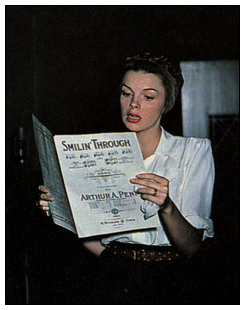
JUDY GARLAND AND A STRAIGHT MAN'S REVIEW

Growing up, I was close to my grandfather, and he instilled in me a love to the music, movies, and entertainment of the 1930s and 1940s. I immersed myself into every facet of old Hollywood, and I still do. It filled the void of my awkward years between grade school and college when I did not have much options with the opposite sex.

In the 1930s and 1940s, entertainers like Judy Garland were not seen as “gay icons”. I have asked one of my homosexual friends why Garland is so beloved among gay men, and his answer was that “her personal struggles seemed to mirror those of gay men in America during the height of her fame.” In recent years it seems that Judy Garland is only admired in the homosexual community, and I feel that is not true. I am a heterosexual who also likes Judy Garland.

My preference for Judy Garland is her younger years before she was given the unfortunate boot from MGM studios in 1950. I have never heard a voice like hers coming out of someone so young. You truly forget that Judy Garland was only 17 when she filmed The Wizard Of Oz. She seemed so assured and confident in herself that many seasoned thespians do not possess. Unfortunately, we now know that Garland never felt confident in herself, and she turned to booze and drugs to mask her insecurities.

She is widely regarded as a movie star, but do yourself a favor and listen to her recordings she did for Decca Records in the 1930s and 1940s. As a singer at that time, she was among the best. Do yourself a favor and listen to her record she made of the song “Could This Be The End Of The Rainbow” in 1940. It has nothing to do with The Wizard Of Oz, but the song sounds like it is sung by a 30 year old and not a young 18 year old. Judy’s voice was truly as advanced as her lifestyle was. Older stars like Jo Stafford, Ginny Simms, and Dinah Shore were making records, singing of lost loves and loneliness, but I would recommend you listening to a 20 year old Judy Garland singing “No Love, No Nothin” from 1942. No one has sung it better.


It is a crime that Judy Garland never won an acting Oscar, although she was nominated in 1954 and 1961. Again, I prefer the movies Judy did when she was younger. A little forgotten movie called Little Nellie Kelly (1940) is a great example of her acting at the time. The movie was a musical, but in the film Garland played two roles as a mother and then later as the grown daughter. There was surprising drama for a 1940 Garland film in the film from death of a loved one to family estrangement. I am really surprised the film isn’t remembered more than it is.

Of course the big joy of being a Judy Garland fan is seeing her in those splashy MGM musicals that they were so famous for. In her first “adult” role, she outdanced newcomer Gene Kelly in For Me And My Gal (1942). You can see the pain in her eyes singing “After You’ve Gone”. The scene was supposedly filmed right around the time her marriage to musician David Rose was breaking up, and MGM forced her to have an abortion. Another great underrated Garland movie moment was her cameo appearance in the all-star musical Thousands Cheer (1943). She was only on screen briefly but she sang one of her best musical numbers “The Joint Is Really Jumping”. She never recorded the song commercially, and it is just a typical jive number of the war era, but it was a great moment.


I could go on and on, but I just want people to know that Judy Garland is just not an icon for the gay community. During the 1930s and 1940s, Garland was a happy diversion from the pain of the Great Depression and World War II, and her films and records gave people hope for the future. I am not a huge fan though of the post 1950 Garland. She made some great albums for Capitol Records in the late 1950s, and Judy made memorable movies like "A Star Is Born" (1954) and "Judgement At Nuremberg" (1961), but in my opinion there is nothing like the young Judy Garland. Sadly, Garland died way too young at the age of 47 in 1969, but this heterosexual fan is happy for all of the entertainment she provided in that short but talented life…


Thursday, December 6, 2012

KING OF THE HILL: A MODERN CLASSIC

In the short history of adult cartoons, there have been many trend setters. The Simpsons expanded the genre that was started by The Flinstones decades earlier. Then South Park and Family Guy came along to shock, appall, and capture the attention of audiences. Nestled in the middle of The Simpsons and Family Guy was a charming little cartoon by the name of King Of The Hill.

King of the Hill was created by Mike Judge and Greg Daniels that ran from January 12, 1997, to May 6, 2010, on the Fox network. It centered on the Hills, a middle-class Methodist family in the fictional small suburban town of Arlen, Texas. It attempted to retain a naturalistic approach, seeking humor in the conventional and mundane aspects of everyday life while dealing with issues comically.

Judge and Daniels conceived the series after a run with Judge's Beavis and Butt-head on MTV, and the series debuted on the Fox network as a midseason replacement on January 12, 1997, quickly becoming a hit. The series's popularity led to syndication around the world, and episodes run every night on Cartoon Network's Adult Swim.

In early 1995, after the successful run of Beavis and Butt-head on MTV, Mike Judge co-created the show King of the Hill with former Simpsons writer Greg Daniels. Judge was a former resident of Garland, Texas, upon which the fictional community of Arlen was loosely based; however, the show was based more specifically on Richardson, Texas, a Dallas suburb, as Judge stated in a later interview. Mike Judge conceived the idea for the show, drew the main characters, and wrote a pilot script.


FOX teamed the cartoonist with Greg Daniels, an experienced prime-time TV writer. Greg Daniels rewrote the pilot script and created several important characters that did not appear in Judge's first draft (including Luanne and Cotton), as well as some characterization ideas (e.g., making Dale Gribble a conspiracy theorist). While Judge's writing tended to emphasize political humor, specifically the clash of Hank Hill's social conservatism and interlopers' liberalism, Daniels focused on character development to provide an emotional context for the series' numerous culture clashes. Judge was ultimately so pleased with Daniels' contributions that he chose to credit him as a co-creator, rather than give him the "developer" credit usually reserved for individuals brought on to a pilot written by someone else.

The show became one of Fox's longest-running series, and at the time of its cancellation the second longest-running American animated series. In 2007 it was named by Time magazine as one of the top 100 greatest television shows of all time.

King of the Hill aired its series finale on September 13, 2009, with four episodes from season 13 unaired. The remaining four episodes aired in syndication on local stations from May 3 to 6, 2010, and on Adult Swim from May 17 to 20, 2010.

I know that grown adults probably should not be watching cartoons, but King Of The Hill is one of those shows that I can not stop watching. The show does not gross out or shock audiences, but it was a charming story about an average family doing average things. It could easily have been a live action comedy, and was much more funny than most of the sitcoms on television today. King of The Hill has been off the air for over two years now, but the show will always be king of the cartoons for me...

Wednesday, December 5, 2012

RIP: DAVID BRUBECK

Dave Brubeck, a pianist and composer whose distinctive mixture of experimentation and accessibility made him one of the most popular jazz musicians of the 1950s and ’60s, died Wednesday morning in Norwalk, Conn. He would have turned 92 on Thursday. He died while on his way to a cardiology appointment, Russell Gloyd, his producer, conductor and manager for 36 years, said. Mr. Brubeck lived in Wilton, Conn.

In a long and successful career, Mr. Brubeck helped repopularize jazz at a time when younger listeners had been trained to the sonic dimensions of the three-minute pop single. His quartet’s 1959 recording of “Take Five” was the first jazz single to sell a million copies.

Mr. Brubeck experimented with time signatures and polytonality and explored musical theater and the oratorio, baroque compositional devices and foreign modes. But he did not always please the critics, who often described his music as schematic, bombastic and — a word he particularly disliked — stolid. His very stubbornness and strangeness — the polytonality, the blockiness of his playing, the oppositional push-and-pull between his piano and Paul Desmond’s alto saxophone — makes the Brubeck quartet’s best work still sound original.

Outside of the group’s most famous originals, which had the charm and durability of pop songs (“Time Out,” “Blue Rondo à la Turk,” “It’s a Raggy Waltz”), some of its best work was in its overhauls of standards like “You Go to My Head,” “All the Things You Are” and “Pennies From Heaven.”

David Warren Brubeck was born on Dec. 6, 1920, in Concord, Calif., near San Francisco. Surrounded by farms, his family lived a bucolic life: his father, Pete, was a cattle buyer for a meat company, and his mother, Elizabeth, was a choir director at the nearby Presbyterian church. When Mr. Brubeck was 11, the family moved to Ione, Calif., where his father managed a 45,000-acre cattle ranch and owned his own 1,200 acres.

At the College of the Pacific, near Stockton, he first studied to be a veterinarian but switched to music after a year. It was there that he learned about 20th-century culture and read about Freud, Marx and serial music; it was also there that he met Iola Whitlock, a fellow student, who became his wife in 1942. He graduated that year and was immediately drafted. For two years he played with the Army band at Camp Haan, in Southern California. In 1944 Private Brubeck became a rifleman, entering basic training — first in Texas, then in Maryland — and was shortly sent to Metz, in eastern France, for further preparation for combat.


Finished with the Army at 25, Mr. Brubeck moved with his wife into an apartment in Oakland, Calif., and, on a G.I. Bill scholarship, studied at Mills College with the French composer Darius Milhaud. Milhaud asked the jazz musicians in his class to write fugues for jazz ensembles, and Mr. Brubeck played the results at a series of performances at Mills College. Mr. Brubeck had such admiration for his teacher that he named his first son, born in 1947, Darius.

Mr. Brubeck had met his most important musical colleague, Paul Desmond, in an Army band in 1943. Mr. Desmond was a perfect foil; his lovely, impassive tone was as ethereal as Mr. Brubeck’s style was densely chorded. In 1947 they met again and found instant musical rapport, fascinated by the challenge of using counterpoint in jazz.

Mr. Brubeck’s first group, an octet formed in 1946, contained five of Milhaud’s students and played pieces influenced by his teachings, using canonlike elements. The group’s earliest recorded work predated a much more famous set of similarly temperate jazz recordings, the 1948-50 Miles Davis Nonet work later packaged as “Birth of the Cool.”

In the late 1940s and early ’50s Mr. Brubeck also led a trio with Ron Crotty on bass and Cal Tjader on drums. It was around this time that he started to develop an audience. He was given an initial boost by the San Francisco disc jockey Jimmy Lyons, later the founder of the Monterey Jazz Festival, who plugged the band on KNBC radio and helped secure it a record deal with the Coronet label.

In 1951 the trio expanded to a quartet, with Mr. Desmond returning. (The permanent lineup change was perhaps inevitable, as Mr. Desmond was desperate to join his old friend’s increasingly popular band, but it may also have had to do with physical necessity: Mr. Brubeck had suffered a serious neck injury while swimming in Hawaii, limiting his dexterity, and he needed another soloist to help carry the music.)


In 1954 Mr. Brubeck was the first jazz musician to be featured on the cover of Time magazine. That same year he signed with Columbia Records, promising to deliver two albums a year, and built a house in Oakland.
For all his conceptualizing, Mr. Brubeck often seemed more guileless and stubborn country boy than intellectual. It is often noted that his piece “The Duke” — famously recorded by Miles Davis and Gil Evans in 1959 on their collaborative album “Miles Ahead” — runs through all 12 keys in the first eight bars. But Mr. Brubeck contended that he never realized that until a music professor told him.

It took a little while for Mr. Brubeck to capitalize on the greater visibility his deal with Columbia gave him, and as he accommodated success a certain segment of the jazz audience began to turn against him. (The 1957 album “Dave Digs Disney,” on which he played songs from Walt Disney movies, didn’t help his credibility among critics and connoisseurs.) Still, by the end of the decade he had broken through with mainstream audiences in a bigger way than almost any jazz musician since World War II.

In 1958, as part of a State Department program that brought jazz as an offer of good will during the cold war, his quartet traveled in the Middle East and India, and Mr. Brubeck became intrigued by musical languages that didn’t stick to 4/4 time — what he called “march-style jazz,” the meter that had been the music’s bedrock. The result was the album “Time Out,” recorded in 1959. With the hits “Take Five” (composed by Mr. Desmond in 5/4 meter) and “Blue Rondo à la Turk” (composed by Mr. Brubeck in 9/8), the album propelled Mr. Brubeck onto the pop charts.

Initially, Mr. Brubeck said, the album was released without high expectations from the record company. But when disc jockeys in the Midwest started playing “Take Five,” the song became a national phenomenon. After the album had been out for 18 months, Columbia released “Take Five” as a 45 r.p.m. single, edited for radio, with “Blue Rondo” on the B side. Both album and single became hits; “Time Out” has since sold close to two million copies.


When Mr. Brubeck’s quartet broke up in 1967, after 17 years, he spent more time with his family and followed new paths. In 1969 he composed “Elemental” (subtitled “Concerto for Anyone Who Can Afford an Orchestra”), a concerto grosso for 45-piece ensemble. He later wrote an oratorio and four cantatas, a mass, two ballets and works for jazz combo with orchestra. Most of his commissioned pieces from the late ’60s on were classical works, many had religious or social themes, and many were collaborations with his wife.

As a composer, Mr. Brubeck used jazz to address religious themes and to bridge social and political divides. His cantata “The Gates of Justice,” from 1969, dealt with blacks and Jews in America; another cantata, “Truth Is Fallen” (1972), lamented the killing of student protesters at Kent State University in 1970, with a score including orchestra, electric guitars and police sirens. He played during the Reagan-Gorbachev summit meeting in 1988; he composed entrance music for Pope John Paul II’s visit to Candlestick Park in San Francisco in 1987; he performed for eight presidents, from Kennedy to Clinton.

In 1968 he formed a quartet with the baritone saxophonist Gerry Mulligan, and later he began working with his musician sons Darius (a pianist), Chris (a bassist), Dan (a drummer) and Matthew (a cellist). He performed and recorded with them often, most definitively on “In Their Own Sweet Way,” a Telarc album from 1997. The classic Brubeck quartet regrouped only once, in 1976, for a 25th-anniversary tour. Mr. Brubeck’s son Michael died a few years ago. In addition to his other sons, Mr. Brubeck is survived by his wife, Iola; a daughter, Catherine Yaghsizian; 10 grandchildren; and four great-grandchildren.


Mr. Brubeck resumed working with a quartet in the late 1970s — finally settling into a long-term touring group featuring the saxophonist Bobby Militello — and thereafter never stopped writing, touring and performing his hits. To the end he was a major draw at festivals. In 1999 Mr. Brubeck was named a Jazz Master by the National Endowment for the Arts. Ten years later he received a Kennedy Center Honor for his contribution to American culture. He gave his archives to his alma mater, now renamed the University of the Pacific.

Despite health problems, Mr. Brubeck was still working as recently as 2011. In November 2010, just a month after undergoing heart surgery and receiving a pacemaker, he performed at the Blue Note in Manhattan. Nate Chinen of The Times, noting that Mr. Brubeck had already “softened his pianism, replacing the old hammer-and-anvil attack with something almost airy,” wrote that his playing at the Blue Note “was the picture of judicious clarity, its well-placed chordal accents suggesting a riffing horn section.”

Mr. Brubeck once explained succinctly what jazz meant to him. “One of the reasons I believe in jazz,” he said, “is that the oneness of man can come through the rhythm of your heart. It’s the same anyplace in the world, that heartbeat. It’s the first thing you hear when you’re born — or before you’re born — and it’s the last thing you hear"...


SOURCE


Tuesday, December 4, 2012

THE LAST DAYS OF TED HEALY


In prior articles, I posted stories on one of my favorite comedy team - The Three Stooges. Three brothers - Moe, Shemp, and Curly Howard along with Larry Fine were comic geniuses for decades. However, behind every comedy team is usually a good manager or producer who really discovers their talent and makes them into stars. That person on the side of The Three Stooges was Ted Healy.

Ted Healy was born on October 1, 1896 and although he is chiefly remembered today as the creator of The Three Stooges, he also had a successful stage and film career of his own. Healy discovered the act in 1925 as they were performing on vaudville. They were originally billed as "Ted Healy And His Stooges", but the trio broke away from Healy in 1934 due to his mismanagement of them and their finances.


Healy went on to establish a promising career in motion pictures, where he was successful in both comedic roles (where he was often grouped with new "stooges", including Jimmy Brewster, Red Pearson and Sammy Glasser) and dramatic roles. After Larry Fine, Moe Howard and Curly Howard left his act in 1934, Healy appeared in a succession of films for 20th Century Fox, Warner Brothers, and MGM. During this period, Healy took to wearing a full toupée in public. He was 41 and under contract to MGM at the time of his death on December 21, 1937, a few hours after preview audiences had acclaimed his work in the Warner Brothers film Hollywood Hotel

A cloud of mystery still hangs over the cause of Healy's death. Newspaper accounts attributed it to serious head injuries sustained in a nightclub brawl while celebrating the birth of his first child. Conflicting reports claimed the comedian died of a heart attack at his Los Angeles home. The death certificate issued by the state of California lists his cause of death as nephritis, or inflammation of the kidneys.

Two days before his death, Healy had visited Moe Howard's wife, Helen, at their Hollywood apartment with the news that Betty (Hickman), his second wife, was pregnant. Excited at the prospect of his first child, he told Howard's wife, "I'll make him the richest kid in the world." Howard later stated in an interview that Healy had always wanted children and that it was ironic that the impending birth of his first child shortly preceded his own death. Howard recalled, "He was nuts about kids. He used to visit our homes and envied the fact that we were all married and had children. Healy always loved kids and often gave Christmas parties for underprivileged youngsters and spent hundreds of dollars on toys."


At the time of Healy's death, the Stooges (consisting of Moe, Larry, and Curly) were at Grand Central Terminal in New York City preparing to leave for a personal appearance in Boston. Before their departure, Howard called Rube Jackter, head of Columbia Pictures' sales department, to confirm their benefit performance at Boston's Children's Hospital. During the conversation, Jackter told Howard that the night editor of The New York Times wanted to talk to him. Howard phoned The Times. The editor, without even a greeting, queried curtly, "Is this Moe?" Howard said it was. The editor then asked, "Would you like to make a statement on the death of Ted Healy?" Howard was stunned. He dropped the phone. Folding his arms over his head, Howard started to sob. Curly and Larry rushed into the phone booth to warn Howard that their train was about to leave. They found him crumpled over, crying. Since Howard seldom openly showed his emotions, Larry cracked to Curly, "Your brother's nuts. He is actually crying." Howard did not explain the reason for his emotional breakdown until he boarded the train. When they arrived back in Hollywood, they learned the details of Healy's death from a writer friend, Henry Taylor. Taylor told Howard that Healy had been out drinking at the Trocadero nightclub on the Sunset Strip, and an argument broke out with three college boys. Healy called them vile names and offered to go outside the club to take care of them one at a time. Once outside, Ted did not have a chance to raise his fists. The three men jumped him, knocked him to the ground and kicked him in the head, ribs and stomach. Healy's friend actor Joe Frisco came on the scene, picked him up from the sidewalk and took him to his apartment, where Ted died of what medical officials initially called a brain concussion.


However, a very different account asserts that Healy was beaten to death by screen legend Wallace Beery, Albert R. Broccoli (later producer of James Bond films), and notorious gangster (and Broccoli's cousin) Pat DiCicco. This account appears in E. J. Fleming's book The Fixers: Eddie Mannix, Howard Strickling, and the MGM Publicity Machine (2004) about legendary MGM "fixers" Mannix and Strickling. Under orders from studio head Louis B. Mayer, MGM sent Beery, one of their most valuable properties, to Europe for several months, while the story of the "three college boys" was fabricated to conceal the truth. (Immigration records confirm a four-month trip to Europe on Beery's part immediately after Healy's death, ending April 17, 1938). There is no proof or creditibility that this is the case though.

Despite his sizable salary, Ted Healy died penniless. MGM's staff members started a fund to pay for his burial. Moe Howard later mentioned that producer Bryan Foy of the famed Foy family of vaudevillians footed a sizeable portion of the bill for the funeral. According to Howard, even in the heyday of his stage career, Ted refused to save money and spent every dime of his salary as fast as he earned it. Healy loved betting on horses, and his favorite reading matter was race track charts.

Healy was survived by his widow, Betty Healy (née Hickman, whom he married on May 15, 1936) and his son, John Jacob Nash — who was baptized in St. Augustine's Church, opposite MGM, a week after Healy's death. John Nash, who legally changed his name to Theodore John Healy in 1959, died on July 16, 2011 from liver failure as a complication of prostate cancer in Stone Mountain, Georgia, a suburb of Atlanta. The death of Ted Healy was a sad death in stark contrast to all the laughs and fun he was responsible for giving vaudville and movie audiences through the years...

Sunday, December 2, 2012

WHERE ARE THEY NOW: DIANA CANOVA

One of the first crushes I had as a young boy was actress Diana Canova on the silly sitcom Soap, which ran from 1977 to 1980. I thought she was the most beautiful woman on television at the time, even though she is around my mother's age! I have not seen her in any projects in a number of years, so I was curious about what she is doing now.

Diana Canova was born on June 1, 1953, West Palm Beach, Florida. She is best known for her role of promiscuous daughter Corinne Tate on Soap, a sitcom that parodied soap operas, between 1977 and 1980. Born as Diane Canova Rivero, her professional surname is the maiden name of her mother, actress and singer Judy Canova. She was raised in the Greater Los Angeles Area, where she graduated from Hollywood High School.

In 1980, ABC executives offered Canova her own television series, starring alongside Danny Thomas in I'm a Big Girl Now. The show lasted just one season. Canova's acting career entered a slump for years before she was cast as Sandy Beatty in Throb!, a successful sitcom which was broadcast in syndication from 1986 to 1988. She played "Jenny" in a revival of Stephen Sondheim's musical Company in 1995.


Canova spent a number of years as a member of the Church of Scientology, an organization she later began to criticize. She found the Scientologists straightforward in their desire for money, declaring in 1993 in a Premier magazine interview, "The first time I walked in those doors, they said, 'Just give us all the money in your bank account.'" She also criticized the Church's counseling practice called auditing, when she said "They're telling you, 'Don't spend $100 an hour on a shrink's couch, it'll ruin your mind.' Auditing is so much better?"

For the most part, Canova has retired from acting and is living in Connecticut. Her last role was in the 1998 movie One True Thing. She occasionally voices for cartoons in video shorts but now mostly works on various plays in Redding, Connecticut for local public schools. Her and her second husband Elliot Scheiner, who is a record producer, fell in love with the area. When Diana was asked what keeps her in the sleepy suburb, she answered: "So many things keep me here — the trees, the birds, the quiet, the short road to New York City — but most of all, it's the kids I get to work with year after year"...

Friday, November 30, 2012

MY FIVE FAVORITE FILMS OF THE 1940S

For the longest time I think the decade of the 1940s were my favorite for movies. I believe it was a great decade for musicals. The movies were great too, and they were a diversion and an escape from World War II. Most of the films were not the most realistic, but again people were looking for an escape not reality. Here are my five favorite movies of the 1940s:


5. HOLIDAY INN (1942)
The Irving Berlin song says it all - "kick your cares down the stairs and come to Holiday Inn". One of the most beloved musicals of the 1940s, the film gave birth to one of the most successful songs of all time "White Christmas". The movie stars Bing Crosby as an entertainer whose partner (Fred Astaire) steals his girl away. Crosby has a nervous breakdown and decides to open an inn which is only open on the holidays. The film's love song "Be Careful It's My Heart" was supposed to be the big hit until "White Christmas" sold in the millions before the movie even came out. The movie has become an holiday classic, and although the blackface "Abraham" number is dated by today's standards, the movie is a great piece of 1940s history.

4. CITIZEN KANE (1941)
This film is Orson Welle's masterpiece, and it is often considered one of the greatest movies ever made. At times it may be a little slow, but it definitely is one of the truly great movies of the classic Hollywood era. The story is a film à clef that examines the life and legacy of Charles Foster Kane, played by Welles, a character based in part upon the American newspaper magnate William Randolph Hearst, Chicago tycoons Samuel Insull and Harold McCormick, and aspects of Welles's own life. Upon its release, Hearst prohibited mention of the film in any of his newspapers. Kane's career in the publishing world is born of idealistic social service, but gradually evolves into a ruthless pursuit of power. Narrated principally through flashbacks, the story is revealed through the research of a newsreel reporter seeking to solve the mystery of the newspaper magnate's dying word: "Rosebud". Welles never did make another movie as high profiled as Citizen Kane, which is unfortunate because he was a movie genius.


3. SHADOW OF A DOUBT (1943)
Another great film by Alfred Hitchcock, the movie is a great movie to show to any just starting to get into classic films. The movie is nearly perfect from the superb acting of Joseph Cotten to the great black and white film work, which used every shadow possible to its advantage. The movie is about a teenager living in the idyllic town of Santa Rosa, California, Charlotte "Charlie" Newton (Teresa Wright), complains that nothing seems to be happening in her life. Then, she receives wonderful news: her uncle (for whom she was named), Charlie Oakley (Joseph Cotten), her mother's younger brother, is arriving for a visit. Two men show up pretending to be working on a national survey of the average American family. One of them speaks to Charlie privately, identifying himself as Detective Jack Graham (Macdonald Carey). He explains that her uncle is one of two men suspected of being a serial killer known as the "Merry Widow Murderer" who seduces, steals from, and murders wealthy widows. Originally Hitchcock wanted William Powell to play Uncle Charlie, but MGM would not loan him out. Shadow Of A Doubt is pretty much as perfect of a movie as you can get.


2. ARSENIC AND OLD LACE (1944)
Beyond a doubt this is one of my favorite comedies of all time, and even though it is a comedy I think Cary Grant should have been nominated for an Oscar for his madcap and zany role.  Arsenic and Old Lace is a 1944 film directed by Frank Capra based on Joseph Kesselring's play of the same name. The script adaptation was by twins Julius J. Epstein and Philip G. Epstein. Capra actually filmed the movie in 1941, but it was not released until 1944, after the original stage version had finished its run on Broadway. The lead role of Mortimer Brewster was originally intended for Bob Hope, but he couldn't be released from his contract with Paramount. Capra had also approached Jack Benny and Ronald Reagan before going with Cary Grant. Boris Karloff played Jonathan Brewster, who "looks like Karloff", on the Broadway stage, but he was unable to do the movie as well because he was still appearing in the play during filming, and Raymond Massey took his place. In addition to Grant as Mortimer Brewster, the film also starred Josephine Hull and Jean Adair as the Brewster sisters, Abby and Martha, respectively. Hull and Adair as well as John Alexander (who played Teddy Roosevelt) were reprising their roles from the 1941 stage production. Hull and Adair both received an eight-week leave of absence from the stage production that was still running, but Karloff did not as he was an investor in the stage production and its main draw. The entire film was shot within those eight weeks. The film cost just over $1.2 million of a $2 million budget to produce. An addition to the movie cast was the beautiful Priscilla Lane and creepy Peter Lorre. Even though it took three years to be released, that is a great movie to watch at Halloween or anytime you want a great laugh.


1. WHITE HEAT (1949)
If I had to pick my favorite classic movie (pre 1970) of all-time it would definitely be the gangster classic White Heat. White Heat is a 1949 film noir starring James Cagney, Virginia Mayo and Edmond O'Brien and featuring Margaret Wycherly, and Steve Cochran. Directed by Raoul Walsh from the Ivan Goff and Ben Roberts screenplay based on a story by Virginia Kellogg, it is considered one of the classic gangster films. James Cagney made the film what it was playing psychotic gangster Cody Jarrett. The character of Cody Jarrett was based on New York murderer Francis Crowley, who engaged in a pitched battle with police in the spring of 1931 at the age of 18. Executed on January 21, 1932, his last words were: "Send my love to my mother." Another inspiration may have been Arthur Barker, a gangster of the 1930s, and a son of Ma Barker. One of the best scenes in the movie and all cinema is the climax at the end. The police surround the building and call on Jarrett to surrender. Jarrett decides to fight it out. When the police fire tear gas into the office, Fallon manages to escape. All of Jarrett's henchmen are shot by the police, or by Jarrett himself when they try to give themselves up (Verna is taken by the police). Jarrett then flees to the top of a gigantic, globe-shaped gas storage tank. When Fallon shoots Jarrett several times with a rifle, Jarrett starts firing into the tank and shouts, "Made it, Ma! Top of the world!" just before it goes up in a massive explosion. I never thought much of Virginia Mayo as an actress, and I still don't, but she was great in this movie as Cagney's backstabbing girlfriend. What is so surprising about the movie and Cagney's portrayal of a gangster is by the end of the movie the viewer actually feels a little bit sorry for the character. That is one of the reasons why this film is my favorite of the decade.


Of course there were a lot of films I would like to include on my favorite list, but I stuck with just the top five. However, here are some of the movies that definitely deserve an honorable mention: The Great Dictator (1940), To Be Or Not To Be (1942), Pride Of The Yankees (1942), The Lost Weekend (1945), and Blue Skies (1946).

Wednesday, November 28, 2012

BORN ON THIS DAY: GLORIA GRAHAME

I remember seeing actress Gloria Grahame years ago in the epic movie musical Oklahoma (1955), and she stood out to me as a truly beautiful actress. Later on I saw her in a secondary lead role in another epic The Greatest Show On Earth (1952), and not only was she a beauty but she was a decent actress as well. Gloria Grahame was born on this day, November 28th in 1923.

Grahame was born Gloria Hallward in Los Angeles, California. Reginald Michael Bloxam Hallward, her father, was an architect and author and her mother, Jeanne McDougall, who used the stage name Jean Grahame, was a British stage actress and acting teacher. McDougall taught her younger daughter acting during her childhood and adolescence. The couple had another daughter, Joy Hallward (1911–2003), an actress who married John Mitchum (the younger brother of actor Robert Mitchum).

She made her film debut in Blonde Fever (1944) and then scored one of her most widely praised roles as the promiscuous Violet, saved from disgrace by George Bailey in It's a Wonderful Life (1946). MGM was not able to develop her potential as a star and her contract was sold to RKO Studios in 1947.

Grahame was often featured in film noir pictures as a tarnished beauty with an irresistible sexual allure. During this time, she made films for several Hollywood studios. She received an Oscar nomination for Best Supporting Actress for Crossfire (1947).

Grahame starred with Humphrey Bogart in the 1950 film In a Lonely Place, a performance which garnered her considerable praise. Though today it is considered among her finest performances, it wasn't a box-office hit and Howard Hughes, owner of RKO Studios, admitted that he never saw it. When she asked to be loaned out for roles in Born Yesterday and A Place in the Sun, Hughes refused and instead made her do a supporting role in Macao. However, she won the Academy Award for Best Supporting Actress in MGM's The Bad and the Beautiful (1952).


Grahame's career began to wane after her performance in the musical film Oklahoma! (1955). Grahame, whom audiences were used to seeing as a film noir siren, was viewed by some critics to be miscast as an ignorant country lass in a wholesome musical, and the paralysis of her upper lip from plastic surgery altered her speech and appearance. Additionally, Grahame was rumored to have been difficult on the set of Oklahoma!, upstaging some of the cast and alienating her co-stars, which furthered her fall from grace in Hollywood. Her personal life was even more spotty with numerous relationships and marriages (she even married an ex-step son at one point).

In 1980, Grahame was diagnosed with stomach cancer but refused surgery, insisting that she did not have the disease. In 1981, she traveled to England to perform in a play. While there, a procedure to have fluid drained from her stomach resulted in a perforated bowel. This became apparent only after she collapsed during a rehearsal. She succumbed to the disease on October 5, 1981 at the young age of 57. Gloria Grahame died young, but hopefully on this day we can remember her birth and the wonderful body of work she left behind...