The film Soldier In The Rain is now available on Warner Brothers Vault series, but for many years the movie collected dust and was never seen. Many people who have seen the movie says it is corny, and fans of Steve McQueen do not like him playing a Gomer Pyle like character, but I think Soldier In The Rain is a charming movie, that I have always enjoyed. I got my DVD copy from a Steve McQueen fan, and it is one of my most cherished movie possessions.
Soldier in the Rain (1963), starring Jackie Gleason and Steve McQueen, is a comedy-drama film about the friendship between an aging Army Master Sergeant (Gleason) and a young country bumpkin buck sergeant (McQueen). Tuesday Weld also stars.
Produced and co-written by Blake Edwards, the screenplay is based on a 1960 novel by William Goldman, who was in the US Army from 1952-1954. The film was directed by Ralph Nelson, who had directed Gleason in Requiem for a Heavyweight the previous year and had a major success with his Lilies of the Field. The film was released five days after President John F. Kennedy's assassination, which didn't help its box office take.
Sergeant Eustis Clay (McQueen) is a peacetime soldier can't wait to finish his service and move on to bigger, better things. He is a personal favorite of Master Sergeant Maxwell Slaughter (Gleason), a military lifer who is considerably brighter than Eustis but enjoys his company and loyalty.
Eustis is involved in a number of schemes and scams, including one in which he will sell tickets to see an equally dim private named Meltzer run a three-minute mile. He inconveniences Slaughter more than once, including a traffic mishap that requires him being bailed out of jail.
Determined to tempt Slaughter with the joys of civilian life before his hitch is up, Eustis fixes him up on a date with the much-younger, not too bright Bobbi Jo Pepperdine. At first Slaughter is offended but gradually he sees another side of Bobbi Jo, including a mutual fondness for crossword puzzles. Eustis and Slaughter golf together and begin to enjoy the good life.
One night, Eustis is devastated to learn of the death of Donald, his dog. A pair of hated rivals wh use their status as Military Policemen to lure Eustis into a barroom brawl. He is beaten two-against-one and is nearly defeated when Slaughter angrily comes to his rescue. Together they win the fight, but the middle-aged, overweight Slaughter collapses from the effort.
Hospitalized, he delights Eustis by suggesting that they leave the Army together and go live on a tropical isle, surrounded by blue seas and beautiful girls. Slaughter dies, however, and Eustis, a changed man, re-enlists in the Army for another hitch.
Film critic Craig Butler wrote about the film's theme, "An absorbing film that deserves to be much better known, Soldier in the Rain is a sometimes uneasy blend of comedy and drama that doesn't always quite come off, but has so much going for it that one is glad to overlook its flaws. A buddy picture set in the peacetime Army, Soldier is concerned with how a strong friendship can develop between two people of differing personalities and aims. Jackie Gleason and Steve McQueen are different types, and the fact that they have such a strong bond may at first seem unlikely, but as the film progresses it somehow seems natural and inevitable. Blake Edwards and Martin Richlin have done an excellent job of adapting William Goldman's novel, and together with director Ralph Nelson have opted to emphasize the character aspects of the material over the plot."
MY RATING: 9 OUT OF 10
Monday, December 5, 2011
Saturday, December 3, 2011
SEX SYMBOLS OF THE CINEMA: 1930s
As a new decade approached in the movie industry - sound had taken over the movies. Now sex symbols on the screen needed to do more than bat an eye or looked seductive, they had to talk. It did not matter how beautiful they were, if they opened their mouths and sounded like a shrill Minnie Mouse, then they were out of a job.
In addition to sound in the movies, the industry was hit with a morality code in 1934. Movies of the 1920s and early 1930s were very risque, and the code was created to keep the movies pure and wholesome. That code would remain a part of the movie industry until the 1960s. The sex symbols of the 1930s had to be sexy without overtly sexual, and they had to use their voices to keep the audience's attention. These actresses of the 1930s fit the profile of what a 1930s starlet was:
GRETA GARBO (1905-1990)
Born in Sweden as the much less marketable Greta Gustafsson (a name more befitting a herring fisherman) this Viking beauty was pillaging the hearts of America as early as 1927. Although her Hollywood career was a short one, Garbo is still considered the quintessential movie star, not only for her looks but also her huskie voice. She left movies in 1941 - never to return. Even Bing Crosby tried to coax her out of retirement to make a movie with him. By the 1970s and 1980s, she was an elusive legend in New York - and she only longed to be alone.
JOAN CRAWFORD (1905-1977)
During the 1920s actress Joan Crawford (originally Lucille Fay LeSueur) Charlestoned her way into the public consciousness when she became known as America’s most famous flapper, which is something like a female hipster with a shred of dignity if you can believe such a thing. Opposite to her screen persona however, the real Crawford was a hard working Texas girl who had to flaunt her goods in male stage films before someone finally decided she wasn’t too monstrously ugly to star in a movie’s leading role. Her reputation is tarnished as "Mommie Dearest" now, but she was one of the screen's great sex symbols of the 1930s.
MARLENE DIETRICH (1901-1992)
Marlene Dietrich was another foreign import from Germany, brought over to America to rival Greta Garbo, because as far as movie producers back then were concerned, one Germanic actress with strong facial features was as good as the other. They were of course right, because pretty soon Dietrich became one of the most famous and best paid women of her era. Dietrich wore a crude face-lifting mechanism in most of her movies, composed of a set of hooks borrowing into her skin, hidden safely away under wigs and such. Like Garbo she lived many years a reclusive. However, Dietrich appeared on film as late as 1979 with David Bowie (of all people) to sing a sad version of "Just A Gigalo". Her personality was still there, but her looks had faded.
MAE WEST (1893-1980)
Mae West was not only an early cinematic sex symbol, she was also a crusader against censorship, and an activist fighting for the rights of homosexuals. Her movies not only were banned often but so were many of her radio broadcasts, namely a dirty radio sketch she did on Adam and Eve. West worked with many of the great actors of Hollywood like Cary Grant, WC Fields, and George Raft, but I do not feel the movies ever really captured the full personality that Mae West possessed. She made most of her best movies in the 1930s, and by the 1960s she basically became a caricature of herself. A rumor came out in the 1960s that she was actually a man, but despite the heavy make-up she wore to try to remain looking young, she was indeed a woman.
Even though Greta Garbo was considered odd for leaving movies in the 1940s, she might have been the smartest. The other starlets like Dietrich, Crawford, and West stayed in the industry too long. Garbo ended her career on a high note. As the decade of the 1930s ended, so did a lot of the innocence of a country as we got thrusted into World War II. The sex symbols played an important part in the morale of our soldiers and getting the country through tough times again...
In addition to sound in the movies, the industry was hit with a morality code in 1934. Movies of the 1920s and early 1930s were very risque, and the code was created to keep the movies pure and wholesome. That code would remain a part of the movie industry until the 1960s. The sex symbols of the 1930s had to be sexy without overtly sexual, and they had to use their voices to keep the audience's attention. These actresses of the 1930s fit the profile of what a 1930s starlet was:
GRETA GARBO (1905-1990)
Born in Sweden as the much less marketable Greta Gustafsson (a name more befitting a herring fisherman) this Viking beauty was pillaging the hearts of America as early as 1927. Although her Hollywood career was a short one, Garbo is still considered the quintessential movie star, not only for her looks but also her huskie voice. She left movies in 1941 - never to return. Even Bing Crosby tried to coax her out of retirement to make a movie with him. By the 1970s and 1980s, she was an elusive legend in New York - and she only longed to be alone.
JOAN CRAWFORD (1905-1977)
During the 1920s actress Joan Crawford (originally Lucille Fay LeSueur) Charlestoned her way into the public consciousness when she became known as America’s most famous flapper, which is something like a female hipster with a shred of dignity if you can believe such a thing. Opposite to her screen persona however, the real Crawford was a hard working Texas girl who had to flaunt her goods in male stage films before someone finally decided she wasn’t too monstrously ugly to star in a movie’s leading role. Her reputation is tarnished as "Mommie Dearest" now, but she was one of the screen's great sex symbols of the 1930s.
MARLENE DIETRICH (1901-1992)
Marlene Dietrich was another foreign import from Germany, brought over to America to rival Greta Garbo, because as far as movie producers back then were concerned, one Germanic actress with strong facial features was as good as the other. They were of course right, because pretty soon Dietrich became one of the most famous and best paid women of her era. Dietrich wore a crude face-lifting mechanism in most of her movies, composed of a set of hooks borrowing into her skin, hidden safely away under wigs and such. Like Garbo she lived many years a reclusive. However, Dietrich appeared on film as late as 1979 with David Bowie (of all people) to sing a sad version of "Just A Gigalo". Her personality was still there, but her looks had faded.
MAE WEST (1893-1980)
Mae West was not only an early cinematic sex symbol, she was also a crusader against censorship, and an activist fighting for the rights of homosexuals. Her movies not only were banned often but so were many of her radio broadcasts, namely a dirty radio sketch she did on Adam and Eve. West worked with many of the great actors of Hollywood like Cary Grant, WC Fields, and George Raft, but I do not feel the movies ever really captured the full personality that Mae West possessed. She made most of her best movies in the 1930s, and by the 1960s she basically became a caricature of herself. A rumor came out in the 1960s that she was actually a man, but despite the heavy make-up she wore to try to remain looking young, she was indeed a woman.
Even though Greta Garbo was considered odd for leaving movies in the 1940s, she might have been the smartest. The other starlets like Dietrich, Crawford, and West stayed in the industry too long. Garbo ended her career on a high note. As the decade of the 1930s ended, so did a lot of the innocence of a country as we got thrusted into World War II. The sex symbols played an important part in the morale of our soldiers and getting the country through tough times again...
Labels:
actress,
Greta Garbo,
Joan Crawford,
Mae West,
Marlene Dietrich,
sex symbols
Thursday, December 1, 2011
RIP: DAUGHTER OF LORETTA YOUNG DIES
Judy Lewis, a psychotherapist and former actress who wrote a book about her complicated heritage as the illegitimate daughter of Hollywood legends Loretta Young and Clark Gable, has died. She was 76.
A longtime resident of Los Angeles, Lewis died of cancer Friday in Gladwyne, Pa., according to her daughter, Maria Tinney Dagit.
Brought up in Bel-Air as Young's adopted daughter, Lewis was an adult when she learned that the glamorous leading lady and Gable, the dashing star of "Gone With the Wind," had conceived her during a brief affair in the 1930s.
Fearful of scandal, Young hid the pregnancy and later fabricated the adoption. Gable never acknowledged that Lewis was his daughter, although he visited her once when she was 15, an experience that Lewis tenderly recounted in her 1994 memoir, "Uncommon Knowledge."
Young was single and 22 and Gable married and 34 when they co-starred in "Call of the Wild" (1935), based on the classic novel by Jack London. The rest of their story unfolds like a B movie: The unmarried, devout Catholic known for playing wholesome roles discovers she is pregnant as she is set to star in legendary director Cecil B. DeMille's religious-themed film "The Crusades," goes abroad to avoid gossip, and returns to Los Angeles to give birth in secrecy. Then she turns the infant over to a home run by nuns, retrieves her daughter before she turns 2, fakes the adoption and raises the child under a cloud of lies.
"I had to write this book," Lewis told The Times in 1994 when her memoir was released. "I don't think anyone knows what it's like not to be acknowledged by your own parents."
She was born on Nov. 6, 1935, in a little house in Venice, where Young hid during the last weeks of the pregnancy. Lewis spent the first months of her life there. According to her memoir, Gable visited her there and was so appalled to find her sleeping in a drawer that he took $400 out of his pocket and told Young to "buy her a decent bed."
When she was eight months old, Young placed her in a Catholic orphanage in San Francisco, retrieving her when she was 19 months old. Her "adoption" was leaked to Hollywood columnist Louella Parsons.
When she was 5, her mother married radio producer Tom Lewis and had two sons with him. Although she had his last name, he never adopted her and treated her poorly. Young apparently never told him that Gable was her daughter's father, but it was an open secret in Hollywood — one that, amazingly, never reached young Judy's ears because all her friends had been instructed not to tell her.
The physical hints, however, were difficult to ignore. Lewis had Gable's broad smile and his famously prominent ears. She hid her ears under bonnets until she was 7, when she underwent surgery to pin them back.
One day in 1950 Lewis came home from Marymount Girls Catholic School to find the screen idol standing in her front hallway.
"I couldn't believe my eyes," she wrote in her memoir. "He was right in front of me, and he was smiling at me. His eyes were crinkled into smile lines at the corners and he was so tall that I had to look up. He was much more handsome than I remembered him from the movies.… What is he doing here? I wondered to myself. But I could say nothing. I was speechless."
She tried to escape upstairs to prepare for a dinner date, but her mother commanded her to stay. Over the next hour, Gable sat beside her on the sofa and engaged her in earnest conversation about herself. Before he left, he thanked her for a lovely visit. Then, she recalled, he "bent down and, cupping my face in his two big hands, kissed me lightly on the forehead."
She never saw him again.
Not until several years later did she begin to grasp the meaning of the mysterious visit. Two weeks before her wedding, she panicked and told her fiance, Joe Tinney, she could not marry him because "I don't know who I am." She said he told her, "Judy, don't worry about it. I know everything about you. You're Clark Gable's daughter." She was astounded.
It took her eight years, when she was 31 and appearing in the soap opera "The Secret Storm," to confront her mother. Young, after throwing up in the bathroom, told her that Gable indeed was her father. Then she made Lewis promise to tell no one.
In the 1980s, after a two-decade acting career that included appearances on Broadway and dozens of television shows, Lewis became a marriage and family therapist, working with foster children and pregnant teens.
Her marriage to Tinney ended in divorce in 1972. In addition to her daughter, she is survived by two grandsons and three half-brothers, including John Clark Gable, who was born after his famous father died of a heart attack while filming "The Misfits" in 1960.
When Lewis' book came out, her mother publicly denied Gable's paternity. Estranged for years, the two women reconciled shortly before Young died in 2000. Young's silence about the affair with Gable was not broken until a few months after her death in "Forever Young," an authorized biography by Joan Wester Anderson.
Lewis never had a chance to ask Gable the questions that swirled in her head for years: Did he want a child? What was he thinking that day they met? Would he have wanted to help raise her if her mother hadn't pushed him away? She said that whenever she watched Gable's loving scenes with his on-screen daughter in "Gone With the Wind," she cried.
"It's very sad to me," she told the London Telegraph in 2002, "because he's so dear with her. I pretend it's me."
SOURCE
A longtime resident of Los Angeles, Lewis died of cancer Friday in Gladwyne, Pa., according to her daughter, Maria Tinney Dagit.
Brought up in Bel-Air as Young's adopted daughter, Lewis was an adult when she learned that the glamorous leading lady and Gable, the dashing star of "Gone With the Wind," had conceived her during a brief affair in the 1930s.
Fearful of scandal, Young hid the pregnancy and later fabricated the adoption. Gable never acknowledged that Lewis was his daughter, although he visited her once when she was 15, an experience that Lewis tenderly recounted in her 1994 memoir, "Uncommon Knowledge."
Young was single and 22 and Gable married and 34 when they co-starred in "Call of the Wild" (1935), based on the classic novel by Jack London. The rest of their story unfolds like a B movie: The unmarried, devout Catholic known for playing wholesome roles discovers she is pregnant as she is set to star in legendary director Cecil B. DeMille's religious-themed film "The Crusades," goes abroad to avoid gossip, and returns to Los Angeles to give birth in secrecy. Then she turns the infant over to a home run by nuns, retrieves her daughter before she turns 2, fakes the adoption and raises the child under a cloud of lies.
"I had to write this book," Lewis told The Times in 1994 when her memoir was released. "I don't think anyone knows what it's like not to be acknowledged by your own parents."
She was born on Nov. 6, 1935, in a little house in Venice, where Young hid during the last weeks of the pregnancy. Lewis spent the first months of her life there. According to her memoir, Gable visited her there and was so appalled to find her sleeping in a drawer that he took $400 out of his pocket and told Young to "buy her a decent bed."
When she was eight months old, Young placed her in a Catholic orphanage in San Francisco, retrieving her when she was 19 months old. Her "adoption" was leaked to Hollywood columnist Louella Parsons.
When she was 5, her mother married radio producer Tom Lewis and had two sons with him. Although she had his last name, he never adopted her and treated her poorly. Young apparently never told him that Gable was her daughter's father, but it was an open secret in Hollywood — one that, amazingly, never reached young Judy's ears because all her friends had been instructed not to tell her.
The physical hints, however, were difficult to ignore. Lewis had Gable's broad smile and his famously prominent ears. She hid her ears under bonnets until she was 7, when she underwent surgery to pin them back.
One day in 1950 Lewis came home from Marymount Girls Catholic School to find the screen idol standing in her front hallway.
"I couldn't believe my eyes," she wrote in her memoir. "He was right in front of me, and he was smiling at me. His eyes were crinkled into smile lines at the corners and he was so tall that I had to look up. He was much more handsome than I remembered him from the movies.… What is he doing here? I wondered to myself. But I could say nothing. I was speechless."
She tried to escape upstairs to prepare for a dinner date, but her mother commanded her to stay. Over the next hour, Gable sat beside her on the sofa and engaged her in earnest conversation about herself. Before he left, he thanked her for a lovely visit. Then, she recalled, he "bent down and, cupping my face in his two big hands, kissed me lightly on the forehead."
She never saw him again.
Not until several years later did she begin to grasp the meaning of the mysterious visit. Two weeks before her wedding, she panicked and told her fiance, Joe Tinney, she could not marry him because "I don't know who I am." She said he told her, "Judy, don't worry about it. I know everything about you. You're Clark Gable's daughter." She was astounded.
It took her eight years, when she was 31 and appearing in the soap opera "The Secret Storm," to confront her mother. Young, after throwing up in the bathroom, told her that Gable indeed was her father. Then she made Lewis promise to tell no one.
In the 1980s, after a two-decade acting career that included appearances on Broadway and dozens of television shows, Lewis became a marriage and family therapist, working with foster children and pregnant teens.
Her marriage to Tinney ended in divorce in 1972. In addition to her daughter, she is survived by two grandsons and three half-brothers, including John Clark Gable, who was born after his famous father died of a heart attack while filming "The Misfits" in 1960.
When Lewis' book came out, her mother publicly denied Gable's paternity. Estranged for years, the two women reconciled shortly before Young died in 2000. Young's silence about the affair with Gable was not broken until a few months after her death in "Forever Young," an authorized biography by Joan Wester Anderson.
Lewis never had a chance to ask Gable the questions that swirled in her head for years: Did he want a child? What was he thinking that day they met? Would he have wanted to help raise her if her mother hadn't pushed him away? She said that whenever she watched Gable's loving scenes with his on-screen daughter in "Gone With the Wind," she cried.
"It's very sad to me," she told the London Telegraph in 2002, "because he's so dear with her. I pretend it's me."
SOURCE
Labels:
Clark Gable,
deaths,
Judy Lewis,
Loretta Young,
news
Wednesday, November 30, 2011
TCM IN DECEMBER: MY TOP PICKS
The holiday season is here. TCM is the Santa Claus of classic movies, so here is what they have for viewers under the Christmas tree...
DECEMBER 4 - 8:00 PM
The Seven Little Foys (1955)
The famed vaudevillian puts his children in the act to keep the family together when his wife dies. Bob Hope strikes a more dramatic role in this movie. The highlight is James Cagney song and dance cameo as George M. Cohan. (Cast: Bob Hope, Milly Vitale, George Tobias)
DECEMBER 7 - 7:00 AM
George Washington Slept Here (1942)
A pair of New Yorkers face culture shock when they buy a dilapidated country house. Jack Benny was a much better actor than he got credit for, and he had great chemistry with his co-star Ann Sheridan. (Cast: Jack Benny, Ann Sheridan, Charles Coburn)
DECEMBER 8 - 2:30 AM
Ziegfeld Follies (1946)
Legendary showman Flo Ziegfeld imagines the kind of Follies he could produce with MGM's musical stars. William Powell recreates his role as Flo Ziegfeld for the last time. A ton of stars appear in this film. (Cast: William Powell,Fred Astaire, Lucille Bremer)
DECEMBER 14 - 9:15 PM
Huckleberry Finn (1920)
A young vagabond escapes with a runaway slave to sale a raft up the Mississippi. I have never seen this film, but I would like to. I imagine it is the earliest film version of the Mark Twain novel. (Cast:Lewis Sargent, Katherine Griffith, Martha Mattox)
DECEMBER 16 - 2:30 PM
The Cabin In The Cotton (1932)
A sharecropper fighting for better working conditions succumbs to the boss's seductive daughter. This is another film I have never seen, and it is one of Bette Davis' earliest movies.(Cast:Richard Barthelmess, Dorothy Jordan, Bette Davis)
DECEMBER 19 - 12:15 AM
I Could Go On Singing (1963)
An American singing star in London tries to reclaim the son she gave up for adoption. This film was as close to autobiographical as Judy Garland got during her lifetime. It is a surprisingly good movie that gets overlooked. (Cast: Judy Garland, Dirk Bogarde, Jack Klugman)
DECEMBER 20 - 2:00 AM
Bundle Of Joy (1956)
A shop girl is mistaken for the mother of a foundling. Eddie Fisher was no actor, but he was in great voice for this movie with his then wife Debbie Reynolds. (Cast:Eddie Fisher, Debbie Reynolds, Adolphe Menjou)
DECEMBER 28 - 4:30 AM
The Champ(1931)
A broken-down prizefighter battles to keep custody of his son. The late Jackie Cooper really made this film, and he was much more of an actor than he got credit for. (Cast: Wallace Beery, Jackie Cooper, Irene Rich)
DECEMBER 30 - 9:30 AM
The Great Train Robbery (1903)
In this silent short, bandits rob the passengers on a train in this pioneering western. I have always wanted to see this movie. It is short but it is amazing to see a movie film 108 years ago! (Cast: Broncho Billy Anderson, Marie Murray, George Barnes)
DECEMBER 30 - 1:15 PM
THE HOUSE I LIVE IN(1945)
Singer Frank Sinatra explains the importance of racial tolerance to a group of tough kids. Another movie short, Sinatra won an special Oscar for this film. I am not a huge Sinatra fan, but I also like the song "The House I Live In".
DECEMBER 4 - 8:00 PM
The Seven Little Foys (1955)
The famed vaudevillian puts his children in the act to keep the family together when his wife dies. Bob Hope strikes a more dramatic role in this movie. The highlight is James Cagney song and dance cameo as George M. Cohan. (Cast: Bob Hope, Milly Vitale, George Tobias)
DECEMBER 7 - 7:00 AM
George Washington Slept Here (1942)
A pair of New Yorkers face culture shock when they buy a dilapidated country house. Jack Benny was a much better actor than he got credit for, and he had great chemistry with his co-star Ann Sheridan. (Cast: Jack Benny, Ann Sheridan, Charles Coburn)
DECEMBER 8 - 2:30 AM
Ziegfeld Follies (1946)
Legendary showman Flo Ziegfeld imagines the kind of Follies he could produce with MGM's musical stars. William Powell recreates his role as Flo Ziegfeld for the last time. A ton of stars appear in this film. (Cast: William Powell,Fred Astaire, Lucille Bremer)
DECEMBER 14 - 9:15 PM
Huckleberry Finn (1920)
A young vagabond escapes with a runaway slave to sale a raft up the Mississippi. I have never seen this film, but I would like to. I imagine it is the earliest film version of the Mark Twain novel. (Cast:Lewis Sargent, Katherine Griffith, Martha Mattox)
DECEMBER 16 - 2:30 PM
The Cabin In The Cotton (1932)
A sharecropper fighting for better working conditions succumbs to the boss's seductive daughter. This is another film I have never seen, and it is one of Bette Davis' earliest movies.(Cast:Richard Barthelmess, Dorothy Jordan, Bette Davis)
DECEMBER 19 - 12:15 AM
I Could Go On Singing (1963)
An American singing star in London tries to reclaim the son she gave up for adoption. This film was as close to autobiographical as Judy Garland got during her lifetime. It is a surprisingly good movie that gets overlooked. (Cast: Judy Garland, Dirk Bogarde, Jack Klugman)
DECEMBER 20 - 2:00 AM
Bundle Of Joy (1956)
A shop girl is mistaken for the mother of a foundling. Eddie Fisher was no actor, but he was in great voice for this movie with his then wife Debbie Reynolds. (Cast:Eddie Fisher, Debbie Reynolds, Adolphe Menjou)
DECEMBER 28 - 4:30 AM
The Champ(1931)
A broken-down prizefighter battles to keep custody of his son. The late Jackie Cooper really made this film, and he was much more of an actor than he got credit for. (Cast: Wallace Beery, Jackie Cooper, Irene Rich)
DECEMBER 30 - 9:30 AM
The Great Train Robbery (1903)
In this silent short, bandits rob the passengers on a train in this pioneering western. I have always wanted to see this movie. It is short but it is amazing to see a movie film 108 years ago! (Cast: Broncho Billy Anderson, Marie Murray, George Barnes)
DECEMBER 30 - 1:15 PM
THE HOUSE I LIVE IN(1945)
Singer Frank Sinatra explains the importance of racial tolerance to a group of tough kids. Another movie short, Sinatra won an special Oscar for this film. I am not a huge Sinatra fan, but I also like the song "The House I Live In".
Labels:
Bette Davis,
Bob Hope,
Frank Sinatra,
Richard Barthelmess,
TCM
Monday, November 28, 2011
FORGOTTEN ONES: DAVEY LEE
Everyone remembers the old number "Sonny Boy". Al Jolson made it famous in the late 1920s when he made nearly every song famous. Forgotten child actor Davey Lee was the one that Al sang the vintage song to in the film "The Singing Fool" (1928).
Born in Hollywood, California, on December 29, 1924, David Lea became Davey Lee, the child star who was billed with Al Jolson in The Singing Fool, Al Jolson's second talking film, in 1928. He followed his brother, Frankie Lee, who was three years older, into show business, ultimately becoming a far greater star. Cast as Al Jolson's three year old son in the 1928 film, The Singing Fool, he was dubbed "Sonny Boy," an appellation that remained with him for the rest of his life. The song "Sonny Boy" was a solid hit, often credited as being the first million selling recording, and the film, The Singing Fool, the top grossing motion picture until Gone With The Wind.
Over the course of the following few years, young Davey Lee became quite the phenomenon in Hollywood, and beyond. He was quickly featured in a film of his own, titled Sonny Boy, with Edward Everett Horton and Betty Bronson, the film has a decidedly adult major theme of marital discord and infidelity. The climax of the film, which unfortunately did not survive the ravages of time, featured Davey Lee, himself, singing a full throated version of "Sonny Boy."
His next film was another first, the debut of canine star Rin Tin Tin in Frozen River. During the filming of this movie, Rinty reportedly did not recognize Davey as the star that he was, and tried to take a nip out of the child. Still, Davey was rescued in the scene, and Rin Tin Tin, and progeny, made it to television under the training of Lee Duncan.
Davey returned to Al Jolson's side in the 1929 film Say It With Songs. Reprising his role with a new name, Little Pal, he survives in this movie, providing a happy ending for a Jolson film most notable for its lack of blackface.
At about the same time, Davey entered the recording studio for a final take on a piece he had first recorded in June, 1929, in Chicago. The New York tracks were released on the Brunswick Label in 1929, as "Sonny Boy's Bear Story," a monologue with song accompanied by a small orchestra. It was told in two parts, on both sides of a 78 rpm record, and, reportedly, sold quite well. You can listen to the recording by clicking the advertisement for the record shown at left!
Also in 1929, Davey appeared in the movie Skin Deep, about which precious little is known other than it stared yeoman actor Monte Blue, and is said to somehow concern a mistaken identity. In 1930, his role of Bunny Hart played to Jack Holt, Dorothy Revier and Zasu Pitts in The Squealer, the story of a gang czar and his society wife. This is another film you are not likely to find at your local video store.
Davey also recorded another record that year, "I've Lost My Dog" and "Davey and His Tog Tatters," released on the Brunswick label. Unfortunately, no copies of this recording are known to exist.
Reportedly earning some $3000 per week in 1930, Davey Lee left show business at the ripe age of six. There are stories that his health was suffering, and others that his mother received an offer of $3500 for him to make appearances in vaudeville, but either way, this was the end of his short film career. Despite some of Al Jolson's stories to the contrary, there is no evidence that he and Davey every crossed paths in later life. There is a photo, however, from the era of the Jolson biopics, which shows Davey Lee again sitting on Al Jolson's knee. This may have been their last meeting, as Al Jolson died the next year. For those who are mathematically challenged, Davey would have been 24 years old in this photo.
Later in life, he enjoyed performing in local theatre, and was a guest at several annual conventions of the International Al Jolson Society, where his contribution to the early films of Al Jolson was richly appreciated.
Davey Lee suffered a stroke in his senior years, and was ultimately cared for in a nursing home for several year. He passed away on June 17, 2008.
Born in Hollywood, California, on December 29, 1924, David Lea became Davey Lee, the child star who was billed with Al Jolson in The Singing Fool, Al Jolson's second talking film, in 1928. He followed his brother, Frankie Lee, who was three years older, into show business, ultimately becoming a far greater star. Cast as Al Jolson's three year old son in the 1928 film, The Singing Fool, he was dubbed "Sonny Boy," an appellation that remained with him for the rest of his life. The song "Sonny Boy" was a solid hit, often credited as being the first million selling recording, and the film, The Singing Fool, the top grossing motion picture until Gone With The Wind.
Over the course of the following few years, young Davey Lee became quite the phenomenon in Hollywood, and beyond. He was quickly featured in a film of his own, titled Sonny Boy, with Edward Everett Horton and Betty Bronson, the film has a decidedly adult major theme of marital discord and infidelity. The climax of the film, which unfortunately did not survive the ravages of time, featured Davey Lee, himself, singing a full throated version of "Sonny Boy."
His next film was another first, the debut of canine star Rin Tin Tin in Frozen River. During the filming of this movie, Rinty reportedly did not recognize Davey as the star that he was, and tried to take a nip out of the child. Still, Davey was rescued in the scene, and Rin Tin Tin, and progeny, made it to television under the training of Lee Duncan.
Davey returned to Al Jolson's side in the 1929 film Say It With Songs. Reprising his role with a new name, Little Pal, he survives in this movie, providing a happy ending for a Jolson film most notable for its lack of blackface.
At about the same time, Davey entered the recording studio for a final take on a piece he had first recorded in June, 1929, in Chicago. The New York tracks were released on the Brunswick Label in 1929, as "Sonny Boy's Bear Story," a monologue with song accompanied by a small orchestra. It was told in two parts, on both sides of a 78 rpm record, and, reportedly, sold quite well. You can listen to the recording by clicking the advertisement for the record shown at left!
Also in 1929, Davey appeared in the movie Skin Deep, about which precious little is known other than it stared yeoman actor Monte Blue, and is said to somehow concern a mistaken identity. In 1930, his role of Bunny Hart played to Jack Holt, Dorothy Revier and Zasu Pitts in The Squealer, the story of a gang czar and his society wife. This is another film you are not likely to find at your local video store.
Davey also recorded another record that year, "I've Lost My Dog" and "Davey and His Tog Tatters," released on the Brunswick label. Unfortunately, no copies of this recording are known to exist.
Reportedly earning some $3000 per week in 1930, Davey Lee left show business at the ripe age of six. There are stories that his health was suffering, and others that his mother received an offer of $3500 for him to make appearances in vaudeville, but either way, this was the end of his short film career. Despite some of Al Jolson's stories to the contrary, there is no evidence that he and Davey every crossed paths in later life. There is a photo, however, from the era of the Jolson biopics, which shows Davey Lee again sitting on Al Jolson's knee. This may have been their last meeting, as Al Jolson died the next year. For those who are mathematically challenged, Davey would have been 24 years old in this photo.
Later in life, he enjoyed performing in local theatre, and was a guest at several annual conventions of the International Al Jolson Society, where his contribution to the early films of Al Jolson was richly appreciated.
Davey Lee suffered a stroke in his senior years, and was ultimately cared for in a nursing home for several year. He passed away on June 17, 2008.
Labels:
actors,
Al Jolson,
child stars,
Davey Lee,
forgotten
Saturday, November 26, 2011
SEX SYMBOLS OF THE CINEMA: 1920s
When you read about movie sex symbols you instantly think of bombshells like Marilyn Monroe or Rita Hayworth. Sex symbols in the movies though are pretty much as old as the film industry itself. During the silent screen era, the sex symbol really made its mark to film goers. The rise of the flapper and prohibition truly caused America to go through a sort of sexual revolution. Mixing jazz and illegal liquor into society caused a loosening of the sexual hang-ups that the morally uptight country had had since their independence in 1776.
With the silent movies, audiences had to use their imagination because there were no words. The actresses who became sex symbols during the 1920s did not have the advantage of seducing by whispering sweet nothings to the audience. These vamps had use their eyes, their body, and their every movement. It was not easy being a sex symbol in the 1920s, but these women were the favorites of movie audiences:
CLARA BOW (1905- 1965)
Rumor has it that this undisputed sex symbol of the 20s got into the Hollywood game when at age 18 she entered the office of a studio exec dressed in her high school uniform, landing on their payroll just a few days later. Bow was never a great film actress, but most of her movies made money. When sound came to the films, her career came to an end. During her lifetime, Bow was the subject of wild rumors regarding her sex life; most of them were untrue. A tabloid called The Coast Reporter published lurid allegations about her in 1931, accusing her of exhibitionism, lesbianism, drug addiction, alcoholism, and having contracted venereal disease. The publisher of the tabloid then tried to blackmail Bow, offering to cease printing the stories for $25,000, which led to his arrest by federal agents and, later, an eight-year prison sentence.
LOUISE BROOKS(1906-1986)
Louise Brooks made her screen debut in the silent The Street of Forgotten Men, in an uncredited role in 1925. Soon, however, she was playing the female lead in a number of silent light comedies and flapper films over the next few years, starring with Adolphe Menjou and W. C. Fields, among others. She was noticed in Europe for her pivotal vamp role in the Howard Hawks directed silent "buddy film", A Girl in Every Port in 1928.It has been said that her best American role was in one of the early sound film dramas, Beggars of Life (1928), as an abused country girl on the run with Richard Arlen and Wallace Beery playing hoboes she meets while riding the rails. Brooks had always been very self-directed, even difficult, and was notorious for her salty language, which she didn't hesitate to use whenever she felt like it. In addition, she had made a vow to herself never to smile on stage unless she felt compelled to, and although the majority of her publicity photos show her with a neutral expression, she had a dazzling smile. By her own admission, she was a sexually liberated woman, not afraid to experiment, even posing fully nude for art photography, and her liaisons with many film people were legendary, although much of it is speculation.
THEDA BARA(1885-1955)
Theda Bara has the honor to be one of the few people in history who actually helped create a new word in the English language. The story goes thusly: thanks to Bara’s roles of sexually provocative women, she quickly became known to movie audiences as “The Vampire” because same as female empowerment, vampires are terrifying monsters. Then, seeing as all of the country was too busy oppressing minorities to properly pronounce words, the nickname was shortened to “vamp” and a new word was born. But it’s not like Bara ever had anything against that. Actually she did everything to maintain her reputation as a lustful poison in female form, often showing as much as a 1 square foot of bare skin in each movie.
POLA NEGRI (1897-1987)
Pola Negri was the stage moniker of Polish actress Barbara Chalupiec, presumably adopted to honor the mighty polar bear, Poland’s deadliest natural predator. In accordance with the ferocious origin of her name Negri quickly became known for her femme fatale image, despite the fact that in real life she was an obnoxious, attention seeking brat if the word of her bitter rivals is to be believed. Sadly, Negri’s career went downhill when they put sound in movies and it turned out this foreign woman spoke English with an accent!!
When Al Jolson first sang about his Mammy in 1927 on film, it spelled the end to some of these first sex symbols like Pola Negri. Her accent was too think for audiences discovering these talkies. However, the same type of accent that destroyed Negri's career in the 1920s, would be same type of accent that would rocket actresses Greta Garbo and Marlene Dietrich to super stardom in the 1930s...
With the silent movies, audiences had to use their imagination because there were no words. The actresses who became sex symbols during the 1920s did not have the advantage of seducing by whispering sweet nothings to the audience. These vamps had use their eyes, their body, and their every movement. It was not easy being a sex symbol in the 1920s, but these women were the favorites of movie audiences:
CLARA BOW (1905- 1965)
Rumor has it that this undisputed sex symbol of the 20s got into the Hollywood game when at age 18 she entered the office of a studio exec dressed in her high school uniform, landing on their payroll just a few days later. Bow was never a great film actress, but most of her movies made money. When sound came to the films, her career came to an end. During her lifetime, Bow was the subject of wild rumors regarding her sex life; most of them were untrue. A tabloid called The Coast Reporter published lurid allegations about her in 1931, accusing her of exhibitionism, lesbianism, drug addiction, alcoholism, and having contracted venereal disease. The publisher of the tabloid then tried to blackmail Bow, offering to cease printing the stories for $25,000, which led to his arrest by federal agents and, later, an eight-year prison sentence.
LOUISE BROOKS(1906-1986)
Louise Brooks made her screen debut in the silent The Street of Forgotten Men, in an uncredited role in 1925. Soon, however, she was playing the female lead in a number of silent light comedies and flapper films over the next few years, starring with Adolphe Menjou and W. C. Fields, among others. She was noticed in Europe for her pivotal vamp role in the Howard Hawks directed silent "buddy film", A Girl in Every Port in 1928.It has been said that her best American role was in one of the early sound film dramas, Beggars of Life (1928), as an abused country girl on the run with Richard Arlen and Wallace Beery playing hoboes she meets while riding the rails. Brooks had always been very self-directed, even difficult, and was notorious for her salty language, which she didn't hesitate to use whenever she felt like it. In addition, she had made a vow to herself never to smile on stage unless she felt compelled to, and although the majority of her publicity photos show her with a neutral expression, she had a dazzling smile. By her own admission, she was a sexually liberated woman, not afraid to experiment, even posing fully nude for art photography, and her liaisons with many film people were legendary, although much of it is speculation.
THEDA BARA(1885-1955)
Theda Bara has the honor to be one of the few people in history who actually helped create a new word in the English language. The story goes thusly: thanks to Bara’s roles of sexually provocative women, she quickly became known to movie audiences as “The Vampire” because same as female empowerment, vampires are terrifying monsters. Then, seeing as all of the country was too busy oppressing minorities to properly pronounce words, the nickname was shortened to “vamp” and a new word was born. But it’s not like Bara ever had anything against that. Actually she did everything to maintain her reputation as a lustful poison in female form, often showing as much as a 1 square foot of bare skin in each movie.
POLA NEGRI (1897-1987)
Pola Negri was the stage moniker of Polish actress Barbara Chalupiec, presumably adopted to honor the mighty polar bear, Poland’s deadliest natural predator. In accordance with the ferocious origin of her name Negri quickly became known for her femme fatale image, despite the fact that in real life she was an obnoxious, attention seeking brat if the word of her bitter rivals is to be believed. Sadly, Negri’s career went downhill when they put sound in movies and it turned out this foreign woman spoke English with an accent!!
When Al Jolson first sang about his Mammy in 1927 on film, it spelled the end to some of these first sex symbols like Pola Negri. Her accent was too think for audiences discovering these talkies. However, the same type of accent that destroyed Negri's career in the 1920s, would be same type of accent that would rocket actresses Greta Garbo and Marlene Dietrich to super stardom in the 1930s...
Labels:
actress,
Clara Bow,
Louise Brooks,
Pola Negri,
sex symbols,
Theda Bara
Thursday, November 24, 2011
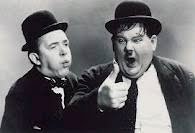
LAUREL AND HARDY FAN GROUP KEEPS LAUGHING
Laurel and Hardy fan group keeps laughs alive
by Susan King
They meet every Tuesday afternoon at the famous Culver Hotel in Culver City, seated at a center table in the restaurant, engaged in lively, loud luncheon conversation. They are members of the Sons of the Desert, the international Laurel and Hardy appreciation society, and a more devoted group is hard to find.
The name derives from the 1933 comedy starring Stan Laurel and Oliver Hardy. They play friends with domineering wives who hope to attend a convention of their fraternal organization, called Sons of the Desert. The film society has "tents" all over the world, including several in California, with the Way Out West tent in Hollywood.
A recent Sons gathering was particularly ebullient. The group was thrilled about the recent release of "Laurel & Hardy: The Essential Collection" DVD set which contains 58 comedy shorts and features starring the gangly Englishman Laurel and the portly Hardy that they made for producer Hal Roach from 1929 through 1940. Among the highlights are "Sons of the Desert," 1937's "Way Out West," 1938's "Block-Heads" and 1932's Academy Award-winning short "The Music Box," in which the boys try to deliver a piano up a massive flight of stairs.
"The reason we meet here is that the Hal Roach Studios were right down the block," offered Richard W. Bann, author of such film history books as "The Little Rascals: The Life and Times of Our Gang," which he penned with Leonard Maltin. "We meet here because we can't meet there for lunch. They tore the studio down in 1963."
Bann hands over a copy of the menu from the studio's Our Gang Café — the Our Gang comedies were another Roach franchise — from the 1930s where one could get a caviar appetizer for 30 cents. "It was right in front of the studio," said Bann. "It was open to the public, and Our Gang and Laurel and Hardy would eat there with the public. It was a family studio — everyone was friendly."
Sitting across from Bann at the table is John Duff, who said he first fell in love with Laurel and Hardy as a boy of 5 when he would get up early on Saturday mornings to watch them on TV. "I made a promise to myself that one day I would have a library of their films. I started collecting 16mm films, and over the years I have got the DVDs."
Like Duff, Mike Nemeth's affection for the pair dates to TV in the 1950s. "They are the warmest, the best," he said.
"There is no question in my mind that Laurel and Hardy comes closet to representing the average American as he bumbles along in life," Nemeth said. "Despite all the messes they get into, they still stick up for one another and love each other. This warmth brings us close to them like no other comedians."
"I think that's one of the reasons why people took to them so much, because they were eternal optimists," said Randy Skretvedt, author of "Laurel and Hardy: The Magic Behind the Movies."
"There is a scene in the Laurel and Hardy movie 'Block-Heads" where Ollie comes to visit Stan in the old soldiers home after not seeing him for 20 years," related Skretvedt. "They make small talk, but the undercurrent of the scene is basically 'I love you and miss you." What other comedy team would do a scene like that?"
Former child star Johnny Crawford of "The Rifleman" fame, who now has a big-band orchestra, actually met Laurel before his death in 1965. "I was doing an interview for some local TV show and also being interviewed was Babe London," recalled Crawford. London had appeared in the 1931 Laurel and Hardy short "Our Wife."
"She talked about her past with Laurel and Hardy. We became friends, and I was determined to get to meet Stan Laurel," Crawford said. "One day we arranged a time to go to his apartment in Santa Monica. My father, my mother and my younger brother and myself all drove there. He was a wonderful, gracious host, very sweet."
Veteran comic Jim MacGeorge not only knew Laurel, he also played him in a series of commercials more than 40 years ago with Chuck McCann as Hardy and also on the 1966 Laurel and Hardy cartoon series, which featured Larry Harmon as the voice of Hardy. Scratching his head like Laurel, MacGeorge gets a perplexed grin on his face and suddenly transforms into the comic actor.
MacGeorge recalled that he had gotten Laurel's phone number from his agent. Standing outside his apartment, MacGeorge wondered if he should call Laurel. "I said to myself, 'Do it.'"
Not only was Laurel pleased to hear from a fan, he asked him to come to lunch the following week. "So I used to go there and visit him. I would knock on the door, and he would open it. He would say, 'How are you, lad?' He called everyone lad. I said, 'How are you? He said, 'My life is over. Come on in. He said the same thing every time."
SOURCE
by Susan King
They meet every Tuesday afternoon at the famous Culver Hotel in Culver City, seated at a center table in the restaurant, engaged in lively, loud luncheon conversation. They are members of the Sons of the Desert, the international Laurel and Hardy appreciation society, and a more devoted group is hard to find.
The name derives from the 1933 comedy starring Stan Laurel and Oliver Hardy. They play friends with domineering wives who hope to attend a convention of their fraternal organization, called Sons of the Desert. The film society has "tents" all over the world, including several in California, with the Way Out West tent in Hollywood.
A recent Sons gathering was particularly ebullient. The group was thrilled about the recent release of "Laurel & Hardy: The Essential Collection" DVD set which contains 58 comedy shorts and features starring the gangly Englishman Laurel and the portly Hardy that they made for producer Hal Roach from 1929 through 1940. Among the highlights are "Sons of the Desert," 1937's "Way Out West," 1938's "Block-Heads" and 1932's Academy Award-winning short "The Music Box," in which the boys try to deliver a piano up a massive flight of stairs.
"The reason we meet here is that the Hal Roach Studios were right down the block," offered Richard W. Bann, author of such film history books as "The Little Rascals: The Life and Times of Our Gang," which he penned with Leonard Maltin. "We meet here because we can't meet there for lunch. They tore the studio down in 1963."
Bann hands over a copy of the menu from the studio's Our Gang Café — the Our Gang comedies were another Roach franchise — from the 1930s where one could get a caviar appetizer for 30 cents. "It was right in front of the studio," said Bann. "It was open to the public, and Our Gang and Laurel and Hardy would eat there with the public. It was a family studio — everyone was friendly."
Sitting across from Bann at the table is John Duff, who said he first fell in love with Laurel and Hardy as a boy of 5 when he would get up early on Saturday mornings to watch them on TV. "I made a promise to myself that one day I would have a library of their films. I started collecting 16mm films, and over the years I have got the DVDs."
Like Duff, Mike Nemeth's affection for the pair dates to TV in the 1950s. "They are the warmest, the best," he said.
"There is no question in my mind that Laurel and Hardy comes closet to representing the average American as he bumbles along in life," Nemeth said. "Despite all the messes they get into, they still stick up for one another and love each other. This warmth brings us close to them like no other comedians."
"I think that's one of the reasons why people took to them so much, because they were eternal optimists," said Randy Skretvedt, author of "Laurel and Hardy: The Magic Behind the Movies."
"There is a scene in the Laurel and Hardy movie 'Block-Heads" where Ollie comes to visit Stan in the old soldiers home after not seeing him for 20 years," related Skretvedt. "They make small talk, but the undercurrent of the scene is basically 'I love you and miss you." What other comedy team would do a scene like that?"
Former child star Johnny Crawford of "The Rifleman" fame, who now has a big-band orchestra, actually met Laurel before his death in 1965. "I was doing an interview for some local TV show and also being interviewed was Babe London," recalled Crawford. London had appeared in the 1931 Laurel and Hardy short "Our Wife."
"She talked about her past with Laurel and Hardy. We became friends, and I was determined to get to meet Stan Laurel," Crawford said. "One day we arranged a time to go to his apartment in Santa Monica. My father, my mother and my younger brother and myself all drove there. He was a wonderful, gracious host, very sweet."
Veteran comic Jim MacGeorge not only knew Laurel, he also played him in a series of commercials more than 40 years ago with Chuck McCann as Hardy and also on the 1966 Laurel and Hardy cartoon series, which featured Larry Harmon as the voice of Hardy. Scratching his head like Laurel, MacGeorge gets a perplexed grin on his face and suddenly transforms into the comic actor.
MacGeorge recalled that he had gotten Laurel's phone number from his agent. Standing outside his apartment, MacGeorge wondered if he should call Laurel. "I said to myself, 'Do it.'"
Not only was Laurel pleased to hear from a fan, he asked him to come to lunch the following week. "So I used to go there and visit him. I would knock on the door, and he would open it. He would say, 'How are you, lad?' He called everyone lad. I said, 'How are you? He said, 'My life is over. Come on in. He said the same thing every time."
SOURCE
Subscribe to:
Posts (Atom)