They included Gerry and the Pacemakers, Billy J. Kramer and the Dakotas, Tommy Quickly, and Cilla Black, his only female client. As a gay man, Epstein had to observe great discretion in public, since homosexuality was still illegal in the UK, although he tolerated a certain amount of banter about it in private. The stress of managing the world's first supergroup took its toll, and he withdrew into drink and pills. On August 27, 1967, Epstein died at age 32, from an accidental overdose of sedatives. Epstein was found on a single bed, dressed in pyjamas, with various correspondence spread over a second single bed. He is buried at Liverpool Long Lane Jewish Cemetery in Liverpool, England. The Beatles did not attend Epstein's funeral, both to allow his family some privacy and to avoid attracting fans and the media...
Sunday, September 6, 2026
FORGOTTEN ONES: BRIAN EPSTEIN
They included Gerry and the Pacemakers, Billy J. Kramer and the Dakotas, Tommy Quickly, and Cilla Black, his only female client. As a gay man, Epstein had to observe great discretion in public, since homosexuality was still illegal in the UK, although he tolerated a certain amount of banter about it in private. The stress of managing the world's first supergroup took its toll, and he withdrew into drink and pills. On August 27, 1967, Epstein died at age 32, from an accidental overdose of sedatives. Epstein was found on a single bed, dressed in pyjamas, with various correspondence spread over a second single bed. He is buried at Liverpool Long Lane Jewish Cemetery in Liverpool, England. The Beatles did not attend Epstein's funeral, both to allow his family some privacy and to avoid attracting fans and the media...
Wednesday, June 24, 2026
FORGOTTEN ONES: LOUISE CAMPBELL
At one point, she worked as a dental assistant, an experience which she said was "invaluable to me in my acting" as she observed changes in patients' facial expressions in the dentist's office, with their changing expressions displaying "their real character."
Campbell gained early theatrical experience by performing in stock theater. Her Broadway debut was in Three Men on a Horse (1935). Her other Broadway credits include Julie the Great, Guest in the House (1941), A House in the Country (1936) and White Man (1936). A column in the June 13, 1942, issue of Billboard complimented "Louise Campbell, that fine actress, for a lovely, beautifully projected, altogether excellent performance in Guest in the House."
Campbell went to Hollywood in 1937 and made 13 films in the 1930s and 1940s. Her film debut was in Bulldog Drummond Comes Back (1937).Her film credits included Bulldog Drummond sequels, Night Club Scandal (1937), Men with Wings (1938), The Buccaneer (1938) with Fredric March, and The Star Maker (1939) with Bing Crosby. It would be her most popular film, playing Bing's wife in the loose bio of songwriter Gus Edwards. Watching her film appearances, Louise looks and sounds amazingly like Mary Martin.
Campbell was married to actor Horace McMahon, whom she met when they were both in the Broadway play Three Men on a Horse. They wed in 1938 and remained married until his death in 1971. Not much is know about Louise's private life, but I believe she had three children. Campbell died November 5, 1997, in Norwalk Hospital in Norwalk, Connecticut. She is buried at St. Mary's Cemetery in Norwalk, Connecticut. Louise led a full life, and she was remembered by her family even if she was not remembered by Hollywood...
Saturday, January 31, 2026
FORGOTTEN ONES: EDDIE CANTOR
This wasn’t the first time Cantor faced censorship. NBC admitted it had previously silenced him, though details remain vague. Cantor’s frustration reflected a broader struggle entertainers faced in balancing humor, innuendo, and public decency during a rapidly evolving media landscape.
Like many performers of his era, Cantor used blackface in his early vaudeville routines—a practice now widely condemned for its racist caricatures and dehumanizing portrayals. His character “Jefferson,” created in 1912, was part of a tradition that perpetuated harmful stereotypes. While Cantor later advocated for racial equality and supported Black performers like Sammy Davis Jr., his early career remains a troubling reminder of the entertainment industry’s complicity in systemic racism.
Despite his success, Cantor wrestled with the limitations of his public persona. Typecast as a naive, effeminate character in films well into his forties, he sought to reshape his image as a serious and intelligent figure. His efforts to support Jewish causes and redefine his legacy often clashed with the comedic roles that had made him famous.
Cantor’s immense popularity faded rapidly after his death in 1964. Though he was once one of the most bankable stars in Hollywood, today he is largely forgotten—a phenomenon some scholars attribute to his hybrid identity as both singer and comedian, which defied easy categorization. His contributions to entertainment and activism are undeniable, but his legacy remains complicated by the cultural norms of his time and the contradictions within his career...
Thursday, November 27, 2025
FORGOTTEN ONES: CAROLINE MCWILLIAMS
Sunday, October 5, 2025
FORGOTTEN ONES: ARTHUR LAKE
I almost guarantee that anyone under 50 even knows the name Blondie, let alone the actor who played Dagwood - Arthur Lakes. In the 1940s, Arthur Lakes was pretty much a household name. Arthur William (Silverlake) Lake Jr. was born on April 17, 1905, in Corbin, Kentucky, when his father Arthur Adolph Silverlake (né Timberlake; 1882–1920) and uncle Archie Glenn Silverlake (né Timberlake; 1882–1963) were touring with a circus in an aerial act known as "The Flying Silverlakes". His mother, Edith Goodwin (née Edith Blanche Fautch; 1888–1958) was an actress. His parents later appeared in vaudeville in a skit "Family Affair", traveling throughout the South and Southwest United States. Arthur first appeared on stage as a baby in Uncle Tom's Cabin; his sister Florence and he became part of the act in 1910. Their mother took the children to Hollywood to get into films, and Arthur made his screen debut in the silent Jack and the Beanstalk (1917). Florence became a successful actress achieving a degree of fame as one of the screen wives of comedian Edgar Kennedy.
Universal Pictures signed Lake to a contract where, as an adolescent, he played character parts in Westerns. At age 19 he began starring in a long series of comedy shorts for Universal, which ran through 1930. He signed with RKO Radio Pictures shortly after it formed in 1928. There he made Dance Hall (1929), and Cheer Up and Smile (1930). Moviegoers first heard Lake speak when he appeared as Harold Astor, the lead of the 1929 musical comedy On with the Show!, which is notable as the first all-talking feature film using the Vitaphone process, and as Warner Bros' first all-color film shot in two-color Technicolor. In the early sound film era, Lake typically played light romantic roles, often with a comic "Mama's Boy" tone to them, such as 1931's Indiscreet, starring Gloria Swanson. He also had a substantial part as the bellhop in the 1937 film Topper.
Arthur Lake is best known for portraying Dagwood Bumstead, the husband of the title character of the Blondie comic strip, in 28. Blondie features produced by Columbia Pictures between 1938 and 1950, co-starring Penny Singleton as Blondie and Larry Simms as Baby Dumpling (later known as Alexander). Lake also played Dagwood on the radio series, which ran concurrently with the film series from 1938 to 1950, earning Lake a star on the Hollywood Walk of Fame at 6646 Hollywood Blvd. (Many of the actors on the radio show noted Lake's commitment to the program, stating that on the day of the broadcast, Lake became Dagwood Bumstead.)
Far from feeling bitter about being typecast, Lake continued to embrace the role. He played Dagwood in a short-lived 1957 Blondie TV series, and often gave speeches to Rotary clubs and other civic organizations (eagerly posing for pictures with a Dagwood sandwich), well into the 1960s and beyond. He died in 1987.
In his book about the Black Dahlia murder case, author Donald H. Wolfe asserts that Arthur Lake was questioned by the Los Angeles Police Department as a suspect, having been acquainted with the victim through her volunteer work at the Hollywood Canteen. No charges were filed and Lake was one of many persons of interest in a case that remains unsolved.
Lake died of a heart attack in Indian Wells, California, on January 9, 1987, and is interred in the Hollywood Forever Cemetery, in the Douras family mausoleum, along with actress Marion Davies and her husband, Horace G. Brown. Lake's widow Patricia was interred there upon her death in 1993...
Sunday, August 10, 2025
FORGOTTEN ONES: HENRY THIES
In the past however, Henry Thies had nervous problems. Two years before his death, he had tried to commit suicide by taking an overdose of pills. After that attempt, Thies was a patient in a mental hospital for nearly 15 months.
He had new performances and radio shows scheduled and was a very successful bandleader. If he hadn't ended his life, his band would have continued to hit greater heights of fame and stardom. It's sad that he died from a self inflicted gunshot wound on June 12, 1935. His wife, his son (who was 19), and a mother and a sister survived him...
Monday, November 18, 2024
FORGOTTEN ONES: BELLE BAKER - PART TWO
Baker had a brief film career as silent film gave way to lavish technicolor musical talkies. She made her film debut starring in the 1929 talkie Song of Love. The film survives and has been screened at film festivals but not released on DVD. Song of Love features two songs performed by Baker written by her husband, "I'm Walking with the Moonbeams (Talking to the Stars)" and "Take Everything But You". She made two more film appearances, in Charing Cross Road (1935) and Atlantic City (1944; in which she performed "Nobody's Sweetheart").
In 1932, Baker became a regular on Jack Denny's radio program on CBS. She was a guest performer on The Eveready Hour, broadcasting's first major variety show, which featured Broadway's top headliners. Baker continued performing through the 1930s, but limited her performances to radio shows.
Baker's first marriage was in 1913, to producer and promoter Lew Leslie. The couple divorced in 1918. In 1919, she married Maurice Abrahams, a successful Russian-American songwriter/composer, who wrote such songs as "Ragtime Cowboy Joe", "He'd Have to Get Under — Get Out and Get Under (to Fix Up His Automobile)", "I'm Walking with the Moonbeams (Talking to the Stars)", and "Take Everything But You". The couple had one child, Herbert Joseph Abrahams, later known as Herbert Baker, who became a screenwriter. After Abrahams' death in 1931, Baker restricted her performing to radio. On September 21, 1937, she remarried, to Elias Sugarman, editor of the theatrical trade magazine, Billboard. The couple divorced in 1941. She made one final television appearance in This Is Your Life in 1955, just two years before her death.
Baker was a Zionist, stating in 1924: "I am a firm believer in Zionism. I believe that the Jewish people should have a home of their own. It is the one prayer our fathers have been saying through the centuries." While in England in 1935, Baker hosted a show to raise money for Jews fleeing Nazi persecution through the United Jewish Appeal.Several years before her death, she performed several songs at the opening of a Congregation Sons of Israel on Irving Place alongside the president of the American Jewish Committee, Rabbi Irving Miller.
Many of Baker's family later became involved with show business after her. Her brother, Irving Becker, married stage actress Vinnie Phillips and became a road manager for a production of Tobacco Road. Additionally, the broadway actress, Marilyn Cooper was her niece.
Baker was very well known and famous throughout her lifetime. At the height of Baker's popularity in the 1920s, a poll taken from over 3 million people found her and Sophie Tucker to be tied for the most popular Vaudeville stars.
Many of Baker's songs, such as My Yiddishe Mama, Blue Skies and All Of Me are still popular to this day. During her lifetime, she was referred to as "the Female Al Jolson and the Sarah Bernardt of Songland." Like Jolson and Bernardt, Belle Baker is sadly forgotten today in 2024...
Wednesday, November 13, 2024
FORGOTTEN ONES: BELLE BAKER - PART ONE
Baker was born Bella Becker in 1893 to a Russian Jewish family originally from Akmene, Lithuania on New York's Lower East Side. She was the third child of eight children born to Hyman (Chaim) Becker and Sarah Rabinowitz. Her mother was chronically ill. Born into extreme poverty, Baker was unable to attend school and was forced to work in a factory when she was 6 years old.
Baker started performing at the Lower East Side's Cannon Street Music Hall at age 11, where she was discovered by the Yiddish Theatre manager Jacob Adler. She was managed in vaudeville by Lew Leslie, who would become Baker's first husband. She made her vaudeville debut in Scranton, Pennsylvania, at the age of 15. She performed in Oscar Hammerstein I's Victoria Theatre in 1911, although her performance was panned, mainly for her song choices. By age 17, she was a headliner. One of her earliest hits was "Cohen Owes Me $97". Belle Baker on the sheet music cover of Nick Clesi's 1916 hit "I'm Sorry I Made You Cry"
In 1926, Baker became the lead in a play called Betsy. In this play, Baker played the oldest daughter of a Jewish family named the Kitzels. The mother (portrayed by Pauline Hoffman) wouldn't let any of her children get married until Betsy (played by Baker) got married. Legend has it that the story desperately needed a Baker song, and so she called Irving Berlin for help. Baker introduced his hit song Blue Skies in Betsy. The song was such a hit that she played it for twenty-four encores on opening night. Blue Skies would later become immortalized by Al Jolson's performance of it in the first ever talkie movie, The Jazz Singer.
Tuesday, September 17, 2024
FORGOTTEN ONES: CARL GRAYSON
While in Europe, he met bandleader Johnny Hamp who signed him as a violinist and vocalist for Hamp’s Kentucky Serenaders Orchestra during the band’s 1930 England tour. Not long after, Graub began singing and playing with the Henry Busse Orchestra. Busse was the bandleader at the Chez Paree Night Club in Chicago owned by notorious gangster boss Al Capone. At Chez Paree, Graub met a singer named Georgia Madelon Baker and they married in Chicago in June, 1933.
Around this time, Graub began billing himself professionally as Carl Grayson, while his new wife billed herself as Madelon Grayson. One night in June 1936, Grayson was spotted by Columbia Studio Chief Harry Cohn singing “Is It True What They Say About Dixie”. Cohn offered Grayson a job on the spot, reported the next day by gossip columnist Hedda Hopper as “the quickest contract in film history”. Grayson moved to Hollywood the same year. At Columbia, Cohn visioned Grayson as a replacement for Roy Rogers who wanted out of his Columbia contract to work for Republic Pictures. Columbia billed him as Donald Grayson for several pictures, beginning with Dodge City Trail (1936) and Outlaws of the Prairie (1937) with Donald Grayson singing with the Sons of the Pioneers. Next came The Old Wyoming Trail (1937), Cattle Raiders (1938), and Call of the Rockies (1938). Bob Nolan replaced Grayson as the Sons lead singer, and about as quick as he had been signed, his three-year contact with Columbia was not renewed.
In the meantime, Madelon Grayson appeared in Girls of the Road (1940) and soon thereafter, filed for divorce against her husband, with the Los Angeles Times reporting the couple’s contentious allegations as front page news on March 16, 1940.
Free to return to musical opportunities, Grayson answered the calling from Spike Jones who was actively pursuing unique and talented musicians willing to play and perform his brand of zany musical comedy. The band signed a long-term engagement as the house band for the Jonathan Club in Los Angeles, billing itself the Donald Grayson and His Jonathan Club Dance Band. When Jones recruited clarinetist Del Porter, he brought in members of his band, the Feather Merchants, and the growing new orchestra emerged as Spike Jones and the City Slickers, the name a derivative from an early 1940’s Cindy Walker song called “Gonna Stomp Them City Slickers Down”.
It was no secret that early member of the City Slickers were heavy drinkers, and when Jones gave up drinking himself, he quickly became intolerant of alcohol abuse among the musicians he employed in his band. As popularity of the City Slickers soared after the release of “Der Fuhrer’s Face”, Grayson was among several members who made a mass exodus in the transition where Jones soon found himself in a better position to pick talent for his band from a broader pool of expert musicians, skillful comedians and multi-talented performers, rather than rely on the comparatively frat house party culture that pervaded among the band’s earlier ranks. Grayson’s alcoholism had become problematic, and he was replaced by clarinet player and equally-competent “gluggist” Mickey Katz in 1946. He played with Eddy Brandt and the Hollywood Hicks, but faded into obscurity, most likely due to pervasive drinking that too often becomes its own fulltime and all-consuming job.
He died in obscurity in April 1958 at age 49 without fanfare or an obituary. The cause of death was said to be liver cirrhosis and cancer. Only a handful of people who remembered him were said to have attended his funeral or memorial service, but there is no published record known. Disposition of his remains may have been assigned through indigent means: a sad ending for this once-talented and promising star whose light faded far too early on this earth...
Monday, July 22, 2024
FORGOTTEN ONES: THE MERRY MACS
Formed to play proms in Minneapolis, Minnesota, the group originally consisted of the three McMichael brothers: tenors Judd (1906–1989) and Joe (1916–1944), and baritone Ted (1908–2001). They were discovered by organist-bandleader Eddie Dunstedter of station WCCO, who suggested they perform in masks and dubbed them The Mystery Trio.
In 1931–32, the McMichaels toured with the orchestra of arranger-composer Joe Haymes, who renamed them The Personality Boys. By 1933 they added a female lead singer, Cheri McKay, and changed their name to The Merry Macs. At Haymes' recommendation, Victor Records engaged the group for one single that year, their first recording.
In 1936, they appeared on several national radio programs, and Cheri McKay was replaced by Helen Carroll. (McKay trained her successor in the group's singing style.) Another record session followed with Ray Noble's orchestra. The Merry Macs started appearing with Fred Allen on Town Hall Tonight starting on November 17, 1937. In September 1938, they signed a contract with Allen for the 1938–1939 season, and they remained until the end of the 1940 season.
Vocal quartets had customarily harmonized like barbershop quartets. The Merry Macs revolutionized vocal harmony with closer harmonic chords. This style inspired other groups, like The Modernaires and Six Hits and a Miss. In 1938 The Merry Macs signed with Decca Records and recorded "Pop Goes the Weasel". The Merry Macs (with Carroll) sang a swing version of "Down by the Old Mill Stream" in the 1939 Vitaphone musical Seeing Red, Red Skelton's first film.
In 1939, Mary Lou Cook (1908–2008) replaced Helen Carroll. This is the foursome that most listeners know from film appearances. The McMichael brothers and Cook appeared as a specialty act in Hollywood movies, including 1940's Love Thy Neighbor, and Universal Pictures gave The Merry Macs their own feature-film series in 1941. Their most famous film is Ride 'Em Cowboy (1942), an Abbott and Costello comedy in which The Merry Macs offer musical interludes. At the time, Cook was married to actor Elisha Cook, Jr.; she ended both her marriage and her affiliation with The Merry Macs at about the same time.
Youngest brother Joe McMichael served in the armed forces and died in 1944 following an accidental overdose of Sulfa tablets while ill. He was replaced by Clive Erard, then Dick Baldwin, and finally Vern Rowe. The foursome of Judd, Ted, Marjory, and Vern continued performing until Judd retired from show business in 1964.
Vern and Ted took The Merry Macs to the U.K. where they made it their home until Vern and Ted retired 1967 and return to their homeland USA The Merry Macs continued in Britain making its base on the south coast Salisbury Wiltshire until 2000 when Harold Lambert John Reg Peter and their female vocalist Lettice Mackenzie Campbell retired from the music entertainment industry Cheri McKay was the first female vocalist 1933-36 with Lettice Mackenzie Campbell being the last female vocalist and the longest serving 1977-2000 with The Merry Macs. The singing group is largely forgotten now, but they gave hope and optimism in their songs during a difficult time in America's history...
Sunday, April 21, 2024
FORGOTTEN ONES: VAUGHN DE LEATH
In January 1920, inventor and radio pioneer Lee DeForest brought her to the cramped studio of his station, 2XG, located in New York City's World's Tower, where De Leath broadcast "Swanee River". Although not, as is sometimes stated, the first broadcast of live singing, she established herself as a skilled radio performer, and De Forest would later note: "She was an instant success. Her voice and her cordial, unassuming microphone presence were ideally suited to the novel task. Without instruction she seemed to sense exactly what was necessary in song and patter to successfully put herself across". According to some historical accounts of this incident, having been advised that high notes sung in her natural soprano might shatter the fragile vacuum tubes of her carbon microphone's amplifier, De Leath switched to a deep contralto and in the process invented "crooning", which became the dominant pop vocal styling for the next three decades.
Her recording career began in 1921. Over the next decade she recorded for a number of labels, including Edison, Columbia, Victor, Okeh, Gennett, and Brunswick. She occasionally recorded for the subsidiary labels of some of these companies under various pseudonyms. These included Gloria Geer, Mamie Lee, Sadie Green, Betty Brown, Nancy Foster, Marion Ross, Glory Clarke, Angelina Marco, and Gertrude Dwyer. De Leath had a highly versatile range of styles, and as material required could adapt as a serious balladeer, playful girl, vampish coquette, or vaudeville comedian.
In 1923, she became one of the first women to manage a radio station, WDT in New York City, over which she also performed and led a sixty-piece orchestra. In 1928 she appeared on an experimental television broadcast, and later became a special guest for the debut broadcast of The Voice of Firestone radio show. She also was one of the first American entertainers to broadcast to Europe via transatlantic radio transmission.
De Leath made her last recording in 1931 for the Crown label. She made her final nationwide network performances in the early 1930s. In her waning years, she made radio appearances on local New York stations, including WBEN in Buffalo.
De Leath was married twice. In 1924 she wed artist Leon Geer, from whom she was divorced in 1935. The following year, she married musician Irwin Rosenbloom, from whom she was divorced in 1941.
In 1931, De Leath sued Kate Smith for using the "First Lady of the Radio" designation. Although Smith desisted for a time, she resumed the mantle after De Leath's death.After her career went into decline, De Leath endured considerable financial difficulties, complicated by a drinking problem, which contributed to her death at age 48 in Buffalo, New York. Her obituary in The New York Times incorrectly stated her age at death as 42. Her ashes were buried in her childhood home of Mount Pulaski, Illinois. Vaughn De Leath did too young and was forgotten too soon...
Sunday, January 21, 2024
FORGOTTEN ONES: TINY HILL
In 1931 Hill formed his first big band, which was known as the "Fat Man's Band". Hill played the drums with the trio, which played for several years in and around Decatur, Illinois. In 1934 Hill joined the Byron Dunbar band in Decatur as a drummer and vocalist. After a year with Dunbar, Hill left to form his own band, taking many of Dunbar's band members with him. They had their first appearance at the Ingleterra Ballroom in Peoria, Illinois on October 31, 1935.
Members of Hill's new band were Dick Coffeen and Harold King on trumpets; John Noreuil on trombone, Jim Shielf on piano, and Reightno Corrington on bass. The reed section included Bobby Walters, Bob Kramar and Nook Schreier, who also did arranging. The group's style was Dixieland jazz and hillbilly music. Their theme song was "Dream Girl". By 1937 the band was playing its warm and easy-to-dance-to music three nights a week to packed audiences at the Ingleterra Ballroom.
Augmented by vocalists such as Allen De Witt, Bob Freeman, Irwin Bendell and Hill himself, the group's popularity soon extended to Nebraska, Missouri and Iowa, growing steadily throughout the 30s and 40s. Soon the band was playing in ballrooms coast to coast. Hill toured the country for a while and landed on the coast to play four months at the Casino Gardens, Ocean Park, California. He returned to Chicago in 1942. Further appearances included Aragon and Trianon in Chicago and The Rainbow Ballroom in Denver.

In 1943 Hill and his orchestra became the summer replacement band on the Lucky Strike Your Hit Parade radio show. In January 1950, Hill moved to Colorado where he would spend time when not on the road. He purchased a 140-acre (0.57 km2) dairy farm at Fort Lupton named Mountain View. In 1951 the band traveled 46,000 miles (74,000 km) in ten months. In 1952, the band racked up 61,000 miles (98,000 km) in 11 months, in his fleet of Packard automobiles. Fast cars were one of Hill's hobbies. In '51 and again in '52, the band was his guests at the Indianapolis Memorial Day Races. Another of his hobbies was cooking. In 1956, Hill opened Radio Station KHIL in Brighton, Colorado.
He eventually spent less time on the road and more time with his business interests.
Despite the ending of the Big Bands era, Hill continued to play in small combos in the Denver-Brighton area, often returning to the Midwest for guest appearances. Undeterred by the decline in the commercial appeal of the big band sound, Hill resolutely remained at the helm of the combo until his death in 1971. His final public performance was to a capacity audience in Emden, Illinois on July 17, 1971. The inscription on his tombstone reads: "Forgotten quickly by many, remembered forever by a few."
Monday, November 20, 2023
FORGOTTEN ONES: ROSE MURPHY
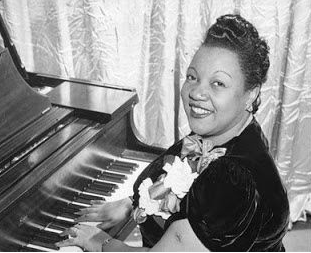
Murphy began her musical career in the late 1930s, playing intermission piano for such performers as Count Basie, and became popular in the United States and United Kingdom in the late 1940s. She is best known for her high-pitched singing style, which incorporated scat singing, giggling, and percussive sound effects. "Busy Line", one of her most well-known songs, made use of perhaps her most famous vocal sound effect: the 'brrp, brrrp' of a telephone ring. A version of the song was later used in 1990 by BT Cellnet in a television commercial, which was such a success that RCA reissued the original recording. Princess Margaret became a fan after "Busy Line" became a hit in England. She attended Murphy's concerts in London, imitated her while playing the piano and sang "Busy Line" at parties. Murphy was known for her highly personalized rendition of ''I Can't Give You Anything but Love.''
During a two-week engagement at Hollywood Roosevelt's Cinegrill in June 1989, Murphy became ill and returned to New York City. She died in New York aged 76 on November 16, 1989, and, though married four times, left no direct descendants. Her final marriage, from 1950 to 1977, was to Eddie Matthews, a businessman who, from 1928 to 1933, had been married to Ethel Waters. Rose Murphy and her radio broadcasts in the UK are referred to in the novel, Under the Pink Light, by the British author Brian Hurst. Rose Murphy is now forgotten, but she doesn't deserve to be...
Saturday, August 5, 2023
FORGOTTEN ONES: BOB CHESTER
He was born in Detroit, Michigan, United States. Chester's stepfather ran General Motors's Fisher Body Works. He began his career as a sideman under Irving Aaronson, Ben Bernie, and Ben Pollack. He formed his own group in Detroit in the mid-1930s,with a Glenn Miller-influenced sound. This band was unsuccessful in local engagements and quickly dissolved. He then put together a new band on the East Coast under the direction of Tommy Dorsey and with arrangements by David Rose. This ensemble fared much better, recording for Bluebird Records.
Chester's group, billed "The New Sensation of the Nation," had its own radio show on CBS briefly in the fall of 1939. The twenty-five-minute program aired from the Hotel Van Cleve in Dayton, Ohio late on Thursday nights (actually 12:30 am Friday morning, Eastern Time); the September 21, 1939 edition can be heard on the One Day In Radio tapes, archived by Washington D.C. station WJSV.
Chester's Bluebird records have proved excellent sellers, both for retail dealers and coin phonograph operators such as "From Maine to California"; "Wait Till the Sun Shines, Nellie"; "Madeliaine"; and two songs from "Banjo Eyes" - "Not a Care in the World" and "A Nickel to My Name". His only national hit was "With the Wind and the Rain in Your Hair" (b/w "I Walk With Music"; Bluebird 10614), which featured Dolores O'Neill on vocals and went to No. 18 on the chart in April 1940.
Chester's orchestra included trumpeters Alec Fila, Nick Travis, Lou Mucci, and Conrad Gozzo, saxophonists Herbie Steward and Peanuts Hucko, drummer Irv Kluger, and trombonist Bill Harris. His female singers included Dolores O'Neill, Kathleen Lane, and Betty Bradley; among his male singers were Gene Howard, Peter Marshall, Bob Haymes, and Al Stuart.
The orchestra disbanded in the mid-1940s, due in part to the shrinking market for big band sound. After a stint as a disc jockey at WKMH radio, Chester assembled another band for a short time in the early 1950s, but after it failed he retired from music and returned to Detroit, to work for the rest of his life in auto manufacturing. Bob Chester died in October 1966, at the age of 58. Forgotten in 1966, he is even more forgotten today...
Wednesday, May 31, 2023
FORGOTTEN ONES: JUNE HAVER
20th Century Fox had plans to mold Haver as a glamour girl stand-in for the studio's two biggest stars, Alice Faye and Betty Grable. She debuted on screen in a supporting role as Cri-Cri in Home in Indiana (1944). According to the actress, she had just turned 17 years old when her scenes were filmed. Even before Home in Indiana was released, she was assigned to replace Alice Faye in the Technicolor-musical, When Irish Eyes Are Smiling. Later that year, she co-starred with her future husband, Fred MacMurray, in Where Do We Go From Here?, which was the only time the pair appeared together in a film.
During her career at Fox, Haver was originally groomed to be the next Betty Grable (standing a diminutive 5'2", she was known as "Pocket Grable"). She even co-starred with Grable in the 1945 film, The Dolly Sisters, for which she had to put on weight. While filming, rumors about a possible clash between the two actresses arose, mostly because of their frequent comparison, but Haver refuted this with: "Betty is a big star and I'm just starting. I try to be nice to her, and she reciprocated by being just as nice to me. It's silly to think two girls can't work together without quarreling. You see, I've two sisters. I'm the ham between the bread and butter — the middle sister — and I understand girls pretty well. Betty likes to talk about her baby, so we talk about her baby."
At the urging of friends Ann Miller and Ann Rutherford, Haver finally joined the Academy of Motion Picture Arts and Sciences at the age of 75. For her contribution to the motion picture industry, June Haver has a star on the Hollywood Walk of Fame at 1777 Vine Street. Due to June making her last film in 1953, the memory of June Haver continue to fade. When she died of heart failure in 2005 at the age of 79, she was largely forgotten. However, her talent and beauty lives on in his movies that she made...
Sunday, February 5, 2023
FORGOTTEN ONES: AHNA CAPRI
Ahna's other memorable movie roles include the terrified Nicky in the creepy Devil worship horror winner The Brotherhood of Satan; feisty wildlife photographer Terry in Piranha; and luscious assassin Londa Wyeth in the tacky Crown International exploitation romp The Specialist. Among the many TV shows Capri guested were "Ms. Columbo," "Baretta," "Kojak," "Police Story," "Cannon," "Mannix," "Ironside," "Adam-12," "The Mod Squad," "The Invaders," "The Wild, Wild West," "I Spy," "The Man from U.N.C.L.E.," "Branded," "Leave It to Beaver," and "Maverick."
During the filming of Enter the Dragon, Capri became close friends with co-stars Bob Wall, Bruce Lee, John Saxon and Jim Kelly. Wall, closest to Ahna in the days before her passing, explained that anyone who came into contact with her knew he was in the presence of someone very special. “She brought a light to our experience while filming Enter the Dragon and she will be missed greatly,” Wall said.
She made her last film in 1979.
A longtime resident of the San Fernando Valley, she never married.
Her death was the result of an auto accident in North Hollywood on August 9, in which a 5-ton truck driven by a 22-year-old female driver collided with her car. She was in a coma on life support for 11 days, and passed away with family members at her side.
She was survived by her sister Rose and brother Peter...
Sunday, August 7, 2022
FORGOTTEN ONES: FANNY BRICE
Here is an excellent article by David Soren...Fanny Brice (October 29, 1891 – May 29, 1951) was one of the greatest stars of vaudeville, and was also successful for a time in movies and a sensation later in her life on radio as well. Portrayed by Barbra Streisand on stage and in the movie Funny Girl , she was best known for her comic and dramatic songs and her radio persona as Baby Snooks. Rather ungainly in appearance, she could twist her face into knots or open wide her cavernous mouth to express exaggerated emotion in her comic songs, or she could come on-stage dressed to the nines and belt out a dramatic torch song such as My Man, the American version of the French success Mon Homme.Fannie Brice posing as her famous character.
Born Fania Borach in New York City to an immigrant Jewish family, she dropped out of school and knocked around in burlesque long enough to be offered a spot in the Ziegfeld Follies of 1910 and 1911 which brought her great fame, made even greater by her return in 1921 to introduce the mega-hit My Man, a song which had become a standard for the sexy French goddess Mistinguett who sang it with a husky voice slightly off key. Brice belted it out with tremendous feeling it became one of the great hit songs of the Roaring Twenties. It was still so popular by 1928 that it became the title of a feature film starring Fannie which is today considered lost.
From the time she first entertained, Fanny Brice was a crowd-pleaser who quickly became a superstar. Unlike her contemporaries who were often known for one thing, Fannie could bring either broad slapstick comedy or pathos to her performances and sometimes both. She was so popular and such a workaholic that she was still a top performer up until two days before her death, of a cerebral hemorrhage.
When movie musicals became the rage in the late 1920s and early 1930s, Fannie Brice was immediately picked to star but musicals quickly fell out of favor and her movie career never took off despite a few appearances in films such as Everybody Sing (1938). She did not live long enough to become a force on television and only made one appearance, as Baby Snooks, for CBS in 1950.
Despite her personal difficulties and tragedies, Fannie remained a major star for more than 40 years and in the finest tradition of vaudeville went out still leaving them laughing, even into the 1950s when vaudeville was quickly becoming a memory...
_op_Schiphol_(Grand_Gala_du_Disque_1965),_Bestanddeelnr_918-2516_ShiftN.jpg)

.jpg)


.jpg)