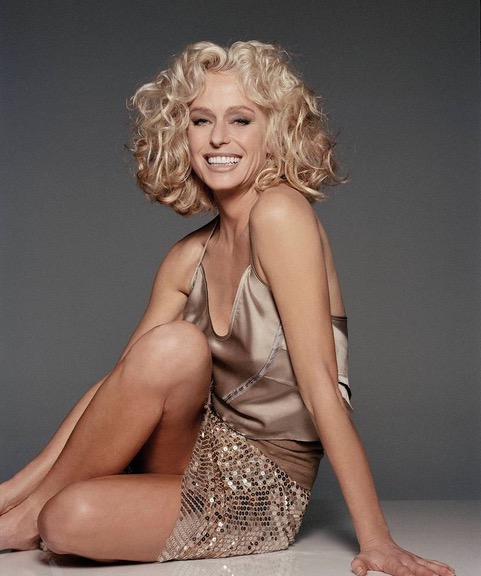
One of the best dancers in Hollywood and one of the most beautiful was the underrated Eleanor Powell. Here are some photos from the past that show her everlasting beauty...
A TRIP DOWN MEMORY LANE
A nostalgic journey to the past to relive the golden days of entertainment!
Sunday, February 15, 2026
Wednesday, February 11, 2026
Sunday, February 8, 2026
REFLECTIONS: MAE CLARKE ON PUBLIC ENEMY
I said, “Well, I’ll tell you what. I’ll do it– once. I’ll trust you not to hurt me, and that’s all. Just for the guys. Okay.” So that’s what we did, and we did it just once. Didn’t hurt me. […]
After I left the studio I drove myself alone and held myself in. I got to my house and then I was no longer Mae the actress. Home meant Mother and Dad and my brother and sister. So home was very protective to me, and they all liked me a lot. mother opened the door and said, “Oh, good, I’ve got so-and-so for dinner.” And I said, “Mother,” and put my head on her shoulder and broke down crying. She said, “Why, darling, what’s the matter?” She patted me and said, “Oh, now, it can’t be that bad.” She was a great soother, which helped me to cry more.I said, “Mother, something happened today that I will never, ever, get over. It will be part of my life from now on. It’s going to hurt all the time, and I couldn’t get out of it. I didn’t know what to do. I wanted everybody to like me and I wanted to be a good sport and I wanted to work with Mr. Cagney again because awfully good. He’s going to be a great star; they all say so.”
I told her. And she, of course, knew exactly what to do. She told me: “That’s not the end of the world. You’ve had worse than that.” Without putting me down about it, she put it just in the right tempo to get me to stop crying and come on in and sit down and have a good meal and give me diversion.
Now my father was always in on things without my telling him. He was busy doing something, but he was listening. He just went quietly to the piano and played things like “A Pretty Girl Is Like A Melody.” He consoled me through the piano, and I knew it. That was the way he talked to me. And I loved it. The things that always got me well were Daddy’s music and Mother’s soup. Those were surefire. People still ask me, “Do you think that scene, with all the longevity it’s had, has helped you or hurt you?” I think I’ll leave it to you and movie fans on what I think...
Thursday, February 5, 2026
MY FATHER AND HIS 80TH BIRTHDAY
Born in Verona on February 5, 1946, Francis was the only son of Francis L. Lobosco and Katherine Campbell. His father, a hardworking man from Allegheny County, passed away suddenly in 1969, and Francis carried forward the quiet strength and resilience that defined his family. He was raised in a household that valued tradition, faith, and perseverance—qualities that would shape his own approach to life.
He was a devoted son, especially to his mother Katherine, who outlived both her husband and son. He also became a father himself, leaving behind a son, David Lobosco and a daughter, Christina Swanson, who both continues to honor his legacy.
Though Francis’s life was not marked by public accolades or headlines, it was rich in the ways that matter most: family, community, and quiet integrity. He lived through a transformative era in American history—from the post-war boom to the cultural shifts of the 1960s and 70s—and remained grounded in the values instilled by his parents and extended family, including his aunts Anna and Sarah Lobosco.
His passing on January 31, 1991, due to heart failure, was a profound loss to those who knew him. Yet, even in death, Francis’s story is one of enduring connection. He was laid to rest in Mount Carmel Cemetery in Verona, the same resting place as his father—a symbol of the deep roots the Lobosco family planted in the region.
As we mark what would have been his 80th birthday, we remember Francis not just for the years he lived, but for the quiet impact he made. His life reminds us that legacy isn’t always loud—it’s often found in the everyday acts of love, loyalty, and presence...
Monday, February 2, 2026
FIDDLER ON THE ROOF TRIVIA
"Anyone who ever plays Tevye should be thankful to Zero Mostel. He gave us all room and I know I wouldn't have done the movie without the advantage of a year's rehearsal on stage."
Director Norman Jewison: " One reason I liked Topol's performance so much on the stage was that he projected his sense of destiny as, and pride in being, a Jew. His Tevye never loses dignity and strength; he is a man who knows who he is and where he's going."
To make Topol look older, the makeup team clipped 15 white hairs from Jewison's beard and applied them to Topol's eye brows (seven on the left, eight on the right).
Topol was on active duty with the Israeli army when he was nominated for an Oscar for "Fiddler on the Roof" in early 1972. He was granted leave so he could attend the ceremony in Los Angeles that year...
Saturday, January 31, 2026
FORGOTTEN ONES: EDDIE CANTOR
This wasn’t the first time Cantor faced censorship. NBC admitted it had previously silenced him, though details remain vague. Cantor’s frustration reflected a broader struggle entertainers faced in balancing humor, innuendo, and public decency during a rapidly evolving media landscape.
Like many performers of his era, Cantor used blackface in his early vaudeville routines—a practice now widely condemned for its racist caricatures and dehumanizing portrayals. His character “Jefferson,” created in 1912, was part of a tradition that perpetuated harmful stereotypes. While Cantor later advocated for racial equality and supported Black performers like Sammy Davis Jr., his early career remains a troubling reminder of the entertainment industry’s complicity in systemic racism.
Despite his success, Cantor wrestled with the limitations of his public persona. Typecast as a naive, effeminate character in films well into his forties, he sought to reshape his image as a serious and intelligent figure. His efforts to support Jewish causes and redefine his legacy often clashed with the comedic roles that had made him famous.
Cantor’s immense popularity faded rapidly after his death in 1964. Though he was once one of the most bankable stars in Hollywood, today he is largely forgotten—a phenomenon some scholars attribute to his hybrid identity as both singer and comedian, which defied easy categorization. His contributions to entertainment and activism are undeniable, but his legacy remains complicated by the cultural norms of his time and the contradictions within his career...
Friday, January 30, 2026
RIP: CATHERINE O'HARA
O’Hara was born in Toronto in 1954. She was the second youngest of seven children; her father worked for the Canadian Pacific Railway, and her mother was a real estate agent. Her first acting gig was portraying the Virgin Mary in a Nativity play. After graduating from high school, she got a job as a waitress at the Second City Theater in Toronto.
“I was lucky enough to watch everybody,” she said in 2024 of the theater’s legendary talent, which included Dan Aykroyd, Joe Flaherty and family friend Gilda Radner. When she auditioned to become a member, Flaherty had some discouraging feedback.
“He said, ‘Keep up the good work. Your day job, I mean: waitressing,’” she told PEOPLE. She didn’t listen and landed a spot when she auditioned again.
She joined the company in 1974. One of her stagemates was comedian Eugene Levy, who would become one of her closest friends and collaborators. O’Hara told The New Yorker in 2019 that at first she was scared of being on stage.
“My crutch was, in improvs, when in doubt, play insane. Because you didn’t have to excuse anything that came out of your mouth. It didn’t have to make sense.”
In 1976, the theater began its own TV show, called Second City Television (and usually abbreviated as SCTV). O’Hara was a staple of the sketch program, which aired on NBC in the ‘80s. O’Hara became known not only for her impressions of celebrities, including Meryl Streep and Brooke Shields, but also for original characters that became fan favorites. O’Hara was content with SCTV, but the show did not provide her with a consistent paycheck. “Our producer would get a deal with a network, and we’d have a show for a season or two, and then that deal would go away. There’d be a break, then we’d do the show again,” she said.
During one break in 1981, “I got asked to be on Saturday Night Live. And of course I said yes. Who doesn’t want to do that?” But then SCTV was picked up again and she went back to her home — before she’d ever done a single episode of SNL. Her best friend from high school, Robin Duke, took her SNL slot. “It all worked out the way it was supposed to,” she reflected. As part of the SCTV writing staff, she received five Emmy nominations, winning once.
Her film debut was 1980’s Double Negative, which also featured Levy and other SCTV costars like Flaherty and John Candy. Next, she appeared in Martin Scorsese's 1985 black comedy After Hours and 1986’s Heartburn. In 1988, she had a role in Beetlejuice as Delia Deetz, the stepmother of Winona Ryder’s Lydia. O’Hara reprised her role in the 2024 sequel Beetlejuice, Beetlejuice.
In 1990, she was cast in Home Alone as the harried mom of Macaulay Culkin’s Kevin. “It's a perfect movie, isn't it?” she reflected in 2024. “I need to care about the whole thing,” she said of how she chooses projects. “I don't care to do a great role in a bad project. You want to be part of something good, and that's how you go.” She reprised her role for 1992’s Home Alone 2: Lost in New York.
In 1996, she appeared in her first Guest mockumentary, Waiting for Guffman. She would also appear in 2000’s Best in Show and 2003’s A Mighty Wind, in which she and Levy sang together. She was called the actress the “gifted queen of the bittersweet” in a review of 2006’s For Your Consideration, another collaboration with Guest.
In 2015, she teamed up with Levy once again for Schitt’s Creek, created by his son Dan. It was not the first time she and Levy played characters who were romantically involved. Of their long working relationship, she told the media at the time, “I would love to think we continue to challenge each other, like a good married couple would do.”
In 2020, she won the Emmy for outstanding lead actress in a comedy series for the role. "I will forever be grateful to Eugene and Daniel Levy for the opportunity to play a woman of a certain age, my age, who gets to fully be herself,” she said in part during her speech. She also won a Golden Globe and a SAG Award for the series.
Other TV roles for O’Hara included guest spots on Six Feet Under, Curb Your Enthusiasm and 30 Rock. She also received an Emmy nomination for her performance in the 2010 TV film Temple Grandin. She voiced characters in the animated films Frankenweenie, The Addams Family and Elemental, and in 2024, she appeared in the action film Argylle and season 2 of The Last of Us.
In 1992, she married Bo Welch. They met when he worked as a production designer on Beetlejuice. They shared sons Matthew and Luke. O’Hara is survived by them...


.jpg)