Showing posts with label drama. Show all posts

Wednesday, January 28, 2026

A STAR IS BORN: A FLAWED MASTERPIECE

George Cukor’s A Star Is Born (1954) is often hailed as a landmark in Hollywood musical drama, celebrated for Judy Garland’s powerhouse performance and its emotionally resonant narrative. Yet, despite its acclaim, the film is not without significant problems—both in its production history and in its final form. These issues have sparked debate among critics and cinephiles for decades.

Perhaps the most glaring issue with A Star Is Born is the infamous studio interference that led to the mutilation of Cukor’s original vision. The film was initially released at a running time of 182 minutes, but Warner Bros. quickly cut nearly 30 minutes after its premiere to allow for more daily screenings. These cuts were made without Cukor’s input and resulted in the loss of key character development and narrative cohesion. In 1983, a restoration effort attempted to reconstruct the original version using surviving footage and production stills, but the damage was already done. The missing scenes—especially those that deepened Norman Maine’s tragic arc—left the film feeling uneven and emotionally rushed in places.
 
While Judy Garland’s performance is rightly celebrated, the film’s portrayal of her character, Esther Blodgett, reflects problematic gender dynamics. Esther’s rise to fame is framed almost entirely through the lens of her relationship with Norman Maine, a fading star whose alcoholism and self-destruction dominate the narrative. Esther’s success is constantly overshadowed by her emotional labor in supporting Norman, culminating in a finale that reinforces the idea that a woman’s ultimate role is to sacrifice for the man she loves. This dynamic, while emotionally powerful, reinforces outdated tropes about women’s roles in both relationships and the entertainment industry.


Even in its restored form, A Star Is Born suffers from pacing issues. The first act is rich with musical numbers and character development, but the second half becomes increasingly melodramatic and rushed. The tonal shift from vibrant musical to somber tragedy is jarring, and the film struggles to maintain narrative momentum. This imbalance is partly due to the missing footage, but also reflects a structural flaw in the screenplay. The film devotes significant time to Esther’s rise, but Norman’s decline—arguably the emotional core of the story—feels compressed and underexplored.

Judy Garland’s performance is undeniably magnetic, but the film leans heavily on her real-life struggles to enhance its emotional impact. Her personal history with addiction and career setbacks mirrors Esther’s journey, blurring the line between performance and autobiography. While this adds a layer of poignancy, it also raises ethical questions about how much the film exploits Garland’s vulnerabilities for dramatic effect. The result is a performance that feels both transcendent and uncomfortably self-referential.

A Star Is Born (1954) remains a powerful and influential film, but its legacy is complicated by production woes, gendered storytelling, and structural flaws. It is a film of breathtaking highs and frustrating lows—a flawed masterpiece that continues to inspire admiration and critique in equal measure...


Thursday, March 6, 2025

RECENTLY VIEWED: ZERO DAY

 Recently I was look on Netflix and a limited series caught my eye by the name of Zero Day. Zero Day is an American political thriller television miniseries created by Eric Newman, Noah Oppenheim, and Michael Schmidt for Netflix, directed by Lesli Linka Glatter, and featuring an ensemble cast led by Robert De Niro. It is about a former president investigating a devastating zero-day cyberattack in the US. The series was released on Netflix on February 20, 2025.

A former President of the United States is appointed to lead an investigation into a massive zero day cyberattack that causes multiple deaths and disasters nationwide.

Robert De Niro leads the cast as a former president who is suffering from memory lapses. His portrayal of this  character is pretty reserved compared to other film roles. He appears presidental, but I do not feel this is De Niro's best performance. At times it seemed he wasn't so into the performance. Maye that is just. His daughter is played by Lizzy Caplan, who I have been aware of since her appearance in the monster movie Cloverfield in 2008. She was excellent in her role, and she elevated De Niro's performance. The current president is played by Angela Bassett. While she had some good scenes with De Niro, she was pretty much wasted in this film.

The plot was actually pretty good. At times it was convoluted, but it is scary because that kind of cyber attack is realistic and could happen. How government and society is completely divided these days is also realistically portrayed in the series. 

Lizzy Caplan made the Series for me, and Robert De Niro is still great to watch. The limited series is not the best show I have seen, but it was worth my time. There are only six episodes and most of them are around 50 minutes long. It's not a long committment, so definitely give this series a watch. It makes you think...

MY RATING: 7 of 10


Saturday, July 20, 2024

RECENTLY VIEWED: SUITS


I just finished binge watching the entire 9 season season of the television series Suits, and I am glad I did. I am sorry I missed it the first time around. Suits is an American legal drama television series created and written by Aaron Korsh. Produced by Universal Content Productions, it premiered on USA Network on June 23, 2011.

Set in a fictional New York City corporate law firm, the series follows Mike Ross (Patrick J. Adams), a college dropout with a photographic memory, as he works as an associate for the successful and charismatic attorney, Harvey Specter (Gabriel Macht). Suits focuses on Harvey and Mike winning lawsuits and closing cases, while at the same time hiding Mike's secret of never having attended law school. It also features Rick Hoffman as Louis Litt, a neurotic, manipulative and unscrupulous financial-law partner; Meghan Markle as the ambitious, talented paralegal Rachel Zane; Sarah Rafferty as Harvey's legal secretary and confidante Donna Paulsen; and Gina Torres as the firm's control-obsessed, profit-above-all managing partner, Jessica Pearson.

On January 30, 2018, the series was renewed for an eighth season, but Torres, Adams, and Markle left the show. Katherine Heigl joined the cast as Samantha Wheeler. Recurring characters Alex Williams (DulĂ© Hill) and Katrina Bennett (Amanda Schull) were promoted to series regulars. The show was renewed for a 10-episode ninth and final season on January 23, 2019, which premiered on July 17, 2019.

Throughout its run, Suits was nominated for numerous awards, including individual attention for Torres and Adams. Besides two nominations recognizing her role as a supporting actress, Torres was awarded Outstanding Performance in a Television Series at the 2013 NHMC Impact Awards. Adams was nominated for Outstanding Performance by a Male Actor in a Drama Series at the 2012 Screen Actors Guild Awards. The show itself was nominated for two People's Choice Awards. Its success spawned a short-lived spin-off, Pearson, centered on Jessica Pearson's entry into Chicago politics, which premiered alongside the final season of Suits on July 17, 2019. Suits concluded on September 25, 2019, after nine seasons and 134 episodes. The show received an immense surge in popularity after it was added to Netflix and Peacock in 2023, prompting NBCUniversal to begin development on a new spin-off series, titled Suits: L.A.

Althought most of the cast I do not know, they worked so great together. The chemistry between Patrick Adams and Gabriel Macht made the show. I can't believe I watched all 134 episodes in a matter of a month and a half, but it was worth it. It is great show, and I recommend it!

MY RATING: 9 out of 10 stars


Sunday, February 25, 2024

GUEST REVIEW: LARCENY

The later great Bruce Krogan is back with another great review. This time around he is reviewing a forgotten 1948 film noir...

Watching Larceny I thought the way the film was building toward the climax I was sure of a sentimental ending. But far from it with this film. What we get is a crackerjack and original realistic ending in this noir film.

John Payne plays a smooth talking confidence man who is part of a gang headed by Dan Duryea. Duryea has set up a big score and Payne has to romance war widow Joan Caulfield who thought her hero husband walked on water. The con involves swindling Caulfield ot of money to build a youth center for the town's young people and Payne poses as a GI buddy of the late husband.

Payne's working a few cons here. He's also going out with the sultry and possessive Shelley Winters who is two timing Duryea. In the end though he falls for Caulfield and that sets up the climax.


Shelley Winters also has one of her good career roles in Larceny. The kind of woman that ought to come with a warning label. And Duryea gives us one of his classic bad guy roles as well.

The script is a fine piece of writing and the director gets some great performances out of his ensemble cast. Do not miss this one, it's one of the best noirs out there.

BRUCE'S RATING: 8 out of 10


Monday, January 29, 2024

RECENTLY VIEWED: MAX ROSE

I remember hearing about the movie Max Rose when it first came out. I finally had the opportunity to see it. It is actually free on the Roku Channel as well as You Tube. The weather out is dreary so the movie is as well. Max Rose is a 2016 American drama film written and directed by Daniel Noah, and distributed by Paladin Films. The film stars Jerry Lewis, Kevin Pollak, Kerry Bishé, Claire Bloom and Dean Stockwell. Its story follows a jazz pianist who suspects that his wife of 65 years may have been unfaithful.

The film was among the last released for Jerry Lewis, Dean Stockwell and Mort Sahl, before their passings in 2017 and 2021 respectively, although Lewis and Stockwell filmed scenes for other films later that were released before Max Rose, including The Trust, Persecuted, and Entertainment.

Max Rose is an aging jazz pianist who learns that his wife of 65 years may have been unfaithful to him. Though his career was not everything he had hoped it would be, Max Rose always felt like a success because his beautiful, elegant wife, Eva, was by his side. While going through her things, however, Max discovers an object bearing an intimate inscription from another man, a shocking revelation that leads him to believe his entire marriage, indeed, his entire life, was built on a lie. Coping with anger, withdrawal and his own fragile health, Rose embarks on an exploration of his past, all the while searching for Eva's mystery suitor, hoping to find the answers he needs to be at peace.


Jerry Lewis had not starred in a movie in quite some time, so I was anxious to see him on screen, and in a drama as well. Jerry did a good job on the script, but I think he lacked the facial expressions that his character needed. Kevin Pollack had little to do in the movie, but he was great as Jerry's son. The person that stole the film was Kerry Bishe as the grand-daughter that helps Jerry cope with the loss of his wife. If you are a fan of Jerry Lewis, you will like this movie. The film is a little bit choppy, but it is worth watching. After watching the movie, I reached out to my wife and told her how much I loved her. She thought I was crazy and asked "So what movie did you watch now?". It was a good swan song for Jerry Lewis...

MY RATING: 8 out of 10


Wednesday, March 15, 2023

GUEST REVIEW: PATHS OF GLORY

Here is a review from Bruce Kogan's massive amount of movie reviews on the IMDB...

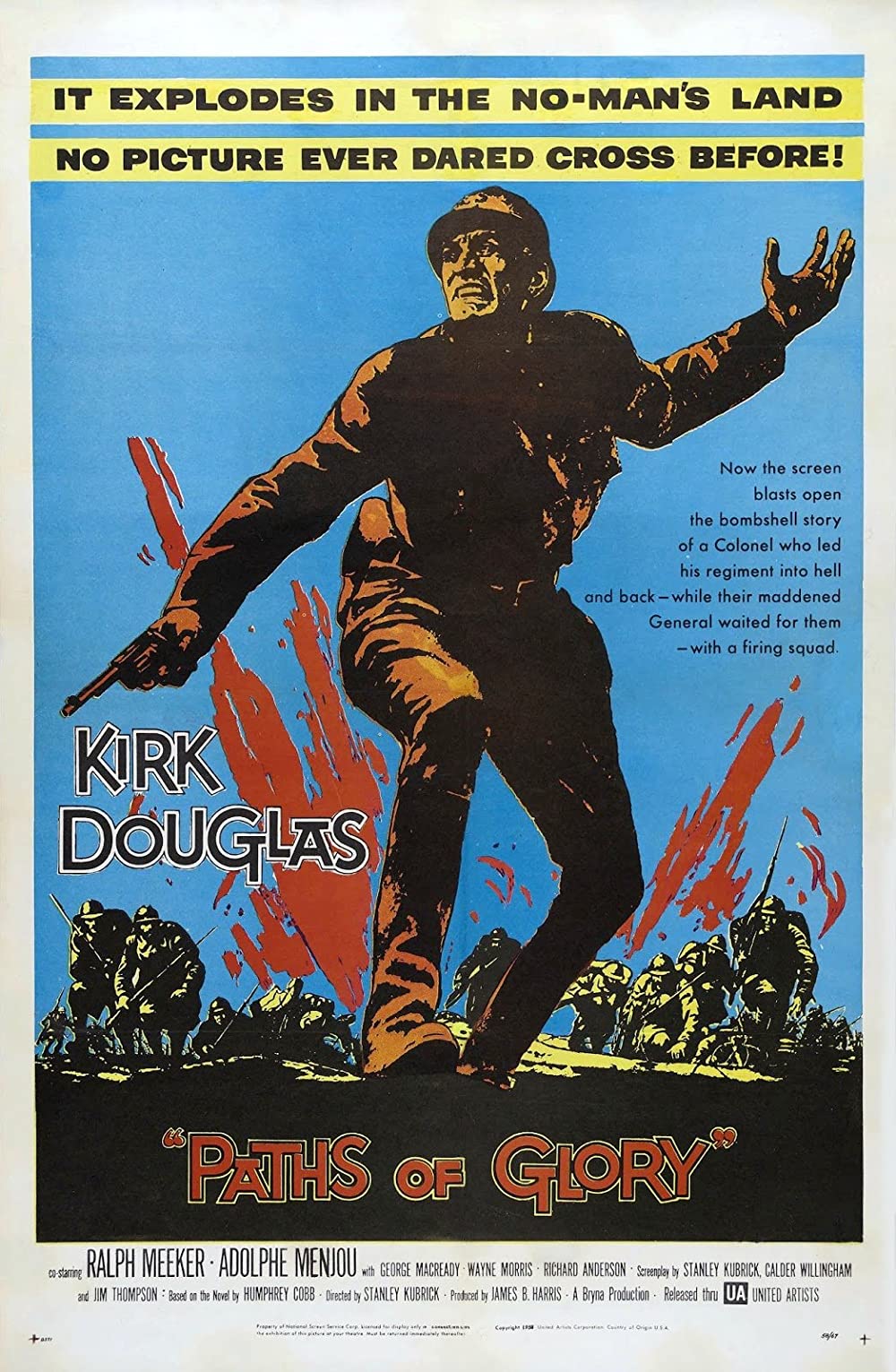
Almost one hundred years later the concept of that static war of the trenches that was the Western front of World War I is almost unfathomable. After the French army stopped the German offensive at the Battle of the Marne, the French and British armies faced the Germans in a line of trenches that stretched from Belgium to Switzerland. About a quarter of France was occupied for four years in that time. The casualties ran into the millions in that stalemate that gains were only measured in meters.

It was always just one more offensive over the top charging into automatic weapon fire that would break the other guy. Just such an offensive was planned one day in 1916 against a German stronghold dubbed the ant hill.

General George MacReady, promised a promotion by his superior Adolphe Menjou, orders a beaten and tired battalion to charge the ant hill. The attack flops and MacReady looks for scapegoats. He decides after coming down from shooting 100 men to a selected three drawn by lot. The unlucky three are Joseph Turkel, Ralph Meeker, and Timothy Carey.


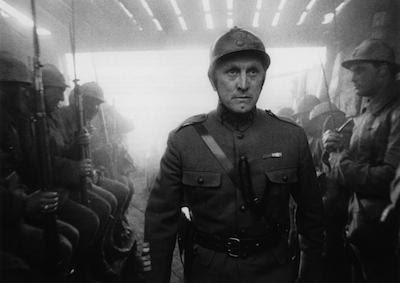
The commander of the three Kirk Douglas asks to serve as their counsel and he makes a good show of it at the kangaroo court martial they have. But the fix is definitely in.

Except for Spartacus, Kirk Douglas rarely plays straight up heroic types in film. Even his good guys have an edge to them, a dark side. But as Colonel Dax, Douglas is at his most heroic. He may be one dimensional here, but he's great. Especially in that last scene with Adolphe Menjou when he tells the man off in no uncertain terms, mainly because Menjou has misread Douglas's motives.


Menjou and Macready portray two different military types. The arrogant MacReady as versus the very sly Menjou. Not very admirable either of them. Menjou was not very popular at this time in Hollywood because of the blacklist. He favored it very much, his politics were of the extreme right wing. Nevertheless he was a brilliant actor and never better than in this film, one of his last.

The enlisted men are a good bunch also. They're kind of like the posse in The Oxbow Incident, just an ordinary group who become ennobled in martyrdom as they go to the firing squad for the sake of politics.

Paths of Glory is one of the best anti-war films ever made. It ranks right up there with All Quiet on the Western Front which showed the war from the German point of view. Both will be classics 200, 300, a thousand years from now...

BRUCE'S RATING: 10 out of 10
MY RATING: 9 out of 10


Sunday, March 5, 2023

GUEST REVIEW: ROUGHLY SPEAKING


The late Bruce Kogan returns to this blog with memories of this Rosalind Russell film that I never saw...

Based on a true story, someone had the genius over at the Brothers Warner to shell some bucks out for the services of Rosalind Russell for the lead. She really is so right for the part of Louise Randall Pierson a woman who through time and circumstance is forever reinventing herself. A little like Mame Dennis who lives to the fullest and like Molly Brown, she maybe down, but she ain't licked.

From Donald Woods she gets her four kids, but they are incompatible and divorce. She then marries Jack Carson who has ideas, but he's content to be a Vice President with his dad's flower nursery firm. Roz kick starts the ambition in him and their lives are quite the rollercoaster, but they are happy. And the kids are completely accepting of him

The image we have of Jack Carson in most of his roles is the lovable blowhard. But he had a really never appreciated talent for taking it down however many pegs necessary to achieve a great serious performances in a lot of serious roles. He and Russell work well together in Roughly Speaking.


There's a nice epic quality to Roughly Speaking. Coming out as it did at the nd of World War Ii it exudes a cheerful optimism about America and its people. The kind of stuff people wanted to hear in 1945.

It still holds up well as good entertainment...

BRUCE'S RATING: 7 OUT OF 10


Sunday, October 2, 2022

GUEST REVIEW: TWELVE ANGRY MEN

The late great movie reviewer Bruce Kogan returns to our blog with a look at the courtroom drama - Twelve Angry Men (1957). Kogan, being a political activist, was well aware of all facets of the judicial system...

When I was younger I thought 12 Angry Men was a near perfect ensemble film with a great group of male players. At that time in those sexist fifties women had an automatic out from jury duty. It was not unusual to have all male juries as we have here.

Then I served on a few juries and my concepts changed. One of the key scenes of the film is when Henry Fonda produces a switchblade knife exactly like the weapon the young perpetrator allegedly used in the stabbing death of his father. The second that Fonda produced that knife, someone should have yelled for a mistrial.

In all 50 states of the United States of America, a standard jury instruction is that the jury is to decide the guilt or innocence of a defendent on the evidence presented at trial. Jurors are free to come and go until they are sequestered for the verdict. But they are instructed not to go near the crime scene or gather ANY independent evidence.

I remember being on jury duty and assigned on a case where the crime took place in an apartment that was one block away from one of two routes to a BMT subway stop that took me to work. And those same subways also took me to downtown Brooklyn and the court house. I made it a point to take the IRT to court for the next two weeks while the trial went on to avoid the temptation of going over to the crime scene.


It was a great dramatic effect, but totally at odds with our legal system. I can't believe that something that elementary was left in a film that was purported to be a realistic look at jury deliberations.

The juries I was on did debate and in some cases quibble over all the points of the trial. They were a good cross section of the breed Brooklynus Americanus just as in 12 Angry Men. If you watch Law and Order you know how hard the prosecutors job is to get 12 people to convict.

Still it's a wonderful group of players that participated here. Henry Fonda and Lee J. Cobb are the biggest names in the cast. But others like Robert Webber, John Fiedler, Martin Balsam, and Jack Klugman got their first real notice in this film.

Jack Klugman's portrayal was a particular favorite of mine among the group. He's from the same slum background as the defendent and some of the knowledge he has from that environment makes for the most compelling argument for the defendent's innocence.

We should be thankful that Sidney Lumet assembled and directed the find cast he did...

 
BRUCE'S RATING: 6 out of 10
MY RATING: 7 out of 10


Sunday, May 15, 2022

SHADOW OF A DOUBT: 1943 REVIEW

Here is the 1943 review of a Alfred Hitchcock classic as it appeared in the New York Times on January 13, 1943...

You've got to hand it to Alfred Hitchcock: when he sows the fearful seeds of mistrust in one of his motion pictures he can raise more goose pimples to the square inch of a customer's flesh than any other director of thrillers in Hollywood. He did it quite nicely in "Rebecca" and again in "Suspicion" about a year ago. And now he is bringing in another bumper crop of blue-ribbon shivers and chills in Jack Skirball's diverse production of "Shadow of a Doubt," which came to the Rivoli last night.Yes, the way Mr. Hitchcock folds suggestions very casually into the furrows of his film, the way he can make a torn newspaper or the sharpened inflection of a person's voice send ticklish roots down to the subsoil of a customer's anxiety, is a wondrous, invariable accomplishment. And the mental anguish he can thereby create, apparently in the minds of his characters but actually in the psyche of you, is of championship proportions and—being hokum, anyhow— a sheer delight.

But when Mr. Hitchcock and/or his writers start weaving allegories in his films or, worse still, neglect to spring surprises after the ground has apparently been prepared, the consequence is something less than cheering. And that is the principal fault—or rather, the sole disappointment—in "Shadow of a Doubt." For this one suggests tremendous promise when a sinister character—a gentleman called Uncle Charlie—goes to visit with relatives, a typical American family, in a quiet California town. The atmosphere is charged with electricity when the daughter of the family, Uncle Charlie's namesake, begins to grow strangely suspicious of this moody, cryptic guest in the house. And the story seems loaded for fireworks and a beautiful explosion of surprise when the scared girl discovers that Uncle Charlie is really a murderer of rich, fat widows, wanted back East.But from that point on the story takes a decidedly anticlimactic dip and becomes just a competent exercise in keeping a tightrope taut. It also becomes a bit too specious in making a moralistic show of the warmth of an American community toward an unsuspected rascal in its midst. We won't violate tradition to tell you how the story ends, but we will say that the moral is either anti-social or, at best, obscure. When Uncle Charlie's niece concludes quite cynically that the world is a horrible place and the young detective with whom she has romanced answers, "Some times it needs a lot of watching; seems to go crazy, every now and then, like Uncle Charlie," the bathos is enough to knock you down.However, there is sufficient sheer excitement and refreshing atmosphere in the film to compensate in large measure for its few disappointing faults.


Thornton Wilder, Sally Benson and Alma Reville have drawn a graphic and affectionate outline of a small-town American family which an excellent cast has brought to life and Mr. Hitchcock has manifest completely in his naturalistic style. Teresa Wright is aglow with maiden spirit and subsequent emotional distress as the namesake of Uncle Charlie, and Patricia Collinge gives amazing flexibility and depth to the role of the patient, hard-working, sentimental mother of the house. Henry Travers is amusing as the father, Edna May Wonacott is fearfully precocious as "the brat" and Hume Cronyn makes a modest comic masterpiece out of the character of a literal-minded friend.As the progressively less charming Uncle Charlie, Joseph Cotten plays with smooth, insinuating ease while injecting a harsh and bitter quality which nicely becomes villainy. He has obviously kept an eye on Orson Welles. And MacDonald Carey and Wallace Ford make an adequate pair of modern sleuths.The flavor and "feel" of a small town has been beautifully impressed in this film by the simple expedient of shooting most of it in Santa Rosa, Calif., which leads to the obvious observation that the story should be as reliable as the sets...


Sunday, March 27, 2022

GUEST REVIEW: BORN TO LOVE

 Last year the world lost a great man when Bruce Kogan died. He not only was a great political activist, but he was a move buff that reviewed many great and not so great movies for this blog. When wish to keep his memory alive by publishing some of his great reviews on these blog pages...

The first of four films Constance Bennett did with Joel McCrea was one that you'd better bring the bath towels to the theater if you saw it. I'm sure even the men had a tear or two seeing what Connie went through.

An American nurse in London during World War I Bennett has American ace Joel McCrea and stiff upper lip British major Paul Cavanaugh after her. She loves McCrea and can't see Cavanaugh.

But when McCrea gets shot down and goes missing in action she's very pregnant and the sympathetic Cavanaugh is ready to marry her and make her respectable.


The usual complications ensue after that and Bennett pays a heavy price for her romances.

Born To Love fits rater neatly into that category called women's pictures. Women who worried where the next meal might come from, plunked don their nickel and could sympathize with a woman like Bennett and her complicated romantic life.

For this type the film is OK, but I doubt we'll see a remake in this century.

BRUCE'S RATING: 5 out of 10


Saturday, September 5, 2020

THE FACE BEHIND THE MASK: A 1941 REVIEW

The little know film The Face Behind The Mask (1941) is one of my favorite film noir of all time, but when the movie came out the initial review was not too kind. I 100% disagree with this review. Here is the original review that appeared in the NY Times on February 7, 1941...


Despite a certain pretentiousness toward things psychological, "The Face Behind the Mask," current at the Rialto, may safely be set down as just another bald melodramatic exercise in which the talents of Peter Lorre again are stymied by hackneyed dialogue and conventional plot manipulations. 

As an immigrant whose hopes of acquiring a footing in the new world are dashed after his face is horribly disfigured in a boarding house fire, Mr. Lorre strives earnestly to present a psychological study of a man who is driven, to crime against the dictates of his conscience in order to finance a plastic surgery operation. But this theme is not fully developed by the scenarists, nor is it pointed up to any extent by Director Robert Florey. 

The deliberate pace at which the story unfolds tends more to expose its flaws than to create a brooding atmosphere of conflict between the mind and soul of the protagonist. Peter Lorre is wasted in this one dimensional role as is the young and beautiful Evelyn Keyes. Both actors must be fullfilling a contract obligation to Columbia Pictures to make a film so beneath them...


Monday, April 29, 2019

GUEST REVIEW: RAGTIME

Bruce Kogan is back with his guest review to end our month of Ragtime stories. This review is a look at the 1981 movie version of Ragtime. It's a great movie with a great review from Bruce...

Back in the day when Hollywood was grinding out B westerns it wasn't unusual at all to see famous folks of the west in stories that had absolutely nothing to do with their own lives or to see many famous people interacting when they never even met in real life.

Ragtime revives some of that dubious tradition in filming E.L. Doctorow's novel about the Teddy Roosevelt years of the first decade of the last century. Teddy figures into this briefly as does his Vice President Charles Fairbanks. Booker T. Washington is here too, as are the principals of the Stanford White murder, and New York City Police Commissioner Rhinelander Waldo.

It's quite a blend because Roosevelt and Fairbanks ran for re-election in 1904 as Fairbanks is shown delivering a campaign speech. He wasn't even Vice President then, just a Senator from Indiana. Fairbanks was running for Vice President because Roosevelt had no Vice President in his first term. He succeeded to the presidency when Willima McKinley was assassinated.

The Stanford White murder took place in 1906 and was then called the crime of the century. Many such murders right up to O.J. Simpson were given that dubious distinction. And Rhinelander Waldo was not NYPD Police Commissioner until 1910 and he was much younger than James Cagney. 


Still and all E.L. Doctorow's book is made into a fine film which got a whole bunch of Academy Award nominations including Best Picture, Best Director for Milos Forman and Supporting player nominations for Howard Rollins, Jr. and Elizabeth McGovern.

The main story is about Coalhouse Walker, Jr. a black ragtime pianist and his Sarah. She has his baby and they'd like to get married. But a whole lot of things, some of them peripherally connected to the true events and people previously mentioned that lead him and a gang to take possession of the Morgan Library and threaten to blow it up.


Howard Rollins was a real tragedy. This was a great start to a short, but brilliant career that included his long running role as Virgil Tibbs in the TV series In the Heat of the Night and the film A Soldier's Story. He died way too young from AIDS contracted from a lot of intravenous drug use.

Elizabeth McGovern is the famous Evelyn Nisbet, the girl on the red velvet swing which was the title of another film that dealt with the Stanford White murder. McGovern's performance is probably closer to the real Evelyn than Joan Collins was in that earlier film. She's basically a goldigger who juggled two men, her husband Harry K. Thaw and her upscale lover, society architect Stanford White. Her circus act led to White's death, Thaw's commitment to an insane asylum and a vaudeville career for her.

Ragtime was eagerly awaited because of the anticipated return of James Cagney to the screen after being off for 19 years. Cagney is clearly aged, but he gets through the role because unlike that television film Terrible Joe Moran, he's not the center of the film, though he's first billed. Note that he's sitting down during most of his performance and when he has to stand the camera is a discreet distance. It's nothing like the bouncing Cagney of old, but light years better than Terrible Joe Moran.


This was also the final joint appearance as it turned for the team that invented the buddy film, James Cagney and Pat O'Brien even though they have no scenes together. O'Brien is Harry K. Thaw's attorney and Mrs. O'Brien plays Thaw's mother under her maiden name of Eloise Taylor. She was an actress before she married Pat, but gave up her career to raise their four children.

Author Norman Mailer plays Stanford White, fulltime architect and hedonist and Robert Joy plays the demented millionaire Harry K. Thaw and both fit the parts perfectly. Maybe one day we will have a definitive film version just concentrating on the murder and it's aftermath for the three principals.

Milos Forman gave us a remarkable evocation of an exciting time in American history. It seemed that America had limitless possibilities then. I doubt they'll be saying that about the first decade of this century...

BRUCE RATING: 9 OUT OF 10
MY REVIEW: 10 OUT OF 10


Thursday, March 21, 2019

RECENTLY VIEWED: AFTER LIFE

I am not a big television fan unless I am watching classic movies or re-runs of The Office or The Twilight Zone. However, I finally entered the modern age and became a Netflix member. I was recently lucky enough to catch the new series After Life. After Life is a British dark comedy web television series created, executive produced, and directed by Ricky Gervais (who also plays its main character), that premiered on 8 March 2019, on Netflix.

After Life follows Tony, who has a perfect life before his wife dies from a battle with breast cancer. After contemplating suicide, he then decides to live long enough to punish the world for his wife's death by saying and doing whatever he wants to. Although he thinks of it as sort of a superpower, the situation turns tricky when everyone around him starts trying to make him a better person again.

No review can do justice to the show. Season one is six episodes long, and I have never had a television show affect me the way that Gervais' show did. I laughed. I squirmed. I cried. This is all within a 28 minute episode. Luckily, I have never lost a spouse, but I have lost extremely important people in my life like my grandfather and my father. Ricky Gervais' portrayal of Tony is just amazing. He manages to capture every emotion that someone has when they lose a loved one. I have always liked Ricky Gervais' work, and he makes me laugh hysterically with his stand up comedy specials, but I never realized what a striking actor he is. He deserves and Emmy for this role.


After watching the sixth and final episode the other night, I crawled in bed with my wife who went to bed earlier, and I just looked at her and held her hand as she slept. (Unfortunately, she woke up and was none to happy with me!). This show made me laugh, but it also made me realize that I will never take my wife for granted. After Life made me realize that I want to make every moment to matter with my wife and kids, because life is too short.

If you want a show that will make you ball your eyes out as well as cause you to pee your pants in laughter, then Ricky Gervais has really given us a treat with this new show. Keep the tissues and clean underwear handy when you watch this one. The only fault I could find with After Life is that a six-episode season is too short. I hope there will be a season two...

MY RATING: 10 out of 10


Sunday, September 16, 2018

GUEST REVIEW: ONCE A THIEF

Bruce Kogan is back to review another film. I have to admit I have never of 1951's Once A Thief but after reading this review I want to see it now!

Cesar Romero and June Havoc star in this shoestring B film about a woman who falls for the wrong guy and both pay for it in the end.

June Havoc plays a waitress in a Los Angeles beanery who's been around the block a few times and sets in motion a train of events when she feels sorry for Marie McDonald when she can't pay her bill and gets her a job at her place of work.

McDonald barely escaped from a heist she was in on up north and she's wanted. Romero is a flashy small time crook who runs a bookmaking parlor with Lon Chaney, Jr. in back of Chaney's tailor shop.


All three, Romero, Havoc, and Chaney are in parts that they would have gotten more critical acclaim for had they been at a major studio for this film. Romero who was usually second leads and/or romantic rival of the leading man really shows some acting chops in this part. Chaney also showed he was capable of more than the horror films Universal Pictures put him in.

As for Havoc she spent most of her career on the stage, but her film appearances were in mostly B films. She's the hardboiled dame in love with the wrong guy and great at the part.


Fans of all three of these people, this dental floss budget film should not be missed by any of you...

BRUCE'S RATING: 5 OUT OF 10
MY RATING: HAVE NOT SEEN YET!

Saturday, March 11, 2017

THE BOY WITH THE GREEN HAIR: A 1948 REVIEW

One of my guilty pleasures when I was first collecting movies was The Boy With The Green Hair. At the time it was a rare movie that was just different. I liked it though. Here is the original 1948 review by Bosley Crowther from the New York Times of January 13, 1949...

A novel and noble endeavor to say something withering against war on behalf of the world's unnumbered children who are the most piteous victims thereof is made in the RKO picture, "The Boy With Green Hair," a fantasy-drama in color, which opened at the Palace yesterday. But the fact that the effort is earnest is no surety of its success. For all its proper intentions, the gesture falls short of its aim.

As mere sentimental entertainment, this tale of a lad whose hair turns green as a sort of miraculous token of the cruelty of war is unevenly appealing, it being, in certain respects, a beneficiary of the pattern of the charming "On Borrowed Time." The lad in the case is an orphan and he lives with a kindly old man who has a rare tenderness toward children—and who goes by the winning name of "Gramp." Furthermore, this attractive youngster becomes obsessed with a frightening idea, from which his gentle old guardian attempts to protect and deliver him.

In its scan of the poignant relations between the elderly man and the troubled boy, this film does project intimations of real compassion which are irresistible. And it profits in this projection from cozy performances by Dean Stockwell as the youngster and Pat O'Brien as the old man. Master Stockwell is lovable yet sturdy, diminutive yet strong, and Mr. O'Brien is softly sentimental without going into "Hearts and Flowers."


But, unfortunately, the idea with which the lad becomes obsessed—and which is, supposedly, responsible for his hair turning green—is weakly motivated. And the fanciful device of rendering his hair symbolic is not only arbitrary but vague.

It is not established, for instance, whether all this we see on the screen—the phenomenal hirsute coloration and the resentment of the townsfolk thereto—is supposed to be a boy's hallucination, just another of a couple he has, or whether it is intended as a strictly whimsical device. If the former, it isn't consistent with the evident fancies of this lad's mind. If the latter, it is strangely inconclusive, when pictured thusly. And, frankly, it's banal.


For it might stand to reason that a youngster of a particularly introverted sort could be so upset by anxieties that he would sense an extreme conspicuousness. And he might even tie up this fancy in a childish way with the victimizations of war. But to reason, in adult whimsey, that wars are caused by such a superficial thing as resentment of coloration is absurd and misleading.

It is very much to be regretted that Ben Barzman and Alfred Lewis Levitt, in writing this film's script from a modest little story by Betsy Beaton, and Joseph Losey in directing it, did not clarify the implication. Not only is it now confused, but one gets the uncomfortable feeling that it is just a bright adult notion gone wrong. The use of the by-now quite hackneyed "Nature Boy" as a musical theme does not dignify the conception. The supporting cast is adequate...


SOURCE


Sunday, November 29, 2015

IT'S A WONDERFUL LIFE: A 1946 REVIEW

I have to admit I have never seen the 1946 classic It's A Wonderful Life. I have seen parts of it, but not the whole movie. I vow I will try to remedy that this year! In the meantime here is what the New York Times thought of the film when it published this review on December 23, 1946...

The late and beloved Dexter Fellows, who was a circus press agent for many years, had an interesting theory on the theatre which suited his stimulating trade. He held that the final curtain of every drama, no matter what, should benignly fall upon the whole cast sitting down to a turkey dinner and feeling fine. Mr. Fellows should be among us to see Frank Capra's "It's a Wonderful Life," which opened on Saturday at the Globe Theatre He would find it very much to his taste.

For a turkey dinner, with Christmas trimmings, is precisely what's cooking at the end of this quaint and engaging modern parable on virtue being its own reward. And a whole slew of cozy small-town characters who have gone through a lot in the past two hours are waiting around to eat it—or, at least, to watch James Stewart gobble it up. For it is really Mr. Stewart, who does most of the heavy suffering in this film, and it is he who, in the end, is most deserving of the white meat and the stuffing.

That is because Mr. Capra, back from the war, has resumed with a will his previously manifest penchant for portraying folks of simple, homely worth. And in this picture about a young fellow who wants to break away from his small-town life and responsibilities but is never able to do so because slowly they close in upon him, Mr. Capra has gone all out to show that it is really a family, friends and honest toil that make the "wonderful life."


His hero is a personable fellow who wants to travel and do big things but ultimately finds himself running a building-and-loan association in a one-horse town, married and locked in constant struggle with the greedy old banker of the town. And when it finally looks as though the banker is about to drive him to ruin, he makes what appears a brash endeavor to take his own baffled life. Whereupon a heavenly messenger providentially intercedes and shows him, in fanciful fashion, what the town would have been like without him. The vision is so distressing that he returns to his lot with boundless joy — and is saved, also providentialy, by the financial assistance of his friends.

In composing this moralistic fable, Mr. Capra and his writers have tossed in a great abundance of colloquial incidents and emotional tangles of a mistful, humorous sort. The boyhood of his hero, the frolic at a high school dance, the clumsy pursuit of a courtship—all are shown in an entertaining way, despite the too frequent inclinations of every one to act juvenile and coy. And the heavier sections of the drama are managed in a tense, precipitate style.


As the hero, Mr. Stewart does a warmly appealing job, indicating that he has grown in spiritual stature as well as in talent during the years he was in the war. And Donna Reed is remarkably poised and gracious as his adoring sweet-heart and wife. Thomas Mitchell, Beulah Bondi, H. B. Warner and Samuel S. Hinds stand out among the group of assorted small-town characters who give the picture variety and verve. But Lionel Barrymore's banker is almost a caricature of Scrooge, and Henry Travers' "heavenly messenger" is a little too sticky for our taste.

Indeed, the weakness of this picture, from this reviewer's point of view, is the sentimentality of it—its illusory concept of life. Mr. Capra's nice people are charming, his small town is a quite beguiling place and his pattern for solving problems is most optimistic and facile. But somehow they all resemble theatrical attitudes rather than average realities. And Mr. Capra's "turkey dinners" philosophy, while emotionally gratifying, doesn't fill the hungry paunch...