
Showing posts with label Clara Bow. Show all posts
Showing posts with label Clara Bow. Show all posts
Friday, May 17, 2019
CELEBRITY ADS: CLARA BOW
Here is a great vintage advertisement that featured Clara Bow. She was selling eye make-up that would give you eyes that looked just like the "It" girl! This advertisement was from 1927. At the time, Clara Bow was appearing in the Paramount silent move Children Of Divorce...


Friday, March 17, 2017
PHOTOS OF THE DAY: CLASSIC HOLLYWOOD ON ST. PATRICK'S DAY
Everyone is Irish on St. Patrick's Day, and to celebrate the wearing of the green, here are some excellent pictures of classic Hollywood celebrating...
 |
| JUNE HAVER |
 |
| CLARA BOW |
 |
| ARLENE DAHL |
 |
| OLGA SAN JUAN |
 |
| MAUREEN O'HARA |
 |
| LUCILLE BALL |
Monday, June 27, 2016
FINAL RESTING PLACES: CLARA BOW

Known as the 'It Girl,' she is considered America's first "Sex Symbol". Born to poverty in Brooklyn, New York, she won a photo beauty contest that launched her film career in 1922. She was "discovered" while working at a Coney Island Hot Dog stand run by Nathan Handwerker, who would later find fame in his own right as the founder of Nathan's Franks.
The silent movie, "It" (1927), made her a household name ("It" refers to "sex appeal"). She often played a young, frisky, openly sensual, rebellious girl in many of her movies, yet this role probably defined the attitude of society at that time, and it made her a star. She was the definitive "Flapper" of the 1920s. Probably one of the more overworked and underpaid actresses in the industry, she made 58 films between 1922 and 1933. Unlike many Hollywood stars, she did not flaunt her wealth, but lived on par with the middle class, living in a small 7 room house in Beverely Hills.

Her sexual liaisons and extremely public private life were legendary, and in 1928 she had a torrid affair with director Victor Fleming that made headlines continuously. In 1927, she had the female lead role in Wings the first Oscar winning "Best Picture." With the coming of sound movies in 1929, her thick Brooklyn accent lost her many fans, and her career waned.
Adding to her problems were gambling debts, unpaid IRS taxes, embezzlement by her secretary, and several sensational public court battles involving divorce and alienation of affection between several husbands and wives. In 1931, she married film cowboy Rex Bell, and retired from making films in 1934. She became a doting mother of two boys, settling down and never making another movie. She died at age 60 of a heart attack, in Los Angeles, California. The marker on her crypt marker her birth year as 1907, but she was born in 1905...

Friday, January 11, 2013
CLARA BOW RETROSPECTIVE
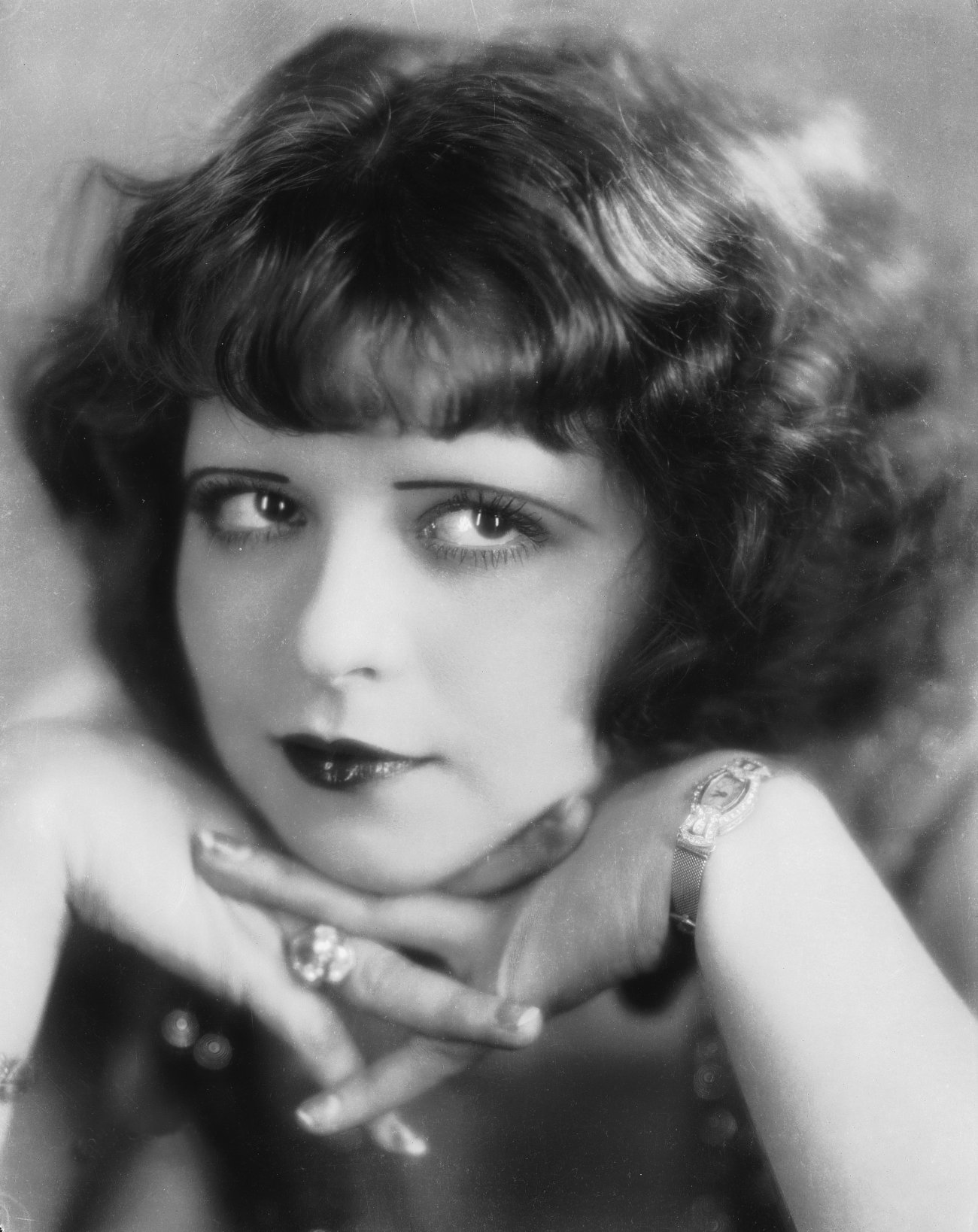
"She was the first sex symbol," said David Stenn, author of "Clara Bow: Runnin' Wild." "I think more than that, Clara was the first female star whose appeal was 50-50," he noted. "She could pull the male audience who wanted her and the female audience who wanted to be her."
Bow's winsome appeal is on display in the UCLA Film & Television Archive's new retrospective "Call Her Savage: Clara Bow Hits the Screen." It opens in January at the Billy Wilder Theater with her last two films, 1932's "Call Her Savage" and 1933's "Hoop-La," both of which were recently restored. Stenn, who has also funded restorations of Bow's films, will introduce the screenings.
Other films in the retrospective include the 1927 romantic comedy "It," which lead to Bow's nickname, the "It" girl; 1927's "Wings," which won the first best picture Oscar; 1929's "The Wild Party," which was her first talkie; and the rarely seen 1931 film "Kick-In."
When Bow began in films, female stars such as Gloria Swanson, Mary Pickford and Lillian Gish ruled the box office. Unlike today, where Hollywood mostly caters to boys and young men, "the whole star system was created for female audiences," noted Jan-Christopher Horak, head of the archive.
"Empirically, more young women went to the movies than young men, and once they had families, they made the decision and they catered to that audience," said Horak. "If you look at the ratio between male and female stars, it is almost the opposite of what it is now. "
With her short, wavy hair, big expressive eyes and abundant spunk, Bow embodied the spirit of the carefree, uninhibited Jazz Age flapper. Bow's popularity paralleled the enormous inroads women were making post-World War I, beginning with finally getting the right to vote in 1920, getting rid of their corsets and entering the workforce in larger numbers.
"There is much more gender equality and Clara Bow epitomizes the 'It' girl — someone who is single, young and loves sex and is not afraid of it," said Horak. "That is completely different from the Victorian image that D.W. Griffith is propagating in the teens and even until the '20s."
Bow was "extremely refreshing to the working-class public," said Elaina B. Archer, producer and co-writer of the documentary "Clara Bow: Discovering the 'It' Girl."
"Everyone loved her across societal borders," Archer said. "Clara allowed them to relax. She wasn't ashamed of her sexuality — she embraced it."
By the late 1920s, said Stenn, "she was the No. 1 box office attraction. Clara Bow was such a huge draw at Paramount she was contracted to do four movies a year. They were simply known as 'Winter Bow,' 'Spring Bow,' 'Summer Bow' and 'Fall Bow.'"

Behind her mask of sauciness and vitality, though, Bow was dealing with a lot of demons.
Just like Monroe, Bow had a poor, Dickensian childhood. "She was literally born in a one-room cold-water flat above a Baptist church in Brooklyn to a mother who tried to kill her," said Stenn. And though her father abused her, Bow protected him all of his life.
Her behavior off-screen was unconventional. There were scandals and highly publicized love affairs. "The sad thing was the studios were very hypocritical," said Archer. "When it came to Clara, they expected her to be free on the screen and then reined her in off screen," Archer said. "I think in a lot of ways, they used her up. She was hurt by what she went through."
By the early '30s, she was physically and mentally exhausted. She had made 45 films in six years. Bow had a nervous breakdown after "Kick-In" and was admitted into a sanitarium. During this time, she met and married cowboy actor Rex Bell. Two years later, she retired and moved with Bell to a ranch in Nevada and had two children.
But she never was free of her mental distress. There was a suicide attempt in 1944, followed in 1949 by a stay at a mental institution. After Bell's death in 1962, she moved back to Hollywood, where she died in seclusion of a heart attack at age 60 in 1965...

SOURCE
Monday, October 15, 2012
PHOTOS OF THE DAY: A CLASSIC HOLLYWOOD HALLOWEEN
Looking at old pictures of classic Hollywood, it was such a glamourous time for tinsel town. I never get tired seeing classic pictures, and I especially love at this time of the year to take a look back at some classic Hollywood Halloween pictures. They were not really scary but they were fun...
 |
| CAROLE LOMBARD (1908-1942) |
 |
| BETTY GRABLE (1916-1973) |
 |
| ESTHER WILLIAMS (1921-2013) |
 |
| MARTHA VICKERS (1925-1971) |
 |
| ADELE JERGENS (1917-2002) |
 |
| CLARA BOW (1905-1965) |
Thursday, September 13, 2012
PHOTOS OF THE DAY: STARS AND THEIR CARS
Nothing captures the essence of the 1930s and 1940s than classic Hollywood and classic cars. Both had so much style in those days. Like classic Hollywood, classic cars had so much character and individuality. Here are just a few pictures of the classic stars with their classic cars:
BING CROSBY AND HIS NEW CADILLAC IN 1947

KIM NOVAK WITH HER CADILLAC IN 1957

CLARA BOW ON A 1919 MOON IN 1926

JOAN CRAWFORD WITH HER NEW 1932 CADILLAC

SOPHIA LOREN ON HER MERCEDES IN THE LATE 1950s

JEAN HARLOW AND HER 1934 CADILLAC


Thursday, January 19, 2012
WINGS AND ITS RESTORATION

By Susan King
One of the favorites for a best picture Oscar nomination this year is the black-and-white silent French film "The Artist." And if the story about the infancy of talkies in Hollywood does earn the top Academy Award, "The Artist" will be the first silent to win the honor since the very first best picture winner, 1927's World War I epic "Wings," directed by William Wellman. In honor of the 85th anniversary of "Wings" and the centennial of Paramount Pictures, the studio that produced the classic, the film starring Buddy Rogers, Richard Arlen, Clara Bow and a young Gary Cooper has been digitally restored. It is making its long-awaited debut on DVD and Blu-ray on Jan. 24.
On Wednesday, the Academy of Motion Picture Arts and Sciences will be unveiling this new restoration, which includes the original color tints as well as sequences that used an early color process called Handschliegl. The process had been used in the black-and-white film to highlight gunfire and flames from the planes. Clark Wilson will provide live organ accompaniment.
Produced for what was then a staggering $2 million, "Wings" changed the landscape of filmmaking with its masterful aerial and battle sequences that featured thousands of real soldiers as extras. Rogers and Arlen play small town rivals who become fighter aces and friends during the Great War; Bow is the girl who loves Rogers. Though Cooper has a tiny part as a doomed pilot, he was so impressive that his appearance made him a star.
Academy programmer Randy Haberkamp said, " 'Wings' is a reminder of not only where we came from, but how visual storytelling is still the essence of great movies. 'Wings' was a blockbuster in the same sense of 'Avatar' and 'Star Wars.' It was screened with live sound effects and full orchestra in Magnascope, a precursor to Imax, and all of these amazingly photographed live stunts, pre-CGI, that had everybody in the seat of the cockpit."
"Wings" had been photochemically restored by preservationist/historian Kevin Brownlow, as well as by the Academy Film Archive. Andrea Kalas, vice president of archives at Paramount, worked closely with the academy and Brownlow on the restorations.
The original nitrate negative and early material had long disappeared, so Paramount searched the world for the best remaining elements, finally finding the most comprehensive print — a duplicate negative made from a nitrate print in the late 1950s — in its own vaults.
"Working with Technicolor, I think we brought the picture back to something that really honors the film," Kalas said.

The DVD will have sound effects created by Oscar-winning sound designer Ben Burtt and his team at Skywalker Sound, as well as the original orchestral score.
The director's actor/writer son William Wellman Jr. was very involved in the restoration and was a participant in the bonus features for the DVD. When he first saw the new restoration, "I could hardly speak when I came out of the theater," he said, adding that the color sequences "had a whole new look to the picture."
Paramount heads Adolph Zukor and Jesse Lasky had been in preproduction on the film for four months before Wellman was hired to direct. It was B.P. Schulberg, head of production, who recommended the 30-year-old Wellman because he was the only Paramount director under contract who had battle experience. Wellman had been a decorated fighter pilot during World War I.
"He had seen all the action that was going to be shown in 'Wings,'" his son said. "There had been plenty of films about World War I, but no one had ever made a movie about the Great War in the air."

After two months on location in San Antonio, William Wellman, whose feisty personality earned him the nickname "Wild Bill," rankled the Paramount brass when he threw out two months of flying sequences he had shot. "It looked terrible," his son said. So his father and the crew "had to invent and create the technology for the aerial effects in the movie. He wanted it to be so real, especially since he had lived it."
SOURCE
Saturday, November 26, 2011
SEX SYMBOLS OF THE CINEMA: 1920s
When you read about movie sex symbols you instantly think of bombshells like Marilyn Monroe or Rita Hayworth. Sex symbols in the movies though are pretty much as old as the film industry itself. During the silent screen era, the sex symbol really made its mark to film goers. The rise of the flapper and prohibition truly caused America to go through a sort of sexual revolution. Mixing jazz and illegal liquor into society caused a loosening of the sexual hang-ups that the morally uptight country had had since their independence in 1776.
With the silent movies, audiences had to use their imagination because there were no words. The actresses who became sex symbols during the 1920s did not have the advantage of seducing by whispering sweet nothings to the audience. These vamps had use their eyes, their body, and their every movement. It was not easy being a sex symbol in the 1920s, but these women were the favorites of movie audiences:

CLARA BOW (1905- 1965)
Rumor has it that this undisputed sex symbol of the 20s got into the Hollywood game when at age 18 she entered the office of a studio exec dressed in her high school uniform, landing on their payroll just a few days later. Bow was never a great film actress, but most of her movies made money. When sound came to the films, her career came to an end. During her lifetime, Bow was the subject of wild rumors regarding her sex life; most of them were untrue. A tabloid called The Coast Reporter published lurid allegations about her in 1931, accusing her of exhibitionism, lesbianism, drug addiction, alcoholism, and having contracted venereal disease. The publisher of the tabloid then tried to blackmail Bow, offering to cease printing the stories for $25,000, which led to his arrest by federal agents and, later, an eight-year prison sentence.

LOUISE BROOKS(1906-1986)
Louise Brooks made her screen debut in the silent The Street of Forgotten Men, in an uncredited role in 1925. Soon, however, she was playing the female lead in a number of silent light comedies and flapper films over the next few years, starring with Adolphe Menjou and W. C. Fields, among others. She was noticed in Europe for her pivotal vamp role in the Howard Hawks directed silent "buddy film", A Girl in Every Port in 1928.It has been said that her best American role was in one of the early sound film dramas, Beggars of Life (1928), as an abused country girl on the run with Richard Arlen and Wallace Beery playing hoboes she meets while riding the rails. Brooks had always been very self-directed, even difficult, and was notorious for her salty language, which she didn't hesitate to use whenever she felt like it. In addition, she had made a vow to herself never to smile on stage unless she felt compelled to, and although the majority of her publicity photos show her with a neutral expression, she had a dazzling smile. By her own admission, she was a sexually liberated woman, not afraid to experiment, even posing fully nude for art photography, and her liaisons with many film people were legendary, although much of it is speculation.

THEDA BARA(1885-1955)
Theda Bara has the honor to be one of the few people in history who actually helped create a new word in the English language. The story goes thusly: thanks to Bara’s roles of sexually provocative women, she quickly became known to movie audiences as “The Vampire” because same as female empowerment, vampires are terrifying monsters. Then, seeing as all of the country was too busy oppressing minorities to properly pronounce words, the nickname was shortened to “vamp” and a new word was born. But it’s not like Bara ever had anything against that. Actually she did everything to maintain her reputation as a lustful poison in female form, often showing as much as a 1 square foot of bare skin in each movie.

POLA NEGRI (1897-1987)
Pola Negri was the stage moniker of Polish actress Barbara Chalupiec, presumably adopted to honor the mighty polar bear, Poland’s deadliest natural predator. In accordance with the ferocious origin of her name Negri quickly became known for her femme fatale image, despite the fact that in real life she was an obnoxious, attention seeking brat if the word of her bitter rivals is to be believed. Sadly, Negri’s career went downhill when they put sound in movies and it turned out this foreign woman spoke English with an accent!!
When Al Jolson first sang about his Mammy in 1927 on film, it spelled the end to some of these first sex symbols like Pola Negri. Her accent was too think for audiences discovering these talkies. However, the same type of accent that destroyed Negri's career in the 1920s, would be same type of accent that would rocket actresses Greta Garbo and Marlene Dietrich to super stardom in the 1930s...
Saturday, November 19, 2011
COMING SOON: SEX SYMBOLS OF THE CINEMA

Starting November 26th and continuing every Saturday through December, we will be spotlighting the sex symbols of the cinema! We will take a look at the popular sex symbols of a particular decade, and also look at what was going on in our society to make them so popular.
We will start with the silent movies of the 1920s and go all the way through the 1960s. Tell your friends about this new series - coming to this blog next Saturday!

Thursday, August 18, 2011
PHOTOS OF THE DAY: SILENT MOVIE ACTRESSES
There are something about the pictures of silent screen actresses that make them so mysterious and alluring. Maybe it is because the public could not hear them talk that made them so great. Either way, I wish more people would realize that some of the silent movie actresses were truly great. Some did not make the transfer to the talkies, but they all were legends in their own way...
NORMA TALMEDGE (1894-1957) 
CLARA BOW (1905-1965) 
MABEL NORMAND (1892-1930) 
COLLEEN MOORE (1899-1988) 
LILLIAN GISH (1893-1993) 
ANITA PAGE (1910-2008) 


Subscribe to:
Posts (Atom)