Showing posts with label Gene Kelly. Show all posts

Tuesday, September 1, 2026

THE LAST DAYS OF GENE KELLY

The decision by Gene Kelly’s widow not to organise a funeral for her late husband when he died in 1996 no doubt surprised many, but she has now revealed the wish came from the Singin’ In The Rain star himself before he passed away.

The legendary actor and dancing star died at the age of 83 following a series of strokes, shortly after he married his third wife Patricia Ward Kelly. His declining health stemmed from strokes he suffered in July 1994 and February 1995, from which he never fully recovered.

Patricia tours the world talking about Gene in which she stands in front of a crowd and reads back, plays and recites some of their memories together – portraying a more personal side to the legendary star. And one subject she touches on is his declining health in his final years.

“I talk about this in the show because a lot of people don’t talk about the end of life and I think it’s really integral. It’s part of it, talking about grief and loss,” she said. “He was in and out ill for much of the time we were together. A lot of it was kept out of the press, we would sneak into hospitals as best we could. He really did face the end of his life with such grace and such dignity. It was really a lesson in how to deal with difficulty, and it was really a bonding time for the two of us.”

The pair first met at the Smithsonian in Washington DC, US, in 1985, when he was the host for a television special about the museum and she was a writer on the project. Despite their 47-year age gap, they enjoyed more than a decade of blissful happiness together, with Patricia helping to care for him before his death.

At the time, she was helping to write down his memories for a book about his life, so has records of almost all of their conversations and movements. She claimed patient confidentiality wasn’t so much of a thing in the ’90s and they’d have nurses selling stories to the press about Gene as he battled illness in his final years. In fact, she claimed some journalists even dressed up as priests to sneak in themselves.

“It was awful. People assume that a celebrity will have the best, but in fact I think it’s very, very hard for a celebrity, very difficult. But in a way it brought us closer, we were fighting the same fight. Of course I was writing down everything, which was a way for me to cope,” she explained.

“As long as I was writing, he was still alive. But then the problem is you realise when you stop writing, what happens then?”


While Patricia said she had grown up herself in a household that spoke openly about death, it wasn’t something she’d touched on initially with Gene. However as he grew older that changed and she expressed pride in how open he became with her.

“It was something that was very familiar when I grew up with my family, so I just felt that I wanted to know exactly what he wanted,” she said. “I assured him that I would do exactly what he wanted me to do.

“I think it was really good for him because, here was a guy from a different generation talking about things that you just generally didn’t talk about. I have to give him a lot of credit, for a man of that age and that stature to really assess and reassess his life and also to consider the end of life as frankly as he did, and lay it out.

“I was very proud of him. And it helped me a lot because I knew, people have such interesting feelings and thoughts about death and the final days, so I just needed to know what he wanted. I stuck to that and I knew, if I took any flack in the public, the press or anything, I would know that I did what he asked me to do. You have to do that for somebody, you have to make that promise.”

In the end, it was Gene’s wish not to have a memorial service or funeral, instead keeping the mourning private for his family. While many will no doubt have been surprised by the decision, Patricia explained it followed a life lived in the limelight – with his final wish for it to happen behind closed doors.

“He was very specific, he wrote that out – I had him write it out and notarise that!” she admitted. “He didn’t want to be buried anywhere, he said, ‘I’m tired of being on a tour bus route. Every time we would leave our house the tour bus would be going by and would follow us. He said, ‘For me it’s dust to dust’, he didn’t need to have a big memorial some place. I really understand that.

“I think some people think they have to go someplace, but for me he’s just always here so I don’t need to go to a particular spot to mourn him. He was very thoughtful.

“I think what helped him was experiencing the death of so many of his friends. He saw what happened to them, so it also helped to guide his choices. We’d sat through a lot of memorial services and visited a lot of gravesites, so he decided what he wanted.”

Before meeting Patricia and settling down, Gene had always insisted he would never marry again following the death of his second wife Jeanne Coyne. The couple had two children together, while Gene already had a daughter with his first wife Betsy Blair, who he divorced in 1957.

However, Patricia admitted it crept up on him and after five years, he eventually popped the question. She recalled: “I think by falling into this relationship through work… we set out to work together and then the other just came upon us both, it wasn’t until five years into being together when I’d lived with him the whole time that he finally got around to it.”


Tuesday, January 13, 2026

FROM THE ARCHIVES: GENE KELLY & VERA-ELLEN

Gene Kelly's widow Patricia recently posted this telegram from Vera-Ellen to Gene. Such great memorabilia from March 28, 1949...


Saturday, September 21, 2024

BRIGADOON: A 1954 REVIEW

Here is the original review of the movie musical Brigadoon, which was released 70 years ago. This review appeared in the New York Times on September 17, 1954...


By Bosley Crowther


AS we recall, the drama critics had a bit of a difficult time placing their pen-points precisely on the secret of the charm of "Brigadoon" when that whimsical play with music opened on Broadway some seven years ago. Was it the dancing, the music, the acting, the story, the decor—or, indeed, a graceful blending of all these elements—that made it a bright and spinning joy? As we recall, the secret was never entirely resolved.And now we're afraid the film critics—at least, this one—will find it equally hard to say why the film made from that triumph is so curiously flat and out-of-joint, rambling all over creation and seldom generating warmth or charm.It cannot be blamed on the story, for the story told in the film, which M-G-M delivered to the Music Hall yesterday, is exactly the same wistful fancy that was spun out upon the stage as written by Alan Jay Lerner, who also prepared the script. 


It is the story of two American hunters who go astray in the Scottish hills and there come upon a spectral village that is lost to the world and to time. Naturally, one of the fellows falls in love with a bonnie ghost, which leads to disturbing complications. It's a fairy-tale story, but it's okay.And it certainly cannot be for want of elaborate and handsome decor that this huge, polychrome motion picture lacks the joy of the show upon the stage. For Arthur Freed has produced it with what appears not a thought of the expense of Scottish costumes, thatched cottages, heather blossoms, scenic backdrops and furze-covered hills. A whole highland village and half a county are spread across the CinemaScope screen. To be sure, it does look artificial, but it is scenery. That, too, is okay.

The music? Well, let's acknowledge that a few of the better songs that made the stage show sweet and lovely are strangely omitted from the film. "Come to Me, Bend to Me" is missing. So is "My Mother's Wedding Day." And, for some unaccountable reason, they have dropped "There But For You Go I."However, "Waitin' for My Dearie" and "I'll Go Home With Bonnie Jean" are still given choral circulation, with a big boost from stereophonic sound, "The Heather on the Hill" still has its fragrance. And there's "Almost Like Being in Love." These, plus some other choral numbers, keep the musical franchise in line.But the dancing and the performance—well, we're afraid that it is in here that the life and the smoothness of the original have been perceptibly lost—which is odd, because the personable Gene Kelly and Cyd Charisse have the lead dancing roles. Even so, their several individual numbers are done too slickly, too mechanistically. What should be wistful and lyric smack strongly of trickery and style. And the several ensemble dances—with the exception of the wild and fierce "The Chase," wherein the Scots pursue a fugitive from their village—seem as calculated as Rockette parades.It might be noted that Mr. Kelly has taken credit for the choreography. On the stage, it was by Agnes De Mille.And those performances! Mr. Kelly's is as thin and metallic as a nail; Miss Charisse's is solemn and posey. A dismal young Scots lassie she! Van Johnson as the friend of Mr. Kelly pouts in a most unfunny way, and Barry Jones, Hugh Laing and Jimmy Thompson make peculiarly stagey Scottish ghosts. Vincente Minnelli's direction lacks his usual vitality and flow."Brigadoon" on the screen, we must say, is pretty weak synthetic Scotch.On the stage at the Music Hall are Gill Johnson and Mike Madill, comedians; Marlene Dell and Don Farnsworth, ballet soloists; Anthony Makas, pianist, and the Glee Club, Corps de Ballet and Rockettes...


Monday, November 13, 2023

BARBRA STREISAND VS GENE KELLY

Barbra Streisand is opening up about her experience working with Gene Kelly. In one chapter of the Academy Award winner's new memoir My Name Is Barbra, Streisand peels back the curtain on her impressions of Kelly when he directed her in 1969's Hello, Dolly!

In the memoir, Streisand, 81, recalls that she felt a disconnect between herself and Kelly, himself a Hollywood star famous for his roles in Singin' in the Rain, among other Golden Age of Hollywood films.

Streisand, who describes Kelly as a childhood celebrity crush, writes that she did not spend any significant amount of time discussing her character Dolly Levi with her director, though she notes she later discovered the filmmaker felt the whole project was pressed for time, while researching her new memoir.


"I was disappointed when the reality of the man didn’t live up to the fantasy I had from watching him on‑screen," Streisand writes. "One day he was so rude to a female dancer that I asked him privately, 'Why were you so mean to her?' And he basically laughed it off and said, 'Yeah, I was pretty tough on her, but that’s okay. I used to yell like that at another dancer, and she became my wife.' "

Streisand writes that Hello, Dolly!'s co-screenwriter and producer Ernest Lehman "was always receptive" to her ideas and questions on-set. She considered Lehman, who died in 2005 at 89, one of her few allies on the 20th Century Fox production.

"I don’t think I’m paranoid, but I felt as if Gene and Walter [Matthau] had an attitude toward me, and it was not positive . . . especially on Walter’s part," she writes in the memoir. "In fact, he was overtly hostile, and I couldn’t figure out why."


"He closed his eyes and yelled, 'Who the hell does she think she is? I’ve been in this business thirty years, and this is only her second movie . . . the first one hasn’t even come out yet . . . and now she’s directing?' " Streisand recalls Matthau saying. "And then he looked at me with pure venom and said, 'You may be the singer in this picture, but I’m the actor! I have more talent in my farts than you have in your whole body!' "

Streisand writes that she was "stunned" by his comments. "I had no defense," she writes. "I had no words. I just stood there and was so humiliated that I ran off the set, crying. I’m not proud of that."

"I wish I could have answered him back. But I never want to be mean or malicious," Streisand adds in the memoir. "That’s not who I am. I want to be strong, not unkind."

Hello, Dolly! went on to win three Academy Awards at the 1970 Oscars (Best Art Decoration-Set Decoration, Best Sound and Best Score). The film was also nominated for Best Picture, Best Cinematography, Best Costume Design and Best Film Editing.

My Name Is Barbra is now available for purchase...


Sunday, October 23, 2022

XANADU: A 1980 REVIEW

Here is a review of the campy musical Xanadu from famed film critic Roger Ebert. He published this on September 1, 1980...


"Xanadu" is a mushy and limp musical fantasy, so insubstantial it keeps evaporating before our eyes. It's one of those rare movies in which every scene seems to be the final scene; it's all ends and no beginnings, right up to its actual end, which is a cheat.

There are, however, a few - a very few reasons to see "Xanadu," which I list herewith: (1) Olivia Newton-John is a great-looking woman, brimming with high spirits, (2) Gene Kelly has a few good moments, (3) the sound track includes "Magic," if you haven't heard it enough already on the radio, and (4) it's not as bad as "Can't Stop the Music."

It is pretty bad, though. And yet it begins with an inspiration that I found appealing. It gives us a young man (Michael Beck) who falls in love with the dazzling fantasy figure (Newton-John) who keeps popping up in his life. Beck works as a commercial artist, designing record album covers, and when he tries to include Olivia in one of his paintings he gets into trouble at work.


That's ok, because he's met this nice older guy (Gene Kelly) who's very rich and wants to open a nightclub like the one he had back in New York in the 1940s. Kelly used to be a sideman in the Glenn Miller Orchestra (and also in the Benny Goodman and Tommy Dorsey bands, having apparently missed the Miller band's fatal last flight). In a quietly charming fantasy scene, he sings a duet with his old flame, the girl singer in the old Miller band-and, lo and behold, it's Olivia Newton-John.

That means both men are in love with the same dream girl, who, we discover, is not of this earth. They team up to convert a rundown old wrestling amphitheater into Xanadu, a nightclub that will combine the music of the 1940s and 1980s. And that is the whole weight of the movie's ideas, except for a scene where Michael Beck visits Olivia in heaven, which looks like a computer-generated disco light show.

Well, Hollywood musicals have been made with thinner plot lines than this one, but rarely with less style. The movie is muddy, it's underlit, characters are constantly disappearing into shadows, and there's no zest to the movie's look. Even worse, I'm afraid, is the choreography by Kenny Ortega and Jerry Trent, especially as it's viewed by Victor Kemper's camera. The dance numbers in this movie do not seem to have been conceived for film.


For example: When Beck and Kelly visit the empty amphitheater, Kelly envisions a '40s band in one corner and an '80s rock group in another. The movie gives us one of each: Andrews Sisters clones in close harmony, and the Electric Light Orchestra in full explosion. Then the two bandstands are moved together so they blend and everyone is on one bandstand, singing one song. It's a great idea, but the way this movie handles it, it's an incomprehensible traffic jam with dozens of superfluous performers milling about.

The Ortega-Trent choreography of some of the other numbers is just as bad. They keep giving us five lines of dancers and then shooting at eye level, so that instead of seeing patterns we see confusing cattle calls. The dancers in the background of most shots muddy the movements of the foreground. It's a free-for-all.

The movie approaches desperation at times in its attempt to be all things to all audiences. Not only do we get the 1940s swing era, but a contemporary sequence starts with disco, goes to hard rock, provides an especially ludicrous country and Western sequence, and moves on into prefabricated New Wave. There are times when "Xanadu" doesn't even feel like a movie fantasy, but like a shopping list of marketable pop images. Samuel Taylor Coleridge dreamed the poem "Xanadu" but woke up before it was over, a possibility overlooked by the makers of this film...


Sunday, April 24, 2022

WHAT A CHARACTER: BEN BLUE

Never a huge star, character actor Ben Blue nevertheless was a popular fixture in countless movies. He was born Benjamin Bernstein in Montreal, Quebec on September 12, 1901 to David Asher Bernstein and Sadie Goldberg. Blue emigrated to Baltimore, Maryland at the age of nine, where he won a contest for the best impersonation of Charlie Chaplin. At the age of fifteen he was in a touring company and later became a stage manager and assistant general manager. He became a dance instructor and nightclub proprietor. In the 1920s Blue joined a popular orchestra, Jack White and His Montrealers. The entire band emphasized comedy, and would continually interact with the joke-cracking maestro. Blue, the drummer, would sometimes deliver corny jokes while wearing a ridiculously false beard. The band emigrated to the United States, and appeared in two early sound musicals — the Vitaphone short subject Jack White and His Montrealers and Universal's feature-length 2-strip Technicolor revue King of Jazz (1930).

In 1930, Blue toured with the "Earl Carroll Vanities". Blue left the band to establish himself as a solo comedian, portraying a bald-headed dumb-bell with a goofy expression. Producer Hal Roach featured him in his "Taxi Boys" comedy shorts, but Blue's dopey character was an acquired taste and he was soon replaced by other comedians. Later in the 1930s he worked at Paramount Pictures, notably in The Big Broadcast of 1938, and later at Metro-Goldwyn-Mayer, in films such as Easy to Wed. One of my favorite roles he had was as Gene Kelly's buddy in the 1942 MGM musical For Me And My Gal.


In 1951, Blue began concentrating on managing and appearing in nightclubs in Hollywood, California and San Francisco. He once appeared in a Reno, Nevada nightclub called the Dollhouse where he lost $25,000 to its owner, Bill Welch. Blue and Maxie Rosenbloom owned and performed in Hollywood's top nightclub in the 1940s called "Slapsie Maxie's." Again, in the 1960s he opened a nightclub in Santa Monica, California, called "Ben Blue's". It quickly became the "in" place and night after night was packed with top celebrities. Ben closed the club three years later because of health problems. Blue made the cover of TV Guide's June 11, 1954 Special Issue along with Alan Young, headlining an edition featuring that season's summer replacement shows. He also made appearances in TV shows such as The Jack Benny Program and The Milton Berle Show.

In 1964 he was indicted by a federal grand jury on six counts of tax evasion for the non-payment of more than $39,000 (approximately $325,000 today) in income taxes from the nightclub he operated, the Merry‐Go‐Round, in Santa Monica, California. The case was contested for five years, before he pled no contest to a single count of evading corporate tax. He was fined $1,000, with the payment suspended.


He also had a recurring role in Jerry Van Dyke's television series Accidental Family in 1967. His film roles included many cameo appearances. In It's a Mad, Mad, Mad, Mad World (1963), his role was the pilot of the Standard J-1 biplane that flew Sid Caesar and Edie Adams, and he played Luther Grilk, the town drunk, in The Russians Are Coming, the Russians Are Coming (1966). His other film appearances included small roles in The Busy Body (1967), A Guide for the Married Man (1967) and Where Were You When the Lights Went Out? (1968). He made one of his last television appearances in Land of the Giants in 1969. He was also seen the following year in the Dora Hall vanity syndicated television special, "Once Upon a Tour". Blue died in Hollywood, California on March 7, 1975. He may never have starred in a movie, but he made many movies better because he was a part of them...


Tuesday, September 21, 2021

THE NICHOLAS BROTHERS: THE POPULAR YEARS

From 1930 to 1932 the Nicholas Brothers played in and around Philadelphia with great success. Their first big break came in 1932, when they were hired to play at Harlem’s famous Cotton Club alongside black show business legends such as the jazz pianist, bandleader, and composer Duke Ellington, the singer Ethel Waters, the bandleader and singer Cab Calloway, and the tap dancer Bill Robinson. The youngsters were an instant sensation. Impeccably attired, Harold and Fayard, now 11 and 18 years old (though billed as much younger), dazzled every audience that walked through the doors of the notorious gangster-run nightclub. They performed intermittently at the Cotton Club, in both its uptown and downtown locations, from 1932 until it closed in 1939.

The Nicholas Brothers were part of a small cadre of black dancers who appeared frequently in Hollywood films of the 1930s and ’40s. Their appearance in the short film Pie, Pie Blackbird (1932) led to a string of features in Hollywood motion pictures, including Kid Millions (1934), An All-Colored Vaudeville Show (1935), and The Big Broadcast of 1936 (1935). Fayard and Harold spent their careers shifting between engagements in vaudeville, movies, nightclubs, concerts, Broadway, records, radio, television, and extensive worldwide tours. Because of their versatility—they could sing, act, and dance and thus were considered a “triple treat”—they headlined all over the world. Fayard Nicholas later said, “We did everything in show business except opera.” They made their Broadway debut in The Ziegfeld Follies of 1936 alongside stars such as the singer Fanny Brice, the comedian Bob Hope, the actress Eve Arden, and the dancer Josephine Baker. In 1937 the brothers so impressed the choreographer George Balanchine with their dancing that they were cast in his production of Rodgers and Hart’s musical Babes in Arms.

During the 1940s the Nicholas Brothers continued to appear in films, including Down Argentine Way (1940), Tin Pan Alley (1940), and Sun Valley Serenade (1941). Because of the racial prejudice characteristic of the era, black performers never held major roles in mainstream feature films, and—unlike such tap dancers as Fred Astaire and Gene Kelly—the Nicholas Brothers did not have the opportunity to try out their acting skills. Instead of leading men, they were presented as a specialty act. Unlike other black performers, however, they rarely donned service uniforms; they usually appeared in formal tie and tails or well-cut suits. Despite these racial restrictions, the brothers’ brief but noteworthy film appearances brought them worldwide celebrity and gave them star billing wherever they traveled. In only one film—The Pirate (1948), starring Gene Kelly and Judy Garland—did they have roles apart from dancing.


The crowning achievement of their work was preserved in the film Stormy Weather (1943), which had an all-black cast. In it the brothers, suited magnificently in white tie and tails, dance on, over, and around the Cab Calloway Orchestra bandstands, dance side-by-side up a flight of stairs, leap onto a piano where they trade syncopated notes with the pianist, jump out onto the floor in full splits, dance up a divided stairway built of gigantic white stairs, meet at the top to exchange a few thrilling moves, and then leap into splits and slide down separate ramps, meeting once again on the dance floor to finish this dazzling routine with a crisp bow.

In the early 1940s they performed with Cab Calloway in the musical variety show The Cotton Club Revue. They had starring roles on Broadway in the musical St. Louis Woman (1946), with music by Harold Arlen, lyrics by Johnny Mercer, and book by Arna Bontemps and Countee Cullen; also featured were Pearl Bailey, Rex Ingram, and Ruby Hill. In 1948 they headlined the indoor circus extravaganza Cirque Medrano in Paris. The following year they appeared in a Royal Command Performance at the London Palladium for the king and queen of England...

TO BE CONTINUED...


Monday, August 16, 2021

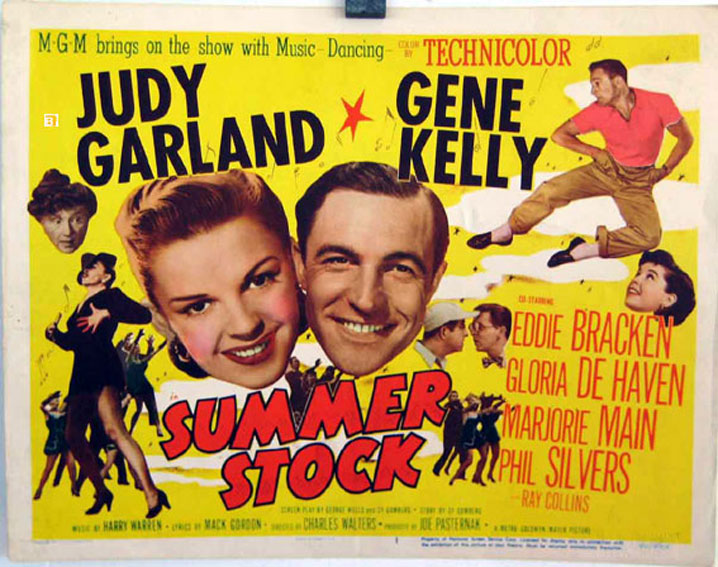
RECENTLY VIEWED: SUMMER STOCK

I recently had the joy of watching the 1950 musical Summer Stock with my eight year old daughter, who is an emerging movie buff! She loves Judy Garland, and even though I have the film on DVD, we watching on a Sunday night airing on TCM. It is not the most-remembered Judy Garland or Gene Kelly movie, but the film is fun to watch. Summer Stock is a 1950 American Technicolor musical film produced by Metro-Goldwyn-Mayer. It was directed by Charles Walters, stars Judy Garland and Gene Kelly, and features Eddie Bracken, Gloria DeHaven, Marjorie Main, and Phil Silvers. Nicholas Castle Sr. was the choreographer.

Garland struggled with many personal problems during filming and Summer Stock proved to be her final film for MGM, as well as her last onscreen pairing with Kelly. By mutual agreement, MGM terminated Garland's contract in September 1950, something studio head Louis B. Mayer said he later regretted doing. As we all know Louis B. Mayer was one of the worst human beings to ever work in Hollywood. 

The plot is slight. Jane Falbury (Judy Garland) is a farm owner whose actress sister, Abigail (Gloria DeHaven), arrives at the family farm with her theater troupe. They need a place to rehearse, and Jane and her housekeeper, Esme (Marjorie Main), reluctantly agree to let them use their barn. The actors and actresses, including the director, Joe Ross (Gene Kelly), repay her hospitality by doing chores around the farm. Although Joe is engaged to Abigail, he begins to fall in love with Jane after Abigail leaves him in an angry fit. Similarly, although Jane is engaged to Orville (Eddie Bracken), she falls in love with Joe. 


The big draw of the film was the music. The most famous number from the movie is Judy’s “Get Happy” number. For most of the film, Judy looked overweight, but this was the last scene filmed for the movie, and Judy had lost a lot of weight for the film. She looked better in the number than she had looked in years! An underrated song in the film is Judy’s love song “Friendly Star”, which was written by the songwriting team Harry Warren and Mack Gordon. Judy sings this song perfectly. Probably the most energetic number of the film was Gene Kelly’s “Dig For Your Dinner” number. It is an amazing feat of dancing that Kelly does as he dances on a table. The movie is worth seeing for that number alone! 

Although Garland and Kelly were the stars originally announced by MGM in 1948 to appear in the film, in February 1949 the studio announced that Garland would be replaced by June Allyson. She was suspended in May 1949, during the filming of Annie Get Your Gun, and spent three months in a hospital in Boston being treated for drug dependence. Betty Hutton replaced her on that film, but she was reinstated to the lead in this one, which was her first one following the suspension. Still, the filming was sometimes a struggle for Judy, who was facing many pressures in her personal life, aside from her heavy reliance on prescription medication. 


Kelly was not the first choice for the role: the producer, Joe Pasternak, originally wanted Mickey Rooney, but was prevailed on to go with Kelly because Rooney was no longer the box office draw he had once been. Busby Berkeley was originally slated to direct the film, but was replaced by Charles Walters before production began. He and Kelly worked on it as a favor to Garland, whose career needed a boost at the time. Later, after filming had begun, Pasternak asked Mayer if he should abandon the film because of Garland's erratic behavior – for example, she was supposed to appear in the "Heavenly Music" number to sing and dance with Kelly and Silvers, but she never showed up for the shoot . 

Dance director Nick Castle did not choreograph "You Wonderful You," "All for You", and "Portland Fancy" – these were done by Kelly – but did do "Dig For Your Dinner" and other numbers. He also did not shoot "Get Happy," which was filmed three months after the rest of the film; instead it was shot by Chuck Walters. In the interval, Garland had been treated by a hypnotist for weight loss and took off 15-20 pounds; she appears considerably thinner in the number. Garland finished filming and embarked on a long-promised vacation from the studio. 

Soon, however, she was called back to star with Fred Astaire and Peter Lawford in the film Royal Wedding, replacing June Allyson, who was pregnant. Once again, she struggled to perform in the face of exhaustion and overwork. She was fired from Royal Wedding, and her contract with MGM was terminated through mutual agreement. Overall, Summer Stock took six months to film, and was a box-office success. My daughter loved the film but she did say it was “kind of crappy for Judy to steal her sister’s boyfriend away!”, but my daughter loved the music. The film marks a sad end of Judy Garland’s time at MGM, but the movie was well made and fun! 

MY RATING: 10 out of 10


Sunday, August 23, 2020

BORN ON THIS DAY: GENE KELLY

Today we celebrate the 108th birthday of one of the greatest dancers of all time Gene Kelly. On a personal note, my Great Aunt babysat a young Gene when they were neighbors briefly. Kelly was born in the East Liberty neighborhood of Pittsburgh on August 23, 1912. He was the third son of James Patrick Joseph Kelly, a phonograph salesman, and his wife, Harriet Catherine Curran. His father was born in Peterborough, Ontario, Canada, to an Irish Canadian family. His maternal grandfather was an immigrant from Derry, Ireland, and his maternal grandmother was of German ancestry. When he was 8, Kelly's mother enrolled him and his brother James in dance classes. As Kelly recalled, they both rebelled: "We didn't like it much and were continually involved in fistfights with the neighborhood boys who called us sissies ... I didn't dance again until I was 15." 
At one time his childhood dream was to play shortstop for the hometown Pittsburgh Pirates. By the time he decided to dance, he was an accomplished sportsman and able to defend himself. He attended St. Raphael Elementary School in the Morningside neighborhood of Pittsburgh and graduated from Peabody High School at age 16. He entered Pennsylvania State College as a journalism major, but the 1929 crash forced him to work to help his family. He created dance routines with his younger brother Fred to earn prize money in local talent contests. They also performed in local nightclubs.
In 1931, Kelly enrolled at the University of Pittsburgh to study economics, joining the Phi Kappa Theta fraternity. He became involved in the university's Cap and Gown Club, which staged original musical productions. After graduating in 1933, he continued to be active with the Cap and Gown Club, serving as the director from 1934 to 1938. Kelly was admitted to the University of Pittsburgh Law School.

His family opened a dance studio in the Squirrel Hill neighborhood of Pittsburgh. In 1932 they renamed it The Gene Kelly Studio of the Dance and opened a second location in Johnstown, Pennsylvania, in 1933. Kelly served as a teacher at the studio during his undergraduate and law student years at Pitt. In 1931 he was approached by the Beth Shalom Synagogue in Pittsburgh to teach dance, and to stage the annual Kermesse. The venture proved a success, Kelly being retained for seven years until his departure for New York.

Kelly eventually decided to pursue a career as a dance teacher and full-time entertainer, so he dropped out of law school after two months. He increased his focus on performing and later claimed: "With time I became disenchanted with teaching because the ratio of girls to boys was more than ten to one, and once the girls reached 16 the dropout rate was very high." In 1937, having successfully managed and developed the family's dance school business, he finally did move to New York City in search of work as a choreographer.Kelly returned to Pittsburgh, to his family home at 7514 Kensington Street by 1940, and worked as a theatrical actor.

After a fruitless search for work in New York, Kelly returned to Pittsburgh to his first position as a choreographer with the Charles Gaynor musical revue Hold Your Hats at the Pittsburgh Playhouse in April 1938. Kelly appeared in six of the sketches, one of which, La cumparsita, became the basis of an extended Spanish number in the film Anchors Aweigh eight years later.


His first Broadway assignment, in November 1938, was as a dancer in Cole Porter's Leave It to Me!—as the American ambassador's secretary who supports Mary Martin while she sings My Heart Belongs to Daddy. He had been hired by Robert Alton, who had staged a show at the Pittsburgh Playhouse where he was impressed by Kelly's teaching skills. When Alton moved on to choreograph One for the Money he hired Kelly to act, sing, and dance in eight routines. In 1939 he was selected for a musical revue, One for the Money, produced by the actress Katharine Cornell, who was known for finding and hiring talented young actors.

Kelly's first big breakthrough was in the Pulitzer Prize–winning The Time of Your Life, which opened on October 25, 1939—in which, for the first time on Broadway, he danced to his own choreography. In the same year, he received his first assignment as a Broadway choreographer, for Billy Rose's Diamond Horseshoe. Soon Hollywood was calling, and the rest was Hollywood history...


Wednesday, June 24, 2020

SUMMER STOCK: A 1950 REVIEW

Here is the original New York Times review of the 1950 musical Summer Stock, which would be the last movie Garland made for MGM.This was written by Bosley Crowther and would appear in the Times on September 1, 1950...

As a tardy salute to summer and to the troupes of ambitious young folk who hie themselves off to rural theatres and "thesp" for the bland vacationists, Metro has brought along a passel of its more amiable and talented kids to give out with merriment and music in a Technicolored lark called "Summer Stock." Headed by Judy Garland in high good spirits and health and Gene Kelly in a state of perfection that finds his legs as lithe as rustling corn, this gang is currently to be witnessed on the Capitol's screen, which is not exactly a cow-barn but serves to project the air of same.And we make that remark advisedly, for the locale and focus of most of the film is a nice big red barn on the verdant acres which Miss Garland, in overalls, presumably farms. 


Here it is that the talents of a troupe of Broadway aspirants are generously tried and here it is that Miss Garland, of course, has her big chance to shine. Naturally, the little farm girl, who has barely tolerated the venture, saves the show. No summer stock cow barn in New England could be more appropriately employed.As usual in Metro romances having to do with the enterprises Of kids, the activities in this instance are a good bit more fanciful than real. Scriptwriters George Wells and Sy Gomberg have hatched out a rather standard plot which Director Charles Walters has been patient and sometimes tedious in distributing on the screen. The book of a musical comedy should move a little faster than does this. However, that is an opinion which we will not too pugnaciously support.For whenever any of the youngsters in this venture give way to song or dance — and they are eagerly disposed in that direction—joy reigns and the barnyard jumps.


Miss Garland starts the proceedings right away with the cheerful advice to all within earshot of her shower bath that "If You Feel Like Singing, Sing," and then spreads the word among her rural neighbors that a "Happy Harvest" is in store for those who do. Miss Garland, we might state at this point, is in excellent musical form.Then, as soon as Mr. Kelly and his thespians arrive on the scene by the generous invitation of Gloria De Haven, who plays Miss Garland's stage-struck sis, that gentleman and his associates pitch in to do their share, by way of comedy with the farm work but by way of pleasure with the songs. "Dig, Dig, Dig for Your Dinner" is a dandy, gay ensemble piece in which Mr. Kelly and Phil Silvers expend the most energy. These two also do a howling hill-billy comedy skit to a brisk tune called "Heavenly Music," with the happy assistance of assorted dogs.Best spots in the show, however, are a solo dance which Mr. Kelly does to "You Wonderful You," and the finale, "Get Happy," in which all eventually join. Mr. Kelly's dance, accomplished with a newspaper and a squeaky board as props, is a memorable exhibition of his beautifully disciplined style. And "Get Happy" finds Miss Garland looking and performing her best.As Miss Garland's rustic fiancé, Eddie Bracken adds some humor to the plot, and Marjorie Main now and then kicks up a ruckus as a wary and skeptical farm maid. Hans Conried, Nita Bieber and Carleton Carpenter are most conspicuous among the happy gang of shapely and talented thespians who amiably fill out "Summer Stock."One the stage at the Capitol are Hal LeRoy, Phil Foster, Rosita Serrano and Noro Morales and his orchestra.


Wednesday, December 19, 2018

PHOTOS OF THE DAY: VERA-ELLEN AND HER LEADING MEN

Vera-Ellen only made 14 movies in her short Hollywood career, but every minute of the screen moment that was captured of her was memorable. Here are some great pictures of some of her leading men and friends that she worked with...


with Danny Kaye and Bing Crosby

with Gene Kelly

with Donald O'Connor

with Caesar Romero

with Rock Hudson

with Edward G. Robinson


Saturday, December 15, 2018

MY FIVE FAVORITE VERA-ELLEN FILMS

As a lifelong fans of movie musicals, I have always loved the dancing in movies. Vera-Ellen was never my favorite dancer growing up. (Eleanor Powell was always my favorite.) However as I get older I have come to really appreciate the movies of Vera-Ellen more. Here are my five favorite Vera-Ellen musicals...


5. THE BELLE OF NEW YORK (1952)
Set in turn-of-the-century New York, wealthy playboy Charles Hill (Fred Astaire) falls in love with Angela (Vera-Ellen) a Salvation Army worker. The plot is slight but the musical numbers are top notch. The highlights was the musical number "Baby Doll" , which was sung by Astaire and danced by Astaire and Vera-Ellen with much emphasis  on twirling motifs and platform work and "Naughty But Nice", which was sung by ghost singer Anita Ellis but danced beautifully by Vera. The film lost money in its initial release, but it is a cute movie.

4. THREE LITTLE WORDS (1950)
This film was a "biography" of songwriters Bert Kalmar and Harry Ruby. Fred Astaire played Kalmar and Red Skelton played Ruby. Vera-Ellen's role was not great, but he played Fred Astaire's wife in this fictional biography. The best number was 'Where Did You Get That Girl" which was danced by Astaire and Vera-Ellen. It was the highlight of the film and most of the other numbers went to Fred Astaire and Red Skelton. Another number not to miss was "Come On Papa". It was another high-kicking song and dance routine, this time for Vera-Ellen though!


3. WHITE CHRISTMAS (1954)
This film is the movie that Vera is most remembered for. It also was her last big movie musical appearance, which is a pity. Vera got the chance to perform some great Irving Berlin numbers, and she never looked lovelier dancing to Berlin songs like: "Abraham" and "Mandy". The film belonged to Bing Crosby, but Vera-Ellen was great as Rosemary Clooney's sister and Danny Kaye's love interest. Vera and Danny Kaye had a beautiful musical dancing to a newer Irving Berlin song "The Best Things Happen While You're Dancing". The movie was a great end to a short movie musical career.

2.WORDS AND MUSIC (1948)
This film was another musical biography that MGM was famous for. This time it was the life story of composers Richard Rodgers and Lorenz Hart. It is sad that Vera-Ellen is only in the movie for one number, but it was one of the greatest dances ever captured on film. Vera dances with Gene Kelly to the classic number "Slaughter On Tenth Avenue". The movie is basically fiction but the appearance that Vera makes in the film is definitely the best part of the film.


1. ON THE TOWN (1949)
Set in New York City, this classic movie musical probably featured Vera-Ellen the most. The whole film is spent with three soldiers (Gene Kelly, Frank Sinatra, and Jules Munshin) trying to find Miss Turnstiles (Vera). I am not a big ballet fan, but I love the "Miss Turnstiles Ballet" (an instrumental number from Leonard Bernstein's score). Vera's dance numbers in the movie tended to be more of a ballet orgin, but the dances were flawless. Although Vera appeared with Fred Astaire and Danny Kaye in a lot of movies, I think the screen chemistry of Vera and Gene Kelly were the best. Vera possessed that athletic and enthusiastic dancing ability that Gene Kelly possessed.

Sunday, August 19, 2018

COVER GIRL: A 1944 REVIEW

Here is a review of the 1944 film Cover Girl. This was published in the NY Times on March 31, 1944...


' Cover Girl,' With Rita Hayworth and Gene Kelly, at the Music Hall -- 'Her Primitve Man' Is Seen at Loew's State Theatre
By BOSLEY CROWTHER

If there were still such a thing in existence as the proverbial "tired business man," then we'd say that the picture made just for him is at the Radio City Music Hall. For Columbia's expensive production (in Technicolor, of course), "Cover Girl," which came to the showplace yesterday as the cream of its Easter program, is precisely the sort of entertainment that used to fill his Broadway bill. Everything happens in it just when you most expect it to. The script is so frankly familiar that it must have come from the public domain. And the characters are as sleekly mechanical as only musical comedy characters dare to be. But it rainbows the screen with dazzling décor. It has Gene Kelly and Rita Hayworth to sing and dance. And virtually every nook and corner is draped with beautiful girls.


Further, this gaudy obeisance to divine femininity has some rather nice music in it from the tune-shop of Jerome Kern. Best of the numbers, both for listening and for watching a dance done thereto, is a rhythm entitled "Tomorrow," to which the principals and Phil Silvers cut a rug. The idea is that they are playmates associated in a Brooklyn night club, and this dance that they do along the quiet streets on their way home in the small hours is a pip. Another pleasant number to which Miss Hayworth and Mr. Kelly nip around is "Put Me to the Test"—an invitation which the script, unfortunately, does.


For this undistinguished fiction about a Brooklyn night-club girl who wins a "cover contest" conducted by a glamorous magazine is so handicapped with clichés that it looks like an obstacle course. What do you think happens when Miss Hayworth wins the contest? She becomes sensationally famous and quarrels with Mr. Kelly, her nice boy friend. And what do you think is her decision after she has been in a big Broadway show (just long enough to do one splurge number)? Go back to Mr. Kelly, of course!

To be sure, Mr. Kelly is a sweet guy and a delightfully able dancer, too, and Miss Hayworth does better with him than with any dancing partner she's had yet. (That comment includes Fred Astaire, whom Mr. Kelly is pushing for top rung.) Miss Hayworth even acts with an enchantment which she has never so capably turned on. But you would think that something better could be found for them to play than this script. You would think that more fun could be worked in than merely Mr. Silvers' corny gags. And, above all, you'd think that the producer, Arthur Schwartz, whose first picture this is, would have tried for something more original and cinematic than a straight "t. b. m. show"...

Thursday, June 21, 2018

PHOTOS OF THE DAY: SUMMER WITH CLASSIC HOLLYWOOD

On this first day of summer I wanted to take a look at how some of the classic Hollywood stars celebrated the fun and the sun that is summer. As always, the classic stars always looked great...


Ann Sheridan

Eartha Kitt


Gene Kelly


Bing and Dixie Lee Crosby


Sammy Davis Jr and Maria Stinger


Ava Gardner