Showing posts with label Summer Stock. Show all posts

Monday, August 16, 2021

RECENTLY VIEWED: SUMMER STOCK

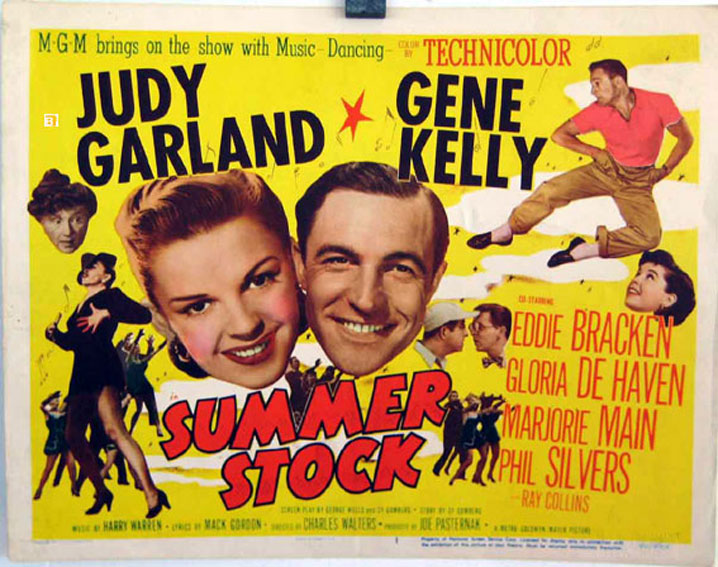
I recently had the joy of watching the 1950 musical Summer Stock with my eight year old daughter, who is an emerging movie buff! She loves Judy Garland, and even though I have the film on DVD, we watching on a Sunday night airing on TCM. It is not the most-remembered Judy Garland or Gene Kelly movie, but the film is fun to watch. Summer Stock is a 1950 American Technicolor musical film produced by Metro-Goldwyn-Mayer. It was directed by Charles Walters, stars Judy Garland and Gene Kelly, and features Eddie Bracken, Gloria DeHaven, Marjorie Main, and Phil Silvers. Nicholas Castle Sr. was the choreographer.

Garland struggled with many personal problems during filming and Summer Stock proved to be her final film for MGM, as well as her last onscreen pairing with Kelly. By mutual agreement, MGM terminated Garland's contract in September 1950, something studio head Louis B. Mayer said he later regretted doing. As we all know Louis B. Mayer was one of the worst human beings to ever work in Hollywood. 

The plot is slight. Jane Falbury (Judy Garland) is a farm owner whose actress sister, Abigail (Gloria DeHaven), arrives at the family farm with her theater troupe. They need a place to rehearse, and Jane and her housekeeper, Esme (Marjorie Main), reluctantly agree to let them use their barn. The actors and actresses, including the director, Joe Ross (Gene Kelly), repay her hospitality by doing chores around the farm. Although Joe is engaged to Abigail, he begins to fall in love with Jane after Abigail leaves him in an angry fit. Similarly, although Jane is engaged to Orville (Eddie Bracken), she falls in love with Joe. 


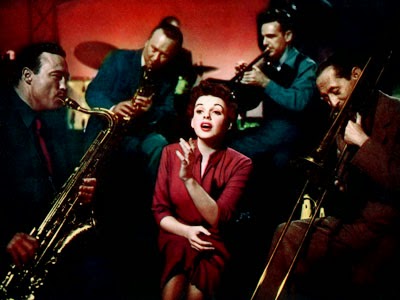
The big draw of the film was the music. The most famous number from the movie is Judy’s “Get Happy” number. For most of the film, Judy looked overweight, but this was the last scene filmed for the movie, and Judy had lost a lot of weight for the film. She looked better in the number than she had looked in years! An underrated song in the film is Judy’s love song “Friendly Star”, which was written by the songwriting team Harry Warren and Mack Gordon. Judy sings this song perfectly. Probably the most energetic number of the film was Gene Kelly’s “Dig For Your Dinner” number. It is an amazing feat of dancing that Kelly does as he dances on a table. The movie is worth seeing for that number alone! 

Although Garland and Kelly were the stars originally announced by MGM in 1948 to appear in the film, in February 1949 the studio announced that Garland would be replaced by June Allyson. She was suspended in May 1949, during the filming of Annie Get Your Gun, and spent three months in a hospital in Boston being treated for drug dependence. Betty Hutton replaced her on that film, but she was reinstated to the lead in this one, which was her first one following the suspension. Still, the filming was sometimes a struggle for Judy, who was facing many pressures in her personal life, aside from her heavy reliance on prescription medication. 


Kelly was not the first choice for the role: the producer, Joe Pasternak, originally wanted Mickey Rooney, but was prevailed on to go with Kelly because Rooney was no longer the box office draw he had once been. Busby Berkeley was originally slated to direct the film, but was replaced by Charles Walters before production began. He and Kelly worked on it as a favor to Garland, whose career needed a boost at the time. Later, after filming had begun, Pasternak asked Mayer if he should abandon the film because of Garland's erratic behavior – for example, she was supposed to appear in the "Heavenly Music" number to sing and dance with Kelly and Silvers, but she never showed up for the shoot . 

Dance director Nick Castle did not choreograph "You Wonderful You," "All for You", and "Portland Fancy" – these were done by Kelly – but did do "Dig For Your Dinner" and other numbers. He also did not shoot "Get Happy," which was filmed three months after the rest of the film; instead it was shot by Chuck Walters. In the interval, Garland had been treated by a hypnotist for weight loss and took off 15-20 pounds; she appears considerably thinner in the number. Garland finished filming and embarked on a long-promised vacation from the studio. 

Soon, however, she was called back to star with Fred Astaire and Peter Lawford in the film Royal Wedding, replacing June Allyson, who was pregnant. Once again, she struggled to perform in the face of exhaustion and overwork. She was fired from Royal Wedding, and her contract with MGM was terminated through mutual agreement. Overall, Summer Stock took six months to film, and was a box-office success. My daughter loved the film but she did say it was “kind of crappy for Judy to steal her sister’s boyfriend away!”, but my daughter loved the music. The film marks a sad end of Judy Garland’s time at MGM, but the movie was well made and fun! 

MY RATING: 10 out of 10


Wednesday, June 24, 2020

SUMMER STOCK: A 1950 REVIEW

Here is the original New York Times review of the 1950 musical Summer Stock, which would be the last movie Garland made for MGM.This was written by Bosley Crowther and would appear in the Times on September 1, 1950...

As a tardy salute to summer and to the troupes of ambitious young folk who hie themselves off to rural theatres and "thesp" for the bland vacationists, Metro has brought along a passel of its more amiable and talented kids to give out with merriment and music in a Technicolored lark called "Summer Stock." Headed by Judy Garland in high good spirits and health and Gene Kelly in a state of perfection that finds his legs as lithe as rustling corn, this gang is currently to be witnessed on the Capitol's screen, which is not exactly a cow-barn but serves to project the air of same.And we make that remark advisedly, for the locale and focus of most of the film is a nice big red barn on the verdant acres which Miss Garland, in overalls, presumably farms. 


Here it is that the talents of a troupe of Broadway aspirants are generously tried and here it is that Miss Garland, of course, has her big chance to shine. Naturally, the little farm girl, who has barely tolerated the venture, saves the show. No summer stock cow barn in New England could be more appropriately employed.As usual in Metro romances having to do with the enterprises Of kids, the activities in this instance are a good bit more fanciful than real. Scriptwriters George Wells and Sy Gomberg have hatched out a rather standard plot which Director Charles Walters has been patient and sometimes tedious in distributing on the screen. The book of a musical comedy should move a little faster than does this. However, that is an opinion which we will not too pugnaciously support.For whenever any of the youngsters in this venture give way to song or dance — and they are eagerly disposed in that direction—joy reigns and the barnyard jumps.


Miss Garland starts the proceedings right away with the cheerful advice to all within earshot of her shower bath that "If You Feel Like Singing, Sing," and then spreads the word among her rural neighbors that a "Happy Harvest" is in store for those who do. Miss Garland, we might state at this point, is in excellent musical form.Then, as soon as Mr. Kelly and his thespians arrive on the scene by the generous invitation of Gloria De Haven, who plays Miss Garland's stage-struck sis, that gentleman and his associates pitch in to do their share, by way of comedy with the farm work but by way of pleasure with the songs. "Dig, Dig, Dig for Your Dinner" is a dandy, gay ensemble piece in which Mr. Kelly and Phil Silvers expend the most energy. These two also do a howling hill-billy comedy skit to a brisk tune called "Heavenly Music," with the happy assistance of assorted dogs.Best spots in the show, however, are a solo dance which Mr. Kelly does to "You Wonderful You," and the finale, "Get Happy," in which all eventually join. Mr. Kelly's dance, accomplished with a newspaper and a squeaky board as props, is a memorable exhibition of his beautifully disciplined style. And "Get Happy" finds Miss Garland looking and performing her best.As Miss Garland's rustic fiancé, Eddie Bracken adds some humor to the plot, and Marjorie Main now and then kicks up a ruckus as a wary and skeptical farm maid. Hans Conried, Nita Bieber and Carleton Carpenter are most conspicuous among the happy gang of shapely and talented thespians who amiably fill out "Summer Stock."One the stage at the Capitol are Hal LeRoy, Phil Foster, Rosita Serrano and Noro Morales and his orchestra.


Tuesday, June 17, 2014

MY FIVE FAVORITE JUDY GARLAND MOVIES

My mother is a much bigger Judy Garland movie fan than I am, but being a lover of classical movies I have definitely seen almost every film Judy has made. She was a good actress, much better than she was given credit for, and I came up with my list of my five favorite Judy Garland films. Again, this is only my opinion and personal preference, and it is not based on anything else…


5. A STAR IS BORN (1954)
After Judy was fired from MGM in 1950, she never really was a movie star again. After 1950, Garland did continue to make movies, but she made quality and not quantity. One of her best acting of her career was done in 1954’s A Star Is Born. Co-starring with James Mason, Judy played a rising star who gets involved with a fading star (Mason). Garland was nominated for an Oscar, but she unfortunately lost. The famous song from the film was “The Man That Got Away”, but my personal favorite number was “Lose That Long Face”. When the movie came out Warner Brothers edited the film to death, and key scenes were lost, but I believe it has recently been completely restored.

4. EASTER PARADE (1948)
By the time Judy made Easter Parade in 1948, her drug problems were really beginning to come to a head. Her weight went up and down during the filming, and it showed in many of her scenes. However, Judy pulled it together to make this musical classic. with Fred Astaire as her leading man and a boatload of Irving Berlin songs. Even though the age difference between Astaire and Garland was 23 years, they make a great song and dance team. Evergreen Irving Berlin songs included the title song, “I Love A Piano”, and “Shakin The Blues Away”, but Berlin also wrote some new songs like: “A Fella With An Umbrella” and “Better Luck Next Time” – the latter of the songs Garland sang brilliantly.


3. THE WIZARD OF OZ (1939)
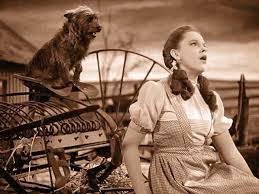
No list of Garland films would be complete without “The Wizard Of Oz”. Judy was the second choice to play Dorothy, after MGM could not get Shirley Temple. The film was not a success when it came out in 1939 – and it would not be until it was shown on television in the 1950s that it would become the classic it is viewed as today. It is hard to add more about this classic, but it was the role that made Judy a star. Sadly, it was reported that Garland began her drug usage while this movie was being made. I am a grown man with children now, but when I watch the scene of Judy singing “Over The Rainbow” on her Kansas farm…I cry like a baby every time.

2. SUMMER STOCK (1950)
MGM ended their relationship with Garland after 1950’s Summer Stock, and it was a big mistake. Again, Garland’s weight fluctuated greatly throughout the movie, but Garland sounded great. She was teamed with Gene Kelly for the third and last time in this film, and like Astaire did in Easter Parade, Kelly helped Garland get through her scenes. Supporting the dynamic duo of musicals were great character stars like: Phil Silvers, Eddie Bracken, and Marjorie Main. The plot of putting on a show at a farm was corny, but the musical numbers made the film great. This movie is one of the first Garland musicals I ever watched on video, so I have a soft spot for the film. Seeing Judy perform “Get Happy” makes the movie worth it alone.


1. FOR ME AND MY GAL (1942)
Judy was going on 20 when she made For Me And My Gal, and it was billed as her first adult role. She was done playing Dorothy and hanging out with Andy Hardy now. Garland played a rising vaudeville star who meets up with a vaudeville ham (played by Gene Kelly in his first movie role). The story takes place during the first World War, so all of the songs are from that era. You would think it would make the movie corny hearing those songs, even in 1942 when the film was made, but it adds some great realism to the movie. For a 1942 musical, there is some real drama in the movie showing some of the horrors of war. The main attraction is Garland who looks and sounds great singing standards like “After You’ve Gone”, “Ballin The Jack”, and “Oh You Beautiful Doll”. Again, the film has a special place in my heart, because I remember my Grandfather telling me it was the first movie he saw in the movie theater was a 13 year old boy. The ending of the movie, is a tearjerker as well, at least to me. For me not being a huge Garland movie fan, a lot of her movies make me cry!

Wednesday, August 1, 2012

MY FIVE FAVORITE GENE KELLY MUSICALS

The month of August marks the 100 anniversary of Gene Kelly's birth. It seems like only yesterday he was dancing with Judy Garland or performing an intricate number on roller skates or a cartoon mouse. Luckily Gene Kelly left his mark in countless great musicals that we can watch over and over again. Here are my five personal favorite Gene Kelly musicals...


5. SUMMER STOCK (1950)
This is often an overlooked Gene Kelly musical. The movie is best remembered as the last movie that Judy Garland did at MGM. Her weight throughout the movie radically changed, but Kelly has some appealing dance numbers. I think one of his most energetic dances of all time was the dance to "Dig Brother Dig". This movie also marked the third and final time Kelly and Judy would appear together on film. It is an amazing example of his talent.

4. SINGIN IN THE RAIN (1952)
At first I wasn't even going to put Singin In The Rain on my list. Sure, I love the movie, but is it my favorite musical - no. I think the number that puts this beloved Kelly musical over the top for me was the "Broadway Dance Ballet" Kelly did with Cyd Charisse. I like the title number Kelly did in the rain, but I have seen it so much. I think the "Moses" number with his co star Donald O' Connor is truly great. Still though, the image of Kelly dancing in the rain with his umbrella is one of the most memorable cinema moments.


3. ON THE TOWN (1949)
This was one of the first Gene Kelly movies I saw back when I was starting to watch classic movies when VHS or even Beta first came out. Gene was of course great in the movie, but On The Town's appeal to me is the cast as a whole - Kelly, Frank Sinatra, Jules Munshin, Ann Miller, Vera-Ellen, and Betty Garrett was like a dream team of musical greats. My favorite number is Ann Miller's "Prehistoric Man", but Kelly took his talents to new heights in this movie with some pretty tricky choreography.

2. FOR ME AND MY GAL (1942)
Watching Gene Kelly in this movie, it is amazing it is his first film. He really had a commanding presence on the screen. This was the first movie he was paired with Judy Garland in, and they made a great team. From the title number to their terrific performance of "Ballin The Jack" they really looked like they were having fun together. For Kelly's first movie he did not really play a nice guy but in the end his character grew. It really was an amazing performance for Kelly just starting out. All of the songs were old even by 1942's standards, but Kelly and Judy brought new life to all of them.


1. BRIGADOON (1954)
My stepfather, who is a 6ft 4in hunter, introduced me to Brigadoon when I was younger. The movie did not do well when it first came out, but I think since then the film has gotten more recognition. Kelly himself was disappointed with the movie because he wanted to film the musical on location in Scotland. MGM refused and shot the entire film on the backlot. One of my favorite numbers was "Almost Like Being In Love", and Kelly's version of the song is another memorable musical moment. Cyd Charisse and Van Johnson also are perfect in their roles as his love interest and his best friend respectively. The movie was one of the last of the great MGM musicals made, but Brigadoon is another example of why 100 years after his birth, Gene Kelly is still remembered...