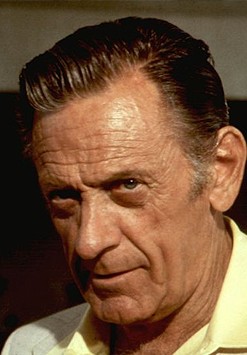
It is hard to believe that William Holden has been dead now for 30 years. Holden was one of the greatest actors of our times. He burst onto the scene with his role in Golden Boy in 1939. He followed that film up with a screen version of the movie of Our Town. By the 1950s, he was starring in hit after hit like: Sunset Boulevard (1950), The Country Girl (1954), Picnic (1955), and The Bridge on the River Kwai (1957) to name a few. Despite the fame and winning an Academy Award in 1954, William Holden faced a lifelong battle with drinking and alcoholism.
The years of his drinking started taking its toll on Holden's chiseled looks by the 1960s. Despite being relatively young still, he was considered Hollywood old school and began losing roles to younger stars like Steve McQueen and Paul Newman. This in turn caused Holden to drink more. He did continue to make some good movies like: The Wild Bunch (1969), The Towering Inferno (1974), and his last movie S.O.B. (1981). However, by that time he was no longer the handsome leading man of movies.
In 1981, Holden was living in Santa Monica, California, on Ocean Avenue. He was partial owner of the building at #535. The Shorecliff Towers. Holden's apartment was on the fourth floor, number 43. He was notoriously private. Even neighbors of many years only received a quick nod from the elusive actor. He also had the habit of disappearing for many days, without notice. That's why it took so long for someone to find him.
According to the autopsy report, Holden was last known to be alive about one week beforehand, when he spoke to his girlfriend Stephanie Powers on the telephone. She indicated that he was drinking, but seemed his normal self and was without complaints.
On Monday November 16, 1981, the building manager, Bill Martin, let curiosity get the best of him. He hadn't seen Holden in many days, and became very concerned, so he let himself in, via the passkey. As we all know, curiosity killed the cat, and Mr. Martin was sure taught a lesson that day.
From the report: "All the lights were off, except for the television, so they used flashlights to get around. Holden was found in a robe and shirt, on the floor. The robe was folded back and beneath the body, with the right arm placed through the sleeve, and the left arm "wadded up" and beneath the body, suggesting that he may have been attempting to dress himself. Examination revealed an apparent laceration on his forehead approximately 3 inches in length. Holden’s doctor showed up and theorized that he provably started vomiting blood, and possibly lacerated the lower portion of his esophagus.
On the scene they found an empty vodka bottle in the trash can, along with 4 beer bottles and a partially full bottle of vodka on the kitchen sink. There was a large quantity of blood surrounding the body as well as all over the bedding and blankets." From the condition of his body, it was decided that he had been dead for at least 4 days.
According to the medical examiner, Holden had tripped on a throw rug and hit his head on the nightstand. The scary part is that he hit it so hard, that it jammed into the wall, and left an indentation of two or three inches into the plaster. There were 8 bloody Kleenex's found next to his body, and a working telephone just inches away from him. The examiner reckoned that Holden didn't comprehend the seriousness of his injury, tried to stop the bleeding himself, and passed out from blood loss. He was probably dead within 15 minutes.
William Holden was only 63...
Friday, November 4, 2011
Wednesday, November 2, 2011
RIP: BERYL DAVIS
Beryl Davis, British Singer With Big Bands, Dies at 87
By PAUL VITELLO
Beryl Davis, a British singer who was beloved in England for carrying on with her cabaret performances during the bombing of London in World War II, and who later performed with Frank Sinatra and the big bands of Benny Goodman and Glenn Miller, died on Friday in Los Angeles. She was 87. The cause was complications of Alzheimer’s disease, said a family spokesman, Greg Purdy.
Ms. Davis, the daughter of the British bandleader Harry Davis, began her professional career early. She performed with her father’s band at 8 and sang with the jazz guitarist Django Reinhardt and his Quintet of the Hot Club of France at 12, traveling with a chaperon. (In between, when she was 9, she won the 1934 All Britain Tap Dancing Championship.)
When the German air force began its blitz in 1940, Ms. Davis’s clear, pure singing style at the front of a jazz group that included the pianist George Shearing and the violinist Stéphane Grappelli, was already familiar to BBC listeners, and to London clubgoers.
She later said leaving the city had never occurred to her. “We just learned to handle the pressure,” she told Richard Grudens for “Jukebox Saturday Night,” his 1999 book about the big-band era. “I would have to be down at the BBC, who had me under contract, at odd hours of the night. Bombs would be dropping, and you just did your best to dodge them.”
She added, “If you didn’t dodge them, well, that was that, you know.”
Ms. Davis was a national star by the time she began singing with some of the American big bands passing through London on tours and performing for the troops. A booking on Dec. 12, 1944, with the Glenn Miller Army Air Force Band at the Queensbury Club, came to haunt her. She sang the Bing Crosby wartime hit “I’ll Be Seeing You.”
After the show, she recalled, as Miller left, “he patted me on the shoulder, and he said, ‘Good show, kid. I’ll be seeing yuh.’ ” A small plane carrying Miller to Paris took off from the outskirts of London three days later, and was never seen again.
Ms. Davis made “I’ll Be Seeing You” her signature song, and often dedicated it to Miller’s memory.
Beryl Davis was born on March 16, 1924, in Plymouth, Devon, in southwestern England, to Harry and Queenie Davis. Her sister, Lisa, became an American television and film actress.
As a singer, she told interviewers, she modeled herself on Ella Fitzgerald, and, partly because of the American accent and swing phrasing she picked up imitating Fitzgerald’s style, Bob Hope invited her to Hollywood in 1947 to be a regular on his radio show. She later sang with Benny Goodman and Vaughn Monroe, and became a familiar voice on the radio shows of Milton Berle, Ed Sullivan, Red Skelton, Abbott and Costello, and others.
Her recording career in the United States never took off, but in 1954 she formed a gospel quartet with three friends from church: her fellow big-band singer Connie Haines and the actresses Jane Russell and Rhonda Fleming. Calling themselves the Four Girls, they had a hit in 1954 with their version of “Do, Lord, Remember Me.”
Ms. Davis continued to sing in nightclubs throughout her life. In the 1970s she became a regular performer on Princess Line cruise ships.
Ms. Davis’s marriage to Peter Potter, a radio personality whose family name was Moore, ended in divorce. In addition to her sister, she is survived by three children, Bill Moore, Merry Moore and Melinda Moore Garber, and two grandchildren.
SOURCE
By PAUL VITELLO
Beryl Davis, a British singer who was beloved in England for carrying on with her cabaret performances during the bombing of London in World War II, and who later performed with Frank Sinatra and the big bands of Benny Goodman and Glenn Miller, died on Friday in Los Angeles. She was 87. The cause was complications of Alzheimer’s disease, said a family spokesman, Greg Purdy.
Ms. Davis, the daughter of the British bandleader Harry Davis, began her professional career early. She performed with her father’s band at 8 and sang with the jazz guitarist Django Reinhardt and his Quintet of the Hot Club of France at 12, traveling with a chaperon. (In between, when she was 9, she won the 1934 All Britain Tap Dancing Championship.)
When the German air force began its blitz in 1940, Ms. Davis’s clear, pure singing style at the front of a jazz group that included the pianist George Shearing and the violinist Stéphane Grappelli, was already familiar to BBC listeners, and to London clubgoers.
She later said leaving the city had never occurred to her. “We just learned to handle the pressure,” she told Richard Grudens for “Jukebox Saturday Night,” his 1999 book about the big-band era. “I would have to be down at the BBC, who had me under contract, at odd hours of the night. Bombs would be dropping, and you just did your best to dodge them.”
She added, “If you didn’t dodge them, well, that was that, you know.”
Ms. Davis was a national star by the time she began singing with some of the American big bands passing through London on tours and performing for the troops. A booking on Dec. 12, 1944, with the Glenn Miller Army Air Force Band at the Queensbury Club, came to haunt her. She sang the Bing Crosby wartime hit “I’ll Be Seeing You.”
After the show, she recalled, as Miller left, “he patted me on the shoulder, and he said, ‘Good show, kid. I’ll be seeing yuh.’ ” A small plane carrying Miller to Paris took off from the outskirts of London three days later, and was never seen again.
Ms. Davis made “I’ll Be Seeing You” her signature song, and often dedicated it to Miller’s memory.
Beryl Davis was born on March 16, 1924, in Plymouth, Devon, in southwestern England, to Harry and Queenie Davis. Her sister, Lisa, became an American television and film actress.
As a singer, she told interviewers, she modeled herself on Ella Fitzgerald, and, partly because of the American accent and swing phrasing she picked up imitating Fitzgerald’s style, Bob Hope invited her to Hollywood in 1947 to be a regular on his radio show. She later sang with Benny Goodman and Vaughn Monroe, and became a familiar voice on the radio shows of Milton Berle, Ed Sullivan, Red Skelton, Abbott and Costello, and others.
Her recording career in the United States never took off, but in 1954 she formed a gospel quartet with three friends from church: her fellow big-band singer Connie Haines and the actresses Jane Russell and Rhonda Fleming. Calling themselves the Four Girls, they had a hit in 1954 with their version of “Do, Lord, Remember Me.”
Ms. Davis continued to sing in nightclubs throughout her life. In the 1970s she became a regular performer on Princess Line cruise ships.
Ms. Davis’s marriage to Peter Potter, a radio personality whose family name was Moore, ended in divorce. In addition to her sister, she is survived by three children, Bill Moore, Merry Moore and Melinda Moore Garber, and two grandchildren.
SOURCE
Labels:
Beryl Davis,
big band,
deaths,
news,
singers
FORGOTTEN ONES: BETTY CLOONEY
Rosemary Clooney was one of the most adored vocalists of the 20th century, and her brother Nick Clooney is a famous broadcaster and the father of actor George Clooney. Many people forget though that there was another sibling who started out in the big bands with Rosemary. Unfortunately, she died young and in the shadows of her famous sister, but Betty Clooney deserves to be remembered.
Betty Clooney was born in April of 1931 in Maysville, Kentucky. She and her older (by three years) Rosemary, loved to sing as kids and became an important part of their grandfather's political campaigns for mayor of their hometown. Soon the Clooney family moved to Cincinnati, Ohio where the girls continued to vocalize. In their teens they went to radio station WLW for an audition and were successful where they remained on the staff of the station for two years in 1945 and 46. One day they were heard by bandleader Tony Pastor. The bandleader originally hesitated on hiring both sisters, but soon relented and so The Clooney Sisters hit the road with the Pastor band. They appeared in a movie short with the Pastor Orchestra in 1947. The Clooney Sisters recorded a number of songs for Columbia with the Tony Pastor Band like "The Secretary Song", "I'm My Own Grandpa" and "If I Had A Million Dollars".
After three years of this, Betty decided to return home to Cincinnati while Rosie got a call from New York to do a recording session with Columbia Records. Rosie hit the big time nationally with her first record "Come On-A My House" while Betty concentrated on local jobs near home. She was the vocalist on Ruth Lyons "50-50 Club" and had her own shows called "Teen Canteen" and "Boy Meets Girl". Soon she had a number of national network television offers-at first with Robert Q. Lewis on CBS radio and television, and "Van Camp's Little Show". Then, subbing for her sister on "Songs For Sale" with Steve Allen, and then the "Morning Show" with Jack Paar for CBS. Betty Clooney made some recordings for the Cincinnati based King Records label who usually concentrated on R & B and country music. Memorable recordings included "Anyone Can Fall In Love" and "Faithful". Betty also recorded for RCA's subsidiary label "X".
Betty Clooney performed at the Starlight Roof of the Waldorf-Astoria Hotel in the earky fifties and had a regular spot on the Gary Moore television show for CBS. She met and later married Pupi Campo, bandleader on CBS television in the early fifties. In her spare time away from music she began a horse breeding farm back in Kentucky. In the mid nineteen fifties Betty recorded for Coral Records a subsidiary label of Decca Records. The two Clooney Sisters also made a couple of recordings for Columbia with "I Still Feel The Same About You", and their best known tune "Sisters" on in 1954. She appeared with sister Rosemary on the Lux Variety Show in 1957.
Soon after during the later nineteen fifties Betty Clooney called it a singing career and concentrated on raising a family and tending to her four children. She returned to daytime television for a time in the early sixties on NBC's Today Show with John Chancellor and Hugh Downs. After a number of years out of the spotlight, Betty and Rosemary made a few guest appearances on brother Nick Clooney's television variety show on Cincinnati television. There was talk of a reunion tour with the Clooney Sisters, but that was never to be as Betty Clooney passed away from a cerebral hemorrhage in July of 1976. She was only 45 years old. In her memory Rosemary and Nick Clooney established the Betty Clooney Foundation in 1983 and the Betty Clooney Center in Long Beach, California, which opened in 1988. Both are dedicated to treatment for traumatic brain injuries.
Unfortunately, there is not much available for the listener to enjoy the musical memories of Betty Clooney. However, there is one CD called "Sisters" from England on the Sepia label, which features Betty on 14 tracks (less on the U.S. version) plus a live performance by Rosemary at the London Palladium in 1955. You will get to hear Betty on her own and in a couple of duets with Bill Darnell. Right now it is the only source readily available.
Betty Clooney will always remain in the shadow of her more recognized sister in the history of American pop music. Betty was married to one person her whole life, Cuban band leader Pupi Campo, and they had four successful children together. If a music listener discovers the music of Betty Clooney, they will find someone more than just Rosemary's sister, because Betty was a competent and excellent singer in her own way...
Betty Clooney was born in April of 1931 in Maysville, Kentucky. She and her older (by three years) Rosemary, loved to sing as kids and became an important part of their grandfather's political campaigns for mayor of their hometown. Soon the Clooney family moved to Cincinnati, Ohio where the girls continued to vocalize. In their teens they went to radio station WLW for an audition and were successful where they remained on the staff of the station for two years in 1945 and 46. One day they were heard by bandleader Tony Pastor. The bandleader originally hesitated on hiring both sisters, but soon relented and so The Clooney Sisters hit the road with the Pastor band. They appeared in a movie short with the Pastor Orchestra in 1947. The Clooney Sisters recorded a number of songs for Columbia with the Tony Pastor Band like "The Secretary Song", "I'm My Own Grandpa" and "If I Had A Million Dollars".
After three years of this, Betty decided to return home to Cincinnati while Rosie got a call from New York to do a recording session with Columbia Records. Rosie hit the big time nationally with her first record "Come On-A My House" while Betty concentrated on local jobs near home. She was the vocalist on Ruth Lyons "50-50 Club" and had her own shows called "Teen Canteen" and "Boy Meets Girl". Soon she had a number of national network television offers-at first with Robert Q. Lewis on CBS radio and television, and "Van Camp's Little Show". Then, subbing for her sister on "Songs For Sale" with Steve Allen, and then the "Morning Show" with Jack Paar for CBS. Betty Clooney made some recordings for the Cincinnati based King Records label who usually concentrated on R & B and country music. Memorable recordings included "Anyone Can Fall In Love" and "Faithful". Betty also recorded for RCA's subsidiary label "X".
Betty Clooney performed at the Starlight Roof of the Waldorf-Astoria Hotel in the earky fifties and had a regular spot on the Gary Moore television show for CBS. She met and later married Pupi Campo, bandleader on CBS television in the early fifties. In her spare time away from music she began a horse breeding farm back in Kentucky. In the mid nineteen fifties Betty recorded for Coral Records a subsidiary label of Decca Records. The two Clooney Sisters also made a couple of recordings for Columbia with "I Still Feel The Same About You", and their best known tune "Sisters" on in 1954. She appeared with sister Rosemary on the Lux Variety Show in 1957.
Soon after during the later nineteen fifties Betty Clooney called it a singing career and concentrated on raising a family and tending to her four children. She returned to daytime television for a time in the early sixties on NBC's Today Show with John Chancellor and Hugh Downs. After a number of years out of the spotlight, Betty and Rosemary made a few guest appearances on brother Nick Clooney's television variety show on Cincinnati television. There was talk of a reunion tour with the Clooney Sisters, but that was never to be as Betty Clooney passed away from a cerebral hemorrhage in July of 1976. She was only 45 years old. In her memory Rosemary and Nick Clooney established the Betty Clooney Foundation in 1983 and the Betty Clooney Center in Long Beach, California, which opened in 1988. Both are dedicated to treatment for traumatic brain injuries.
Unfortunately, there is not much available for the listener to enjoy the musical memories of Betty Clooney. However, there is one CD called "Sisters" from England on the Sepia label, which features Betty on 14 tracks (less on the U.S. version) plus a live performance by Rosemary at the London Palladium in 1955. You will get to hear Betty on her own and in a couple of duets with Bill Darnell. Right now it is the only source readily available.
Betty Clooney will always remain in the shadow of her more recognized sister in the history of American pop music. Betty was married to one person her whole life, Cuban band leader Pupi Campo, and they had four successful children together. If a music listener discovers the music of Betty Clooney, they will find someone more than just Rosemary's sister, because Betty was a competent and excellent singer in her own way...
Labels:
Betty Clooney,
forgotten,
Rosemary Clooney,
singers
Monday, October 31, 2011
TCM IN NOVEMBER: MY TOP PICKS
Hard to believe it is another month. It is another month to see what cinema classics Turner Classic Movies will be showing. This month my picks are heavy into musicals, but there are a lot of goodies on the television this month...
NOVEMBER 3 - 6:30 AM
Jolson Sings Again (1949)
After a premature retirement, the legendary singer revives his career to entertain the troops during World War II. This sequel to the 1946 film is even more enjoyable than the first one, but again there is not much fact to this bio pic. (Cast: Larry Parks, Barbara Hale, William Demarest)
NOVEMBER 4 - 3:45 AM
What Ever Happened to Baby Jane? (1962)
A crazed, aging star torments her sister in a decaying Hollywood mansion. This is one of my favorite movies of all time, and I never get tired seeing Bette Davis and Joan Crawford going at it! (Cast: Bette Davis, Joan Crawford, Victor Buono)
NOVEMBER 6 - 6:00 PM
Trouble Along the Way (1953)
A famous football coach uses underhanded means to turn a bankrupt college's team into winners. John Wayne did not make many comedies, but this one is one of his best. He has a lot of chemistry with Donna Reed as well. (Cast: John Wayne, Donna Reed, Charles Coburn)
NOVEMBER 12 - 11:00 PM
The Producers(1968)
A Broadway producer decides to get rich by creating the biggest flop of his career. Mel Brooks can do no wrong in my eyes, and this film is a true classic. Only Brooks can get away with writing a song about Adolf Hitler! (Cast: Zero Mostel, Gene Wilder, Dick Shawn)
NOVEMBER 14 - 6:00 PM
Smash-Up, the Story of a Woman (1947)
A singer's wife turns to the bottle when she fears she's lost her husband to success. Reportedly when this movie came out it causes quite a sensation because it is reportedly the story of Dixie Lee Crosby, Bing Crosby's first wife. (Cast: Susan Hayward, Lee Bowman, Marsha Hunt)
NOVEMBER 21 - 6:00 PM
Ada (1961)
A call girl weds an easygoing politician and helps him against corrupt state officials. I wish Dean Martin would have done more dramas. This movie has been on my list to see again for years. (Cast: Susan Hayward, Dean Martin, Wilfrid Hyde-White)
NOVEMBER 23 - 8:00 PM
Sweet Rosie O'Grady (1943)
When a reporter exposes her past in burlesque, a musical theatre star sets out for revenge. Since AMC stopped showing classic movies, it is hard to see Betty Grable films on television, so this is a rare treat. (Cast: Betty Grable, Robert Young ,Adolphe Menjou)
NOVEMBER 24 - 8:00 PM
Anything Goes (1956)
The members of a song-and-dance duo promise the lead in their next show to two different women. This movie was the second version of the Cole Porter musical, and it would be the last movie Bing made for Paramount after twenty plus years with the studio. (Cast: Bing Crosby, Donald O'Connor, Mitzi Gaynor)
NOVEMBER 27 - 10:15 PM
Strike Me Pink (1936)
An assertiveness course gets a shy guy mixed up with racketeers at an amusement park. Eddie Cantor movies are hard to come by on television, and even though this is not his best effort, it is worth watching. (Cast: Eddie Cantor, Ethel Merman, Sally Eilers)
NOVEMBER 30 - 3:45 AM
Garbo Talks (1984)
A young man risks everything to help his dying mother meet Greta Garbo. Any movie with Anne Bancroft is worth watching, and this is a great movie to just relax on the couch with. (Cast: Anne Bancroft, Ron Silver, Carrie Fisher)
NOVEMBER 3 - 6:30 AM
Jolson Sings Again (1949)
After a premature retirement, the legendary singer revives his career to entertain the troops during World War II. This sequel to the 1946 film is even more enjoyable than the first one, but again there is not much fact to this bio pic. (Cast: Larry Parks, Barbara Hale, William Demarest)
NOVEMBER 4 - 3:45 AM
What Ever Happened to Baby Jane? (1962)
A crazed, aging star torments her sister in a decaying Hollywood mansion. This is one of my favorite movies of all time, and I never get tired seeing Bette Davis and Joan Crawford going at it! (Cast: Bette Davis, Joan Crawford, Victor Buono)
NOVEMBER 6 - 6:00 PM
Trouble Along the Way (1953)
A famous football coach uses underhanded means to turn a bankrupt college's team into winners. John Wayne did not make many comedies, but this one is one of his best. He has a lot of chemistry with Donna Reed as well. (Cast: John Wayne, Donna Reed, Charles Coburn)
NOVEMBER 12 - 11:00 PM
The Producers(1968)
A Broadway producer decides to get rich by creating the biggest flop of his career. Mel Brooks can do no wrong in my eyes, and this film is a true classic. Only Brooks can get away with writing a song about Adolf Hitler! (Cast: Zero Mostel, Gene Wilder, Dick Shawn)
NOVEMBER 14 - 6:00 PM
Smash-Up, the Story of a Woman (1947)
A singer's wife turns to the bottle when she fears she's lost her husband to success. Reportedly when this movie came out it causes quite a sensation because it is reportedly the story of Dixie Lee Crosby, Bing Crosby's first wife. (Cast: Susan Hayward, Lee Bowman, Marsha Hunt)
NOVEMBER 21 - 6:00 PM
Ada (1961)
A call girl weds an easygoing politician and helps him against corrupt state officials. I wish Dean Martin would have done more dramas. This movie has been on my list to see again for years. (Cast: Susan Hayward, Dean Martin, Wilfrid Hyde-White)
NOVEMBER 23 - 8:00 PM
Sweet Rosie O'Grady (1943)
When a reporter exposes her past in burlesque, a musical theatre star sets out for revenge. Since AMC stopped showing classic movies, it is hard to see Betty Grable films on television, so this is a rare treat. (Cast: Betty Grable, Robert Young ,Adolphe Menjou)
NOVEMBER 24 - 8:00 PM
Anything Goes (1956)
The members of a song-and-dance duo promise the lead in their next show to two different women. This movie was the second version of the Cole Porter musical, and it would be the last movie Bing made for Paramount after twenty plus years with the studio. (Cast: Bing Crosby, Donald O'Connor, Mitzi Gaynor)
NOVEMBER 27 - 10:15 PM
Strike Me Pink (1936)
An assertiveness course gets a shy guy mixed up with racketeers at an amusement park. Eddie Cantor movies are hard to come by on television, and even though this is not his best effort, it is worth watching. (Cast: Eddie Cantor, Ethel Merman, Sally Eilers)
NOVEMBER 30 - 3:45 AM
Garbo Talks (1984)
A young man risks everything to help his dying mother meet Greta Garbo. Any movie with Anne Bancroft is worth watching, and this is a great movie to just relax on the couch with. (Cast: Anne Bancroft, Ron Silver, Carrie Fisher)
Labels:
Anne Bancroft,
Dean Martin,
Larry Parks,
Susan Hayward,
TCM
Sunday, October 30, 2011
DORIS DAY WINS LIFETIME ACHIEVEMENT AWARD
Doris Day Wins Lifetime Achievement Award from L.A. Film Critics
By Steve Pond
Doris Day has been named recipient of the Los Angeles Film Critics Association's 2011 Career Achievement Award, the critics group announced on Saturday.
"Decades on from the main body of her work, Doris Day is still arguably the template to which Hollywood turns when trying to quantify and capture ‘girl-next-door’ appeal,” said LAFCA president Brent Simon in a release announcing the honor.
“Equally at home in snappish romantic comedies and more dramatic fare, Day was the biggest female star of the 1960s, giving a series of delightfully perceptive performances."
Day's has often been a subject of speculation when the Academy meets to choose its honorary Oscar winners, though she has a long-running and well-known reluctance to attend ceremonies.
The association also announced that it will vote for the winners of its 2011 awards on Sunday, Dec. 11. While the New York Film Critics Circle, which usually chooses its winners the day after the Los Angeles critics, decided to move its voting into November, LAFCA opted not to change its voting date.
From the LAFCA press release:
"Still one of the top box office performers of all time, Doris Day starred onscreen alongside some of the biggest male stars of her day, including Clark Gable, James Stewart, Cary Grant, Jack Lemmon, David Niven and of course Rock Hudson. Her screen credits include 'Calamity Jane,' 'The Man Who Knew Too Much,' 'The Tunnel of Love,' 'Pillow Talk,' 'Lover Come Back' and 'That Touch of Mink.' Her career as a singer was just as impressive; indeed, Day received a Grammy Lifetime Achievement award in 2008. She released more than two dozen albums, experiencing Billboard chart success and in 1957 winning an Academy Award for Best Original Song for 'Que Sera Sera,' which would become her signature tune. A passionate animal rights activist for several decades, Day just this year released an album of jazz standards and cover tunes produced by her late son, Terry Melcher, her first new material in more than four decades.
"Founded in 1975, The Los Angeles Film Critics Association (LAFCA) is comprised of Los Angeles-based, professional film critics working in the Los Angeles print and electronic media. Each December, LAFCA members vote on the year’s Achievement Awards, honoring screen excellence on both sides of the camera. Plaques of recognition are then presented to winners during LAFCA’s annual awards ceremony, held in mid-January.
"Aside from honoring each year’s outstanding cinematic achievements, LAFCA has also makes a point to look back and pay tribute to distinguished industry veterans with its annual Career Achievement Award, which is announced in October, as well as to look forward by spotlighting fresh, promising talent with its annual New Generation Award. In addition, over the past three decades, LAFCA has sponsored and hosted numerous film panels and events and donated funds to various Los Angeles film organizations, especially where film preservation was concerned...
SOURCE
By Steve Pond
Doris Day has been named recipient of the Los Angeles Film Critics Association's 2011 Career Achievement Award, the critics group announced on Saturday.
"Decades on from the main body of her work, Doris Day is still arguably the template to which Hollywood turns when trying to quantify and capture ‘girl-next-door’ appeal,” said LAFCA president Brent Simon in a release announcing the honor.
“Equally at home in snappish romantic comedies and more dramatic fare, Day was the biggest female star of the 1960s, giving a series of delightfully perceptive performances."
Day's has often been a subject of speculation when the Academy meets to choose its honorary Oscar winners, though she has a long-running and well-known reluctance to attend ceremonies.
The association also announced that it will vote for the winners of its 2011 awards on Sunday, Dec. 11. While the New York Film Critics Circle, which usually chooses its winners the day after the Los Angeles critics, decided to move its voting into November, LAFCA opted not to change its voting date.
From the LAFCA press release:
"Still one of the top box office performers of all time, Doris Day starred onscreen alongside some of the biggest male stars of her day, including Clark Gable, James Stewart, Cary Grant, Jack Lemmon, David Niven and of course Rock Hudson. Her screen credits include 'Calamity Jane,' 'The Man Who Knew Too Much,' 'The Tunnel of Love,' 'Pillow Talk,' 'Lover Come Back' and 'That Touch of Mink.' Her career as a singer was just as impressive; indeed, Day received a Grammy Lifetime Achievement award in 2008. She released more than two dozen albums, experiencing Billboard chart success and in 1957 winning an Academy Award for Best Original Song for 'Que Sera Sera,' which would become her signature tune. A passionate animal rights activist for several decades, Day just this year released an album of jazz standards and cover tunes produced by her late son, Terry Melcher, her first new material in more than four decades.
"Founded in 1975, The Los Angeles Film Critics Association (LAFCA) is comprised of Los Angeles-based, professional film critics working in the Los Angeles print and electronic media. Each December, LAFCA members vote on the year’s Achievement Awards, honoring screen excellence on both sides of the camera. Plaques of recognition are then presented to winners during LAFCA’s annual awards ceremony, held in mid-January.
"Aside from honoring each year’s outstanding cinematic achievements, LAFCA has also makes a point to look back and pay tribute to distinguished industry veterans with its annual Career Achievement Award, which is announced in October, as well as to look forward by spotlighting fresh, promising talent with its annual New Generation Award. In addition, over the past three decades, LAFCA has sponsored and hosted numerous film panels and events and donated funds to various Los Angeles film organizations, especially where film preservation was concerned...
SOURCE
Friday, October 28, 2011
MUSIC REVIEW: BOBBY DARIN AND JOHNNY MERCER
I am trying to get my son, who is going on two years old, into the music that I love - the great standards. So far, he shows some promise! Anyways, last night he picked a CD from my collection to listen to. It was a great duet album - Bobby Darin and Johnny Mercer: Two Of A Kind!
Two of the all-time giants of American popular music come together in this delightful album originally released in the early sixties on Atlantic. According to the liner notes, written by Stanley Green, it was Bobby Darin's idea to undertake this project, and Mercer "was excited about the idea right from the start." Listening to the finished product, there is no doubt about that. The two are really enjoying themselves in the studio, which means that we, as listeners, are allowed to share in the fun. Johnny Mercer, who was one of the few songwriters who could sing, was in fine voice on this record. I personally think it was one of his best singing efforts.
As Green notes, there are hardly any standards in the album: "For this recital, both men decided that though the accent would be on the old-timers, the all-too-familiar warhorses would be kept carefully locked up in the stable." Thus, Darin and Mercer go through a great selection of old tunes, from "Indiana" to "East of the Rockies" to "Jellyroll," all delivered with a casualness that makes them irresistible. They also unearth a couple of obscure gems like "My Cutie's Due at Two to Two," "Paddlin' Madelin' Home," or "Caretaker's Daughter," and they even have time to throw in a classic written by Harry Barris and originally performed by Bing Crosby with the Rhythm Boys, "Mississippi Mud."
Some of Johnny Mercer's own compositions are also highlighted in this project, proving once more (as though it were really necessary!) that he is one of the most gifted, poetic songwriters of all time. For instance, "If I Had My 'Druthers" is given an enjoyable, laid-back treatment, while the reading of "Bob White" is among the best ever committed to wax.
Finally, the title track, "Two of a Kind," a tale of friendship and camaraderie, is a splendid collaboration by Bobby and Johnny, complete with ad-libbed asides that remind us of the timeless comic tradition of Bing Crosby and Bob Hope. Just like Bing and Bob, Johnny Mercer and Bobby Darin are, indeed, two of a kind...
MY RATING: 10 OUT OF 10
Two of the all-time giants of American popular music come together in this delightful album originally released in the early sixties on Atlantic. According to the liner notes, written by Stanley Green, it was Bobby Darin's idea to undertake this project, and Mercer "was excited about the idea right from the start." Listening to the finished product, there is no doubt about that. The two are really enjoying themselves in the studio, which means that we, as listeners, are allowed to share in the fun. Johnny Mercer, who was one of the few songwriters who could sing, was in fine voice on this record. I personally think it was one of his best singing efforts.
As Green notes, there are hardly any standards in the album: "For this recital, both men decided that though the accent would be on the old-timers, the all-too-familiar warhorses would be kept carefully locked up in the stable." Thus, Darin and Mercer go through a great selection of old tunes, from "Indiana" to "East of the Rockies" to "Jellyroll," all delivered with a casualness that makes them irresistible. They also unearth a couple of obscure gems like "My Cutie's Due at Two to Two," "Paddlin' Madelin' Home," or "Caretaker's Daughter," and they even have time to throw in a classic written by Harry Barris and originally performed by Bing Crosby with the Rhythm Boys, "Mississippi Mud."
Some of Johnny Mercer's own compositions are also highlighted in this project, proving once more (as though it were really necessary!) that he is one of the most gifted, poetic songwriters of all time. For instance, "If I Had My 'Druthers" is given an enjoyable, laid-back treatment, while the reading of "Bob White" is among the best ever committed to wax.
Finally, the title track, "Two of a Kind," a tale of friendship and camaraderie, is a splendid collaboration by Bobby and Johnny, complete with ad-libbed asides that remind us of the timeless comic tradition of Bing Crosby and Bob Hope. Just like Bing and Bob, Johnny Mercer and Bobby Darin are, indeed, two of a kind...
MY RATING: 10 OUT OF 10
Labels:
Bobby Darin,
Johnny Mercer,
music review,
singers
Wednesday, October 26, 2011
ISLAND OF LOST SOULS RETURNS
CLASSIC ISLAND OF LOST SOULS ON DVD
By David Colton, USA
A pouty Charles Laughton cracks a whip at animal men outside the House of Pain. A gruesome Bela Lugosi asks, "Are we not men?" And a sultry "Panther Woman'' longs to mate with the man who came from the sea. These and other pre-Hollywood Production Code perversities fill the 1932 Paramount film Island of Lost Souls, which has been out of circulation for more than a decade, an unholy grail for cult and classic horror fans.
Today, just in time for Halloween, Criterion releases a fully restored version on DVD ($29.95) and Blu-Ray ($39.95), including digitally enhanced footage, more than two hours of extras, and bits of dialogue unheard since censors descended on the film as late as the 1950s.
"In the pantheon of horror films, Island of Lost Souls is the most audacious, ferocious and subversive shocker of the 1930s," says horror historian Gregory William Mank. "It's 'Golden Age Horror' at its most magnificently amok, the lurid tale of a mad doctor who, via vivisection, transforms a panther into a woman, and then hopes to mate her with a human male.
"No wonder 11 nations banned it in 1933."
So influential was the film that audiences rarely forgot its dark Darwinian horrors. The 1970s rock group Devo even adopted its name and theme of "de-evolution" from the movie's attempt to create a race of beast-men.
"Island had a long-lasting impact on filmmakers, authors, musicians, anyone who saw it in their formative years," says Criterion producer Susan Arosteguy. "It still has so many modern sensibilities."
"It made the most huge impression,'' Devo's Gerald Casale says on the disc. "That's how we saw the world anyway. We were in the House of Pain."
Based on H.G. Wells' Island of Dr. Moreau (Wells hated the film, by the way), the movie "fully reflects the Darwinian anxieties that fueled the great Victorian horror novels as well as the horror film cycle (Frankenstein, Dracula) of the Great Depression,'' says film historian David J. Skal. "Both eras were obsessed with the idea of evolutionary degeneration, as well as fears of an underclass uprising in a politically unstable time.
"Island of Lost Souls still delivers these anxieties with an especially raw wallop."
The cast is especially noteworthy: "Laughton's Moreau is one of the all-time iconic mad scientists,'' says Skal. "Mesmerizing. An amazing performance,'' agrees Mank.
Laughton, then 33, was married to Elsa Lanchester, who went on to play the shock-haired Bride of Frankenstein in 1935. Unknown Kathleen Burke was recruited after a nationwide contest to be the Panther Woman.
"Paramount Studios kept Burke on contract for a while, but she always bore the curse of the Panther Woman,'' says Mank. "In her next film, Murdersin the Zoo, Lionel Atwill fed her to alligators."
As for Lugosi, who just the year before had triumphed in Dracula, his role as Sayer of the Law accelerated a spiral into B-movie typecasting. "A desperate move at the time,'' says Mank, "but he gives a striking, savagely bestial portrayal. And today, his performance is part of Lugosi legend and lore.''
SOURCE
By David Colton, USA
A pouty Charles Laughton cracks a whip at animal men outside the House of Pain. A gruesome Bela Lugosi asks, "Are we not men?" And a sultry "Panther Woman'' longs to mate with the man who came from the sea. These and other pre-Hollywood Production Code perversities fill the 1932 Paramount film Island of Lost Souls, which has been out of circulation for more than a decade, an unholy grail for cult and classic horror fans.
Today, just in time for Halloween, Criterion releases a fully restored version on DVD ($29.95) and Blu-Ray ($39.95), including digitally enhanced footage, more than two hours of extras, and bits of dialogue unheard since censors descended on the film as late as the 1950s.
"In the pantheon of horror films, Island of Lost Souls is the most audacious, ferocious and subversive shocker of the 1930s," says horror historian Gregory William Mank. "It's 'Golden Age Horror' at its most magnificently amok, the lurid tale of a mad doctor who, via vivisection, transforms a panther into a woman, and then hopes to mate her with a human male.
"No wonder 11 nations banned it in 1933."
So influential was the film that audiences rarely forgot its dark Darwinian horrors. The 1970s rock group Devo even adopted its name and theme of "de-evolution" from the movie's attempt to create a race of beast-men.
"Island had a long-lasting impact on filmmakers, authors, musicians, anyone who saw it in their formative years," says Criterion producer Susan Arosteguy. "It still has so many modern sensibilities."
"It made the most huge impression,'' Devo's Gerald Casale says on the disc. "That's how we saw the world anyway. We were in the House of Pain."
Based on H.G. Wells' Island of Dr. Moreau (Wells hated the film, by the way), the movie "fully reflects the Darwinian anxieties that fueled the great Victorian horror novels as well as the horror film cycle (Frankenstein, Dracula) of the Great Depression,'' says film historian David J. Skal. "Both eras were obsessed with the idea of evolutionary degeneration, as well as fears of an underclass uprising in a politically unstable time.
"Island of Lost Souls still delivers these anxieties with an especially raw wallop."
The cast is especially noteworthy: "Laughton's Moreau is one of the all-time iconic mad scientists,'' says Skal. "Mesmerizing. An amazing performance,'' agrees Mank.
Laughton, then 33, was married to Elsa Lanchester, who went on to play the shock-haired Bride of Frankenstein in 1935. Unknown Kathleen Burke was recruited after a nationwide contest to be the Panther Woman.
"Paramount Studios kept Burke on contract for a while, but she always bore the curse of the Panther Woman,'' says Mank. "In her next film, Murdersin the Zoo, Lionel Atwill fed her to alligators."
As for Lugosi, who just the year before had triumphed in Dracula, his role as Sayer of the Law accelerated a spiral into B-movie typecasting. "A desperate move at the time,'' says Mank, "but he gives a striking, savagely bestial portrayal. And today, his performance is part of Lugosi legend and lore.''
SOURCE
Labels:
Bela Lugosi,
Charles Laughton,
horror,
Island Of Lost Souls,
news
Subscribe to:
Posts (Atom)


