Showing posts with label Peter Lorre. Show all posts

Friday, June 12, 2026

HOLLYWOOD WIVES: ANNE MARIE BRENNING


Anne Marie Brenning (February 27, 1922 – April 26, 1971) was a German-born woman best known as the wife of iconic actor Peter Lorre. Though she lived largely outside the public eye, her life intersected with Hollywood history through her marriage to one of cinema’s most enigmatic figures. Anne Marie was born in Hamburg, Germany, to Otto and Katie Brenning. Little is publicly known about her early years, but she came of age during a turbulent time in German history, witnessing the rise of the Nazi regime and the devastation of World War II.

Anne Marie met Peter Lorre in the early 1950s at a private clinic in Garmisch-Partenkirchen, Bavaria, where both were patients. Their shared experiences and connection led to a romance that culminated in marriage on July 21, 1953, in Los Angeles, California.

At the time, Peter Lorre was already a well-established actor, known for his chilling performance in M (1931) and roles in classics like Casablanca and The Maltese Falcon. Anne Marie became his third wife, and their union would last until his death in 1964, though they reportedly separated in 1962.


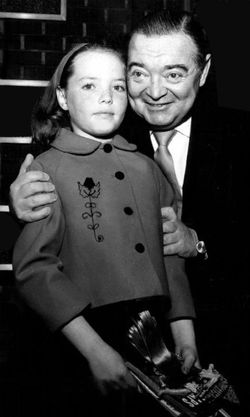
The couple had one daughter, Catharine Evelyn Lorre, born in 1953. Peter Lorre once remarked affectionately that their daughter “looked like him, but it looked better on her.” Despite the glamour of Hollywood, their family life was marked by personal struggles, including Peter’s declining health and addiction issues.

After Peter Lorre’s death in 1964, Anne Marie lived quietly in Los Angeles. She passed away on April 26, 1971, at the age of 49. She was laid to rest beside her husband at Hollywood Forever Cemetery in Los Angeles.

Though Anne Marie Brenning never sought the spotlight, her life was deeply entwined with one of Hollywood’s most distinctive actors. Through her daughter Catharine, her legacy continued—though tragically, Catharine also died young in 1985. Anne Marie remains a quiet figure in the annals of film history, remembered primarily through her connection to Peter Lorre, but her story adds a human dimension to the life of a man often shrouded in mystery...


Sunday, June 26, 2022

BORN ON THIS DAY: PETER LORRE

On this day - June 26th, the great character actor Peter Lorre was born. Peter Lorre was born László Löwenstein in Rózsahegy in the Slovak area of the Austro-Hungarian Empire, the son of Hungarian Jewish parents. He learned both Hungarian and German languages from birth, and was educated in elementary and secondary schools in the Austria-Hungary capitol Vienna, but did not complete. As a youth he ran away from home, first working as a bank clerk, and after stage training in Vienna, Austria, made his acting debut at age 17 in 1922 in Zurich, Switzerland.

 He traveled for several years acting on stage throughout his home region, Vienna, Berlin, and Zurich, including working with Bertolt Brecht, until Fritz Lang cast him in a starring role as the psychopathic child killer in the German film M (1931). After several more films in Germany, including a couple roles for which he learned to speak French, Lorre left as the Nazis came to power, going first to Paris where he made one film, then London where Alfred Hitchcock cast him as a creepy villain in The Man Who Knew Too Much (1934), where he learned his lines phonetically, and finally arrived in Hollywood in 1935. In his first two roles there he starred as a mad scientist in Mad Love (1935) directed by recent fellow-expatriate Karl Freund, and the leading part of Raskolnikov in Crime and Punishment (1935), by another expatriate German director Josef von Sternberg, a successful movie made at Lorre's own suggestion. He returned to England for a role in another Hitchcock film, Secret Agent (1936), then back to the US for a few more films before checking into a rehab facility to cure himself of a morphine addiction.


After shaking his addiction, in order to get any kind of acting work, Lorre reluctantly accepted the starring part as the Japanese secret agent in Thank You, Mr. Moto (1937), wearing makeup to alter his already very round eyes for the part. He ended up committed to repeating the role for eight more "Mr. Moto" movies over the next two years.

Lorre played numerous memorable villain roles, spy characters, comedic roles, and even a romantic type, throughout the 1940s, beginning with his graduation from 30s B-pictures The Maltese Falcon (1941). Among his most famous films, Casablanca (1942), and a comedic role in the Broadway hit film Arsenic and Old Lace (1943). Due to years of addiction, Lorre's health began to fade in the 1950s, and he ended his career starring in many low budget horror films. He died in 1964 at the young age of 59, and his birthday is worth celebrating due to all the great films he made that audiences still love...


Saturday, September 5, 2020

THE FACE BEHIND THE MASK: A 1941 REVIEW

The little know film The Face Behind The Mask (1941) is one of my favorite film noir of all time, but when the movie came out the initial review was not too kind. I 100% disagree with this review. Here is the original review that appeared in the NY Times on February 7, 1941...


Despite a certain pretentiousness toward things psychological, "The Face Behind the Mask," current at the Rialto, may safely be set down as just another bald melodramatic exercise in which the talents of Peter Lorre again are stymied by hackneyed dialogue and conventional plot manipulations. 

As an immigrant whose hopes of acquiring a footing in the new world are dashed after his face is horribly disfigured in a boarding house fire, Mr. Lorre strives earnestly to present a psychological study of a man who is driven, to crime against the dictates of his conscience in order to finance a plastic surgery operation. But this theme is not fully developed by the scenarists, nor is it pointed up to any extent by Director Robert Florey. 

The deliberate pace at which the story unfolds tends more to expose its flaws than to create a brooding atmosphere of conflict between the mind and soul of the protagonist. Peter Lorre is wasted in this one dimensional role as is the young and beautiful Evelyn Keyes. Both actors must be fullfilling a contract obligation to Columbia Pictures to make a film so beneath them...


Monday, March 4, 2019

THE SAD LIFE OF CATHARINE LORRE

Peter Lorre was one of the best character actors of all-time. Even the horrible movies he made were made better because of Peter's acting. Sadly though, Peter's personal life was sad and scary like some of his movies. Lorre suffered from an addiction to morphine and spent much of the 1940s trying to get clean. It was there at a clinic that he met his thrd and final wife - Anne Marie Brenning. They were married in 1953, and they had a child right away. Catharine was the only child of actor Peter Lorre and Anne Marie Brenning Lorre, and she was born on September 21, 1953.

Cathy had a number of strikes against her. Peter and Annemarie (Brenning)’s marriage was in trouble as early as 1956. Finally, they separated in 1962, when Cathy was nine years old. She was only 11 when her father died of a stroke on March 23, 1964. Annemarie was an alcoholic and died a few years later on April 26, 1971. What to do with Cathy? No one seemed to want her. Finally, Celia Lovksy, Peter’s first wife, offered theater and film critic James Powers (who was married to Karen Verne until her death in 1967) the upstairs of her house on Crescent Heights if he would adopt Cathy. He did and Celia moved into the basement. (Cathy thought of Celia [“Mumili”] as a grandmother. As such, she functioned as a hub for the Lorre family, connecting all to the center, even the actor’s second and third wives.)


Catharine nearly fell victim to "Hillside Stranglers" Angelo J. Buono and Kenneth A. Bianchi, who approached her one night in 1977 intending to abduct and murder her as they had and would do to ten women before the law caught up with them. Learning she was Peter Lorre's daughter, they just let her go. They were movie fans and liked Lorre's work. Catharine was 25 at the time. After the capture of Bianchi and Buono, and their photographs were made public, Catharine realized who they were. Later in interviews, Catharine stated that she never felt threatened by either man: She believed it to be a casual and friendly encounter. Bianchi and Buono stated that the only reason her life was spared was because Peter Lorre was her father.

In 1980, Catharine got married and had a few happy years, but her husband lost his life in a tragic motorcycle accident, leaving her a widow.


Catherine never took care of herself with no real parental guidance around and, she suffered from juvenile diabetes- As she grew older, complications from her diabetes took a greater toll until in her final year she was hospitalized at Harbor General. At that point, she was suffering vision and circulation problems. She spent upwards of a year there and died shortly after. She died of sepsis and encephalomalacia, complications from diabetes, on May 7, 1985, at age 32.

Sadly, unbeknownst to family and friends, she remained in the morgue for nearly a month before funeral arrangements were made. Only a few people attended her funeral. The only people at her funeral were Larry Lorre, Cathy’s cousin; Peter Lorre’s attorney, Robert Shutan; his son Peter Shutan (named after the actor); and Cathy’s nurse. She was buried at Inglewood Cemetery on June 4, 1985. It seemed like at every turn Cathy had bad things happen to her. The pain that she endured in her short 32 years seems overwhelming, but hopefully she did have some happiness and she is at peace now...


Monday, March 30, 2015

WHAT A CHARACTER: PETER LORRE

I am always announcing who may favorites are, but without a doubt my favorite character actor all time was Peter Lorre. His style and accent made him popular with his fans. Born Laszlo Loewenstein in Rosenberg, Austria-Hungary (now Ruzomberok, Slovakia) on June 26, 1904, his parents were Alois and Elvira Lorre. He was educated in Vienna, but at age 17, he ran away from home, working as a bank clerk in Vienna, and then making his acting debut in Zurich, Switzerland.

He was a virtual unknown for seven years, playing bit parts in numerous films in Germany, Austria and Switzerland, until 1931, when German director Fritz Lang cast him as a psychopathic child killer in "M" (1931). After several more German films, the Nazis came to power, and in 1933, he left for Paris, and in 1935, for Hollywood. He was able to find work immediately, and played Raskolnikov in "Crime and Punishment" (1935).

In the late 1930s, he played Japanese sleuth, Mr. Moto, in a series of eight Mr. Moto B films, and became a Hollywood icon after roles in "The Maltese Falcon" (1941) and "Casablanca" (1942). In 1938, the Nazis used images of Peter Lorre from "M" in their propaganda film "Der Ewige Jude" ("The Eternal Jew"), to portray Jews in a negative light.

After the war, he went to Germany, where he wrote, directed and starred in "Der Verlorene" ("The Lost One") (1951), paying homage to his former homeland. After that movie, his roles declined, and his last movie was with Jerry Lewis, in "The Patsy" (1964). He was actually the first James Bond villain, playing the role of Le Chiffre, in "Casino Royale" (1954), long before Sean Connery made 007 a hit star in the 1962 film, "Dr. No." He also was in the original "Voyage To The Bottom of The Sea," where he played Commodore Lucius Emory.

He was married three times, first to Celia Lovsky (1934 to March 1945, divorced), then to Karen Verne (25 May 1945 to 1949), and last to Anne Marie Brenning (21 July 1950 until his death). He had one child, a daughter, Catharine, born in 1950. Catharine was almost abducted by the Hillside Stranglers, Kenneth Bianchi and Angelo Buono, who let her go when they found out she was Peter Lorre's daughter; she discovered this when they were finally caught.


Sadly his daughter died very young. Catharine suffered from juvenile diabetes- As she grew older, complications from her diabetes took a greater toll until in her final year she was hospitalized at Harbor General. At that point, she was suffering vision and circulation problems. She spent upwards of a year there and died shortly after. She died of sepsis and encephalomalacia, complications from diabetes, on May 7, 1985, at age 32. Sadly, unbeknownst to family and friends, she sat in the morgue for nearly a month before funeral arrangements were made.

Peter's voice style was often imitated in films and cartoons, and he was easily one of the most mimicked and caricatured of the Hollywood stars. Once, while he and Vincent Price went to view Bela Lugosi at Bela's funeral, and upon seeing Bela dressed in his famous Dracula cape, quipped "Do you think we should drive a stake through his heart just in case?". Peter Lorre died in failing health after having a stroke on March 23, 1964...

Thursday, December 4, 2014

MOVIES THAT HAVE CHANGED MY LIFE

Movies affect everyone in different ways. Casual movie viewers are different than movie buffs, because the movies do not seem to affect them as much as they do to the true movie lover. Every movie lover has watched movies that have changed their lives. I recently turned 40 (ugh), and I have almost been a movie lover since then. I have a lot of movies that have had a profound influence on my life. Here are five films off the top of my head that have remained me with through my growing up:


1.    THE FACE BEHIND THE MASK (1941)
This is a little known B-movie put out by Columbia Pictures. Starring the great Peter Lorre, the film tells the story of a meek immigrant that just wants to live the American dream. That American Dream for Lorre becomes a nightmare when the tenement he found a place to live in catches fire and severely deforms him. No one will help him as society views him as a monster. He joins a gang and rises in their ranks quickly. When Lorre becomes rich from his gangster dealings, he has a doctor construct a mask to hide his burn scares. As Lorre becomes movie involved in murder, stealing, and underhanded dealings – the little shy immigrant he once was disappears, until he meets a blind girl (played expertly by Evelyn Keyes).  Keyes makes Lorre come alive again, and he realizes she loves him for what is on the inside and not the outside. He tries to leave the gang, but he faces dire consequences. The movie is short, but the story of the shy immigrant has always tugged at my heart strings. I think about this movie at least once a month. It has never been released on DVD, but I have a great copy from TCM, who shows it maybe every other year. It is really a tender and sad story.
 

2.    JAWS (1975)
Although this movie is on the borderline of a classic and a modern movie, I grew up with the movie, and it has been a part of my life for a long time. This Steven Spielberg masterpiece is also my favorite movie of all-time. I have watched the movie 75-100 times, but I have to admit if I watch it in a dark room at the right time, it still scares me. When I first saw the movie as a child it terrified me. For a good five years or so after watching the movie, I could not have my arms or legs dangle off of my bed for fear that a shark would come and bite me! This film is a great example of the type of horror movies I love. I love a movie where you don’t see the monster – at least right away. The mechanical shark during film production kept on breaking, so Spielberg had to create scenes without the shark. Thank goodness is broke so much. Because of the problem with the production, the movie created the suspense and the terror without seeing the shark. The movie, the theme song, and the terror of the movie has never left me.


3.    ROOMMATES (1995)
Growing up, I had a close relationship with my Grandfather. For a long time, until I met my wife, he was my best friend. When my Parents were emotionally and physically not there – my Grandfather was. This little known 1995 film starring Peter Falk and DB Sweeney has affected me more than any other film. The movie is about a grandfather (played by Falk) who has to raise his grandson after his daughter and son in law are killed. The movie spans several years as the grandfather and grandson grow up together.The grandson gets older and never forgets his grandfather. When he gets married, his grandfather is right there. When the grandson’s wife (played by a young Julianne Moore) is killed, Peter Falk steps in to help with his great grandson. I remember seeing this movie with my Mom and Stepfather.   Whenever I would go to the movies with them, I would dissect and review the movies on the way home. At the end of this movie, I cried for fifteen minutes straight on the way home. When the movie came out on DVD, we had my Grandparents over and all watched it together. My Grandfather even had a tear in his eye. My Grandfather died in 2002, and although I have this movie on DVD I have only watched the movie those two times. It affected me that much. 

 
4.    THE COUNTRY GIRL (1954)
Anyone who knows me, know I am a huge Bing Crosby fan. My Grandfather instilled in me a love of the music and movies of the era of golden Hollywood. My Grandfather never liked this film, because he liked his Bing Crosby as a carefree crooner. I thought this film was amazing, because it showed Bing’s range as an actor. He was amazing in this role as the down on his luck entertainer who lets booze destroy his marriage and career after the death of his son (played by a young Jon Provost). Grace Kelly played his wife and won an Oscar for her role as the emotionally tired wife. The scenes with Bing and his son are touching, and I never fail to tear up after the scene where his son dies. He is walking happily with his son, when a photographer wants to take a picture of Bing. He lets go of his son’s hand to pose for a picture briefly, but his sons runs into traffic and is killed. It is amazing the pain Bing conveys in his eyes and the anguish he feels as he blames himself through the years. The movie has an optimistic ending, but in the back of my head I can’t keep thinking that the story was not over. I can’t picture ever being able to recover after the death of a young child. Seeing Bing in this film makes me hope I never have to.


5.    WORDS AND MUSIC (1948)
One of my favorite musicals is this so-called biography of composer Richard Rodgers and lyricist Lorenz Hart. It is not a great musical, and as a biography there is not much fact in the film, but the idea of the movie and the music has always stuck with me. The majority of my favorite songs were written by Rodgers and Hart like: “My Funny Valentine”, “Spring Is Here”, “You Are Too Beautiful”, “My Romance”, “My Heart Stood Still”, and “He Was Too Good To Be True” – among countless others. The film showcased the music as well as the lives of the composers. Rodgers was played by Tom Drake, and Lorenz Hart was played expertly by Mickey Rooney. In the movie, Hart is portrayed as a lonely and sad man who never finds love. In real life, Hart was an alcoholic who could not come to terms with his homosexuality, and he literally died in the gutter in 1943. I wish they would make a movie on Lorenz Hart’s life now, because they could show everything about Hart’s life that they were too afraid to show in 1948. The movie is not great, but the story and talent of Lorenz Hart is timeless...

Tuesday, October 28, 2014

ARSENIC AND OLD LACE: MY FAVORITE COMEDY

Anyone who reads my blog knows I love to make lists of my favorite things. I can make a list about anything, but that’s a whole other story. I am going to take the time now to proclaim what I feel is the best comedy film of all-time…Arsenic And Old Lace (1944).

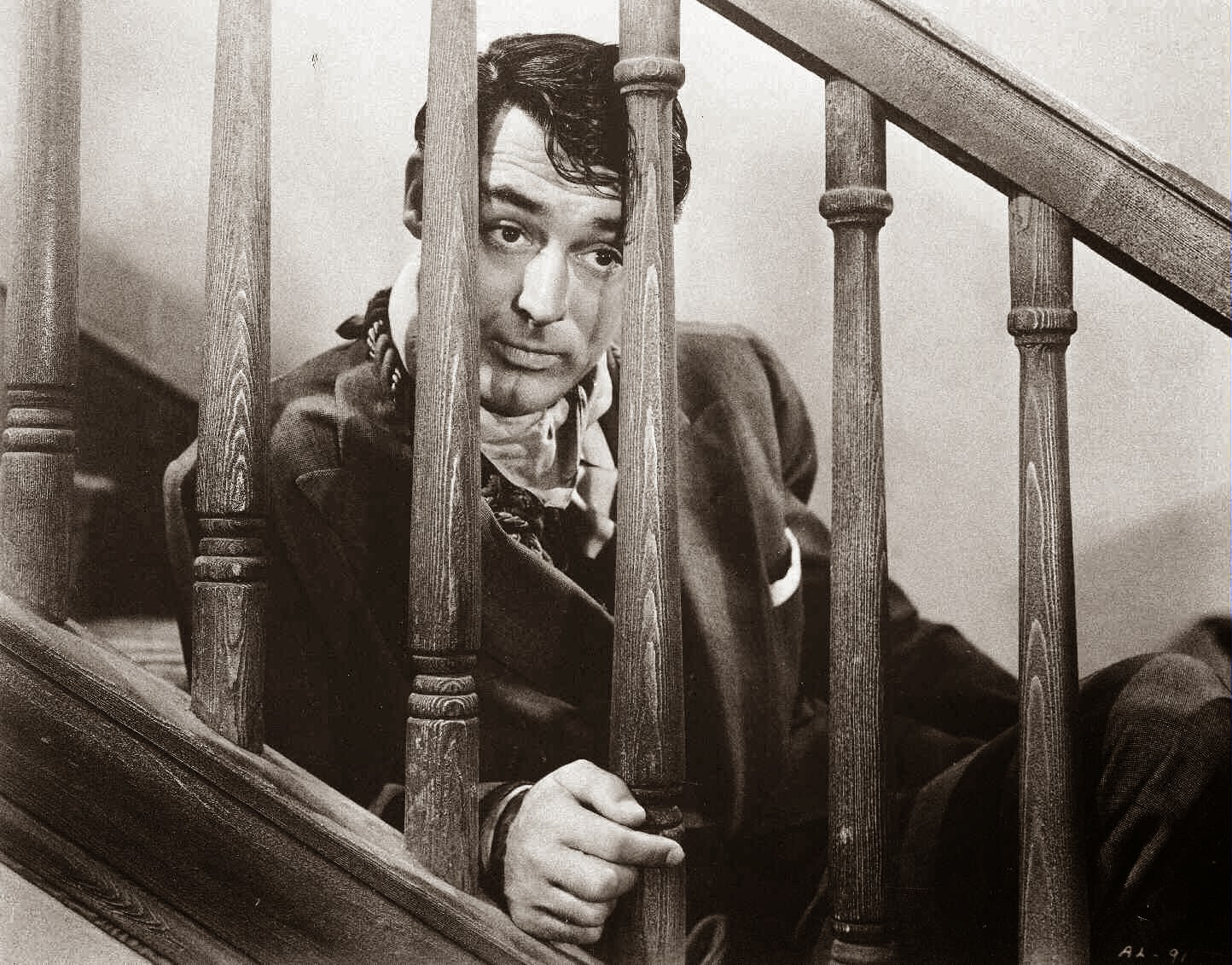
I love movies that make me laugh, but often with classic comedies the humor does not transfer through the generations. That is not the case with this 1944 slapstick comedy. The movie is 70 years old now, but I laugh as though it came out yesterday. Sure, I laugh at the modern comedies of Steve Carell and Will Ferrell, and some of them are quite good. There is just something about this Cary Grant comedy that makes me laugh every time I have seen it. I have watched it now at least 20 times! It is not really a scary movie, but for some reason I love to watch it around Halloween.


The director Frank Capra actually filmed the movie in 1941 because of star Cary Grant's availability, but it was not released until 1944, after the original stage version had finished its run on Broadway. The lead role of Mortimer Brewster was originally intended for Bob Hope, but he could not be released from his contract with Paramount. Capra had also approached Jack Benny and Ronald Reagan before learning that Grant would accept the role. Boris Karloff played Jonathan Brewster, who "looks like Karloff," on the Broadway stage, but he was unable to do the movie as well because he was still appearing in the play during filming, and Raymond Massey took his place. The film's supporting cast also features Priscilla Lane, Jack Carson, Edward Everett Horton and Peter Lorre. Josephine Hull and Jean Adair portray the Brewster sisters, Abby and Martha, respectively. Hull and Adair, as well as John Alexander (who played Teddy Roosevelt), were reprising their roles from the 1941 stage production. Hull and Adair both received an eight-week leave of absence from the stage production that was still running, but Karloff did not as he was an investor in the stage production. He really wanted to transfer his stage role to the movie. Karloff later expressed that it was one of the regrets he had in his career.
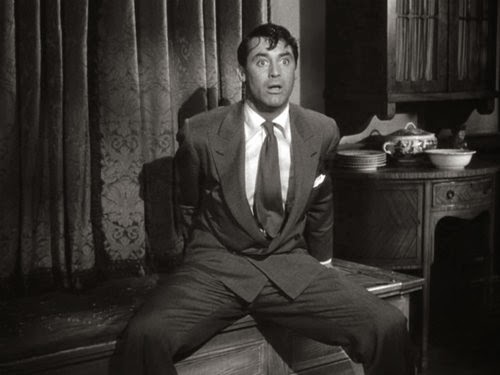
After making the bold statement that this film was the best comedy of all-time, I better give some pretty good examples, and this film is full of it. It is just wonderful to see the transformation of Cary Grant’s character (Mortimer Brewster) throughout the film. In the first scenes, he seems to be a man who is confident and self-assured. He is getting married to his beautiful girlfriend (played cutely by Priscilla Lane). He returns home to his aunts who have helped to raise him to discover that for years the saintly aunts have been murdering people and burying them in their basement. There is no scene in Cary Grant’s career as great as the scene when he first discovers one of the victim’s bodies in living room storage chest.


Raymond Massey (as Grant’s criminally insane brother) and Peter Lorre (as his meek assistant) are supposed to be horrific criminals, but they add a lot of comedy as well. When they discover the aunts are murderers, they give huge astonished looks like Grant did. However, what is even funnier is Massey and Lorre are trying to count the total number of men they murdered, and the aunts have beat them.
John Alexander is another scene stealer as the uncle who thinks he is Teddy Roosevelt. There is some funny historic humor. When the director of  a mental hospital (Edward Everett Horton) comes to evaluate the uncle, Alexander gives him a dirty look. Cary Grant asks his uncle what is wrong and he sticks out his tongue and says “That’s Taft!” (William Taft was a protégé of Roosevelt, who later had a falling out with him). The aunts have used “Teddy” to help bury the bodies by telling him that their murder victims died because of the Yellow Fever in Panama.
I think what makes me laugh at Arsenic And Old Lace so much is that the movie shows us a family that seem normal as the movie opens, but they turn out to be genuinely crazy. Everyone’s family is like that. Everyone has a crazy uncle or a brother who is the black sheep. After Grant discovers his aunts are serial killers, and his brother is completely deranged, Cary does not even want to get married. He’s afraid he will go crazy too, and by the end of the movie it seems like he will go completely nuts. The aunts though have one more secret to tell Cary before they are taken away…literally. Cary Grant was adopted. He is not part of the Brewster family! The movie did not depend on topical humor like the war so the laughs are not dated. Basically, the jokes are about the absolute absurdity of this family. When you think the family is as crazy as it gets, it just gets crazier. I don’t think I would have laughed at the film as much if Cary Grant had not been in it. His slapstick approach to the role, his facial expressions, and his decent into insanity himself is just hilarious. There are a lot of comedies, old and new, that make me laugh, but Arsenic And Old Lace is my favorite of all-time…


Wednesday, August 15, 2012

FILM BIOS AND THEIR CASTING

Since almost movies began, the industry was interested in making film biographies of famous people. Especially in classic Hollywood, the movies were not truly factual, but "based on" the life of a famous person. Some of those film biographies like Pride Of The Yankees (Gary Cooper as Lou Gehrig) or The Spirit Of St. Louis (Jimmy Stewart as Charles Lindbergh) are famous to this day.

I have always been interested in who can be cast as a famous person. For years I said to people that Kevin Spacey bears a striking resemblance to crooner Bobby Darin. Then Spacey (although too old) made and starred in a movie of Darin's life called Beyond The Sea (2004). My wife gets tired of me constantly telling her I had the idea for the movie even before Spacey did!

Through the years interesting casting has been announced like Tom Hanks as Dean Martin, Forest Whitaker as Louis Armstrong, and Reese Witherspoon as Peggy Lee. As of this article, the movies have not came to be - but the casting ideas are still interesting.

Here are some movie casting ideas I have been thinking about for years and you heard it here first if they ever happen!


STEVE BUSCEMI as PETER LORRE
No two actors in film history are more bug eyed and sickly looking than Steve Buscemi and the great Peter Lorre (1904-1964). Lorre's life might not be the story Hollywood is looking for, but Buschemi could play him. Lorre's later years was filled with constant gall bladder pain and an addiction to morphine, so maybe there is a movie there.


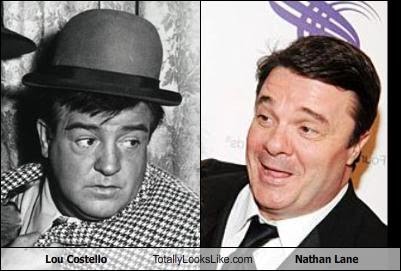
NATHAN LANE as LOU COSTELLO
I think both Nathan Lane and legendary comedian Lou Costello (1906-1959) are truly great entertainers. At one point in Lane's career I think he could have played funny man Costello. The time might have passed now that Lane is in his mid 50s, but I think the similarities and even voice to a degree are uncanny.


HALLE BERRY as LENA HORNE
Berry has already played famous actresses like Dorothy Dandridge (1922-1965), but of all of the great black actresses out there I think only Berry could play legendary singer Lena Horne (1917-2010). When Horne was alive it was proposed that Janet Jackson would play her life, but Horne was against it. Berry of course can not sing, but she can act.


CHRIS ROCK as RICHARD PRYOR
Now I know this is stretching it a bit, but I always thought Chris Rock has more acting chops than his movies have shown. He is a great comedian, and I believe he can capture the essence of fellow funny man Richard Pryor (1940-2005). Pryor's life could make a trilogy of movies not just one film, but again Chris Rock is not yet viewed as a capable dramatic actor.


KELSEY GRAMMER AS JACK BENNY
I am a big fan of both Kelsey Grammer and Jack Benny (1894-1974), and it is amazing at the similarities in the comic styles of both actors. Looking at Grammer on the television series "Cheers" and "Frasier", you see a lot of Jack Benny in Grammer's mannerisms. Grammer even hosted a great special on Benny for NBC in 1995. I am not sure of Kelsey Grammer looks enough like Jack Benny, but I think it would be a great role to do. Unfortunately, Jack Benny was such a nice guy, it would probably be boring doing his life story.

For every great film movie like Jamie Foxx as Ray Charles in Ray (2004), there is Faye Dunaway as Joan Crawford in Mommie Dearest (1981). Still Hollywood will continue to make film biographies because where else but Hollywood could the town get the best ideas and stories. The stars' lives are often more interesting than the movies they were in.

What casting ideas do you have...

Sunday, April 15, 2012

MOVIE REVIEW: THE FACE BEHIND THE MASK

When I first started really collecting movies, back in the day of Beta and VHS tapes, I managed to tape a short movie that was long forgotten. I think it was actually on Cinemax at the time.

The movie is not even 90 minutes long, but this little movie has been one of my favorite movies all these years. The Face Behind the Mask is a minor B-movie crime-drama released by Columbia Pictures in 1941. It starred Peter Lorre and Evelyn Keyes and was directed by Robert Florey and Wallace MacDonald. To date, it has never been released on DVD or video.

Based on the radio play by Thomas Edward O'Connell, The Face Behind the Mask was not a film that Lorre held in high esteem. His co-star Don Beddoe, who plays the police officer who befriends Janos in the film, once said, "I don't think Peter was very much impressed with The Face Behind the Mask. His other successes, such as M, made him pretty blasé about this particular venture."

The film is the story of a hopeful new immigrant, Janos Szaby (Peter Lorre), who, on his first day in New York City, is trapped in a hotel fire that leaves his face hideously scarred. Refused employment due to his appearance although he possesses tremendous skill as a watchmaker, the only way he can survive is by turning to theft, using his skilled hands to disable alarms. Eventually he becomes the leader of a gang of thieves, and raises enough money to commission and wear a realistic latex mask of his own face.


Janos then falls in love with Helen (Evelyn Keyes) a blind woman who sees only the good in him, and attempts to leave his life of crime behind him. Unfortunately, his gang come to believe that he has betrayed them to the police, and attempt to kill him by car bomb, an attempt on his life that he survives but that Helen does not. In retaliation, Janos disguises himself as the pilot of the private plane the gang is flying out of the city with, which he lands in the Arizona Desert and lets out the fuel, suicidally stranding both the gang and himself without food or water, dooming them all to a slow death. At the film's end, Janos's body and that of his enemies are discovered by the police. The climax, set in a desolate stretch of desert with Janos tied to an abandoned plane, is a bleak counterpoint to the immigrant's hopeful beginnings. More than anything, The Face Behind the Mask is a vision of the American dream gone horribly wrong but under the artful direction of Robert Florey along with Franz F. Planer's atmospheric cinematography and Lorre's sensitive performance, it becomes a rich, multi-layered character study, a gem among the Columbia Pictures programmers of the forties.


If you are a fan of Peter Lorre or the understated performances of Evelyn Keyes, then I recommend The Face Behind The Mask. This movie deserves to be remembered and preserved on DVD. I was lucky to catch an airing of the forgotten film on TCM, and my copy is one of my prized possessions in my movie collection. This fine character study is not one that should be missed...

MY RATING: 10 out of 10

Sunday, January 22, 2012

PHOTOS OF THE DAY: THE CLASSIC STARS READ

Sometimes it is hard to believe that movie stars do anything more than looking in the mirror and admiring themselves. However, most of the classic Hollywood stars were much deeper than the public ever knew. Here are some great pictures of classic Hollywood stars reading, whether it be a script or a good book, it is still interesting...


DEAN MARTIN


LILLIAN GISH


MARILYN MONROE


PETER LORRE


DAVID NIVEN


MARLON BRANDO