Showing posts with label Cary Grant. Show all posts

Wednesday, August 19, 2026

THE BOX OFFICE STARS: 1960

1960 was the dawn of another decade, and the 1960s cinema was changing just as the whole world was. Here are the top ten movie stars of 1960...


1. DORIS DAY
2. ROCK HUDSON
3. CARY GRANT


4. Elizabeth Taylor 
5. Debbie Reynolds
6. Tony Curtis
7. Sandra Dee
8. Frank Sinatra
9. Jack Lemmon
10. John Wayne.

Tuesday, July 21, 2026

THE BIGGEST BOX OFFICE HITS: CARY GRANT

Cary Grant, one of Hollywood’s most iconic leading men, enjoyed a career that spanned over three decades and included a wide range of genres—from screwball comedies to suspenseful thrillers. Known for his charm, wit, and impeccable timing, Grant starred in numerous box office successes. Here are the five biggest box office hits of his career, adjusted for inflation and cultural impact:


1. North by Northwest (1959)
Director: Alfred Hitchcock
Box Office (Original Gross): Approx. $13 million
Adjusted Gross: Over $130 million
 
Why It Was a Hit:
A masterclass in suspense and style, North by Northwest is often considered one of Hitchcock’s greatest films. Grant plays Roger Thornhill, a suave advertising executive mistaken for a spy. The film’s iconic scenes—like the crop-duster chase and Mount Rushmore climax—cemented its place in cinematic history.
 
2. Charade (1963)
Director: Stanley Donen
Box Office (Original Gross): Approx. $13.5 million
Adjusted Gross: Over $120 million
 
Why It Was a Hit:
Often dubbed “the best Hitchcock movie Hitchcock never made,” Charade paired Grant with Audrey Hepburn in a stylish blend of romance, mystery, and comedy. The chemistry between the leads and the film’s Parisian setting made it a crowd-pleaser.

 
3. Operation Petticoat (1959)
Director: Blake Edwards
Box Office (Original Gross): Approx. $18.6 million
Adjusted Gross: Over $180 million
 
Why It Was a Hit:
This World War II comedy, co-starring Tony Curtis, was a massive commercial success. Grant’s role as a submarine commander dealing with chaos and pink paint showcased his comedic timing and broad appeal.
 
4. To Catch a Thief (1955)

Director: Alfred Hitchcock
Box Office (Original Gross): Approx. $8.8 million
Adjusted Gross: Over $90 million
 
Why It Was a Hit:
Set against the glamorous backdrop of the French Riviera, this romantic thriller featured Grant as a retired cat burglar opposite Grace Kelly. The film’s elegance, suspense, and star power made it a box office draw.


5. The Philadelphia Story (1940)
Director: George Cukor
Box Office (Original Gross): Approx. $3.3 million
Adjusted Gross: Over $60 million
Why It Was a Hit:
A classic romantic comedy, The Philadelphia Story starred Grant alongside Katharine Hepburn and James Stewart. The film’s witty script and sophisticated performances helped revive Hepburn’s career and solidified Grant’s status as a top-tier leading man.

Cary Grant’s box office success was not just about numbers—it was about the enduring charm and sophistication he brought to every role. His films continue to captivate audiences, proving that true star power never fades.

Wednesday, March 18, 2026

THE BOX OFFICE STARS: 1959

The decade of the 1950s ended with a lot of great movies and great stars. It was still the golden years of Hollywood. Here are the top box office stars of 1959...


1. Rock Hudson
2. Cary Grant
3. James Stewart


4. Doris Day
5. Debbie Reynolds
6. Glenn Ford
7. Frank Sinatra
8. John Wayne
9. Jerry Lewis
10. Susan Hayward.                                         


Monday, October 27, 2025

REFLECTIONS: JAMES MASON ON ALFRED HITCHCOCK

James Mason on Alfred Hitchcock: "You can see from the way he uses actors that he sees them as animated props. He casts his films very, very carefully and he knows perfectly well in advance that all the actors that he chooses are perfectly capable of playing the parts he gives them, without any special directorial effort on his part. He gets some sort of a charge out of directing the leading ladies, I think, but that's something else."

Eleven years after being mentioned in "Rope" (1948) as making an excellent villain, Mason was finally cast by Sir Alfred Hitchcock as such in "North by Northwest" (1959).

Mason suffered a severe heart attack shortly after filming ended.

In 1952, Mason purchased a house previously owned by Buster Keaton. There he discovered reels of nitrate film of some of Keaton's work that was considered lost, including "The Boat" (1921). He arranged to have the decomposing films transferred to safety stock, saving them from oblivion.

"I'm a character actor: the public never knows what it's getting by way of a Mason performance from one film to the next. I therefore represent a thoroughly insecure investment."


Saturday, April 19, 2025

MEL BROOKS MEETS CARY GRANT

Aside from his ex-wives, most people really liked Cary Grant. He wasn’t a controversial figure on-screen or off. For nearly five decades, he was the Platonic ideal of what a male movie star should look like. He was suaveness personified. Even Ginger Rogers said he was one of the greatest dancers she ever shared a floor with, and that’s coming from a person who made ten movies with Fred Astaire.

Not everyone in Hollywood was susceptible to his charm, though. Sometime around the late 1950s or early ‘60s, after he’d left the Sid Caesar Show, Mel Brooks was in Hollywood writing a movie. The building he was working in happened to be across the street from Grant’s production company, Granart. He couldn’t believe his luck. The Cary Grant was right next door, and he might even get a chance to see him in person.

One afternoon, Brooks bumped into the actor, and it turned out that the admiration ran both ways. “Mel Brooks,” the North By Northwest star said, “I’ve bought all your albums. You made me poor.” Brooks panicked but managed to strike up a conversation with him. Grant invited him to lunch, and the comedian thought he’d died and gone to heaven.

He remembered thinking it was odd that the actor only ate a hardboiled egg for lunch. They chatted, but the conversation was relegated to the type of small talk that most people – even extroverts – absolutely shudder just thinking about. They discussed their favourite colours (at least in Brooks’s memory). They discussed their favourite cars. For the record, Grant said Rolls Royce, which, if you think about it, was really never a question. They parted ways at their respective buildings, and Brooks assumed that was the end of it.

The next day, Grant called his office and invited him out for lunch again. The process repeated, right down to that single hardboiled egg. The same thing happened the next day. Finally, after a few days of these lunches, Brooks had had enough. The phone rang, and he told his secretary to tell the silver screen legend that he wasn’t there. “I had nothing more to say to him,” he said. “I said my favourite colour. I said my favourite car. There was nothing more to talk about.”

It would have been interesting to have heard Grant’s side of the story. Presumably, he would have had a different perspective on how that friendship blossomed and withered, and he might even have taken issue with the colour Brooks identified as his favourite (yellow). The comedian has told the story many times over the years, including several times on The Johnny Carson Show, but it’s much harder to find instances in which Grant talks about Brooks, positively or otherwise.

He was, it should be noted, not a complete dullard by most accounts. Anyone who has seen any of his movies will notice that he made romantic comedies look easy. He had perfect comic timing and never overplayed his hand as an actor. Even Clint Eastwood was a fan of his work. Sadly, however, it seems that his love for Brooks was unrequited...


Saturday, August 7, 2021

SUSPICION: 80 YEARS LATER

It is hard to believe that this classic Hitchcock film turns 80 years old. The film is not remembered as much as it should be...

Much has been written, correctly and incorrectly, about the difficulties surrounding the ending of Alfred Hitchcock's Suspicion(RKO-1941), the director's fourth Hollywood production, based on Francis Iles's Before the Fact. What follows is an examination the shooting script before and after revisions, production correspondence, a careful study of the finished picture, and the director's statements after the fact.

Hitchcock himself told François Truffaut and numerous other interviewers that his original intention was to have Johnnie Aysgarth (Cary Grant) guilty of the crimes for which he is suspected, and that Lina (Joan Fontaine), aware of her husband's guilt writes a letter to her mother (Dame May Witty) indicating that she knows Johnnie is going to murder her and she intends to allow him to do so. Later, Hitchcock said, Johnnie brings Lina a glass of poisoned milk, and she gives him the letter to mail. The last scene would have been Johnnie mailing the incriminating letter.

This ending, reminiscent of the ironic or twist endings of many an Alfred Hitchcock Presents installment, was never actually filmed, nor is there evidence that it was ever scripted that way. While the twist ending would have satisfied the Production Code, Hitchcock and RKO knew that audiences would have difficulty accepting Lina's drinking the milk which she knows to be poisoned, and so, according to Hitchcock biographers John Russell Taylor and Donald Spoto, it was the director's suggestion early on in his involvement with the production, that the story should be about a "neurotically suspicious woman".


In spite of the lack of script material for an "incriminating letter" ending, there is much evidence in the finished film to support Hitchcock's statements that this was his preferred ending. Such an ending is consistent with -- and would have completed -- a major theme in the existing picture.

In the opening sequence, it is a postage stamp which Johnnie borrows from Lina that ultimately brings them together. Using the stamp to pay his fare, Johnnie remarks to the annoyance of the conductor, "Write to your mother!" Thus, foreshadowing the ending of Lina's incriminating letter to her mother. At crucial moments in the film letters are sent and received. When Lina elopes with Johnnie, the excuse that she gives her parents when she goes out is that she is going to the post office.

The theme of "letters" is carried forward in the game of anagrams that Lina plays with Beaky. At the moment when Lina decides she will leave Johnnie, she writes a letter to him, ultimately tearing it up (an action that would be repeated by both Judy Barton in Vertigo and Melanie Daniels in The Birds). Johnnie then enters with a telegram containing news of his father-in-law's death. Later, Lina's suspicions mount when Johnnie hides a letter he's received from an insurance company. Finally, Hitchcock makes his cameo appearance dropping a letter into a mailbox.


Also telling are several suggested titles contained in a memo from producer Harry Edington to RKO executive Peter Lieber, dated December 10, 1940, which include: Letter from a Dead Lady, A Letter to Mail, Posthumously Yours, Forever Yours, Yours to Remember, and Your Loving Widow -- all suggestive of the "incriminating letter" ending.

This ending however was foiled for several reasons. One reason is that RKO did not wish to have Cary Grant portray a murderer. A second, and more likely reason is that the Production Code would not allow Lina to allow herself to be murdered. Criminals could commit suicide within the Code, but a heroine could not, in spite of the fact that her actions would help convict a murderer. Despite the indecision over its ending, the film was a tremendous success, and more importantly Hitchcock had enjoyed a measure of creative freedom which he knew that he would not get at Selznick International...

Saturday, February 1, 2020

PHOTOS OF THE DAY: ODD PAIRINGS - 5TH EDITION

It has been a long time since we published this feature on odd classic Hollywood pairings. The older additions of the popular feature can be found here:

STILL MORE ODD PAIRINGS - JANUARY 20, 2017

EVEN MORE ODD PAIRINGS - JULY 12, 2014

MORE ODD PAIRINGS - JULY 16, 2012

ODD PAIRINGS - APRIL 19, 2011


Here now are some more of the oddest parings of stars and celebrities that can truly only come together in Hollywood...

David Bowie and Elizabeth Taylor

Al Pacino, Lillian Gish, and Grace Kelly

Marlon Brando and Charlie Chaplin

Cab Calloway, Eartha Kitt, and Cary Grant

Michael Jackson and Danny Kaye

Edith Piaf and Carmen Miranda

Saturday, January 6, 2018

MARLENE DIETRICH AND THE UNISEX TUXEDO

Marlene Dietrich made the tux luxe for all.

Born in Berlin as Marie Magdalene Dietrich, she became a star during Hollywood’s Golden Age. The image she’s best remembered is her turn in a man’s tux with top hat and white tie in Josef von Sternberg’s 1930 film Morocco. Google even remembered Marlene Dietrich’s 116th birthday—and her gender-defying tuxedo—with a December 27th doodle.

Her boundary-pushing performance—Dietrich, playing a cabaret singer, kisses a woman in the audience—stunned and titillated audiences, according to the BBC. Dietrich’s big-screen appropriation of the men’s tuxedo was a long leap at a time when women wearing trousers was still far from accepted.

The era of her widest fame included the World War II years when women stepped into factories and manufacturing to support the US war effort, events that helped set in motion the ongoing struggle for greater equality between the sexes. As the Costume Society  wrote last year of her wardrobe, “at times, Dietrich looked far better in suits than men themselves.”


She was also a bisexual star when homosexuality was a crime in many jurisdictions, and elevated drag to a new level. Today’s doodle was illustrated by Sasha Steinberg, who was a winner of RuPaul’s Drag Race, performing as Sasha Velour. “Despite the pressures of the time, she followed her own course, especially in terms of politics and gender,” Velour said.

Her film career extended into the 1970s, as did her international cabaret appearances. Decades after Dietrich’s pioneered her signature look, Yves Saint Laurent designed “le smoking,” the first tuxedo for women. It came to symbolize “female liberation,” according to a statement for the 2005 exhibition Yves Saint Laurent Smoking Forever.

Dietrich, who died in 1992, is remembered as a symbol of liberation in various forms. After Hitler’s Nazi regime took control of Germany, she became an exile, went to war zones to encourage American troops and traveled widely to promote the sale of war bonds. She resisted repeated attempts by the Third Reich to lure her back and instead became an emblem of a free Germany...


SOURCE

Monday, August 1, 2016

COOKING WITH THE STARS: CARY GRANT

This receipe from classic Hollywood legend Cary Grant really made my mouth water. It really looks tasty, and there is nothing like good BBQ in the summer...


Cary Grant’s Oven-Barbecued Chicken

Ingredients:
3 chickens, 1 ½ lbs each (or 1 chicken, 4.5 lbs), cut into pieces
Olive or vegetable oil for frying
1 cup ketchup
½ cup Worcestershire sauce
½ cup water
½ cup A-1 sauce
¼ cup sugar
¼ cup cider vinegar
1 onion, peeled and chopped
1 clove garlic, peeled and chopped
2 tbsp cornstarch (or more if needed)

Directions:
Preheat oven to 325 degrees F. Heat olive or vegetable oil in a large skillet over medium till hot. Fry the chicken pieces in the hot oil in batches till browned. Season with salt and pepper as you cook.
Place browned chicken pieces in a 9x13 baking dish. In a saucepan, combine ketchup, Worcestershire sauce, water, A-1 sauce, sugar, cider vinegar, onion and garlic. Whisk together over medium heat till warm.

In a small bowl, whisk together 2 tbsp cornstarch with 2 tbsp cold water till smooth. Slowly add the cornstarch mixture to the barbecue sauce, whisking till incorporated. Continue to whisk over medium heat till the sauce is hot, bubbly, and thickened. Remove from heat. Pour the sauce evenly across the top of the chicken pieces. Cover the roasting dish with foil.

Bake the chicken for 60-75 minutes, or until the meat is tender and well cooked. Remove from the oven. If you’d like to serve extra sauce with the chicken, skim the fat drippings from the top of the sauce. To thicken the leftover sauce, pour it into a saucepan and heat over medium. Mix together equal amounts of cornstarch and water, a half tablespoon at a time, and slowly whisk into the sauce. Heat and add the cornstarch mixture, stirring constantly, till desired consistency is reached. Serve chicken warm with the thickened barbecue sauce on the side.


Thursday, December 17, 2015

CARY GRANT: THE FINAL INTERVIEW

I found this article that I thought would be interesting. It is the last interview that Cary Grant gave in July of 1986 - just four months before his death. To the end he was one of the greatest actors that Hollywood has even known... 


This interview with Mr. Grant was done four months before his death. He did the interview in connection with a film tribute in his honor at the University of Iowa in Iowa City. This is one of the last public conversations with a legend...

KENT SCHUELKE: What was your earliest ambition?
CARY GRANT: My earliest? I don't know, just to keep breathing in and out, I guess. I had no definite ambition. One has to go through one's education before forming thoughts about what one wants to do. Unless you've got some mad ideas about being a fireman or a great boxer or a football player. But I had none of those.

KS: What about acting?
CG: I had no ambition toward acting.

KS: I understand that as a boy you dreamed of traveling on the high seas. Did you want to be a sailor?
CG: Yes. I had an ambition to travel. I was born in a city -- Bristol -- from which there was a great deal of travel. It was a very old city, and in those days the ships came and left all the time from the port. I was constantly interested in what was going on down there and in those ships that took people all over the world.

KS: How did you get started in acting?
CG: Because of my wish to travel, I joined a small troupe of ground acrobats. I first came to New York with the troupe. When the troupe went back to England, I remained here. I liked this country very much, and gradually I got into musicals. In those days, a musical generally only lasted a year, so there weren't very many. But I was in musicals before I came to film.

KS: Young people who weren't even born when you made your last film are now discovering you in your classics. What do you think about that?
CG: I think they have a long life ahead of them. They will make their own choices. I hope for the best for the coming generation, but it doesn't seem to promise too much. But in every century people complain how the world is going. I don't know what the young people think or do; I only hear the emanation of their thoughts -- rock groups and similar noises. But if that's what makes them happy, fine -- as long as they don't do it next to me.


KS: How do you see yourself?
CG: How can I see myself? We are what we are in the opinion of others. It's up to them to make up their minds as to what we are. I can only see myself as a man of 82 who keeps on functioning. I do the best I can under the circumstances in which I've placed myself.

KS: How would you like history to remember you?
CG: As ... "A congenial fellow who didn't rock the boat," I suppose.

KS: Is your life relatively quiet these days?
CG: I live pretty quietly -- but what does one expect a man my age to do?

KS: Is that how you want to live out the rest of your life, quietly in Beverly Hills?
CG: I don't know how long that's going to be -- "the rest of my life" -- but I enjoy what I am doing and, of course, I shall live out my life here unless some extraordinary change suddenly occurs. If I didn't enjoy living in Beverly Hills, then I would move -- I can afford to do that.

KS: What is the most difficult thing about being Cary Grant, the movie star?
CG: I don't consider it difficult being me. The only thing that I wish -- that we all wish -- is that our faces were no longer part of our appearance in public. There's a constant repetition of people approaching me -- either for those idiotic things known as autographs or for something else. That's the only thing I deplore about this particular business.

KS: Do fans still approach you today?
CG: It happens, but not as much as it might to a Robert Redford or some younger, more popular star of today. It gets to be a bore.

KS: Have there been many interesting encounters with your fans?
CG: The people I'd most like to meet are the people who are the least likely to come up to me.

KS: Are you accessible to your fans? Do you interact with them?
CG: I do not care or like to talk to [my fans]. I'm not rude. I try to be as gracious as I can when someone next to me at dinner wants to know how I feel about a leading lady. But I don't answer any letters. I couldn't possibly answer everybody. I can't even attend to my own legal matters. I must receive two sacks of mail every day. So you can't answer the people. You feel rather sorry you can't, especially when there are children concerned, but it can't be done.

KS: Is is true that President Kennedy once telephoned you from the White House just to hear the sound of your voice?
CG: We all knew each other, just as we know our current President, who is a very dear and very friendly man. We [Reagan and Grant] are old friends.


KS: Film students break your films apart and analyze them. Do you think scholars place too much emphasis on films that were made strictly for entertainment?
CG: Oh, yes. A film's a film. As Hitch would say when someone would get all upset on the set, "Come on, fellas, relax -- it's only a movie." Now, if you want to bisect it and tri-sect it and cut it up into little pieces, well, that's up to you. We made them. We didn't know their intentions half the time, except to amuse and attract people to the box office.


KS: What are your memories of working with Alfred Hitchcock?
CG: I have only happy ones. They're all vivid because they're all interesting. It was a great joy to work with Hitch. He was an extraordinary man. I deplore these idiotic books written about him when the man can't defend himself. Even if you defend yourself against that kind of literature, it gets you nowhere.

KS: You worked with some of the most beloved leading ladies in film history. Who was the best actress with whom you worked?
CG: I've worked with many fine actresses. But in my opinion, the best actress I ever worked with was Grace Kelly. Ingrid [Berman], Audrey [Hepburn], and Deborah Kerr were splendid, splendid actresses, but Grace was utterly relaxed -- the most extraordinary actress ever. Her mind was razor-keen, but she was relaxed while she was doing it. I appreciated that. It's not an easy profession, despite what most people think.

KS: Was it disappointing to you that Kelly gave up acting to marry Prince Rainier?
CG: As far as we were concerned, she as a lady, number one, which is rare in our business. Mostly, we have manufactured ladies -- with the exception of Ingrid, Deborah and Audrey. Grace was of that ilk. She was incredibly good, a remarkable woman in every way. And when she quit, she quit because she wanted to.

KS: How was working with Katharine Hepburn?
CG: Marvelous. I worked with her about five times. One doesn't do a thing more than once -- unless you're an idiot -- that one doesn't like.

KS: In the 1950s, you announced that you were retiring from films. The retirement was short-lived, but what made you want to give up films at the height of your career?
CG: I was tired of making films.


KS: How did your friends and colleagues react to your decision?
CG: People say all sorts of things. I gave it up because I got tired of doing it at that point in my life; I had no idea then whether I would resume my career or not. The last time I left, I knew I wouldn't return to it. I enjoyed the profession very much, but I don't miss it a bit.

KS: Has anyone in the movie industry ever told you that your work has influenced the films they've done?
CG: Everybody copies everybody else, if they think you're doing something better than they. Athletes do that; that's evident in baseball scores and the improvement of the hitter today.

KS: How do you respond to the criticism that you never portrayed anyone but yourself in your films?
CG: Well, who else could I portray? I can't portray Bing Crosby; I'm Cary Grant. I'm myself in that role. The most difficult thing is to be yourself -- especially when you know it's going to be seen immediately by 300 million people.

KS: What about the people who say you should have expanded your repertoire to include more "character" roles?
CG: I don't care what people say. I don't take into consideration anything anyone says, including the critics. There's no point: You've made the film, it's done and if they want to criticize it, that's up to them. I don't pay attention to what anybody says -- except perhaps the director, the producer and my fellow actors. But I'm not making films; I haven't made a film in 20 years.

KS: Do you think these people misinterpret what you were trying to do?
CG: I have no concern with what anyone else is thinking -- I can't affect it -- or with what anybody else is saying anywhere in the world at any dinner table tonight. They may be discussing me or somebody else; I don't care. I've nothing to do with it, and I can't control it, so it doesn't matter what people say.

KS: Do you have a favorite film?
CG: Not really. I did them all for a purpose. Sometimes I hoped for better results; sometimes I was surprised by the results.

KS: Why did you leave acting for the business world in the '60s?
CG: Acting became tiresome for me. I had done it. I don't know how much further I might have gone in it. I have no knowledge of that, of course. But I enjoyed going from where I started on to a different world, equally interesting -- perhaps more so...


Monday, June 1, 2015

PHOTOS OF THE DAY: HOLLYWOOD KIDS - PART ONE

Here is the first of three installments of Hollywood children and their famous parents. Each installment will feature three offspring of tinsel town royality...

(Please feel free to request any updates or pictures of Hollywood offspring...)


Jennifer Grant, the daughter of Cary Grant (1904-1986) and Dyan Cannon (born 1937)

Jennifer Grant today at 49


B.D. Hyman, the daughter of Bette Davis (1908-1989) and William Grant Sherry (1914-2003)

B.D. Hyman today at 67


Joey Luft, the son of Judy Garland (1922-1969) and Sid Luft (1915-2005)

Joey Luft today at 59


Tuesday, October 28, 2014

ARSENIC AND OLD LACE: MY FAVORITE COMEDY

Anyone who reads my blog knows I love to make lists of my favorite things. I can make a list about anything, but that’s a whole other story. I am going to take the time now to proclaim what I feel is the best comedy film of all-time…Arsenic And Old Lace (1944).

I love movies that make me laugh, but often with classic comedies the humor does not transfer through the generations. That is not the case with this 1944 slapstick comedy. The movie is 70 years old now, but I laugh as though it came out yesterday. Sure, I laugh at the modern comedies of Steve Carell and Will Ferrell, and some of them are quite good. There is just something about this Cary Grant comedy that makes me laugh every time I have seen it. I have watched it now at least 20 times! It is not really a scary movie, but for some reason I love to watch it around Halloween.


The director Frank Capra actually filmed the movie in 1941 because of star Cary Grant's availability, but it was not released until 1944, after the original stage version had finished its run on Broadway. The lead role of Mortimer Brewster was originally intended for Bob Hope, but he could not be released from his contract with Paramount. Capra had also approached Jack Benny and Ronald Reagan before learning that Grant would accept the role. Boris Karloff played Jonathan Brewster, who "looks like Karloff," on the Broadway stage, but he was unable to do the movie as well because he was still appearing in the play during filming, and Raymond Massey took his place. The film's supporting cast also features Priscilla Lane, Jack Carson, Edward Everett Horton and Peter Lorre. Josephine Hull and Jean Adair portray the Brewster sisters, Abby and Martha, respectively. Hull and Adair, as well as John Alexander (who played Teddy Roosevelt), were reprising their roles from the 1941 stage production. Hull and Adair both received an eight-week leave of absence from the stage production that was still running, but Karloff did not as he was an investor in the stage production. He really wanted to transfer his stage role to the movie. Karloff later expressed that it was one of the regrets he had in his career.
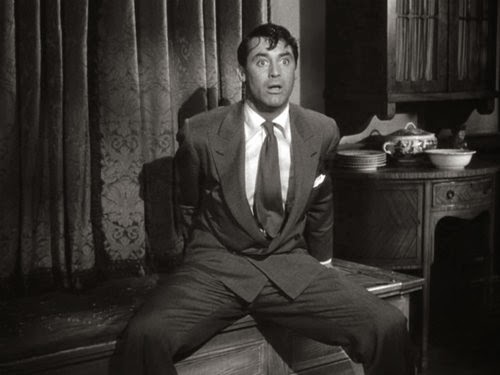
After making the bold statement that this film was the best comedy of all-time, I better give some pretty good examples, and this film is full of it. It is just wonderful to see the transformation of Cary Grant’s character (Mortimer Brewster) throughout the film. In the first scenes, he seems to be a man who is confident and self-assured. He is getting married to his beautiful girlfriend (played cutely by Priscilla Lane). He returns home to his aunts who have helped to raise him to discover that for years the saintly aunts have been murdering people and burying them in their basement. There is no scene in Cary Grant’s career as great as the scene when he first discovers one of the victim’s bodies in living room storage chest.


Raymond Massey (as Grant’s criminally insane brother) and Peter Lorre (as his meek assistant) are supposed to be horrific criminals, but they add a lot of comedy as well. When they discover the aunts are murderers, they give huge astonished looks like Grant did. However, what is even funnier is Massey and Lorre are trying to count the total number of men they murdered, and the aunts have beat them.
John Alexander is another scene stealer as the uncle who thinks he is Teddy Roosevelt. There is some funny historic humor. When the director of  a mental hospital (Edward Everett Horton) comes to evaluate the uncle, Alexander gives him a dirty look. Cary Grant asks his uncle what is wrong and he sticks out his tongue and says “That’s Taft!” (William Taft was a protégé of Roosevelt, who later had a falling out with him). The aunts have used “Teddy” to help bury the bodies by telling him that their murder victims died because of the Yellow Fever in Panama.
I think what makes me laugh at Arsenic And Old Lace so much is that the movie shows us a family that seem normal as the movie opens, but they turn out to be genuinely crazy. Everyone’s family is like that. Everyone has a crazy uncle or a brother who is the black sheep. After Grant discovers his aunts are serial killers, and his brother is completely deranged, Cary does not even want to get married. He’s afraid he will go crazy too, and by the end of the movie it seems like he will go completely nuts. The aunts though have one more secret to tell Cary before they are taken away…literally. Cary Grant was adopted. He is not part of the Brewster family! The movie did not depend on topical humor like the war so the laughs are not dated. Basically, the jokes are about the absolute absurdity of this family. When you think the family is as crazy as it gets, it just gets crazier. I don’t think I would have laughed at the film as much if Cary Grant had not been in it. His slapstick approach to the role, his facial expressions, and his decent into insanity himself is just hilarious. There are a lot of comedies, old and new, that make me laugh, but Arsenic And Old Lace is my favorite of all-time…


Friday, September 12, 2014

PHOTOS OF THE DAY: CANDID CARY GRANT

Readers of my blog know that I am always talking about one of my favorite entertainers Bing Crosby. However, I think one of the greatest actors of all-time was Cary Grant. He is on the top ten list of most classic movie fans. Anyways, I figured it would be fun to take a look at some candid Cary Grant pictures. I tried to find photos that were different...


Friday, December 27, 2013

CARY GRANT ON HIS STYLE

Here is a great article that appeared in GQ magazine back in 1967. In the article, acting icon Cary Grant explained his take on style...

I'm often asked for advice or an opinion about clothes, and I always try to answer the best I can, but I'm not inclined to regard myself as an authority on the subject. Many times during my years in films, some well-meaning group has selected me as best-dressed man of the year, but I've never understood why. The odd distinction surprises me: first, because I don't consider myself especially well dressed, and, secondly, I've never, as far as I can compare the efforts of others with my own, gone to any special trouble to acquire clothes that could be regarded as noticeably fashionable or up-to-date.

Some of my suits are ten to twenty years old, many of them ready-made and reasonably priced. Those that were custom-tailored were made by many different tailors in many different cities: London, Hong Kong, New York and Los Angeles. I believe that American ready-made clothes are the best ready-made clothes in the world: that the well-dressed American man makes a better appearance than the well-dressed man of any other country.

No, it isn't only money that determines how well a man dresses—it's personal taste. Because of the demands of my work, I've purchased dozens of suits over the years and they all have one attribute in common: they are in the middle of fashion. By that I mean they're not self-consciously fashionable or far out, nor are they overly conservative or dated. In other words, the lapels are neither too wide nor too narrow, the trousers neither too tight nor too loose, the coats neither too short nor too long. I've worn clothes of extreme style, but only in order to dress appropriately for the type of character I played in particular films. Otherwise, simplicity, to me, has always been the essence of good taste.


I believe men's clothes—like women's—should attract attention to the best lines of a man's figure and distract from the worst. In all cases, the most reliable style is in the middle of the road—a thoughtful sensible position in any human behavior. Except perhaps on the freeway—but, even then, the middle lane, providing of course, it's on your side of the road, usually gets you where you're going more easily, comfortably, and less disturbingly. And so it should be with clothes. They should be undisturbing, easy and comfortable.

How much on should pay depends on how much one has to spend. I'm reminded of a piece of advice my father gave me regarding shoes: it has stood me in good stead whenever my own finances were low. He said it's better to buy one good pair of shoes than four cheap ones. One pair made of fine leather could outlast four inferior pairs, and, if well cared for, would continue to proclaim your good judgment and taste no matter how old they become. The same applies to suits, so permit me to suggest you buy the best you can afford even though it means buying less. Rather like the stock market: it is usually more sensible to buy just one share of blue chip than 150 shares of a one-dollar stock.

A cardigan coat sweater of lightweight wool and conservative color is a useful investment. It can be worn without a coat on many occasions, and has the advantage of being easily slipped on without those arm-raising contortions and the need to re-comb your hair.

Shoes? I've already mentioned that good shoes look better and last longer. If a man must limit himself to only one pair of shoes for city wear, then they should be black. If two, then a brown pair of darkest chocolate color are useful with almost all suits and, if he has no moccasins, even with grey flannels. The moccasin type of shoe is, to me, almost essential and especially convenient when traveling, since they can be easily slipped off in the airplane or car.


Shirts should usually be white for the evening, but, in the city's grime, it's practical and permissible to wear a light blue or conservatively striped shirt during the day. The type of collar should suit the contours of the neck and face. As a younger man, I tried wearing a flared, too-high collar that, although modish amongst those I regarded as the sophisticates of that day, looked ridiculous on my 17 1/2- inch neck. Luckily, after the embarrassment of viewing myself from almost every angle on screen, that mistake was soon rectified. Button-cuffed shirts are simplest to manage, but if you wear cuff links, as I do, don't, I beg you, wear those huge examples of badly designed, cheap modern jewelry. They, too, are not only ostentatious, but heavy and a menace to the enamel on your car and your girl friend's eye.

Do I have any special do's and don't's about clothes? I can't think of and rules about clothes, since there really aren't any, but I suggest you buy trees to conform to the shape of your shoes, and keep your coats on curved hangers.

Take care of your clothes, keep them clean and in good repair. I suggest you avoid using heavily scented cologne or soaps. When I meet a man I like him to smell like a man, or not to smell at all; certainly he shouldn't smell like a woman. Do see that your socks stay up. Nothing can spoil an otherwise well-groomed effect like sagging socks. Don't stuff your pockets with heavy articles and bulging wallets filled with seldom-used cards. They ruin not only the neatness of your appearance but the actual tailoring of your suit.

Come to think of it, who knows how anything becomes bad or good taste? Who decides a standard of esthetics? If it's the majority, then how is it the minority are the ones considered well dressed? Everything is only exactly what it is. If a man wears the kind of clothes that please him, then, providing they're clean and don't shock society, morals, and little children, what is the difference as long as that man is happy?


SOURCE