Showing posts with label Nat King Cole. Show all posts

Friday, December 12, 2025

STAR FRIENDS: FRANK SINATRA AND NAT KING COLE

Nat King Cole was an enormously popular crooner, earning $4,500 a week in Las Vegas in 1956. He headlined at the whites-only Thunderbird Hotel, where he wasn't allowed to venture beyond the showroom and the cook's resting area behind the kitchen. Cole's road manager was given a room in the hotel because he was white, but the high-paid feature attraction had to find other accommodations. He regularly stayed in a rooming house on the West Side.
 
Frank Sinatra was a great fan of Cole's. While performing at the Sands, Sinatra noticed that Cole almost always ate his dinner alone in his dressing room. Sinatra asked his valet, a black man named George, to find out why. George explained the facts to Frank. "Coloreds aren't allowed in the dining room at the Sands."
 
Sinatra was enraged. He told the maitre d' and the waitresses that if it ever happened again, he'd see that everyone was fired. The next night, Sinatra invited Cole to dinner, making his guest the first black man to sit down and eat in the the Garden Room at the Sands....

Tuesday, March 26, 2024

A DISCOGRAPHY MOMENT: JO STAFFORD - MARCH 26, 1946

Jo Stafford (1917-2008) was one of the greatest female vocalists in all of pop music history/. In the 1940s and 1950s she had a huge musical output. On this studio session she got to record with the great Nat King Cole on piano...


March 28, 1946 (Thursday)

Baby, Won’t You Please Come Home (with Nat King Cole - piano) (Matrix No. 1054) * Recorded for single Capitol 15171
Cindy (with Nat King Cole - piano) (Matrix No. 1055) * Recorded for single Capitol 259
Ridin’ On The Gravy Train (with Nat King Cole - piano) (Matrix No. 1056) * Originally unissued
I’ll Be With You In Apple Blossom Time (with Nat King Cole - piano) (Matrix No. 1057) * Recorded for single Capitol 277

‘Ridin’ On The Gravy Train’ (Matrix No. 1056) was issued in 1991, on the CD ‘Capitol Collectors Series: Jo Stafford’ (Capitol CDP 7 91638 2)


Sunday, January 30, 2022

A DISCOGRAPHY MOMENT: NAT KING COLE - FEBRUARY 6, 1951

Nearly 71 years ago, Nat King Cole was in the Capitol Studios with Nelson Riddle and his Orchestra recording some of these beautiful tunes...


Harry Bluestone, Benny Gill, Seymour Kramer, Dan Lube, William Miller, Misha Russell, Jack Shulman, Robert Sushel, Jerry Vinci, violin; Joe DiFiore, Lou Kievman, viola; Armand Kaproff, Eleanor Slatkin, cello; Kathryn Julye, harp; Buddy Cole, piano; Irving Ashby, guitar; Joe Comfort, Milton Kestenbaum, bass; Lee Young, drums; Nat King Cole, vocals; Les Baxter, conductor; Nelson Riddle, arranger.

Capitol Studios, Los Angeles, CA, February 6, 1951

7107-10Early AmericanCapitol 1565
7108-8Too YoungCapitol 1449, H-357, EAP-2-357, T-357
7109-7Because Of RainCapitol 1501

* Capitol T-357   Nat 'King' Cole - Unforgettable
* Capitol H-357   Nat 'King' Cole - Unforgettable
* Capitol EAP-2-357   Nat 'King' Cole - Unforgettable
* Capitol 1565   Nat King Cole - My Brother / Early American
* Capitol 1449   Nat King Cole - Too Young / That's My Girl
* Capitol 1501   Nat King Cole - Song Of Delilah / Because Of Rain

SOURCE

Saturday, June 12, 2021

NEWSPAPER CLIPPINGS: NAT KING COLE

Here is an interesting article from a New York City magazine article that published on April 11, 1956. The article shows how far we have come on race relations and also how little we have come as well. It is hard to believe that an entertainer such as Nat King Cole would have to deal with something like this...


Friday, April 14, 2017

THE LAST DAYS OF NAT KING COLE

Nat King Cole was and is one of the greatest singers of all-time. He is one of those singers whom I love and have a ton of his recordings, but I don't seem to play too much. After researching and compiling this article, I want to remedy that!

A KOOL menthol cigarette smoker, he would often smoke several cigarettes in a row before recording his songs. He believed they helped keep his deep, crooning voice low. He smoked approximately three packs of cigarettes a day.

In September of 1964, Mr. Cole began experiencing weight loss and severe back pain, harbingers of the lung cancer that had not yet been diagnosed.

Following a performance at the Sands Hotel in Las Vegas, Nevada during this period, he collapsed from pain and had to cut the engagement short. Friends urged him to seek medical help a couple of months later while he was working in San Francisco. He had a chest x-ray done at that time and a cancerous tumor was found on his left lung. Doctors gave him months to live and urged him to stop working. He refused and kept working until he was unable to any longer.


He entered St. John's Hospital in Santa Monica on December 9th and began cobalt (radiation) therapy on the 10th. He then had surgery to remove his left lung on January 25, 1965. Sadly, his father died of heart problems on February 1. Throughout Cole's illness his publicists promoted the idea that he would soon be well and working, despite the private knowledge of his terminal condition. Billboard magazine reported that "Nat King Cole has successfully come through a serious operation and ... the future looks bright for 'the master' to resume his career again." On Valentine's Day Cole and his wife briefly left St. John's to drive by the sea. He died at the hospital early in the morning of February 15 at the age of 45.


Cole's funeral was held on February 18 at St. James Episcopal Church on Wilshire Boulevard in Los Angeles; 400 people were present, and thousands gathered outside the church. Hundreds of members of the public had filed past the coffin the day before. Notable honorary pallbearers included Robert F. Kennedy, Count Basie, Frank Sinatra, Sammy Davis Jr., Johnny Mathis, George Burns, Danny Thomas, Jimmy Durante, Bing Crosby, Alan Livingston, Frankie Laine, Steve Allen, and Pat Brown (the governor of California). The eulogy was delivered by Jack Benny, who said that "Nat Cole was a man who gave so much and still had so much to give. He gave it in song, in friendship to his fellow man, devotion to his family. He was a star, a tremendous success as an entertainer, an institution. But he was an even greater success as a man, as a husband, as a father, as a friend."

According to an article published after his death in the Los Angeles Times, Maria knew for several days that her husband was dying, but kept it a secret from the media so that Nat, who watched a lot of television wouldn't see a bad news report. He did not realize he was dying. Right up until the end, he thought he was recovering...


Friday, January 1, 2016

RIP: NATALIE COLE

Natalie Cole, the American singer who overcame battles with substance abuse and the long shadow of her famous father to earn worldwide success of her own, has died. She was 65.

Cole died Thursday night at Cedar Sinai Hospital in Los Angeles "due to complications from ongoing health issues," according to a statement from her family.

"It is with heavy hearts that we bring to you all the news of our Mother and sister's passing. Natalie fought a fierce, courageous battle, dying how she lived ... with dignity, strength and honor," her sisters, Timolin and Casey Cole, and son, Robert Yancy, said in the statement. "Our beloved Mother and sister will be greatly missed and remain unforgettable in our hearts forever."

The daughter of Nat "King" Cole built a chart-topping career with hits such as "This Will Be," "Inseparable" and "Our Love." She fought health problems for years and received a kidney transplant in 2009 after developing hepatitis, which she blamed on past intravenous drug use.

Cole won nine Grammy Awards, including Album of the Year and Record of the Year in 1992 for "Unforgettable ... With Love," a virtual duet made with the recordings of her late father.

"We've lost a wonderful, highly cherished artist and our heartfelt condolences go out to Natalie's family, friends, her many collaborators, as well as to all who have been entertained by her exceptional talent," said Neil Portnow, President and CEO of The Recording Academy.

Nat "King" Cole died of lung cancer in 1965 at age 45. Natalie was 15 at the time of her father's death. He was already a star in the music industry, and rose to even greater heights in the 1950s and 1960s, when Natalie was born to the R&B legend and Maria Ellington Cole, a onetime vocalist, who died in 2012 at the age of 89.

Inspired by her father's musical gift, Cole began her own career as an R&B singer but later gravitated toward smooth pop and jazz genres.

Her first album, 1975's "Inseparable," won two Grammys — one for best new artist and one for best female R&B vocal performance for the hit "This Will Be (An Everlasting Love)."


Monday, March 17, 2014

BORN ON THIS DAY: NAT KING COLE

One of the greatest singers of our time was Nat King Cole. No matter what genre of music you like, he had a voice that transcended the decades. On this day March 17th, he was born in 1919. Coles had three brothers: Eddie, Ike, and Freddy, and a half-sister, Joyce Coles. Ike and Freddy would later pursue careers in music as well. When Cole was four years old, he and his family moved to Chicago, Illinois, where his father, Edward Coles, became a Baptist minister. Cole learned to play the organ from his mother, Perlina Coles, the church organist. His first performance was of "Yes! We Have No Bananas" at age four. He began formal lessons at 12, eventually learning not only jazz and gospel music, but also Western classical music, performing, as he said, "from Johann Sebastian Bach to Sergei Rachmaninoff".

The family lived in the Bronzeville neighborhood of Chicago. Cole would sneak out of the house and hang around outside the clubs, listening to artists such as Louis Armstrong, Earl Hines, and Jimmie Noone. He participated in Walter Dyett's renowned music program at DuSable High School.

Inspired by the performances of Earl Hines, Cole began his performing career in the mid-1930s while still a teenager, adopting the name "Nat Cole". His older brother, Eddie, a bass player, soon joined Cole's band, and they made their first recording in 1936 under Eddie's name. They also were regular performers at clubs. Cole, in fact, acquired his nickname, "King", performing at one jazz club, a nickname presumably reinforced by the otherwise unrelated nursery rhyme about Old King Cole. He also was a pianist in a national tour of Broadway theatre legend Eubie Blake's revue, "Shuffle Along". When it suddenly failed in Long Beach, California, Cole decided to remain there. He would later return to Chicago in triumph to play such venues as the famed Edgewater Beach Hotel.

Cole's first mainstream vocal hit was his 1943 recording of one of his compositions, "Straighten Up and Fly Right", based on a black folk tale that his father had used as a theme for a sermon. Johnny Mercer invited him to record it for his fledgling Capitol Records label. It sold over 500,000 copies, proving that folk-based material could appeal to a wide audience. Although Cole would never be considered a rocker, the song can be seen as anticipating the first rock and roll records. Indeed, Bo Diddley, who performed similar transformations of folk material, counted Cole as an influence.

Beginning in the late 1940s, Cole began recording and performing pop-oriented material for mainstream audiences, in which he was often accompanied by a string orchestra. His stature as a popular icon was cemented during this period by hits such as "The Christmas Song" (Cole recorded that tune four times: on June 14, 1946, as a pure Trio recording, on August 19, 1946, with an added string section, on August 24, 1953, and in 1961 for the double album The Nat King Cole Story; this final version, recorded in stereo, is the one most often heard today), "Nature Boy" (1948), "Mona Lisa" (1950), "Too Young" (the #1 song in 1951),[7] and his signature tune "Unforgettable" (1951) (Gainer 1). While this shift to pop music led some jazz critics and fans to accuse Cole of selling out, he never totally abandoned his jazz roots; as late as 1956, for instance, he recorded an all-jazz album After Midnight. Cole had one of his last big hits in 1963, two years before his death, with the classic "Those Lazy-Hazy-Crazy Days of Summer", which reached #6 on the Pop chart. Nat died way too young, but he left behind a ton of vocal treasures...

Friday, March 29, 2013

EDEN AHBEZ: SONGWRITER AND NATURE BOY


There was a boy - a very strange enchanted boy...anyone who is a fan of classic popular music is probably familiar with those lyrics from the song "Nature Boy". The song, written in 1948, was very different compared to the other music being put out of the day. However, what is even more unusual than the song is the mysterious songwriter. Eden Ahbez was born George Alexander Aberle on April 15, 1908. He is often considered the first American hippie, whose lifestyle in California was very influential on the hippie movement. He was known to friends simply as Ahbe.

Living a bucolic life from at least the 1940s, he traveled in sandals and wore shoulder-length hair and beard, and white robes. He camped out below the first L in the Hollywood Sign above Los Angeles and studied Oriental mysticism. He slept outdoors with his family and ate vegetables, fruits, and nuts. He claimed to live on three dollars per week.

Though born in Brooklyn, New York to a Jewish father and a Scottish-English mother, he was adopted in 1917 by a family in Chanute, Kansas and raised under the name George McGrew. During the 1930s, McGrew lived in Kansas City, where he performed as a pianist and dance band leader. He probably also lived in New York City for some time, although little is known of that period of his life.

In 1941, he arrived in Los Angeles and began playing piano in the Eutropheon, a small health food store and raw food restaurant on Laurel Canyon Boulevard. During this period, he adopted the name "eden ahbez," choosing to spell his name with lower-case letters, claiming that only the words God and Infinity were worthy of capitalization. He is also said to have desired the A and Z (alpha and omega), the beginning and the end, in his surname. During this period, he married Anna Jacobsen and had a son. Sadly Anna died of leukemia in 1963, and his son drowned mysteriously at the age of 22 in 1971.

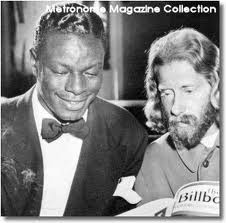
In 1947, at the prompting of Johnny Mercer, Ahbez approached Nat "King" Cole's manager backstage at the Lincoln Theatre in Los Angeles and handed him the music for his song, "Nature Boy." Cole began playing the song for live audiences to much acclaim, but needed to track down its author before releasing his recording of it. Ahbez was discovered living under the Hollywood Sign and became the focus of a media frenzy when Cole's version of "Nature Boy" shot to #1 on the Billboard charts and remained there for eight consecutive weeks during the summer of 1948. Ahbez was covered simultaneously in Life, Time, and Newsweek magazines. Frank Sinatra and Sarah Vaughan later released versions of the song. The melody was also featured in the background of the film The Boy With The Green Hair (1949) which starred Pat O' Brien and Dean Stockwell.


Ahbez continued to supply Cole with songs, including "Land of Love (Come My Love and Live with Me)", which was also covered by Doris Day and The Ink Spots. He also worked closely with jazz musician Herb Jeffries, and, in 1954, the pair collaborated on an album, The Singing Prophet, which included the only recording of Ahbez's four-part "Nature Boy Suite." The album was later reissued as Echoes of Eternity on Jeffries' United National label. In the mid 1950s, he wrote songs for Eartha Kitt, Frankie Laine, and others, as well as writing some rock-and-roll novelty songs. In 1957, his song "Lonely Island" was recorded by Sam Cooke, becoming the second and final ahbez composition to hit the Top 40.

After his only solo record was released in 1960, he began to fade away from the music scene. After the death of his wife and son, Ahbez completely wtihdrew from the public. He hung out in the California desert near Indio and would wander into town for supplies and company, sharing his poems and philosophy. Ahbez kept writing new music and even kept a piano at a local music studio. From the late 1980s until his death, he worked closely with Joe Romersa, an engineer/drummer in Los Angeles. The master tapes, photos, and final works of eden ahbez are in Romersa's possession.

Sadly he died on March 4, 1995, of injuries sustained in a car accident, at the age of 86. Another album, Echoes from Nature Boy, was released posthumously. The music industry in the 1940s and 1950s did not know what to do with Eden Ahbez, but his song "Nature Boy" is as haunting and mysterious in 2012 as it was when it became a surprise hit in 1948. Sometimes the most beautiful music comes out of the strangest places...


Thursday, July 12, 2012

RIP: MARIA HAWKINS COLE


Nat King Cole's widow, Maria Hawkins Cole, dies of cancer, aged 89
BY THE ASSOCIATED PRESS

Nat King Cole's widow, Maria Hawkins Cole, has died in South Florida after a short battle with cancer, aged 89.

The Associated Press cited a family representative as confirming that Maria Cole died Tuesday at a Boca Raton nursing home.

Her daughter, nine-time Grammy Award-winning singer and songwriter Natalie Cole, tweeted:

"I just want to thank everyone for their prayers & loving support. Mom has passed, gone to glory, July 10th 2012. She will be next to Dad at Forest Lawn. — Natalie Cole (@NatMCole) July 12, 2012"

Nat King Cole, who died in 1965 — also of cancer — at the age of 45, was buried at the Glendale, California cemetery along with such "Golden Age" Hollywood stars as Clark Gable, Jimmy Stewart, Jean Harlow, Humphrey Bogart, Errol Flynn and Spencer Tracy.

Maria Cole, born in Boston in 1922, moved to North Carolina to stay with an aunt after her mother died, but later moved to New York to pursue a musical career.

She married a Tuskegee Airmen flyer, Spurgeon Ellington, in 1947, who was killed in Georgia two years later during a routine postwar training flight, according to the Hollywood Reporter.

After performing briefly with Count Basie and swing innovator Fletcher Henderson, Maria Cole was hired by Ellington as a vocalist with his orchestra. She worked for him until 1946, when she embarked on a solo career and was performing at Club Zanzibar when she met Nat King Cole. She married him on Easter Sunday in 1948 at Harlem’s Abyssinian Baptist Church.

The ceremony, just six days after Nat's divorce from his first wife became final, was administered by then-U.S. Rep. Adam Clayton Powell Jr.

Maria Cole traveled and performed with Nat King Cole throughout the '50s. After he died, she established the Cole Cancer Foundation.

A statement by Natalie Cole with her twin sisters Timolin and Casey Cole, cited by the AP, read: "Our mom was in a class all by herself. She epitomized, class, elegance, and truly defined what it is to be a real lady. ... She died how she lived — with great strength, courage and dignity, surrounded by her loving family."


SOURCE

Monday, December 12, 2011

PHOTOS OF THE DAY: CHRISTMAS WITH OLD HOLLYWOOD

It is hard to believe that it is the Christmas season once again. There is nothing better to do at this season than to snuggle in with a good classic movie. Here are some unusual and different pictures of your favorite classic stars during the holidays...


DANNY KAYE AND NAT KING COLE


BUSTER KEATON


JOE E. BROWN


HUMPHREY BOGART AND LAUREN BACALL


GRACIE ALLEN


ESTHER WILLIAMS

Monday, October 11, 2010

FORGOTTEN ONES: BETTY HUTTON


Now I profiled Betty Hutton before on this blog, but when she passed away in 2007 she was and is largely forgotten. Hutton made 19 films from 1942 to 1952 including a hugely popular The Perils of Pauline in 1947. She was billed over Fred Astaire in the 1950 musical Let's Dance. Hutton's greatest screen triumph came in Annie Get Your Gun (1950) for MGM, which hired her to replace an exhausted Judy Garland in the role of Annie Oakley. The film and the leading role, retooled for Hutton, was a smash hit, with the biggest critical praise going to Hutton. (Her obituary in The New York Times described her as "a brassy, energetic performer with a voice that could sound like a fire alarm.")Hutton, however, like Garland, was earning a reputation for being extremely difficult.

In 1944, she signed with Capitol Records, one of the earliest artists to do so, but became unhappy with its management and later signed with RCA Victor. Among her many films was an unbilled cameo in Sailor Beware (1952) with Dean Martin and Jerry Lewis, in which she portrayed Dean's girlfriend, Hetty Button.

Her time as a Hollywood star came to an end due to contract disagreements with Paramount following the Oscar-winning The Greatest Show on Earth (1952) and Somebody Loves Me (1952), a biopic of singer Blossom Seeley. The New York Times indicated that her film career ended because of her insistence that her husband at the time, Charles O'Curran, direct her next film; when the studio declined, Hutton broke her contract. Hutton's last completed film was a small one, 1957's Spring Reunion. She gave an understated, sensitive performance in the drama, but box office receipts seemed to show that the public didn't accept a subdued Hutton...