On this date in 1977, "High Anxiety" was released. It is really an underrated Mel Brooks film!
Wednesday, September 9, 2026
MEL BROOKS AND HIS HIGH ANXIETY
Saturday, April 19, 2025
MEL BROOKS MEETS CARY GRANT
Not everyone in Hollywood was susceptible to his charm, though. Sometime around the late 1950s or early ‘60s, after he’d left the Sid Caesar Show, Mel Brooks was in Hollywood writing a movie. The building he was working in happened to be across the street from Grant’s production company, Granart. He couldn’t believe his luck. The Cary Grant was right next door, and he might even get a chance to see him in person.
He remembered thinking it was odd that the actor only ate a hardboiled egg for lunch. They chatted, but the conversation was relegated to the type of small talk that most people – even extroverts – absolutely shudder just thinking about. They discussed their favourite colours (at least in Brooks’s memory). They discussed their favourite cars. For the record, Grant said Rolls Royce, which, if you think about it, was really never a question. They parted ways at their respective buildings, and Brooks assumed that was the end of it.
The next day, Grant called his office and invited him out for lunch again. The process repeated, right down to that single hardboiled egg. The same thing happened the next day. Finally, after a few days of these lunches, Brooks had had enough. The phone rang, and he told his secretary to tell the silver screen legend that he wasn’t there. “I had nothing more to say to him,” he said. “I said my favourite colour. I said my favourite car. There was nothing more to talk about.”
It would have been interesting to have heard Grant’s side of the story. Presumably, he would have had a different perspective on how that friendship blossomed and withered, and he might even have taken issue with the colour Brooks identified as his favourite (yellow). The comedian has told the story many times over the years, including several times on The Johnny Carson Show, but it’s much harder to find instances in which Grant talks about Brooks, positively or otherwise.
He was, it should be noted, not a complete dullard by most accounts. Anyone who has seen any of his movies will notice that he made romantic comedies look easy. He had perfect comic timing and never overplayed his hand as an actor. Even Clint Eastwood was a fan of his work. Sadly, however, it seems that his love for Brooks was unrequited...
Saturday, March 29, 2025
THE HUMOR OF YOUNG FRANKENSTEIN
Mel Brook's humor has always stood out for its ability to engage with the world by revealing its ugly side. His jokes have famously turned the negative aspects of society upside down to satirically disarm them by exposing their faults and hypocrisy. Films like The Producers and Blazing Saddles are prime examples since they cover sensitive topics like prejudice and racism in a well-received way. Aside from this, however, Brook's comedy also has a penchant for the crass and risqué, which is common among some directors, and Young Frankenstein is no different. The film transforms slapstick antics like kneeing someone in the genitals into an intellectual exercise on the inner workings of the human brain while also using sexual innuendos and wordplay to explore a discourse focused on the nuances of relationships between men and women, regardless of whether they're organic or manufactured beings. As a result, bits like "Rolling Around in the Hay" and "The Mysteries of Life" are memorable and remain relevant today. However, the "Frau Blücher" bit has never been given the same regard.
In many ways, the funny exchanges between Dr. Frederick Frankenstein (Gene Wilder) and Frau Blücher (Cloris Leachman), while comical and unforgettable in their own right, can be viewed as a throwaway bit compared to the others. This is because it doesn't stand out as much among all the other hilarious scenes within the film. After all, juxtaposed against the "Sedagive" routine, Wilder's shrieking "Quiet Dignity" or the "Abby Normal" scene, a little bit of thunder and a horse neighing after hearing the housekeeper's name doesn't have the same comedic impact. However, considering who Frau Blücher is concerning the family, the character's famous scene, including her offering the good doctor a refreshment before bed, might be Young Frankenstein's most underrated and subtlest joke. One that contains a bit of unnoticed raunchiness that highlights Mel Brook's timeless comedic genius -- even almost 50 years later.
Friday, October 25, 2024
RECENTLY VIEWED: REMEMBERING GENE WILDER
With rare home videos and scenes from Wilder's films, the documentary looks at the life and career of actor, writer, and director, Gene Wilder. It includes interviews with former cast and crew members as well as personal memories from family and friends, who share their love for his comedic genius. Among them are Mel Brooks, Wilder's wife, Karen Wilder, Alan Alda, Carol Kane, Harry Connick Jr., Mike Medavoy, Rain Pryor, Dick Cavett, Eric McCormack, Ben Mankiewicz, and Peter Ostrum.
The idea for the film stemmed from Wilder's friendship with Leonard Nimoy, which began when Nimoy directed Wilder in Funny About Love, in 1990.
Producers Julie Nimoy and David Knight saw a press release announcing that Karen Wilder was partnering with the Alzheimer's Association to raise awareness about the disease that ended her husband's life. Nimoy and Knight had produced the 2017 documentary, Remembering Leonard Nimoy, and suggested the idea of a similar film to honor Wilder. Karen Wilder supported the project and granted the filmmakers access to personal photos and home movies from the estate incorporate into the film.
Wilder's narration, also part of the film, is taken from the audiobook version of his 2005 memoir, Kiss Me Like a Stranger: My Search for Love and Art. Production was delayed due to the COVID-19 pandemic, but the filmmakers were finally able to interview Mel Brooks, whose participation Knight said "made the difference" in the final film.
The film made its world premiere at the Los Angeles Jewish Film Festival in May 2023 and won the Audience Favorite and Best Film Awards. In January 2024, Kino Lorber acquired all rights worldwide to the film and planned a theatrical release in March 2024, followed by home video, non-theatrical, and digital releases. The documentary made its streaming debut on Netflix in June 2024.
The producers acknowledge their mutual support with the Alzheimer's Association and the BrightFocus Foundation.It was a wonderful look at a wonderful man. It is as simple as that...
MY RATING: 10 of 10
Tuesday, June 11, 2024
ANOTHER AWARD FOR MEL BROOKS
Brooks became only the fourth person to win a Peabody, Emmy, Grammy, Oscar and Tony, behind Barbra Streisand, Rita Moreno and Mike Nichols. Billy Crystal presented the comedy icon with the honor at the organization’s Los Angeles ceremony. (A PEGOT can also refer to a Pulitzer instead of a Peabody, which just Richard Rodgers and Marvin Hamlisch have achieved.)
“Mel is a genius who believes that comedy should push boundaries, challenge societal taboos and yes, be a little vulgar when the mood calls for it — and with Mel, the mood often calls for it,” Crystal told the crowd at the Beverly Wilshire hotel. “Mel is one of the big reasons that I have a life in comedy. His fearless genius and boundary-pushing humor have been my guiding light since day one,” adding that Brooks has steered him through some of the most pivotal moments of his career.
“For over 70 years, Mel has entertained us. I just want to ask you folks, where would we be without him?” Crystal mused, become noting that Brooks had become “only the fourth PEGOT winner in the process — it’s a big deal, I’m just an ET.”
In his speech, Brooks admitted he wasn’t entirely sure what a Peabody was for, teasing, “When they said, ‘You’ve won a Peabody Award,’ I said, ‘Oh, no shit.’ I thought maybe it was for being the best-looking guy in show business. I had no idea what this award — it’s mostly for electronics. If you’re good at electronics, you can win one of these.”
He joked that he’d like to say he humbly accepted the award “but I’m not humble… Humility is not a part of my vocabulary.” And noting the A-listers who have received the Career Achievement Award in the past, Brooks added, “It’s been won by a distinguished group of esteemed, well-worth [people] winning this award and I feel a little — you really want me to be part of this? These are people that go to good restaurants,” to big laughter from the crowd. In closing, the star declared, “I promised the George Foster Peabody people I will not sell this one.”
Sunday night’s Peabody Awards marked the first time the ceremony has ever been held in Los Angeles, versus its normal home in New York City; the move was initially planned for 2020, but the in-person show has been consistently derailed for the past few years by the pandemic and then by last year’s writers strike...
Thursday, April 25, 2024
MEL BROOKS AT 97
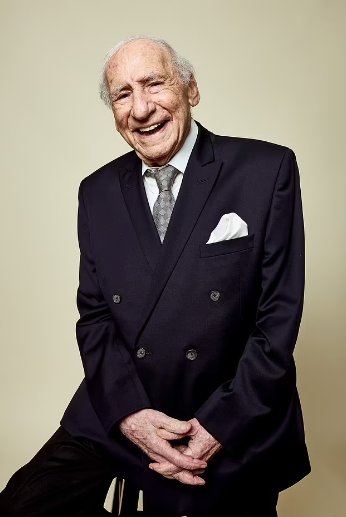
Mel Brooks may be 97 years old but he still knows how to make people laugh. He made a rare appearance at the 15th annual TCM Classic Film Festival in Hollywood at the TCL Chinese Theatre this past weekend. Brooks appeared at the closing night screening of Spaceballs.Brooks co-wrote, produced and directed the 1987 comedy starring Rick Moranis, Daphne Zuniga, Bill Pullman, John Candy, Michael Winslow and more. Brooks also made a cameo in the movie as the characters Yogurt and President Skroob.
While engaging in the panel at the TCM Classic Film Festival, TCM host Ben Mankiewicz asked him if he liked Star Wars. Spaceballs makes a lot of references to Star Wars, poking fun at the characters and concept.
Brooks responded that he thought it was unusual and incredibly original and a combination of things he loved like Robin Hood. He said that it was kind of like a fairytale but with a lot of zaps. No arrows, just zaps, he joked, which garnered some laughs from the audience. It is worth noting that Brooks must have loved Robin Hood as he also poked fun at the story in his 1993 spoof film Robin Hood: Men in Tights.
Wednesday, March 8, 2023
RECENTLY VIEWED: HISTORY OF THE WORLD - PART 2
- Wanda Sykes as various characters
- Nick Kroll as various characters
- Ike Barinholtz as various characters
Sunday, March 20, 2022
ON THE SET OF YOUNG FRANKENSTEIN
Writer Wayne Warga reported in the April 14, 1974, Los Angeles Times:
The castle looms dark and foreboding, a dead tree in a courtyard leading to outside doors with huge knockers. The kind of place where people must come to die. Frankenstein's place. And this time the devout wish is that we'll all die laughing. It's Mel Brooks' version of Frankenstein's place.
It's impossible to tell how many versions of this classic tale have been made around the world, but certainly this must be the first one in which the monster has a zipper in his neck.
The $350,000 castle, on Stage 4 at 20th Century-Fox, is an inspiration of the macabre, while the goings-on of its inhabitants are inspiringly silly.
Brooks is shooting the film in black and white and is using cinematic techniques prominent in the late 1920s and the early 1930s. "It's not satire, it's a salute," he says. "It says, 'Mel Brooks Presents Young Frankenstein' so the audience will, of course, know the comedy will go an inch or two further than one usually expects. But you can't keep winking because it diminishes the melodrama. The melodrama has to be there."
Brooks at work is intense, serious and determined — in startling contrast to the inspired silliness of his films. Gene Wilder plays Frankenstein and, along with Brooks, is the co-author of the screenplay.
"Gene walked in one day and said he wanted to do a picture called 'Young Frankenstein,' Brooks recalls. "I told him he was crazy. A week later we were writing it." …
"Young Frankenstein" became a smash hit. It’s now highly ranked on many best comedy film lists.
SOURCE
Tuesday, October 19, 2021
MEL BROOKS AND HISTORY OF THE WORLD PART 2
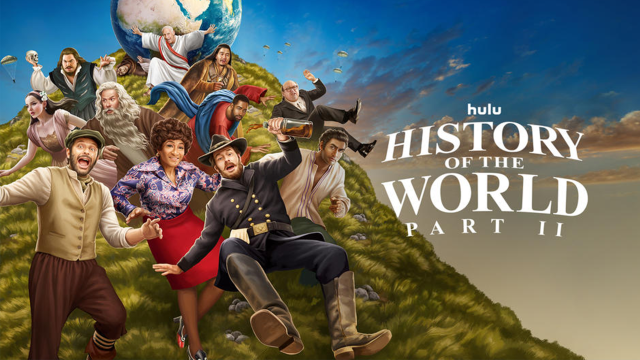
“History of the World, Part II” is described as a sequel to the 1981 film. The film was made up of segments set during different periods of world history. Among those was the Stone Age, Ancient Rome, and the French Revolution. Like most of Brooks’ work, it also featured musical numbers, including one about the Spanish Inquisition and, of course, “Jews in Space.”
Brooks is a writer and executive producer on the series along with Nick Kroll, Wanda Sykes, Ike Barinholtz, David Stassen and Kevin Salter. There is no word yet on which world events the series will cover. Hulu has ordered eight episodes of the show. The writers room is beginning in October with production slated to begin in Spring 2022. Searchlight Television and 20th Television will produce.
“I can’t wait to once more tell the real truth about all the phony baloney stories the world has been conned into believing are History!” Brooks said.
Brooks, a comedy legend and EGOT winner, wrote and directed “History of the World, Part I” in addition to appearing onscreen in five different roles. Those included King Louis XVI and his piss boy doppleganger as well as the stand up philosopher Comicus. The film also featured stars like Gregory Hines, Dom De Luise, Madeline Kahn, Harvey Korman, Cloris Leachman, and many more.
Brooks’ comedy films are consistently ranked among the best of all time, such as “Blazing Saddles,” “Young Frankenstein,” “The Producers,” and “Spaceballs.” He later adapted both “The Producers” and “Young Frankenstein” as critically-acclaimed stage musicals. He has also produced several hit films, most notably David Lynch’s “The Elephant Man.”
Tuesday, June 30, 2020
RIP: CARL REINER
He died of natural causes on Monday night at his home in Beverly Hills, his assistant Judy Nagy confirmed to Variety.
Reiner, the father of filmmaker and activist Rob Reiner, was the winner of nine Emmy awards, including five for “The Dick Van Dyke Show.” His most popular films as a director included “Oh God,” starring George Burns, in 1977; “The Jerk,” with Steve Martin, in 1979; and “All of Me,” with Martin and Lily Tomlin, in 1984.
In his later years, Reiner was an elder statesman of comedy, revered and respected for his versatility as a performer and multi-hyphenate. He was also adept at social media. He maintained a lively presence on Twitter up until the last day of his life.
Reiner remained in the public eye well into his 80s and 90s with roles in the popular “Ocean’s Eleven” trio of films and on TV with recurring roles on sitcoms “Two and a Half Men” and “Hot in Cleveland.” He also did voice work for shows including “Family Guy,” “American Dad,” “King of the Hill,” and “Bob’s Burgers.”
In 2017, Carl Reiner, his longtime friend and frequent comedy partner Mel Brooks, Norman Lear, Kirk Douglas and other nonagenarian Hollywood legends were featured in the HBO documentary “If You’re Not in the Obit, Eat Breakfast,” examining the secrets to longevity in a fickle industry.
Reiner first came to prominence as a regular cast member of Sid Caesar’s “Your Show of Shows,” for which he won two Emmys in 1956 and 1957 in the supporting category. He met Brooks during his time with Caesar. The two went on to have a long-running friendship and comedy partnership through the recurring “2000 Year Old Man” sketches.
Before creating CBS hit “The Dick Van Dyke Show,” on which he sometimes appeared, Reiner and “Show of Shows” writer Mel Brooks worked up an elongated skit in which Reiner played straight man-interviewer to Brooks’ “2000 Year Old Man”; a 1961 recording of the skit was an immediate hit and spawned several sequels, the last of which, 1998’s “The 2000 Year Old Man in the Year 2000,” won the pair a Grammy.
In 1961 Reiner drew on his experiences with Caesar to create and produced “The Dick Van Dyke Show,” a ratings cornerstone for CBS for the next five years. Reiner made guest appearances as the irascible variety show host Alan Brady. The show won Emmys for writing its first three years and for producing its last two. In 1967, Reiner picked up another Emmy for his writing in a reunion variety show with Caesar, Coca and Morris.
Though the “Enter Laughing” movie was modestly received, Reiner continued to direct steadily over the next few decades. “Where’s Poppa?,” an offbeat comedy he directed in 1970, became a cult favorite. Similarly, two other Martin vehicles, the gumshoe spoof “Dead Men Don’t Wear Plaid” and “The Man With Two Brains,” found bigger audiences after their release in theaters.
While the last film he directed was the 1997 romantic comedy “That Old Feeling,” starring Bette Midler and Dennis Farina, Reiner was an active presence in guest roles on television and in supporting roles in films during the 1990s and 2000s, even as he neared and then surpassed his 90th birthday.
He guested on “Frasier” in 1993; reprised the role of Alan Brady on an episode of “Mad About You” in 1995 and won an Emmy for it; and guested on “Ally McBeal,” “Boston Legal” and “House.”
Big screen appearances included 1990’s “The Spirit of ’76,” directed by his son Lucas; “Slums of Beverly Hills” (1998); and all three films in the “Ocean’s Eleven” series...
Monday, July 16, 2018
RECENTLY VIEWED: HOTEL TRANSYLVANIA 3 - SUMMER VACATION
Hotel Transylvania 3: Summer Vacation (known internationally as Hotel Transylvania 3: A Monster Vacation) is a 2018 American 3D computer-animated comedy film produced by Sony Pictures Animation and distributed by Sony Pictures Releasing. The third installment in the Hotel Transylvania franchise, it is directed by Genndy Tartakovsky and written by Tartakovsky and Michael McCullers, and features Adam Sandler, Andy Samberg, Selena Gomez, Kevin James, David Spade, Steve Buscemi, Keegan-Michael Key, Molly Shannon, Fran Drescher, and Mel Brooks reprising their roles as well as new additions to the cast like Kathryn Hahn and Jim Gaffigan.
Taking place a few months after the events of the previous film, the story centers on Dracula, Mavis, Johnny, and the rest of their family, both human and monster, and friends as they take a vacation on a luxury Monster Cruise Ship. Dracula becomes attracted to the ship's mysterious captain Ericka, the great-granddaughter of Abraham Van Helsing, the notorious monster slayer and Dracula's ancient archenemy.
The night before I went to see this movie with my daughter, I watched 2017's IT on HBO, so I think I was in the mood for a mindless and innocent film. The movie is very family friendly, and it was released on Friday July 13th to an audience that obviously wants to see more from this franchise since the movie had the second biggest opening of the three films.
Monday, May 25, 2015
MEL BROOKS, THE NAZIS, AND WORLD WAR II
Mel Brooks is best known for his award-winning comedy films such as Young Frankenstein and Blazing Saddles. But Brooks was also a combat veteran of World War II who fought under General Patton in the Battle of the Bulge: a four-week-long battle that resulted in the death of over 60,000 Allied troops.
Brooks, who was studying psychology at Brooklyn College at the time, was drafted into the Army and sent to war as a combat engineer in the 1104 Combat Engineer Battalion, 78th Infantry Division. During his time in the Army, Brooks was primarily responsible for disarming land mines.
While fighting in Germany, Brooks often heard Nazi propaganda being played from loudspeakers, which must have really got on his nerves because he went about creating his own speaker system to play Al Jolson, a Jewish singer, back at the Nazis, according to Military.
Brooks, when asked about his time at war, said, “War isn’t hell . . . War is loud. Much too noisy. All those shells and bombs going off around you. Never mind death. A man could lose his hearing.”
So the next time you watch Spaceballs, remember that Mel Brooks once fought Nazis with music because apparently he really hated how loud warfare was...
SOURCE
Tuesday, January 6, 2015
HISTORY OF A SONG: SPRINGTIME FOR HITLER
Springtime For Hitler" is the title song of a play subtitled A Gay Romp With Eva And Adolf At Berchtesgaden. The play itself does not actually exist but appears in the 1968 comedy The Producers which was written and directed by Mel Brooks, who is by his own admission a great fan of bad taste.The leading characters of The Producers are accountant Leo Bloom who is played by Gene Wilder, and Max Bialystock who is played by Zero Mostel. The two decide to raise money for and put on a musical which will flop badly, as a tax dodge. To this extent they seek out the worst play ever written, hire the worst director, the worst actors in New York and open on Broadway. They raise two million dollars for the play, which costs a mere hundred thousand, and when it sinks they disappear to South America with the balance. At least that is the plan, but just as satire sometimes misses the mark, so do people read things into plays, songs, etc that isn't really there.
The musical is interpreted by the public as a broadside at the Third Reich, and is a massive success, leaving them with the problem of paying dividends to their expectant investors. Brooks turned the film into a smash Broadway hit, and it was remade on film in 2005. The talented Gary Beach played Hitler and got to sing "Springtime For Hitler" on Broadway and in the 2005 film remake...
Monday, January 20, 2014
FUN FACTS ABOUT BLAZING SADDLES
1. Blazing Saddles, originally titled Tex X, began as a story outline written by Andrew Bergman (Honeymoon in Vegas, The Freshman, Soapdish). After Mel Brooks (Robin Hood: Men in Tights, Spaceballs, High Anxiety) became involved, the film script was written by Bergman, Brooks, Norman Steinberg (Johnny Dangerously, My Favorite Year), Alan Uger (“Family Ties, Champs”) and Richard Pryor (Bustin’ Loose, Jo Jo Dancer, Your Life Is Calling).
2. “The whole movie cost about $2.6 million—nobody got anything.” Brooks said he hardly made much himself, around $50k to write, direct, for everything. The remaining writers (after those that left for financial reasons) held in there and finished writing. They’d write every day until around midnight, then walk to Chinatown where there was a restaurant they liked—they’d have beef and broccoli and a Pepsi, then walk back. Brooks spoke of working hard to get the script done, it had to be completed by July.
3. Liam Dunn (Young Frankenstein, Silent Movie), who played Reverend Johnson, was described by Brooks as “very weird.” The actor had emphysema and when he would finish a scene, they’d ask him “Do you want water? Do you want orange juice? Do you want a cigarette?” Dunn would always choose the cigarette; he’d take a few puffs of smoke, then a few puffs of oxygen.
4. Brooks wanted actor Dan Dailey (It’s Always Fair Weather, The Getaway, My Blue Heaven [1950]) for The Waco Kid, calling him the best civilian horse rider around, but Dailey said he couldn’t do it, he was blind (wore “Coke bottle glasses”). Brooks later ran into John Wayne in the commissary and asked him to read the script. Wayne told Brooks he would read it that night and that Mel should meet him back at the commissary at noon the next day. When they met again, the actor said it was too dirty; “I can’t do it, I’m John Wayne.” Wayne did love the script and told Brooks he was up all night screaming, he loved it and would be first in line to see it.
5. Instead of background music, Brooks wanted foreground music—it had never been done. He brought in Count Basie (“the sweetest guy”) and his band to play April in Paris out in the desert. A composer himself, Brooks wrote I’m Tired and The French Mistake. Composer John Morris and Mel Brooks were both nominated for the title song which was performed by Singer/Songwriter/Actor Frankie Laine. (They lost to The Towering Inferno’s We May Never Love Like This Again.) Brooks said Laine sang with all his heart and tears in his eyes—they didn’t tell him the film was a comedy—Mel thought it worked beautifully.
6. Actress Hedy Lamar (Samson and Delilah, The Strange Woman sued the production for unauthorized use of her name; the case was settled out of court for “not a lot of money, a few thousand dollars. Brooks apologized for “almost using her name.”
Wednesday, November 13, 2013
MOVIE REVIEW: THE PRODUCERS
This film is an adaptation of the 2001 Broadway musical, which in turn was based on the 1968 film of the same name starring Zero Mostel, Gene Wilder, and Andreas Voutsinas. It was produced and distributed domestically by Universal Pictures and distributed overseas by Columbia Pictures.
The flop musical "Funny Boy" (based on William Shakespeare's Hamlet) opens – and closes ("Opening Night"). Afterward, Leo Bloom (Matthew Broderick) arrives at the office of the show's washed up producer, Max Bialystock (Nathan Lane). Max has hired Leo Bloom as his accountant. While studying Max's books, Leo inadvertently inspires Max to gain more money with a flop than a hit by putting on a show that is certain to fail at the box office after collecting an excessive amount of money from their backers and cleverly changing their accounts, leaving them with $2,000,000 to spend. At first, Leo refuses to participate. Max, who cannot change the books himself, attempts to coax Leo into the scheme ("We Can Do It"), but Leo still refuses and returns to his old accounting firm, Whitehall & Marks.
After being chastised by Mr. Marks (Jon Lovitz), Leo fantasizes about being a Broadway producer ("I Wanna Be a Producer"). Realizing that he wants to get into the world and take this risk, Leo quits his job and, with Max, forms Bialystock & Bloom. Max and Leo search for "the worst play ever written" and discover Springtime for Hitler, written by an ex-Nazi named Franz Liebkind (Will Ferrell). They are coerced into performing Adolf Hitler's favorite tune and swearing the sacred "Siegfried Oath" in order to gain Liebkind's signature for Broadway rights to the musical ("Der Guten Tag Hop-Clop"). They solicit a flamboyant gay director, Roger De Bris (Gary Beach) ("the worst director in the world") and his faithful theatrical companion, Carmen Ghia (Roger Bart), to direct and choreograph the play. Roger initially refuses saying that the musical is far too dark and gritty and that Broadway needs to be more "gay" ("Keep It Gay"). He is talked into it, however, after being enticed by Max and Leo, who tell him that if he directs the play, he is certain to win a Tony. Then, Ulla (Uma Thurman), a beautiful Swedish woman, appears at their office for casting despite there being no auditions. Max insists on hiring her as their secretary and auditioning her ("When You've Got It, Flaunt It").
To gain the finances for the musical Max has dalliances with every old lady across town ("Along Came Bialy"). Max and Leo return to the office to discover that Ulla has redecorated it to be entirely white. After Max leaves, Leo laments about Ulla and the dangers of sex straying him from his work, but the attraction between them nevertheless culminates in a kiss between Leo and Ulla ("That Face"). Later, at the auditions for the role of Hitler, Franz becomes angered at a performer's rendition of Hitler's favorite German song. Franz storms the stage and sings the song the correct way ("Haben Sie gehört das Deutsche Band"). Max hires Franz to play Hitler.
On opening night, as the cast and crew prepare to go on stage, Leo wishes everyone "good luck", to which the players are horrified. They explain to Leo that it is in fact "bad luck" to say "good luck" on opening night and that the correct phrase is to say "break a leg" ("You Never Say Good Luck on Opening Night"). Franz leaves to prepare and, in his rush, literally breaks his leg. Max enlists Roger to perform the role in his place, and Roger accepts.
As the show opens, the audience is horrified and begins to walk out until Roger steps on stage as Hitler. Because his performance is so flamboyant, the audience misinterprets the play as an anti-Nazi parody and a mockery of Hitler rather than Franz's original vision ("Springtime for Hitler"). As a result, the show is a success and the IRS will be keeping tabs on Max and Leo. After the show, an angry Franz starts trying to shoot the producers for, despite his show being a hit, making a fool out of Hitler and broken the "Siegfried Oath". However, the police arrest him after hearing the shots, but not before he breaks his other leg while trying to escape. Max, too, gets arrested for his tax fraud. Leo hides away from the police, and Ulla finds him hanging on a coat hanging rod; then, they escape to Rio de Janeiro ("Betrayed"), but they return to stand up for Max in court when Leo realizes that Max is the one person who has ever shown him any degree of respect ("'Til Him"). The judge sentences them both to five years at Sing Sing, but they and Franz are pardoned by the Governor after writing a musical in prison ("Prisoners of Love"). At the end, they go on to become successful Broadway producers.
The movie did not do well in theaters, but if you were a fan of good Broadway tunes and great movie musicals then check this film out. Hollywood has sort of forgotten how to do an old fashioned movie musical, but Mel Brooks did an excellent job transferring his Broadway hit to the screen. I am a huge fan of Nathan Lane and I enjoy Matthew Broderick to a lesser extent. Uma Thurman shocked me more than anybody with her musical and dancing ability, and her number "If You Got It, Flaunt It" is one of my favorite moments in the film. The movie does tend to drag in the end, but if you are a fan of Mel Brooks or The Producers or good show stopping numbers then this movie is for you. I never thought I would be singing a song in the shower about Adolf Hitler until I saw this musical...
MY RATING: 9 OUT OF 10
Friday, October 12, 2012
MY FIVE FAVORITE FILMS OF THE 1970S
5. THE JERK (1979)
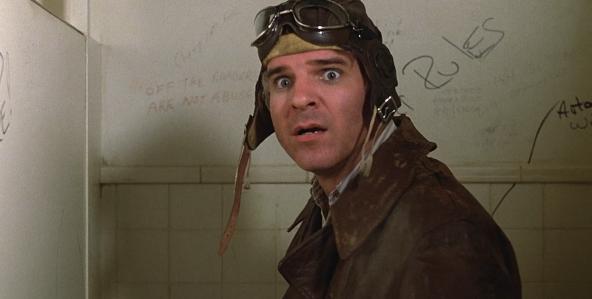
This uproarious comedy made Steve Martin a star. Directed by Carl Reiner, the film was written by Steve Martin, Carl Gottlieb and Michael Elias. This was Steve Martin's first starring role in a feature film. The film also features Bernadette Peters, M. Emmet Walsh and Jackie Mason. In the film Martin plays Navin Johnson. He was abandoned as a child and raised by a sympathetic black family. Now grown Navin does not realize that he is white and not black. He longs to find his way in the world so he sets off to find his “special purpose”. Look for Carl Reiner in a small role playing “Carl Reiner the actor” The movie is simple and Martin’s character is idiotic, but I find myself laughing my way through the movie each time I see it.
4. STAR WARS (1977)
The first film in the series was originally released on May 25, 1977, under the title Star Wars, by 20th Century Fox, and became a worldwide pop culture phenomenon, followed by two sequels, released at three-year intervals. In my opinion, the second movie of the franchise, The Empire Strikes Back, was the best movie in the serious. However, this first movie set the stage for one of the most popular movie series in cinema history. The events depicted in Star Wars media take place in a fictional galaxy. Many species of alien creatures (often humanoid) are depicted. Robotic droids are also commonplace and are generally built to serve their owners. Space travel is common, and many planets in the galaxy are members of a Galactic Republic, later reorganized as the Galactic Empire. I am not a science fiction fan, but this series was one of the biggest things during my childhood. I long for those days.
3. YOUNG FRANKENSTEIN (1974)
The comedy scene in the 1970s belonged to Mel Brooks. Hollywood never truly saw the type of movies Brooks directed until he came along. The film stars Gene Wilder as the descendent of Dr. Frankenstein who uncovers his family scientific secrets. Peter Boyle is very underrated as the Monster. The cast is made in cinema heaven and included: Marty Feldman (perfect as Igor), Teri Garr, Madeline Kahn, Cloris Leachman, and Gene Hackman (in a scene stealing cameo). The film is an affectionate parody of the classical horror film genre, in particular the various film adaptations of Mary Shelley's novel Frankenstein produced by Universal in the 1930s. Most of the lab equipment used as props were created by Kenneth Strickfaden for the 1931 film Frankenstein. To further reflect the atmosphere of the earlier films, Brooks shot the picture entirely in black-and-white, a rarity in the 1970s, and employed 1930s-style opening credits and scene transitions such as iris outs, wipes, and fades to black. The film also features a notable period score by Brooks' longtime composer John Morris. Young Frankenstein is easily one of my favorite comedies of all time.
2. THE GODFATHER PART II (1974)
This film sequel is one of those rare sequels, where the second movie surpasses the original film in popularity and quality. The movie is a 1974 American crime epic that Francis Ford Coppola produced, directed, and co-wrote with Mario Puzo, starring Al Pacino, Robert Duvall, Diane Keaton, and Robert De Niro. Partially based on Puzo's 1969 novel, The Godfather, the film is in part both a sequel and a prequel to The Godfather, presenting two parallel dramas. The main storyline, following the events of the first film, centers on Michael Corleone (Pacino), the new Don of the Corleone crime family, trying to hold his business ventures together from 1958 to 1959; the other is a series of flashbacks following his father, Vito Corleone (De Niro), from his childhood in Sicily in 1901 to his founding of the Corleone family in New York City. Nominated for 11 Academy Awards and the first sequel to win for Best Picture, its six Oscars included Best Director for Coppola, Best Supporting Actor for De Niro and Best Adapted Screenplay for Coppola and Puzo. Pacino won the BAFTA Award for Best Actor and received a nomination for the Academy Award for Best Actor. It deserved every award it received.
1. JAWS (1975)
I personally have to name Jaws as my favorite movie of the 1970s. It is also my favorite movie of all-time. Many people are surprised that this would be an all time favorite movie, but I have converted a few non believers to appreciate and realize what a great movie this is. Jaws is a 1975 American horror/thriller film directed by Steven Spielberg and based on Peter Benchley's novel of the same name. The prototypical summer blockbuster, its release is regarded as a watershed moment in motion picture history. In the story, a giant man-eating great white shark attacks beachgoers on Amity Island, a fictional summer resort town, prompting the local police chief to hunt it with the help of a marine biologist and a professional shark hunter. The film stars Roy Scheider as police chief Martin Brody, Richard Dreyfuss as oceanographer Matt Hooper, Robert Shaw as shark hunter Quint, Murray Hamilton as the mayor of Amity Island, and Lorraine Gary as Brody's wife, Ellen. The screenplay is credited to both Benchley, who wrote the first drafts, and actor-writer Carl Gottlieb, who rewrote the script during principal photography. I could write a book just on this movie, even though I have seen the film at least 70 times, I still find tidbits that I miss…
Of course, I had to pick some honorable mentions – and all the films on this list deserve to be on the top list. Some truly remarkable and great films were made in the 1970s: The Godfather (1972), Blazing Saddles (1974), The Towering Inferno (1974), One Who Flew Over The Cuckoo’s Nest (1975), and Network (1976).

.jpg)
.jpg)
.jpg)