Al Jolson was one of the greatest
entertainers for the good part of two decades. However, by 1940 he was a faded
star. Audiences swooned singers such as Bing Crosby and newcomer Frank Sinatra.
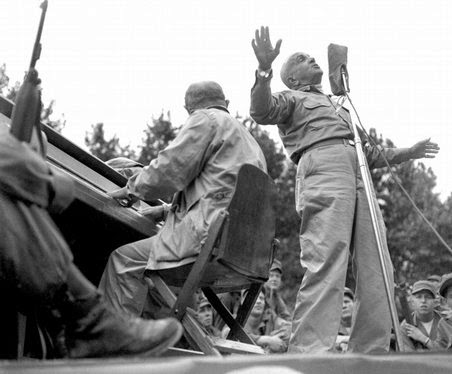
Even though he was forgotten, Jolson lobbied to entertain the troops overseas
and in June of 1942 arrangements were made to send him to Alaska, via Seattle
and Washington. As Al reported in a dispatch to Variety: “We arrived in
Anchorage at 9:10 p.m., Anchorage time, and stayed at the Westward Hotel. When
they told me to observe the blackout regulations and put my lights out I had to
laugh, for in this part of Alaska at midnight you can thread a needle on Main
Street. We gave two performances in Anchorage, each for an audience of 1,500
soldiers. Each show lasted an hour and I almost wore out the knees of my pants
singing ‘Mammy’.
Al didn’t mention that rumours had swept the camp at Anchorage that Lana Turner
was coming. “No she wasn’t - it was Dorothy Lamour,” some one else had said.
When Jolson arrived on stage the soldiers’ disappointment expressed itself in
the silence.
“Hello boys - I’m Al Jolson. You’ll
see my name in the history books.” One soldier laughed, then another. Al told a
joke, and another, and the laughter grew. He chatted about home, told them what
he thought of Hitler and Hirohito and the laughter spread all round. Someone
called for a song. Al gave them what they asked for and he was swamped by
whistling applause. Al Jolson had found a new audience; and the soldiers had
discovered Al Jolson.
Jolson: “Don’t you feel well, son?”
Soldier: “Oh, yessuh, Mista Jolson. It was on’y when you got to singin’ about
Dixie. Well, Mista Jolson, it jest kinda got me - thass all . . . You know
Mista Jolson, dis heah Arctic Ocean is an awful long way f’m tu-tty miles
t’other side of Bummin’ham, Alabama.”
“Until now,” Al reported to Variety,
“the transporting of our small piano had been an overture to an aspirin tablet,
but from here on in it became a major headache. In order to entertain all the
boys detailed in the vicinity of Anchorage, it became necessary to give shows
in foxholes, gun emplacements, dugouts, to construction groups on military
roads, in fact, any place where two or more soldiers were gathered together, it
automatically became a Winter Garden for me and I gave a show. Imagine carting
the piano to these locations. Sometimes it was by truck, once on a side car and
once on a mule pack.”
It was during the Alaskan tour that
one young soldier called out: “Kiss my wife for me when you get back to New
York, will yer Al?”
“I’ll do better than that,” Al called back. “I’ll take her out to dinner.
What’s her name?”
After writing her name down with her
telephone number, he called out: “Any more?”
Everyone shouted at once and Al
wrote down as many names as he could.
“I’ll call them all when I get
back,” he said. And he did, informing mothers, wives and girlfriends that their
loved ones were in fine shape. Jolson spent time talking to the servicemen,
establishing a relationship, till his arrival in a jeep was always met by a
collective: “Hiya, Al!”
Stopping soldiers in the street,
Jolson would say: “My name’s Jolson. Do you wanna hear me sing?”
‘Next Town Reilly’ was a one man
Department of Morale Boosting. “Those guys wouldn’t exactly be immune to a
shapely dish once in a while, too,” Al told the USO, “whether she could sing or
not.”
Jolson: “We woulda brought Lana Turner but she’s busy with the Second Front.”
In July 1942 Jolson and Fried toured
all the US bases in the Caribbean before the USO flew them, along with actress
Merle Oberon and singer Patricia Morison, to England and Northern Ireland.
Singing whatever was wanted, wherever he wanted, even to troops on street
corners, he enjoyed every round of applause. He told servicemen what he had
told their fathers about English beer: “It should have been put back into the
horse.”
The troupe had been scheduled to
appear at the London Palladium with Ben Lyon and Bebe Daniels but Merle Oberon
refused to appear. “We are here to entertain the troops, not the general
public,” she said. Jolson was furious and announced he was returning to the
United States - alone. “I just feel that I could better on my own than I could
as a member of a troupe,” Jolson explained to the New York Times. “If I want to
crowd in an extra show for defence workers in factories, I’d be able to do it.”
Jolson hadn’t ‘gone over’ as well as
he hoped with some of the English audiences and as he sat depressed in the bar
of the Savoy Hotel, Ralph Reader walked in whistling ‘Keep Smiling at Trouble’.
“English, English!” he excitedly greeted Ralph and they reminisced about their
days at the Winter Garden. “They were great days, English, great days,” he said
with a tear in his eye.
New York Times: “There were few jokes in his talk. The comedian was playing a
straight part . . . For, like many other comedians, at heart, Jolson is serious
and sentimental.”
New Yorker: “We’ve just heard from a
soldier who was fortunate enough to be on hand at one of the entertainments
presented before the troops in Ireland by Jolson and some of the other
performers from the States. Jolson, our soldier reports, concluded the
entertainment with what was obviously considered to be the best number in his
repertoire. It was ‘Brother Can You Spare a Dime?’ - and Jolson gave it, as the
people say, everything. No other happening in recent weeks has given us such a
sense of this significant moment in history.”
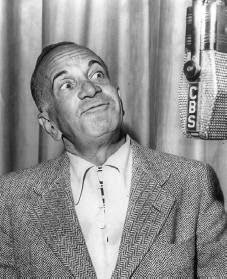
‘The Colgate Show Starring Al Jolson’, a weekly radio show that CBS signed
Jolson to do, ran until June 1943. Usually opening the show with an up-tempo
number like ‘The Yankee Doodle Blues’, or “I’m Sitting On Top of the World’, he
usually ended with a sentimental ballad like ‘Sonny Boy’. The show’s female
vocalist was Jo Stafford and the musical director was Gordon Jenkins.
Gordon Jenkins commenting on Judy Garland and Frank Sinatra: “Neither one, I
have to tell you, had the electricity that Al had.”
In July 1943, Al left on an overseas
tour to entertain the troops. Since Martin Fried had been drafted, Al needed a
pianist to accompany him and asked his friend Harry Akst. At their first stop,
Georgetown, British Guiana, Al found he couldn’t reach the high notes at the
close of ‘Swanee’. In a panic, he was ready to give up the whole tour. Harry
had to convince him that he didn’t have to cash in on high finishes - Crosby
didn’t. “They died with vaudeville,” Harry explained.
The new Al Jolson voice was born -
not so light and breezy but deeper and more mellow.
Jolson had already cancelled his thirteen Colgate radio shows programmed for
the fall when he suddenly began to feel bad. In an emergency flight, Al and
Harry flew home to Miami Beach on 21 September 1943. Less than two weeks later
while standing in a hotel lobby in New York, Jolson suddenly collapsed. Jolson
woke up in a hospital bed to find he had picked up malaria from overseas and it
had turned into pneumonia. His temperature reached 105F and doctors had to
contact a military hospital for the proper serum before he began to recover.
“No more overseas tours for you,” the doctors told him. After recuperating in
Miami he went back to work playing himself in a film biography of George
Gershwin called Rhapsody in Blue.
In October, Al and Harry began
another tour of army hospitals. Winding up in Florida, they then drove up to
New York, before driving west playing to a string of hospitals en route to
California. By the time they reached Los Angeles, Al was complaining of feeling
run down. Suddenly struck down by severe chest pains, Al was rushed into the
Cedars of Lebanon Hospital. Malaria had struck again and this time with a
malignant strain to it.
The Warner brothers, Harry and Jack,
were gravely concerned and requested General Arnold, head of the Army Air
Services, to fly two of his top physicians to Los Angeles. Because of Al’s
tremendous war work the request was granted. The doctors saved his life but had
to remove parts of two ribs and cut a malignant slice out of his left lung. Not
allowed any visitors for a week, Jolson told his nurse: “I’ll never sing
again.” Fortunately for soldiers and the world, Jolson would sing again...


.jpg)