Showing posts with label racism. Show all posts

Thursday, October 14, 2021

MICKEY ROONEY AND HIS OFFENSIVE ROLE

At the age of 93, actor Mickey Rooney passed away in 2014. As his many lengthy eulogies had made abundantly clear, his was a life of stratospheric highs and humiliating lows. He was one of the biggest stars in the world as a teen; he fell into bankruptcy and irrelevancy as an adult. He reinvented himself and rebounded. He crashed and burned. Few lives have had as many epic twists and turns, making his obituaries obsessively engrossing reading.

But there's one thing the newspapers have generally danced past, and it happens to be the role that has cast the longest shadow out of a career of thousands: His performance as Mr. I.Y. Yunioshi in the classic 1961 film "Breakfast at Tiffany's."

In the decades since the film was released, Rooney's portrayal of Yunioshi — taped eyelids, buck teeth, sibilant accent and all — has become one of the persistent icons of ethnic stereotype, brought up whenever conversation turns to the topic of Hollywood racism. The depiction has prompted widespread protests whenever the film is screened; Paramount, the studio behind "Breakfast" has now acknowledged Yunioshi as such a toxic caricature that its canonical "Centennial Collection" DVD release of the film includes a companion documentary, "Mr. Yunioshi: An Asian Perspective," which features Asian American performers and advocates in conversation about the role's lasting cultural impact and the broader context of Asian and other racial stereotypes in entertainment.


Six before his death in 2008, after four decades of stolidly defending the role, even Rooney himself finally expressed some regrets, stating in an interview that if he'd known so many people would be offended, "I wouldn't have done it."

Would that he hadn't. The spectre of Yunioshi continues to haunt Hollywood and Asian America today. Rooney's broadly comic performance, repurposed from his early vaudeville days into the brave new world of the cinema, is the godfather of the "Ching-Chong" stereotype that continues to rear its yellow head today.

And even when laughed at for the right reasons, they're problematic. As many have pointed out in the wake of that campaign, the mainstreaming of these images has the unfortunate side effect of making them seem safe for public consumption…so long as their intent isn't to "harm." The danger of allowing intent to be the sole arbiter of whether something is acceptable can be seen most obviously in the depictions of another marginalized American population — the Native American Indians...


Saturday, September 14, 2019

THE FILMS OF BILLIE HOLIDAY

It is sad that with the racism in Hollywood in the 1930s and 1940s that more African American actresses and actors were not allowed to make their mark on Hollywood. One such star that I think had the potential to make great films was Billie Holiday. She could have been the black Judy Garland. Like Garland, Billie had her share of pain and sorrow that could have transcribed to Hollywood nicely. However, throughout Billie's career, she was only in a few movies.

The first movie she appeared in was as an extra in The Emperor Jones from 1933. The Emperor Jones is a 1933 American pre-Code film adaptation of the Eugene O'Neill play of the same title, was made outside of the Hollywood studio system, financed with private money from neophyte wealthy producers, and directed by iconoclast Dudley Murphy, who had sought O'Neill's permission to film the play since its 1924 production in New York. He cast Paul Robeson in his first film role, Dudley Digges, Frank H. Wilson, and Fredi Washington. The screenplay was written by DuBose Heyward and filmed at Kaufman Astoria Studios with the beach scene shot at Jones beach Long Beach, New York. Robeson starred in the O'Neill play on stage, both in the United States and England, a role that had helped launch his career. Good luck spotting Billie in the film though.


Two years later, Billie appeared with Duke Ellington in Symphony In Black. The film is a nine-and-a-half minute musical short produced in 1935 that features Duke Ellington’s early extended piece, "A Rhapsody of Negro Life". The short was directed by Fred Waller and distributed by Paramount Pictures. Symphony in Black represents a landmark in musical, cultural, and entertainment history as well as significant progress in Ellington’s own biography. It is a member of the first generation of non-classically arranged orchestral scores and perhaps most importantly, one of the first films written by an African-American describing African-American life to reach wide distribution.


A decade would pass before Billie would make her biggest movie appearance in New Orleans (1947). New Orleans is a 1947 American musical romance film featuring Billie Holiday as a singing maid and Louis Armstrong as a bandleader; supporting players Holiday and Armstrong perform together and portray a couple becoming romantically involved. During one song, Armstrong's character introduces the members of his band, a virtual Who's Who of classic jazz greats, including trombonist Kid Ory, drummer Zutty Singleton, clarinetist Barney Bigard, guitar player Bud Scott, bassist George "Red" Callender, pianist Charlie Beal, and pianist Meade Lux Lewis. Also performing in the film is cornetist Mutt Carey and bandleader Woody Herman. The music, however, takes a back seat to a rather conventional plot. The movie stars Arturo de Córdova and Dorothy Patrick, features Marjorie Lord, and was directed by Arthur Lubin.


Billie's only other movie appearance was in another short called Sugar Chile in 1950. The film  presented five jazz numbers in a 15-minute running time. The film includes Billie Holiday performing "God Bless the Child" and "Now, Baby or Never", the Count Basie Sextet performing "One O'Clock Jump", and juvenile performer Frank "Sugar Chile" Robinson performing "Numbers Boogie" and "After School Boogie". The film was directed by Will Cowan and produced and released by Universal-International Pictures. 

More screen roles were becoming available to African American actresses in the 1950s, and some great actresses emerged like Dorothy Dandridge and Ruby Dee, but by the mid 1950s Billie's life was spiraling out of control, and she had a hard time remembering lyrics let alone lines of dialogue. The film career of Billie Holiday should have better, but luckily her voice did the acting for her during her career...


Monday, April 29, 2019

KATE SMITH: A PC TARGET?

America has become expert at picking at scabs and scraping old wounds.

There is not a cadaver in the nation’s 242-year history that is off-limits to being exhumed and examined for moral failings or evidence of contemporary bias. We resurrect people to slay them anew and to rewrite their eulogies.

Earlier this month, we exhumed Kate Smith, a famous American singer who died in 1986. Cultural morticians are now busy reconstructing her legacy and the meaning of her life. She is now being shunned by some as a de facto racist because of at least two songs she recorded early in her career.

Years before Smith recorded her famous version of “God Bless America,” a national treasure, she recorded a song called “That’s Why Darkies Are Born.”

The latter song is an abomination by modern cultural standards. In 1931 it proved to be a hit. The song is nothing more than lyrical blackface, a casual ode to slavery that has been described by some as satire. Those who advance the notion of the song as satire are quick to point out that Paul Robeson, the famous black tenor and orator, also recorded the song:

“Someone had to pick the cotton,

Someone had to pick the corn,

Someone had to slave and be able to sing,

That’s why darkies were born.”


One can only wonder what Smith would say of this awful song were she alive today. Would she apologize? Would she defend the song as a relic of Depression-era America? Or, would she merely shrug it off?

That’s the problem with de facto exhumation. You can’t examine the heart of the person or put their work in context.

That didn’t stop the New York Yankees and the Philadelphia Flyers from immediate action against Smith. When news of the song’s existence was revealed, both the Yankees and the Flyers quickly separated themselves from the artist and her work. The Yankees issued a statement saying that they would no longer play her recording of God Bless America during the 7th inning stretch, and the Flyers have removed the statue of Smith that had stood outside its arena since 1987.

The Yankees, who had been playing Smith’s version of the song since shortly after the September 11th, terrorist attacks, learned of Smith’s offensive song from a fan’s email.

That’s how easily the evisceration of an American icon can occur. One day, Smith rested comfortably in her grave, renowned as a musical genius and winner of the Presidential Medal of Freedom. The next day, her favorite hockey team had covered her head with a sheet.


In February 1976, Smith performed a week long series of concerts at Cleveland’s Front Row in Highland Heights. Her health was already declining, and she would soon stop her national tours. But the sold-out audiences connected with the aging musician. She closed all of her sets with “God Bless America.”

Jane Scott, the venerable Plain Dealer Rock Critic, attended the Wednesday concert and wrote a glowing review. She noted Smith’s “majestic voice” and “booming, hearty manner.” She described her as “old fine wine.”

Scott, America’s first major female rock critic and a beloved figure in popular culture, also penned these words in her review words, which by today’s standards, seem insensitive:

“The big lady with the bigger voice made the night bright and cheery for us all at the Front Row … The years have been kind to Kathryn Elizabeth Smith, now 67. She is still a large woman, but her skin is surprisingly smooth, and her voice is as vibrant as ever.”

Without intention, Scott body-shamed Smith, who had spent a lifetime battling obesity. It just goes to say, we’re all creatures of our time and should be judged by the body of our work and ability to evolve.

Kate Smith had a catalog of hundreds of songs. Two of those songs have come back to haunt her from the grave. Nonetheless, the body of her work stands. God blessed America with Kate Smith...

Sunday, February 24, 2019

JOHN WAYNE AND HIS RACIST BELIEFS

A resurfaced interview of John Wayne, in which the late movie star said he "believes in white supremacy" and called Native Americans "selfish," has gone viral on Twitter, prompting discussion about how to best examine offensive public statements made in past generations.

Screenwriter Matt Williams tweeted a series of quotes by the iconic actor after reading the Playboy interview, which ran in May 1971: "John Wayne was a straight up piece of s--t," he wrote. The tweet quickly racked up more than 21,000 favorites and thousands of comments.

In one excerpt, Wayne says that there's "quite a bit of resentment" among "blacks," musing, "But we can't all of a sudden get down on our knees and turn everything over to the leadership of the blacks. I believe in white supremacy until the blacks are educated to a point of responsibility."

On the subject of Native Americans, Wayne spoke just as candidly: "I don't feel we did wrong in taking this great country away from them," he said, later asserting that they should buy the land back if they still want it. "I think we ought to make a deal with the Indians. They should pay as much for Alcatraz as we paid them for Manhattan. I hope they haven't been careless with their wampum."


"I don't know why the government should give them something that it wouldn't give me," he added in reference to reparations.

Wayne also dismissed criticism of low employment of black people in Hollywood, saying he's done his fair share to rectify the issue. "I've directed two pictures and I gave blacks their proper position. I had a black slave in 'The Alamo,' and I had a number of blacks in 'The Green Berets,'" he said. "I think the Hollywood studios are carrying their tokenism a little too far."

Many of Wayne's anger is directed at the generation under him. Somewhat amusingly, already in his late 60s at the time of the interview, Wayne blasted the "youths" who, today, are now in their 60s and 70s themselves: "The American public is getting sick and tired of what these young people are doing," he said.


In addition to African-Americans, Native Americans and young people, Wayne took issue with liberals, the news media and critics of the Vietnam War. While many of his statements are blatantly dated, others are relatively reflective of the current political landscape more than four decades later.
 While some are coming to the defense of the late actor, who died in 1979, others are less sympathetic.

"You start reading 40-50 year old interviews and you’re not going to like what a lot of famous people said about society." one reader said. In response, another pointed out, "The interviewer was clearly not liking it at the time, so maybe it's not a matter of decade but basic human decency."

Wayne starred in more than 170 films between 1926 and 1977, bringing more people to the box office than any other actor besides Clark Gable...


Friday, October 23, 2015

THE SAGA OF SONG OF THE SOUTH

Song of the South, a 1946 Disney film mixing animation and live action, was based on the "Uncle Remus" stories of Joel Chandler Harris. Harris, who had grown up in Georgia during the Civil War, spent a lifetime compiling and publishing the tales told to him by former slaves.

These stories — many of which Harris learned from an old Black man he called "Uncle George" — were first published as columns in The Atlanta Constitution and were later syndicated nationwide and published in book form. Harris's Uncle Remus was a fictitious old slave and philosopher who told entertaining fables about Br'er Rabbit and other woodland creatures in a Southern Black dialect.

Song of the South consists of animated sequences featuring Uncle Remus characters such as Br'er Rabbit, Br'er Fox, and Br'er Bear, framed by live-action portions in which Uncle Remus (portrayed by actor James Baskett, who won a special Oscar for his efforts) tells the stories to a little white boy upset over his parents' impending divorce. Although some Blacks have always been uneasy about the minstrel tradition of the Uncle Remus stories, the major objections to Song of the South had to do with the live action portions. The film has been criticized both for "making slavery appear pleasant" and "pretending slavery didn't exist", even though the film (like Harris' original collection of stories) is set after the Civil War and the abolition of slavery.

Still, as folklorist Patricia A. Turner writes:
"Disney's 20th century re-creation of Harris's frame story is much more heinous than the original. The days on the plantation located in "the United States of Georgia" begin and end with unsupervised Blacks singing songs about their wonderful home as they march to and from the fields. Disney and company made no attempt to to render the music in the style of the spirituals and work songs that would have been sung during this era. They provided no indication regarding the status of the Blacks on the plantation. Joel Chandler Harris set his stories in the post-slavery era, but Disney's version seems to take place during a surreal time when Blacks lived on slave quarters on a plantation, worked diligently for no visible reward and considered Atlanta a viable place for an old Black man to set out for." 


Kind old Uncle Remus caters to the needs of the young white boy whose father has inexplicably left him and his mother at the plantation. An obviously ill-kept Black child of the same age named Toby is assigned to look after the white boy, Johnny. Although Toby makes one reference to his "ma," his parents are nowhere to be seen. The African-American adults in the film pay attention to him only when he neglects his responsibilities as Johnny's playmate-keeper. He is up before Johnny in the morning in order to bring his white charge water to wash with and keep him entertained.

The boys befriend a little blond girl, Ginny, whose family clearly represents the neighborhood's white trash. Although Johnny coaxes his mother into inviting Ginny to his fancy birthday party at the big house, Toby is curiously absent from the party scenes. Toby is good enough to catch frogs with, but not good enough to have birthday cake with. When Toby and Johnny are with Uncle Remus, the gray-haired Black man directs most of his attention to the white child. Thus Blacks on the plantation are seen as willingly subservient to the whites to the extent that they overlook the needs of their own children. When Johnny's mother threatens to keep her son away from the old gentleman's cabin, Uncle Remus is so hurt that he starts to run away. In the world that Disney made, the Blacks sublimate their own lives in order to be better servants to the white family. If Disney had truly understood the message of the tales he animated so delightfully, he would have realized the extent of distortion of the frame story.


The NAACP acknowledged "the remarkable artistic merit" of the film when it was first released, but decried "the impression it gives of an idyllic master-slave relationship". Disney re-released the film in 1956, but then kept it out of circulation all throughout the turbulent civil rights era of the 1960s. In 1970 Disney announced in Variety that Song of the South had been "permanently" retired, but the studio eventually changed its mind and re-released the film in 1972, 1981, and again in 1986 for a fortieth anniversary celebration. Although the film has only been released to the home video market in various European and Asian countries, Disney's reluctance to market it in the USA is not a reaction to an alleged threat by the NAACP to boycott Disney products. The NAACP fielded objections to Song of the South when it premiered, but it has no current position on the movie.

Perhaps lost in all the controversy over the film is the fact that James Baskett (1904-1948), a black man, was the very first live actor ever hired by Disney. Allegedly, though, Baskett was unable to attend the film's premiere in Atlanta because no hotel would give him a room...


Friday, February 27, 2015

LOUIS ARMSTRONG AND RACISM

On October 31, 1965, Louis (Satchmo) Armstrong gave his first performance in New Orleans, his home town, in nine years. As a boy, he had busked on street corners. At twelve, he marched in parades for the Colored Waif’s Home for Boys, where he was given his first cornet. But he had publicly boycotted the city since its banning of integrated bands, in 1956. It took the Civil Rights Act, of 1964, to undo the law. Returning should have been a victory lap. At sixty-four, his popular appeal had never been broader. His recording of “Hello, Dolly!,” from the musical then in its initial run on Broadway, bumped the Beatles’ ”Can’t Buy Me Love” from its No. 1 slot on the Billboard Top 100 chart, and the song carried him to the Grammys; it won the 1964 Best Vocal Performance award. By the time the movie version came out, in 1969, he was brought in to duet with Barbra Streisand.

Armstrong was then widely known as America’s gravel-voiced, lovable grandpa of jazz. Yet it was a low point for his critical estimation. “The square’s jazzman,” the journalist Andrew Kopkind called him, while covering Armstrong’s return to New Orleans for The New Republic. Kopkind added that “Among Negroes across the country he occupies a special position as success symbol, cultural hero, and racial cop-out.” Kopkind was not entirely wrong in this, and hardly alone in saying so. Armstrong was regularly called an Uncle Tom.

Detractors wanted Armstrong on the front lines, marching, but he refused. He had already been the target of a bombing, during an integrated performance at Knoxville’s Chilhowee Park auditorium, in February, 1957. In 1965, the year Armstrong returned to New Orleans, Malcolm X was killed on February 21st, and on March 7th, known as Bloody Sunday, Alabama state troopers armed with billy clubs, tear gas, and bull whips attacked nearly six hundred marchers protesting a police shooting of a voter-registration activist near Selma. Armstrong flatly stated in interviews that he refused to march, feeling that he would be a target. “My life is my music. They would beat me on the mouth if I marched, and without my mouth I wouldn’t be able to blow my horn … they would beat Jesus if he was black and marched.”


When local kids asked Armstrong to join them in a homecoming parade, as he had done with the Colored Waif’s Home in his youth, he said no. He knew the 1964 Civil Rights Act was federal law, not local fiat. Armstrong had happily joined in the home’s parades in the past, but his refusal here can be read as a sign of the times. The Birmingham church bombings in 1963 had shown that even children were not off limits.

And yet little of what Armstrong said about the civil-rights struggle registered. The public image of him, that wide performance smile, the rumbling lilt of his “Hello, Dolly!,” obviated everything else. “As for Satchmo himself,” Kopkind wrote, “he seems untouched by all the doubts around him. He is a New Orleans trumpet player who loves to entertain. He is not very serious about art or politics, or even life.”


Armstrong grew up poor and powerless, and he never forgot it. Despite his fame, he understood the repercussions for a community after the celebrity savior jets home. “I don’t socialize with the top dogs of society after a dance or concert,” he said in a 1964 profile in Ebony. “These same society people may go around the corner and lynch a Negro.”

Armstrong chose his battles carefully. In September, 1957, seven months after the bombing attempt in Knoxville, he grew strident when President Eisenhower did not compel Arkansas to allow nine students to attend Little Rock Central High School. As Teachout recounts in “Pops,” here Armstrong had leverage, and spoke out. Armstrong was then an unofficial goodwill ambassador for the State Department. Armstrong stated publicly that Eisenhower was “two-faced” and had “no guts.” He told one reporter, “It’s getting almost so bad a colored man hasn’t got any country.”


Doing things Armstrong’s way, no one had to accept responsibility for his actions but Louis Armstrong. When Eisenhower did force the schools to integrate, Armstrong’s tone was friendlier. “Daddy,” he telegrammed the President, “You have a good heart.”

As the pieces come together, a consistency of thought in Armstrong once obscured to us has finally become clear: “You name the country and we’ve just about been there,” he said of his travels with his wife Lucille. “We’ve been wined and dined by all kinds of royalty. We’ve had an audience with the Pope. We’ve even slept in Hitler’s bed. But regardless of all that kind of stuff, I’ve got sense enough to know that I’m still Louis Armstrong—colored.”

Wednesday, February 18, 2015

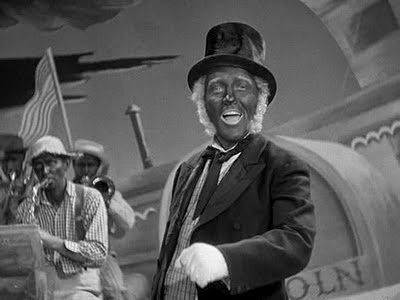
BLACKFACE IN MODERN ENTERTAINMENT

Blackface is a form of theatrical makeup used by performers to represent a black person.In 1848, blackface minstrel shows were an American national art of the time, translating formal art such as opera into popular terms for a general audience. Early in the 20th century, blackface branched off from the minstrel show and became a form in its own right, until it ended in the United States with the U.S. Civil Rights Movement of the 1960s. What was once the norm of American entertainment is quite offensive today, because often blackface would make perpetuate a negative stereotype of the African American race.

Al Jolson and Eddie Cantor brought blackface to the cinema with their popular musicals of the 1930s. Each of their films would usually include one number in blackface. For the Al Jolson musical Big Boy in 1930, Jolson was in blackface the entire movie. However, by the late 1930s Hollywood were using blackface less and less in their films. Bing Crosby, who strived for race equality throughout his career appeared in blackface in three of his movies: Holiday Inn (1942), Dixie (1943), and Here Comes The Waves (1945). Eddie Cantor appeared in blackface in his last movie If You Knew Susie (1948), and Betty Hutton appeared in blackface in the musical Somebody Loves Me as late as 1952.

Is it ever okay for a white to perform in blackface? In 1936 when the lead in touring company of Orson Welles' Voodoo Macbeth (Maurice Ellis) fell ill, Welles stepped temporarily into the part and played the role in blackface.

An example of the fascination in American culture with racial boundaries and the color line is demonstrated in the popular duo Amos 'n' Andy, characters played by two white men who performed the show in blackface. They gradually stripped off the blackface makeup during live 1929 performances while continuing to talk in dialect. This fascination with color boundaries had been well-established since the beginning of the century, as it also had been before the Civil War.

Bing Crosby
The wearing of blackface was once a traditional part of the annual Mummers Parade in Philadelphia. Growing dissent from civil rights groups and the offense of the black community led to a 1964 official city policy ruling out blackface. Also in 1964, bowing to pressure from the interracial group Concern, teenagers in Norfolk, Connecticut, reluctantly agreed to discontinue using blackface in their traditional minstrel show that was a fund-raiser for the March of Dimes.

In 1980, an underground film, Forbidden Zone, was released, directed by Richard Elfman and starring the band Oingo Boingo, which received controversy for blackface sequences.

In 1993, white actor Ted Danson ignited a firestorm of controversy when he appeared at a New York Friars' Club roast in blackface, delivering a risqué shtick written by his then love interest, African-American comedian Whoopi Goldberg. Recently, gay white performer Chuck Knipp has used drag, blackface, and broad racial caricature while portraying a character named "Shirley Q. Liquor" in his cabaret act, generally performed for all-white audiences. Knipp's outrageously stereotypical character has drawn criticism and prompted demonstrations from black, gay and transgender activists.

Blackface and minstrels also serve as the theme of Spike Lee's film Bamboozled (2000). It tells of a disgruntled black television executive who reintroduces the old blackface style in a series concept in an attempt to get himself fired, and is instead horrified by its success.

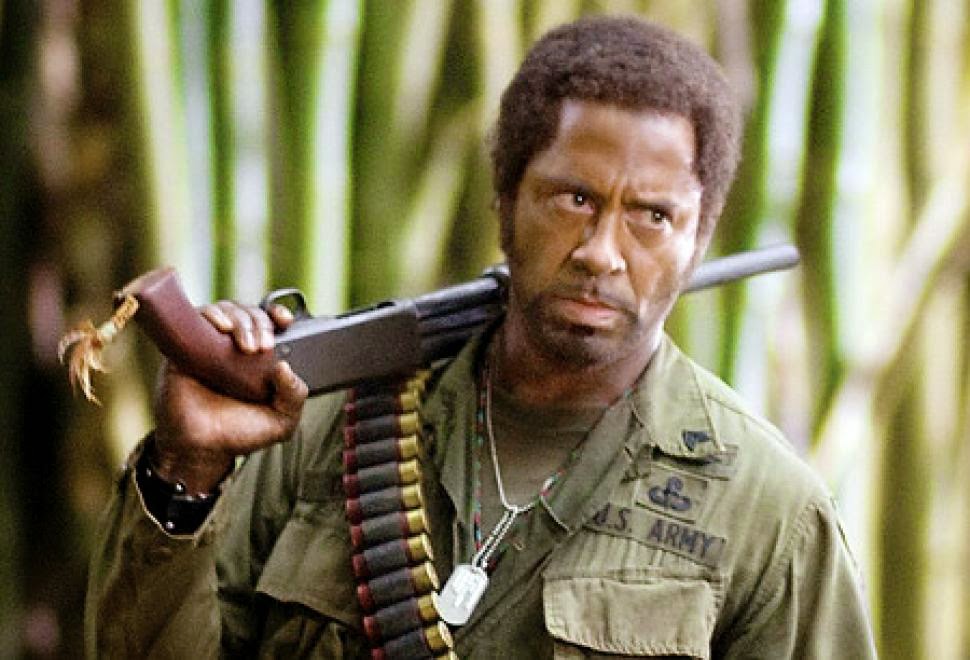
Robert Downey Jr

In 2008, the film Tropic Thunder had Robert Downey Jr. in an Oscar-nominated performance where he plays a Caucasian Australian actor who is so committed to method acting an African-American character that he has his skin surgically darkened and clumsily lecturing to his bemused African-American co-players about racial politics. Aware of the racial connotations that could be misconstrued, Director Ben Stiller had the film screened for a group of African American journalists and representatives of the National Association for the Advancement of Colored People. They in turn responded positively and reassured Stiller that they understood the artistic intent of the character.

While I am against banning classic Hollywood films that have blackface, I do believe it is an outdated "form of entertainment" that is almost embarrassing to sit through in 2015. It is a shame that stars like Al Jolson and Eddie Cantor used it so often in their movies, because they were quite talented. I guess when blackface is used in a "tasteful" way to tell the story and not to show a racial stereotype like in Tropic Thunder then it is okay. It is a fine line though and not matter how you look at it in 2015, blackface might not of meant to be a form of racism when it was popular in movies in the 1930s, but it is highly racial by today's standards and should be...

Eddie Cantor

Monday, June 4, 2012

DIXIE: IS IT A RACIST FILM?

Back in the 1940s, race relations were quite different than they are today in most of the United States. African-Americans had little freedom and rights back then, nearly 80 years after President Lincolm emancipated the slaves. Even though African-American soldiers fought valiantly during World War II against the Axis Powers, they were not looked upon as equals. The entertainment industry was a little different with the popularity of bands such as Cab Calloway and Duke Ellington and singers like Ella Fitzgerald and Billie Holliday. However, they had a long way to go as well.

A popular medium at the time was the use of blackface in performing. Blackface was theatrical makeup used in minstrel shows, and later vaudeville and movies. The use of blackface is almost universally denounced today in 2011, but the debate rages on if it should be deleted and/or forgotten from movies of the 1940s. One such movie that uses blackface a lot was DIXIE (1943).

DIXIE, directed by A. Edward Sutherland, capitalized on the then current trend of musical biographies of popular songwriters of the twentieth century, a cycle that appeared to have begun with the life of George M. Cohan in YANKEE DOODLE DANDY (1942). Unlike this and others made during this period, DIXIE goes back a century, prior to the Civil War in fact, depicting the life of a composer named Daniel Decatur Emmett. His life-story is as unknown as his name itself. The fictional screenplay does toy with the facts before leading to the purpose of its film title, the composition that's to become Emmett's most recognizable American song of all, "Dixie."

Bing Crosby, one of Hollywood's top box office attractions, is properly cast as Dan Emmett. It reunites him with HOLIDAY INN (1942) co-star, Marjorie Reynolds, and re-teams him opposite Dorothy Lamour, in her only film opposite Crosby outside from the seven "Road to" comedies all featuring Bob Hope as part of the funny trio.
Dan Emmett's life is portrayed more to the personification of Çrosby himself, that of a good-natured singer/composer whose only weakness is his forgetfulness, especially when it comes to leaving his lit up smoking pipe around that causes a fire. He is engaged to Jean Mason (Marjorie Reynolds), a beautiful blonde Southern belle whose father (Grant Mitchell) disapproves of their courtship because he feels Dan to be irresponsible and won't amount to anything. Mason's more convinced now after Dan's lit-up pipe has caused the burning and destruction of Mason's old Kentucky home. However, Mason consents to Jean's marriage only if Dan can prove himself capable by doubling his $500 life savings to $1,000 within six months. (A similar opening lifted from the more familiar Fred Astaire musical, SWING TIME, in 1936).

Leaving his clerical job, Dan seeks his fortune in New Orleans. While riverboat bound, he loses all of his $500 to Mr. Bones (Billy De Wolfe), a suave actor and cardsharp. After discovering that he had been cheated, he sets out to find Mr. Bones. Instead of beating him for the return of his money, composer and actor form a partnership leading to the origins of what was to be known as a Minstrel Show. Dan, who has already encountered Millie Cook (Dorothy Lamour) at the boarding house to whom Bones and other out-of work actors (Lynne Overman and Eddie Foy Jr.) owe back rent for their lodgings to her trusting father (Raymond Walburn), finds himself in love with her, in spite that she's the aggressor who made the first move. Dan decides to return to Kentucky and break his engagement to Jean. Upon his return, Dan finds the girl he once loved to be a victim of a crippling disease, polio, that puts him in a difficult situation as to which girl he should marry, and which should get his swan song.

The movie has never been issued on video or DVD leading many people to the conclusion that it has been removed from circulation. However, the movie has been aired on AMC, as late as 1989. The question is...is DIXIE a racist movie? While blackface is outdated and just plain wrong in 2011, the movie DIXIE was a 1940s movie depicting life in the 1860s. The entertainment scene in the 1860s was mostly blackface due to the popularity of the minstrel show. While it is hard to watch DIXIE today because of the black face scenes, it is a part of history that should not be brushed under the carpet. As a society, we need to view the movie from a history standpoint. If we do not learn from history, we are doomed to repeat it. Watching 1943's DIXIE, we need to view it from a historical standpoint. We can look at it from the viewpoint of it being a 1940s depiction of 1860s life. Watching DIXIE some 68 years after it is made does not make us a racist, but it should make us aware and proud of how far we have come...and maybe how far we still need to go.

Thursday, February 3, 2011

REMEMBERING: PIONEERING AFRICAN-AMERICAN ACTORS

In an interview with the L.A. Times 20 years ago, Sidney Poitier, the first African American superstar and the first to win the lead actor Oscar (for 1963's "Lilies of the Field") discussed the extreme prejudice and hardships faced by African American performers in the 1920s, '30s and '40s.

"The guys who were forerunners to me, like Canada Lee, Rex Ingram, Clarence Muse and women like Hattie McDaniel, Louise Beavers and Juanita Moore, they were terribly boxed in," Poitier said then. "They were maids and stable people and butlers, principally. But they, in some way, prepared ground for me."

Here are three pioneering African American actors who strove to break cinematic stereotypes, sometimes successfully, sometimes not. (In an irony, no minorities were nominated for major awards for this year's Oscars, which will be presented on Feb. 27during Black History Month):


Nina Mae McKinney (1912-1967):
The exquisite singer-actress left her South Carolina home at 13 and moved to New York where she got a role in the popular Broadway revue, "Blackbirds of 1928." Director King Vidor saw her in the chorus and cast her in his 1929 film, "Hallelujah," the first all-black sound musical made by a major studio. McKinney stole the film as the seductress Chick, causing a sensation with her "Swanee Shuffle" dance.

MGM signed her to a five-year contract but didn't know what to do with the beautiful young black actress since most African American actresses were relegated to servant or "Mammy" parts. She appeared in only two films, 1931's "Safe in Hell" and 1935's "Reckless," though her scenes were cut and all that is left of her "performance" is supplying Jean Harlow's singing voice.

Like Paul Robeson and Josephine Baker before her, she left for Europe where she was dubbed the "Black Garbo." When World War II broke out, she returned to the U.S., married jazz musician Jimmy Monroe, sang in clubs and made a few more films, most notably 1949's "Pinky. In the 1950s she moved to Athens, Ga., where she performed as the "Queen of the Night." She returned to New York in the late 1960s but didn't perform again. Her death of a heart attack in 1967 mostly went unnoticed.

Louise Beavers (1902-1962):
Just like most black actresses, Beavers found herself relegated to playing maids, servants and even slaves (in real life she had been a maid to actress Leatrice Joy). But she did get a chance to shine in a serious role in 1934's "Imitation of Life" with Claudette Colbert. In the melodrama, Beavers played Delilah Johnson, a housekeeper-cook whose employer (Colbert) transforms her into an Aunt Jemima-esque celebrity. But Delilah has problems with her light-skinned daughter who wants to pass for white. It was the first time in mainstream Hollywood cinema that the problems of an African American character were given as much heft as her white counterparts.

Sadly, "Imitation of Life," however, didn't improve the quality of her roles. Beavers may not have liked the parts she was given, but she remained one of the busiest black actresses in Hollywood, appearing in such films as 1942's "Holiday Inn" and 1948's "Mr. Blandings Builds His Dream House." In the 1950 biopic "The Jackie Robinson Story," she gave a lovely performance as the baseball player's mother. She starred on TV in the 1950s sitcom "Beulah." She died of a heart attack in 1962.

Canada Lee (1907-1952):
When his boxing career ended in 1933 after a blow to his eye caused a detached retina, Lee turned to acting in 1934. His first major stage role was Orson Welles' 1936 "Voodoo Macbeth"; they reunited for Welles' 1941 stage production of Richard Wright's "Native Son."

Lee was cast in Alfred Hitchcock's 1944 thriller, "Lifeboat" as Joe, a torpedoed ship's steward. Lee gave a warm, passionate performance — he refused to speak in the "dialect" forced upon African American actors. He was even better in 1947's boxing classic "Body and Soul," as a boxer with a brain injury who is hired by the fighter who ended his career to be his trainer.

A vocal civil rights activist, he was a member of several left-wing groups and was labeled as a Communist during the Hollywood blacklist. Though he wouldn't name names in front of the House Committee on Un-American Activities, he did call a news conference to say he wasn't a party member. Lee went to South Africa with Poitier to make the 1951 film, "Cry, the Beloved Country," but Hollywood still wouldn't hire him. In a letter to Walter White of the NAACP, Lee wrote "I can't take it anymore. I am going to get a shoeshine box and sit outside the Astor Theatre. My picture is playing to capacity audiences, and my God, I can't get a day's work."

The stress became too much for Lee, who suffered from high blood pressure. He died of a heart attack at the age of 45.


SOURCE