Showing posts with label Joan Caulfield. Show all posts

Sunday, February 25, 2024

GUEST REVIEW: LARCENY

The later great Bruce Krogan is back with another great review. This time around he is reviewing a forgotten 1948 film noir...

Watching Larceny I thought the way the film was building toward the climax I was sure of a sentimental ending. But far from it with this film. What we get is a crackerjack and original realistic ending in this noir film.

John Payne plays a smooth talking confidence man who is part of a gang headed by Dan Duryea. Duryea has set up a big score and Payne has to romance war widow Joan Caulfield who thought her hero husband walked on water. The con involves swindling Caulfield ot of money to build a youth center for the town's young people and Payne poses as a GI buddy of the late husband.

Payne's working a few cons here. He's also going out with the sultry and possessive Shelley Winters who is two timing Duryea. In the end though he falls for Caulfield and that sets up the climax.


Shelley Winters also has one of her good career roles in Larceny. The kind of woman that ought to come with a warning label. And Duryea gives us one of his classic bad guy roles as well.

The script is a fine piece of writing and the director gets some great performances out of his ensemble cast. Do not miss this one, it's one of the best noirs out there.

BRUCE'S RATING: 8 out of 10


Saturday, August 15, 2015

PAST OBITS: JOAN CAULFIELD

It is a shame that actress Joan Caulfield did not get a bigger obituary when she died in 1991. I think she was quite beautiful. Here is her obituary from the New York Times of June 20, 1991...

Joan Caulfield, an actress who starred in films of the 1940's and in television situation comedies of the 1950's, died on Tuesday at Cedars-Sinai Medical Center in Los Angeles. She was 69 years old and lived in Beverly Hills, Calif.

She died of cancer, a hospital spokesman said.

Miss Caulfield was propelled to stardom by the films "Monsieur Beaucaire," in which she appeared with Bing Crosby, and "Blue Skies," with Bob Hope, both released in 1946, and by "Dear Ruth," appearing opposite William Holden, in 1947. On television she was a co-star of "My Favorite Husband," on CBS from 1953 to 1957, and "Sally" on NBC in the 1957-58 season.

Miss Caulfield, who was a native of West Orange, N.J., attended Columbia University and was a fashion model and a cover girl before she landed ingenue roles on Broadway in the early 1940's. Her first stage success was in the 1943 production of the comedy "Kiss and Tell," in which she appeared for 14 months. Paramount Pictures promptly offered her a contract and she began her Hollywood career with "Miss Suzie Slagle's," in 1946.

Her films made the most of her beauty, although she was determined to win a reputation as an actress and not, as she said, "just a decoration."

In 1950, Miss Caulfield married the film producer Frank Ross and subsequently appeared only occasionally in films. She and Mr. Ross were divorced in 1960. She later married Robert Peterson, a dentist, from whom she was also divorced.

She is survived by two sons, Caulfield Kevin Ross of Sherman Oaks, Calif., and John Caulfield Peterson of Sacramento, Calif.; two sisters, Mary Parker of Stuart, Fla., and Elizabeth Victor of Los Angeles, and a grandson...

Wednesday, December 19, 2012

STAR FRIENDS: BING CROSBY AND JOAN CAULFIELD


The marriage of Bing and Dixie Crosby had its ups and downs as any marriage may have. What added to the ups and down is Bing Crosby was the most widely recognized person in the world in the 1940s and poor Dixie was a closet alcoholic. It was the 1940s, and people did not talk about their problems or feelings as they do now. It seemed like looking back at the marriage of Bing and Dixie, Bing buried himself into his work and Dixie became sort of a recluse. However, there has always been a rumor that Bing and actress Joan Caulfield had an affair.

Joan Caulfield was an unknown 22-year-old actress when she got the call in 1945 to play the leading lady in Bing Crosby's motion picture Blue Skies. Mark Sandrich, who was preparing to produce and direct the movie, discovered Caulfield in the rushes of her first Paramount movie, Miss Susie Slagle’s. He was so impressed by her beauty that he wanted to cast her as a song-and-dance star in the Crosby musical -- if Joan could dance. Joan let her enthusiasm overwhelm her honesty and assured Sandrich she could indeed dance. She couldn't. Sandrich sent her to Carmalita Maracci’s dance school at her own expense in the hope that her role could be salvaged.

Sandrich died suddenly on March 4, 1945, at the age of 44, before filming could begin. His replacements were much less sympathetic toward Joan, especially since Crosby's co-star and choreographer, tap-dancer Paul Draper, also wanted Joan out. He did not want a leading lady with two left feet, even if they were pretty feet. Joan's name disappeared from the cast sheets and press releases. Meanwhile, Draper began auditioning other actresses for Joan's part.
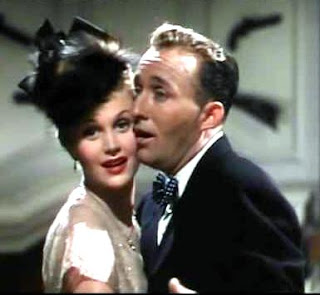

Then, suddenly, Joan was reinstated, Draper was fired, the script was rewritten and Fred Astaire was coaxed to replace Draper. Why were these extraordinary steps taken for an unknown actress? (Joan's first movie, Miss Susie Slagle’s, would not be released until 1946.) Obviously, someone very powerful had taken an interest in Joan and was determined to keep her in that movie. That someone most likely was Bing Crosby, who had just won the Oscar for his role as Father O'Malley in Going My Way. Not only was he Hollywood's leading box-office attraction, Bing was also a major stockholder in Paramount.

Most likely Bing met Joan late in 1944 during the filming of Paramount's all-star movie version of the radio show Duffy's Tavern. Bing, Joan and the four Crosby boys all made an appearance in this film. He and Joan became friends and were seen in public together socially. They recorded the radio version of Bing's movie Sing You Sinners for the Lux Radio Theatre on April 6, 1945.

That Joan and Bing had grown close was widely rumored around Hollywood. Moreover, neither Blue Skies nor Miss Susie Slagle’s had been released when Paramount announced that Bing's next movie, Welcome Stranger, would also co-star Caulfield. Clearly a special relationship had developed between the two. In 1954 Joan admitted to a relationship with a "top film star" who was also a married man with children who eventually chose his wife and children over her.


That this "top film star" was Bing Crosby was confirmed by actress Patricia Neal, who shared a cruise ship to England with Caulfield in 1948. At the time Neal was having her own affair with a much older married actor, Bing's friend Gary Cooper. Like Bing, Coop eventually decided to stay with his family too. Neal wrote:

She [Joan Caulfield] was a lovely girl and we had some good talks. She, too, was in love with an older married man who was quite as famous as Gary [Cooper]. She confided to me that she desperately wanted to marry Bing Crosby. We were in the same boat in more ways than one, but I could not tell her so." (Neal, As I Am, Simon and Schuster, 1988, p109)

Bing requested permission from the Catholic hierarchy to divorce his wife, Dixie, so he could marry Caulfield. The church denied his request and Bing remained with Dixie until her death in 1952. In 1950 Joan married Hollywood producer Frank Ross. They divorced nine years later. She married her dentist in 1960. They divorced in 1966. She never remarried. Each marriage produced a son. Joan died of cancer on June 18, 1991.

To be honest, is an affair really any of our business? Probably not, but it is what good stories are made up. Hopefully the rumors will be confirmed or put to rest when author Gary Giddin's second book on Bing Crosby comes out in the near future...

Wednesday, July 13, 2011

MOVIE SHOWCASE: BLUE SKIES

For over two decades, Bing Crosby was the number one star at Paramount. He successfully rescued the studio from bankruptcy in the early 1930s. Despite that, Paramount rarely put Bing in a technicolor movie. However, when the studio did put Bing in a big budget musical, the result was always out of this world. That was the result of 1946's Blue Skies.

As in Holiday Inn (1942), Blue Skies is designed to showcase the songs of Irving Berlin. The plot, which is presented in a series of flashbacks with Astaire as narrator, follows a similar formula of Crosby beating Astaire for the affections of a leading lady. Comedy is principally provided by Billy De Wolfe.

Joan Caulfield was the protege of Mark Sandrich - who directed many of the Astaire-Rogers musicals - and who was originally slated to direct this film. He died of a heart attack during pre-production and Stuart Heisler was drafted in to replace him. Heisler wanted Caulfield replaced, but Crosby - who was reportedly having an affair with Caulfield - protected her.

Tap dancer Paul Draper was the initial choice to partner Bing Crosby, however, during the first week of production Draper's speech impediment and his trenchant criticism of Caulfield's dance ability led Crosby to insist on his replacement by Astaire who, then forty-seven, had already decided that this would be his final film and that he would retire, having spent over forty years performing before the public. The film was billed as "Astaire's last picture" and its very strong performance at the box office pleased him greatly, as he had dearly wanted to go out on a high note.

The reasons for Astaire's (temporary) retirement remain a source of debate: his own view that he was "tired and running out of gas", the sudden collapse in 1945 of the market for Swing music which left many of his colleagues in jazz high and dry, a desire to devote time to establishing a chain of dancing schools, and a dissatisfaction with roles, as in this film, where he was relegated to playing second fiddle to the lead. Ironically, it is for his celebrated solo performance of "Puttin' On The Ritz," which featured Astaire leading an entire dance line of Astaires, that this film is most remembered today.


The story is told in a series of vignettes and musical numbers that serve to show events in flashback. Our narrative link is New York radio star Jed Potter, who once was a renowned Broadway hoofer. The conceit is that he is on the air, telling his life story... which does not yet have an ending. The tale starts just after World War I and centers around two men who became friends while serving in the Army: rising dancer Potter and the business-minded Johnny Adams. While young, hardworking Potter dreams of and works for stardom, the more laid-back and less disciplined Adams has hopes of becoming a successful nightclub owner.


In time, dancer Potter falls in love with a band singer, a "very pretty girl" named Mary O'Hara. He takes Mary to Adams' nightclub, and she takes a shine to Adams. Potter warns Mary that his old buddy is not the marrying kind. So, of course, she marries Adams. The union is not a happy one, despite the birth of a child. Adams' nightclub business is anything but a resounding success, and it turns out Potter was right: Adams is self-centered and unable to commit to his nightclubs, his marriage, or his daughter. The couple divorces, and Mary tries again with Potter. The two even become engaged. But Mary can't go through with the wedding and takes off. A devastated Potter turns to booze and subsequently suffers an accident that puts an end to his dancing career. He winds up behind a radio microphone, sharing his story with his audience, hoping that wherever Mary is, she can hear him.


Blue Skies was one of the biggest money makers of 1946. On a personal note, the film contains one of my favorite Bing songs "You Keep Coming Back Like A Song". The song was nominated for an Oscar for best song but lost. The movie also ranks as one of Bing Crosby's best movies for Paramount. If you are a Bing Crosby fan and/or a Fred Astaire fan, then this movie is for you. Blue Skies has got it all...