Showing posts with label Groucho Marx. Show all posts

Sunday, April 12, 2026

KITTY CARLISLE AND A NIGHT AT THE OPERA

Kitty Carlisle, on working with the Marx Brothers on "A Night at the Opera" (1935):

"Groucho would come up to from time to time to ask me, 'Is this funny?'' Then, totally deadpan, he'd try out the line. I'd say, 'No, I don't think it is funny', and he'd go away absolutely crushed and try it out on everyone else in the cast. Chico was always playing cards in the back room and had to be called on the set. Harpo would work well until about eleven o'clock. Then he'd stretch out on the nearest piece of furniture and start calling at the top of his voice, 'Lunchie! Lunchie!'"

Carlisle initially refused to take the part when she was asked to mime to someone else's voice. She won, and the song she performs, "Alone", later became her signature tune.

The first sneak preview for this film, held in Long Beach, California, is generally considered one of the greatest bombs in Hollywood history. The Marx Brothers and Irving Thalberg wanted to survey the public's reception to the film, which contained greater continuity and a lengthier side-story romance than the troupe's previous films with Paramount. The audience at Long Beach, the first stop on the preview tour, despised the film and barely uttered a laugh. Cast members reported that Groucho Marx was despondent, and nearly suicidal, immediately following the poor Long Beach reception, while Chico Marx suggested that the crowd may have simply been feeling the after-effects of the recent death of the town's mayor. The reasons for the cool reception in Long Beach is unclear, but Thalberg urged the brothers to continue with the tour, and the next night's preview in San Diego produced riotous laughter that called the nerves of everyone involved...


Wednesday, June 19, 2024

WHAT A CHARACTER: MARGARET DUMONT

One of the true great straight ladies of comedy was Margaret Dumont. She was the comedic foil in many Marx Brothers movies, but she was actually a wonderful actress.Dumont was born Daisy Juliette Baker in 1882 Brooklyn, New York, the daughter of William and Harriet Anna (née Harvey) Baker. Her mother was a music teacher and encouraged Daisy's singing career from an early age.

Dumont trained as an operatic singer and actress in her teens and began performing on stage in the US and Europe, at first under the name Daisy Dumont and later as Margaret (or Marguerite - French for Daisy) Dumont. Her theatrical debut was in Sleeping Beauty and the Beast at the Chestnut Theater in Philadelphia; in August 1902, two months before her 20th birthday, she appeared as a singer/comedian in a vaudeville act in Atlantic City. The dark-haired soubrette, described by a theater reviewer as a "statuesque beauty," attracted notice later that decade for her vocal and comedic talents in The Girl Behind the Counter (1908), The Belle of Brittany (1909), and The Summer Widower (1910). In 1910, she married millionaire sugar heir and industrialist John Moller Jr and retired from stage work, although she had a small uncredited role as an aristocrat in a 1917 film adaptation of A Tale of Two Cities.The marriage was childless, and Margaret would never marry again.


In 1925, she played a stuffy heiress in the Marx Brothers broadway show Coconuts. In the Marxes' next Broadway show, Animal Crackers, which opened in October 1928, Dumont again was cast as foil and straight woman Mrs. Rittenhouse, another wealthy, high society widow. She appeared with the Marxes in the screen versions of both The Cocoanuts (1929) and Animal Crackers (1930). Through 1941, Margaret appeared in seven Marx Brothers films. 

All together, Margaret appeared in 57 films from 1917 to 1964. Dumont played dramatic parts in films including Youth on Parole (1937), Dramatic School (1938), Stop, You're Killing Me (1952), Three for Bedroom C (1952), and Shake, Rattle & Rock! (1956). Her last film role was that of Shirley MacLaine's mother, Mrs. Foster, in What a Way to Go! (1964).


On February 26, 1965, eight days before her death, Dumont made her final acting appearance on the television program The Hollywood Palace, where she was reunited with Groucho, the week's guest host. They performed material from Captain Spaulding's introductory scene in Animal Crackers, including the song "Hooray for Captain Spaulding." The taped show was broadcast on April 17, 1965. Dumont died from a heart attack on March 6, 1965. She was cremated and her ashes were interred at the Chapel of the Pines Crematory in Los Angeles. She was 82, although many obituaries erroneously gave her age as 75.

In 2023, her remains were removed from non-public vaultage in the basement to a publicly accessible niche in the chapel columbarium. Margaret Dumont was the butt of many of Groucho Marx's jokes, but she definitely was quite a character!


Thursday, April 14, 2022

GROUCHO MARX AND ELDER ABUSE

Groucho Marx is one of the greates comic minds of all time. Everything Julius Henry Marx, better known as Groucho, was comic gold. With his zany brothers Harpo, Chico, and sometimes Zeppo, he conquered American vaudeville, the Broadway stage, motion pictures, radio and television. (There was a fifth brother, Gummo, who was not a performer preferring, instead, to earn his daily bread in the dress business and, after Zeppo opened a lucrative talent agency in Hollywood, representing movie stars for 10 percent of their earnings).

By the time Groucho was an old man, however, he experienced significant problems in his daily activities, medical decision-making and the management of his estate. He suffered from elements of dementia, a heart attack and congestive heart failure, falls resulting in a broken hip, and after that hip was repaired, another fall and broken hip, urinary tract infections, strokes and hypertension.

The legal battles over Groucho’s money and possessions carried on long after he died.

Groucho died over 44 years ago, on Aug. 19, 1977, at age 86 of pneumonia, which is known as “the old man’s friend.” The turmoil of his last few years are all too familiar to adult children everywhere who are concerned with the welfare of their elderly parents and other relatives.

Groucho’s “girlfriend” and consort, Erin Fleming, was accused of elder abuse and, to make matters worse, his relationships with his son Arthur and daughter Miriam (children from his first marriage, to Ruth Johnson, a dancer in the Marx Brothers’ vaudeville act) were strained for various reasons. Arthur wrote several works based on life in the Marx family; at one point, Groucho threatened to sue his son over his depiction in one of Arthur’s memoirs.

Groucho also had a complicated relationship with Melinda, his third daughter from his second marriage to Kay Mavis Gorcey. Melinda often performed on her father’s television show, “You Bet Your Life,” and famously inspired a Groucho quip when he was told that she was forbidden from swimming in a country club pool because the family was Jewish. Groucho wrote the country club president, between puffs of his famous cigar: “She’s only half Jewish. How about if she only goes in up to her waist?”


After he divorced Eden Hartford — his third wife who was about 40 years younger than him — in 1969, Groucho met Erin Fleming in 1971. She played some minor roles in films, including Woody Allen’s “Everything You Wanted to Know About Sex But Were Afraid to Ask” (1972).

Her most famous role, however, was as Groucho’s secretary-manager and she was responsible for his popular comeback in the early 1970s. He played various colleges and eventually Carnegie Hall, a performance that resulted in the hit album, “An Evening With Groucho” (1972). That same year, there were revivals of his films at movie houses and libraries across the nation.

The problem was that many of Groucho’s friends felt Fleming was pushing him too hard to perform, evidenced by his advanced age and an inability to remember all of his lines. On the other hand, it was Fleming who waged a successful campaign for Groucho and his brothers to receive a special Academy Award in 1974. In his acceptance speech, after thanking Harpo and Chico, the actress Margaret Dumont, his long suffering foil who never understood his jokes, and his mother, Minnie, “because without her we never would have been anything,” Groucho thanked “Erin Fleming, who makes my life worth living and who understands all my jokes.”

That same year, Fleming was appointed his guardian and temporary conservator of an estate worth between $2 million and $4 million. In 1975, Groucho even tried to adopt her, until a psychologist declared he was not mentally competent to do so.

Groucho’s son, Arthur, took Fleming to court and accused her of having a harmful and destructive influence on his father, including threatening his well-being and being abusive. Arthur further alleged that Fleming pushed Groucho to perform, whether he was able or not, for her own financial gain. Groucho’s nurses claimed Erin overdosed the comedian on tranquilizers and called him nasty names like “pig” and “crazy old man.” Accoridng to court testimony, There were other occasions when Fleming reportedly walked about Groucho’s home naked to taunt him. Melinda Marx, too, testified that Fleming terrorized her father, yelled at him, and tried to alienate him from his family. Others, such as the comedian George Burns and actor Carroll O’Connor, disagreed and felt that her presence made an elderly and ill Groucho want to live.


During Groucho’s final days, a judge appointed the 72-year-old Nat Perrin, a close pal of Groucho’s and who co-wrote the Marx Brothers’ most anarchically funny 1933 film, “Duck Soup,” as temporary conservator of Groucho’s well-being and estate. Later, his 27-year-old grandson, Andrew, was named permanent conservator.

The legal battles over Groucho’s money and possessions carried on long after he died and into the early 1980s. Although he left most of his estate to his three children, Groucho left administrative control of his name, image and movie rights to Fleming. This, too, was a source of legal contretemps. Not only were such rights valuable, but they also carried the potential to encroach upon the income of the heirs to Chico and Harpo’s estates. The lawsuits were ultimately resolved in favor of Groucho’s children. A judge ordered Fleming to pay $472,000, which she bilked from Groucho’s bank accounts while she worked for him. Fleming spent much of the 1990s in and out of mental health facilities, suffering from a variety of psychiatric illnesses, and was often homeless. She died by suicide in 2003 at the age of 61.

Back in the late 1970s, the term “elder abuse” had not even been coined. Even though it clearly existed, it was rarely recognized until it was too late. Today, public health agencies, including the World Health Organization, have declared elder abuse to be a growing problem around the world and have detailed a long list of harmful activities, including physical, sexual, emotional and psychological forms of abuse and neglect, as well as the theft or withholding of financial assets needed to survive...


Monday, September 3, 2018

RIP: GLORIA JEAN

Child actress Gloria Jean passed away on September 1, 2018.She was an American actress and singer who starred or co-starred in 26 feature films between 1939 and 1959, as well as making numerous radio, television, stage, and nightclub appearances.

After moving to Scranton, Pennsylvania, Gloria Jean sang on radio with Paul Whiteman's band. When she was 12, "she was engaged by a smallish New York opera company and became the youngest member of an opera troupe in the United States." Gloria Jean was being trained as a coloratura soprano, when her voice teacher, Leah Russel, took her to an audition held by Universal Pictures movie producer Joe Pasternak in 1938. Pasternak had guided Deanna Durbin to stardom, and with Durbin now advancing to ingénue roles, Pasternak wanted a younger singer to make the same kind of musicals. Up against hundreds of others, Gloria Jean won the audition.

Under contract to Universal, she was given the leading role in the feature The Under-Pup (1939) and became instantly popular with moviegoers. Universal's publicity department initially claimed the singer was 11 years old instead of 13; her actual age was not well known for many decades. For her next two vehicles, she co-starred with Bing Crosby in If I Had My Way (1940) and starred in the well-received A Little Bit of Heaven (also 1940), which reunited her with many from the Under-Pup cast. Her best-known picture is her fourth, Never Give a Sucker an Even Break (1941), in which she co-starred with W. C. Fields.


Gloria Jean made a successful transition to young adult roles. Her dramatic tour de force, as a blind girl being menaced by an escaped killer, was filmed as one of four vignettes for Julien Duvivier's Flesh and Fantasy(1943). Her performance won raves at the film's advance preview, and her segment was the best-received of the four. However, Universal removed the half-hour sequence and shelved it until 1944, when it was expanded into a feature-length melodrama, Destiny. She co-starred with Olsen and Johnson in the big-budget Ghost Catchers (1944), and in her last two Universal features, released in 1945, she was teamed with singer-actor Kirby Grant.

She resumed her movie career as a freelance performer appearing in United Artists, Columbia Pictures, and Allied Artists productions, the best-known being Copacabana (1947) with Groucho Marx. Some stage and television work followed in the 1950s and 1960s, as well as four feature films. Wonder Valley (1953), produced on location in Arkansas, was Gloria Jean's first color movie and is now a lost film. Her next feature was Air Strike (1955), a minor military drama.


After Air Strike Gloria Jean was hired by the owner of the Tahitian restaurant in Studio City, California, as a hostess, greeting and seating dinner guests. She enjoyed the experience and occasionally ran the restaurant in her employer's absence. Show-business patrons were surprised that a film star was now involved in restaurant work, resulting in sympathetic feature stories in the national press. Veteran Hollywood producer Edward Finney, himself a Gloria Jean fan, saw one of these reports and hired her to star in the lightweight comedy Laffing Time (filmed in 1959, re-released as The Madcaps in 1964). Jerry Lewis also read that Gloria Jean was working in a restaurant, and signed her for a singing role in his latest production, The Ladies Man (1961).Lewis removed almost all of her footage from the finished film; she appears only as an extra and has no dialogue. It was her last theatrical motion picture.

After her retirement from Redken, Gloria Jean lived in California with her sister, Bonnie. After Bonnie died in 2007, she moved to Hawaii, where lived with her son and his family. Very late in life she suffered health problems, including two serious falls that slowed her mobility, and an impaired heart condition. She died of heart failure and pneumonia in 2018.

Her authorized biography, Gloria Jean: A Little Bit of Heaven, was published in 2005. A tribute website, GloriaJeanSings.com, followed, again with Gloria Jean's cooperation. Her Internet presence includes a series of videos showing the actress as she appeared in recent years...


Friday, June 30, 2017

RIP: MIRIAM MARX


Just got word from the grapevine that Groucho’s daughter Miriam Marx Allen passed away on June 29th, 2017 at the age 90. She was one of the last links to the Marx Brothers’ glory days. When Miriam was born in 1927 The Coconuts was on Broadway, and the family was still based in New York. When the team retired from films (the first time) after The Big Store she was only 14.

Like her mom Ruth Johnson, who’d also performed with the family act, Miriam sadly developed an alcohol problem, and had a troubled relationship with her famous father. Her book  "Love Groucho: Letters from Groucho Marx to His Daughter Miriam", was first published in 1992.

Miriam’s older brother Arthur, author and playwright, passed away in 2011. She is survived by her half-sister Melinda, 20 years her junior, another link with the storied Marxian past...


Thursday, August 20, 2015

HOW THE MARX BROTHERS GOT THEIR NAMES

Today I found out four of the five Marx brothers got their nicknames during a poker game.

The famed Marx family comedy act was made up of Julius, Adolph, Leonard, Milton, and Herbert Marx. But to all of us who know and love this delightful comedy group, we know these five characters better as Groucho, Harpo, Chico, Gummo, and Zeppo Marx, names four of the five were given one fateful night in 1915.

The boys got involved in a poker game in Galesburg, Illinois with monologist Art Fisher. It was a popular fad around this time to give everyone and anyone a nickname that ended in “o”. For instance, common nicknames were things like “Jingo” or “Bongo” or “Ringo” or “Typo” or “Cheerio”. (You get the idea.)

In this poker game, Fisher was dealing out the cards to the four Marx brothers and he gave them each their nicknames in rapid fire. “First, here’s a card for ‘Harpo’.” Harpo was the easiest, Adolph Marx played the harp.

“Here’s one for ‘Chicko’.” Leonard Marx was a notorious ladies’ man and, in those days, women and girls were often referred to as “chickens”. (Later, as now, the slang term became “chicks”, which had actually previously referred to children since the 17th century.) As Groucho later said, Chico got the nickname as he was a “Chicken chaser”.


You might be wondering at this point, why it was later “Chico” instead of “Chicko”. Supposedly, a typesetter accidentally left the “k” in “Chico” out in one town the brothers were performing in, and his name became “Chico” instead. This typo gave rise to the misconception that his name should be pronounced as “cheek-o”, when in fact the correct pronunciation is actually “Chick-o”. Although, Chico rarely corrected people when they pronounced it wrong, even show hosts who’d interview him.

Next to be dealt a card was Julius, “and here’s a card for Groucho”. As to why this nickname was picked, there are two popular explanations and one that for a long time was put forth by Groucho, which few believe. The first is that the name derived from Julius’ not-so-friendly demeanor. Julius denied this for most of his life. The second popular theory is that it had to do with an item he commonly carried with him, a big pouch-type container, popular at the time, called a “grouch bag” (a.k.a. a small purse that goes around your neck and under your shirt), where Groucho kept his money.

The origin story Groucho himself often put forth was that he got the nickname after “Groucho the Monk” from the Knocko the Monk comic strip. However, shortly before he died, Groucho said that he hadn’t been entirely honest about the origin of his name and that Al Fisher had given him the nickname because of a propensity towards moodiness. However, it isn’t clear if this is any more accurate than his “comic strip character” origin story.


The fourth and least-known Marx brother was Milton, “and here’s a card for Gummo”, Fisher said, as he dealt the final Marx brother his card. This one has two popular theories behind it, but the one the family (excepting Harpo) states is correct is that Milton often wore gumshoes (rubber soled shoes), hence the “gummo” moniker. The alternate origin put forth by Harpo is that Gummo was sneaky and would creep up on people like a gumshoe detective. In both cases, the origin is related to the rubber soled gumshoes (where gumshoe detectives got their name).

As to how the fifth Marx brother got his name, that one’s completely up for debate. A few years later, the new straight man and the youngest of the five brothers entered the act, replacing older brother, Gummo. Herbert Marx somehow became the infamous “Zeppo” Marx. Harpo said Zeppo was named in honor of a wild monkey who played on the bars and ran around named “Zippo”. Groucho, on the other hand, said in 1972 that Zeppo was named after the Zeppelin airships...


SOURCE

Tuesday, May 19, 2015

GROUCHO MARX AND HIS LAST SECRETARY

In January 1974, a 19-year-old UCLA student named Steve Stoliar started The Committee for the Rerelease of Animal Crackers to pressure Universal Studios into releasing the Marx Brothers' 1930 black-and-white film, which had been in copyright limbo for at least two decades. Executives at Universal were more concerned with their recent releases, Airport 75 and Earthquake, than they were in untangling the legal knots necessary to re-release a 44-year-old movie.

"I probably discovered the Marx Brothers when I was in high school and I wondered where they had been hiding all my life," Steve Stoliar said in a recent interview with us.

"They were such a wonderful blend of physical comedy and clever wordplay -- either Groucho's wordplay or Chico's mangling of the language."

Marx mania swept college campuses in the late '60s and early '70s. Their anarchic shenanigans resonated with baby boomers who weren't even alive when the Marx Brothers were making movies. Abbie Hoffman once said, "Groucho Marx had more to do with my subversion than Karl Marx."

Stoliar's campaign led to a campus visit from Groucho himself, who sat down and chatted with damn-near levitated Stoliar. After collecting a few thousand signatures, Universal announced that they would strike two prints of the film and premiere it in Westwood and New York. It broke the box-office record at the United Artists Westwood.

Groucho hired Stoliar to work out of the comedian's Beverly Hills home to handle fan mail and organize all of the memorabilia -- an extraordinary job that would last three years and become the basis for one of the more honest and complex show-biz memoirs in modern memory Raised Eyebrows: My Years Inside Groucho's House.


Stoliar's storied tenure as Groucho Marx's secretary is tempered with highs and lows, bookended by the psychotic Erin Fleming -- Groucho's young and mercurial life manager and companion who hitched her wagon to the star in his declining years. But before the shadow of Erin Fleming would darken the day -- at least for Stoliar--at 1083 Hillcrest Road, it was an auspicious start to a young man's dream-come-true.

"Erin helped me set up the campaign to get Animal Crackers rereleased," Stoliar said. "She would call me at all hours and just start talking about whatever was on her mind. I felt like I had been specially selected that she'd share all of this information with me."

Most extraordinary was Stoliar's free rein around Groucho's house, not to mention Groucho's egalitarian lunch policy which allowed staff to dine with him and freely interact with celebrity guests.

Although several strokes had diminished Groucho's caustic swagger significantly, there were still many flourishes of the wit that made him Groucho--something which never went unnoticed or unappreciated by his secretary.

"He used to love it when I brought him the mail because he subscribed to the Hollywood trade papers," said Stoliar. "One time he came to the table and said, 'Wonderful mail today, nothing but requests for money.' I said, 'You got a Variety didn't you?' 'Yes,' he said. 'A variety of requests for money.'"

"The only limitation was that I was also fighting against time," said Stoliar. "He was getting hazier and having health problems. It wasn't as though the longer I stayed there, the closer we got, because he was pulling away against his will. It was kind of a strange juggling between time and intimacy."
"Steven was being very parental, almost like he was Groucho's bodyguard," recalled Groucho's nephew and Harpo's son, Bill Marx.

"He was a very important figure in Groucho's life at that time from the standpoint of caring."
It was also gratifying for Groucho to have such an enthusiastic and knowledgeable employee in Stoliar.


 And then there were the many moods of Erin Fleming, which kept everyone--cooks, nurses, maids, and secretary/archivists -- on eggshells and off-balance.

"She would fly off the handle, slam her fist, and slam doors," said Stoliar. We used to tell what kind of mood she was in by how hard she'd throw her keys in the dish. You never really knew what you were in for and it was a release of tension when she'd leave."

There were others who hadn't seen Fleming's dark side and had an altogether different take on her -- at first.

"I didn't see anything wrong with her when I met her," Dick Cavett said.

"She was a little overwrought, always a little on edge -- or had an edge on from something -- but she seemed rather nice and charming and devoted to Groucho. He was pretty lonely and his children were not all that available."

Stoliar always remained mindful of the fact that it was Fleming, after all, who made the dream possible and who allowed him access to Groucho and his famous friends.

It was impossible to ignore Groucho's diminishing mental and physical condition, which concerned friends and family and only intensified Fleming's megalomania. She alienated him from his children and continued booking him for appearances, despite his failing condition, and members of the household witnessed Erin yelling at Groucho until he cried.


"I began to hear Arsenic and Old Lace-type references to Erin and, of course, lived to find that most of it was true," Cavett said. "Steve was a good source of information and we were friends enough that it wasn't as if he was distributing gossip to a stranger who might make damaging use of it."

"Groucho said to my dear friend [biographer] Hector Arce in the hospital towards the end, 'This is no way to live,'" Stoliar said. "He was painfully aware of how bad things had gotten. It was time and yet still you hate saying goodbye."

Groucho Marx died on August 19, 1977.

In the months before Groucho's death, his son Arthur Marx took Fleming to court for temporary conservatorship of his father. A California Superior Court judge appointed writer Nat Perrin to handle his dying friend's affairs and Perrin tasked Stoliar to not only watch the house on weekends, but gave him the authority to keep Fleming from entering the premises. A battle over Groucho's estate raged on for nearly six years before the case came to trial in 1983, but the judge ruled in favor of Arthur Marx, ordering Fleming to repay $472,000 to the Marx estate, including $221,000 the Bank of America claimed she had swindled from Groucho...


SOURCE

Saturday, July 12, 2014

PHOTOS OF THE DAY: EVEN MORE ODD PAIRINGS

This is the third addition of this series. I love featuring different pairings of movie stars in pictures that you are used to seeing together. There always seems to be different photos that I discover:


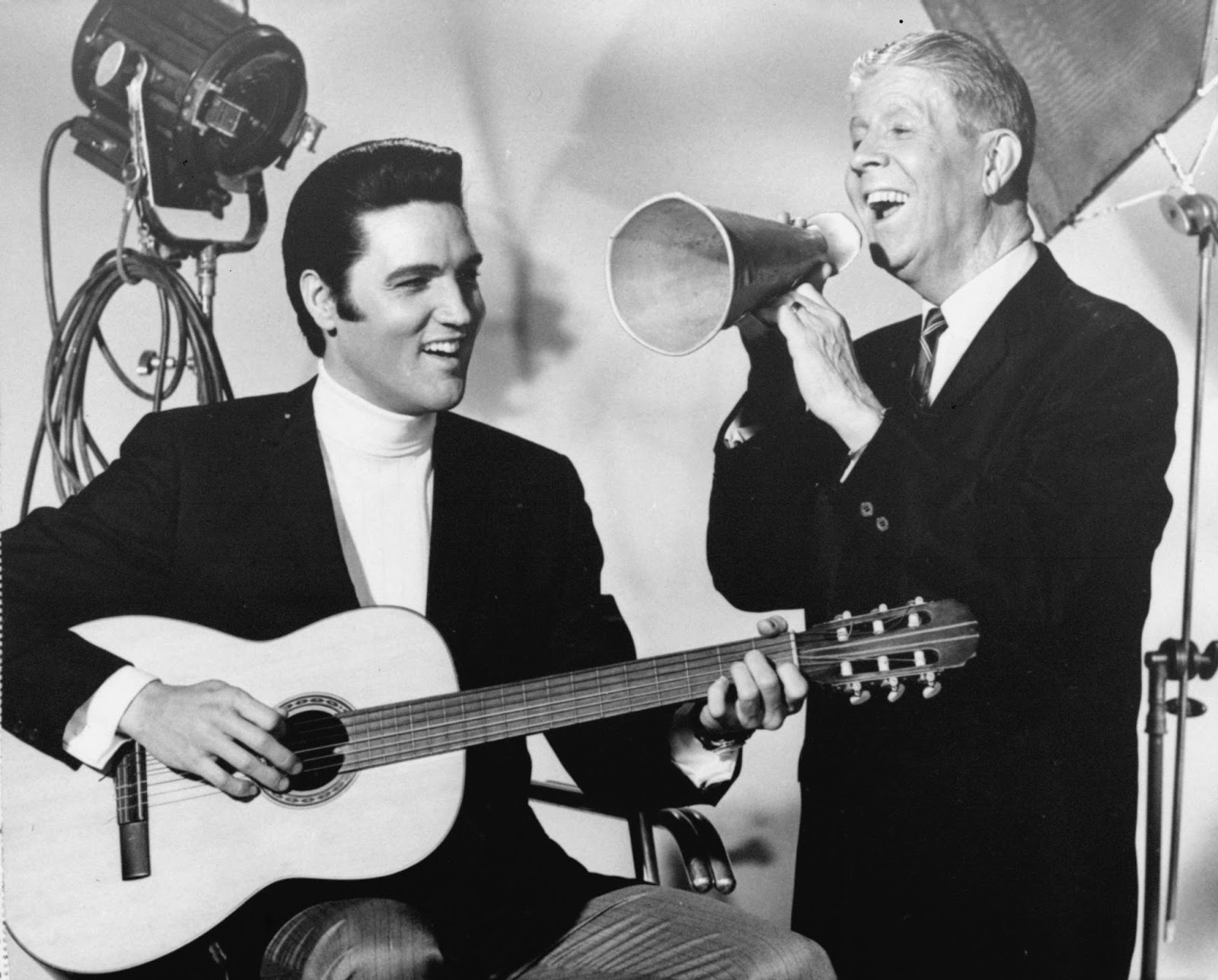
ELVIS PRESLEY and RUDY VALLEE

CHARLIE CHAPLIN and AL JOLSON


MICHAEL JACKSON and FRED ASTAIRE


EDDIE CANTOR, JUDY GARLAND, GEORGE JESSEL

MARY TYLER MOORE and JIMMY DURANTE

GROUCHO MARX and JAYNE MANSFIELD


Sunday, September 23, 2012

WHERE ARE THEY NOW: ERIN FLEMING

Not many people will know who Erin Fleming is - I would guess hardly anyone. I just know the name from reading biographies of Groucho Marx and the Marx Brothers. Fleming's story is a sad one that I discovered ended equally sad.

Erin Fleming, born on August 13, 1941, was a Canadian actress who was best known as the companion and "secretary" to Groucho Marx in his final years.
She appeared in minor roles in five films between 1965 and 1976, during which time she became acquainted with Marx and moved into his house.

Fleming's influence on Marx was controversial. Many close to him admitted that she did much to revive his popularity; these efforts included a series of one-man shows, culminating in a sold-out performance at Carnegie Hall which was released on a best-selling record album and an honorary Academy Award he received in 1974. Also, some observers felt the apparent relationship with a young starlet boosted Groucho's ego, adding to his vitality. Others, including Marx's son, Arthur, described her in Svengali-esque terms, accusing her of exploiting an increasingly senile and frail Marx in pursuit of her own stardom.


In the years leading up to Marx's death in August 1977, his heirs filed several lawsuits against Fleming. One allegation leveled against Fleming was that she was determined to sell Marx's favorite car, a Cadillac, against his wishes. When Marx protested, it was said, Fleming threatened, "I will slap you from here to Pittsburgh." Many people close to Marx believed Fleming was abusive towards him. Arthur wanted temporary conservatorship of his father, and took Fleming to court. According to the book Raised Eyebrows by Groucho's secretary Steve Stoliar, Fleming had several personal problems; he stated in his book that she used drugs, had mood swings, and was given to inappropriate outbursts, both in public and in private.

The court battles dragged into the early 1980s, but judgments were eventually reached in favor of Arthur Marx, ordering Fleming to repay $472,000 to the Marx estate.

Fleming's mental health deteriorated in the 1990s. She was arrested once in the Los Angeles area on a weapons charge, and spent much of the decade in and out of commitments to various psychiatric facilities. She was also reportedly impoverished and homeless in her final years, living on the streets of Hollywood and Beverly Hills. Erin Fleming committed suicide in 2003 by shooting herself...

Monday, July 16, 2012

PHOTOS OF THE DAY: MORE ODD PAIRINGS

Last year I posted some pictures of odd Hollywood pairings, or at least unusual ones that you are not always used to seeing. I dug up a few more different pairings that I think are interesting. Only in Hollywood...

FRED ASTAIRE AND ALICE COOPER


BING CROSBY AND JAMES CAGNEY


CHARLES CHAPLIN AND ALBERT EINSTEIN

BOB HOPE AND MARLON BRANDO


ETHEL MERMAN AND ERNEST BORGNINE


GROUCHO MARX AND DIANA ROSS

TO SEE MORE ODD PHOTO PAIRINGS CHECK OUT MY POST FROM APRIL 9, 2011:
HERE

Thursday, April 14, 2011

RIP: ARTHUR MARX

Arthur Marx, who wrote screenplays for film and television and a best-selling book about his father, “Life With Groucho,” died on Thursday at his home in Los Angeles. He was 89.

As a child Mr. Marx spent several years on the road with Groucho Marx and the rest of the Marx Brothers’ vaudeville act — Chico, Harpo, Gummo and later Zeppo — before enjoying a celebrity-filled youth in Los Angeles as the brothers rose to stardom.

His own show-business career was varied and long, writing Hollywood screenplays and scripts for some of television’s most popular sitcoms.

But his father’s life and career provided Mr. Marx with perhaps his richest source of material. “Life With Groucho,” published in 1954, captivated readers with its sharp but affectionate portrait of Groucho — who peppered the narrative with kibitzing footnotes — and its shrewd account of the show-business milieu in which he thrived. A sequel, “Son of Groucho,” was published in 1972.

Mr. Marx and Robert Fisher, a former writer for Groucho, also wrote the book for a 1970 Broadway musical about the Marx Brothers, “Minnie’s Boys,” with Shelley Winters in the lead role of Minnie Marx, and “Groucho: A Life in Revue,” which was produced Off Broadway in 1986.

Taken together, Arthur Marx’s two books about his father offered a bittersweet picture of life in the Marx home. He described himself as desperate both to escape from his father’s shadow and to please him, an impossible task. The comic genius who kept millions in stitches was, in his private life, miserly and emotionally distant.

“No matter how much he loves you, he’ll rarely stick up for you,” Mr. Marx wrote in “Son of Groucho.” “He’ll make some sort of wisecrack instead to keep from getting involved. It’s a form of cowardice that can be more frustrating than his monetary habits.”

When “Life With Groucho,” which was much sunnier than the sequel, was being serialized in The Saturday Evening Post, Groucho denounced it as “scurrilous” and threatened legal action unless substantial changes were made.

Arthur sent him a phony set of galley proofs with the requested changes but had the book published as written. Groucho never brought the matter up again.

In 1974, Arthur Marx became embroiled in a legal battle to block the appointment of his father’s longtime companion, Erin Fleming, as the conservator of his estate. Lurid court testimony depicted Ms. Fleming as a controlling, abusive caretaker, and a superior court judge eventually appointed Andy Marx, Arthur’s son, to replace her. Groucho died a little more than a month after that, on Aug. 19, 1977.

Arthur Julius Marx was born in Manhattan on July 21, 1921. After his family moved to Los Angeles in the 1930s he gained renown as a tennis player, achieving national ranking while still in high school and playing on the junior Davis Cup team in 1939 with the future stars Jack Kramer, Ted Schroeder and Budge Patty. As a student at the University of Southern California, he competed in national tournaments.

After serving with the Coast Guard in the Philippines during World War II, he returned to Los Angeles and found work as a reader at MGM. He soon turned his hand to screenwriting. He wrote scripts for the 1947 Blondie film “Blondie in the Dough” and several popular short films narrated by Pete Smith.

He later teamed up with Mr. Fisher to write the screenplays for the Bob Hope films “Eight on the Lam,” “A Global Affair,” “I’ll Take Sweden” and “Cancel My Reservation.”

The two went on to write for television sitcoms, including “McHale’s Navy,” “Petticoat Junction, “My Three Sons,” “All in the Family,” “The Jeffersons” and “Maude.” They wrote 41 episodes of the sitcom “Alice” from 1977 to 1981.

Mr. Marx used his tennis experiences as background for a novel, “The Ordeal of Willie Brown” (1951), about an unsavory tennis bum, and his lighthearted magazine articles about his young family were gathered into a comic memoir, “Not as a Crocodile” (1958). At the time, he was married to Irene Kahn, the daughter of the songwriters Gus and Grace Kahn. (Mr. Marx and Ms. Kahn later divorced.)

In addition to his family memoirs, Mr. Marx wrote several show-business biographies, including “Goldwyn: A Biography of the Man Behind the Myth,” “Red Skelton,” “The Nine Lives of Mickey Rooney” and “The Secret Life of Bob Hope.” His joint biography of Dean Martin and Jerry Lewis, “Everybody Loves Somebody Sometime (Especially Himself),” published in 1974, was made into a television movie, “Martin and Lewis,” in 2002.

With Mr. Fisher, he also wrote the comedy “The Impossible Years,” which opened on Broadway in 1965 with Alan King in the starring role of a harried psychiatrist with two teenage daughters. It ran for 670 performances.

In addition to his sons Steve, of Seattle, and Andy, of Los Angeles, he is survived by his wife, Lois; a stepdaughter, Linda Donovan of Pleasant Hill, Calif.; two sisters, Miriam Allen of San Clemente, Calif., and Melinda Berti of Mendocino, Calif.; four grandchildren; and two step-grandchildren.