
Showing posts with label Ginger Rogers. Show all posts
Showing posts with label Ginger Rogers. Show all posts
Wednesday, July 30, 2025
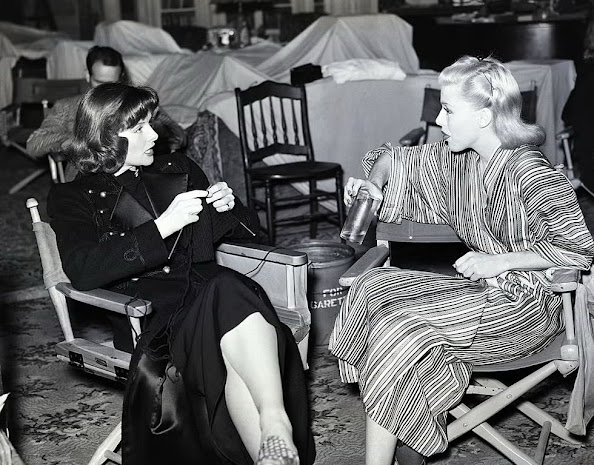
STORY BEHIND THE PHOTO: KATHERINE HEPBURN & GINGER ROGERS
For this photo, we have two greats of show business - Katharine Hepburn and Ginger Rogers. This was taken on the set of their 1937 movie Stage Door. Directed by Gregory La Cava, the film tells the story of aspiring actresses living in a boarding house in New York City, struggling to make their way in the competitive theater world...

Sunday, January 3, 2021
PHOTOS OF DAY: THE VARIOUS DOLLY LEVIS
Probably one of the greatest roles ever on Broadway was that of Dolly Levi in Hello, Dolly! Since the show debuted in 1964, countless actresses have taken on the role. Carol Channing originated the role, while Barbra Streisand was in the movie version. In recent years, Bette Midler and Bernadette Peters were in the revivals of the show. However, here are some of the other classic actresses the played Dolly in the past...
 |
| Betty Grable |
 |
| Ginger Rogers |
 |
| Martha Raye |
 |
| Pearl Bailey |
 |
| Phyllis Diller |
 |
| Ethel Merman |
Saturday, August 29, 2020
PHOTOS OF THE DAY: STILL MORE FINAL PICTURES OF THE STARS
This is fourth installment of this picture series, and some of these photos still are hard to look at. However, these are some of the last photos taken of our favorite stars...
Prior editions:
Final Pictures Of The Stars - March 28, 2012
 |
| Judy Garland on May 29, 1969. She died on June 22, 1969. |
 |
| Ginger Rogers on July 6, 1994. She died on April 25, 1995. |
 |
| Bing Crosby during lunch at his final golf match. He would die a few hours after this photo leaving the golf course - October 14, 1977. |
 |
| Harry James at one of his last performances on June 10, 1983. He died on July 6, 1983. |
 |
| Rudy Vallee around Christmas of 1985. He died on July 3, 1986. |
 |
| Kaye Ballard at her documentary premiere on January 6, 2019. She died on January 21, 2019. |
Saturday, January 25, 2020
CELEBRITY ADS: GINGER ROGERS
Here is the always beautiful and glamourous Ginger Rogers in an 1942 advertisement for make-up. It's a great ad, and it also publicized her new movie with Cary Grant called Once Upon A Honeymoon...


Sunday, March 6, 2016
HOLLYWOOD URBAN LEGEND: FRED ASTAIRE
URBAN LEGEND: Does Fred Astaire's will stipulate that he can never be depicted on film?
STATUS: It is 100% true!

Fred Astaire’s will stipulates that he never be portrayed in a film.
Fred Astaire is likely the most famous ballroom dancer of the 20th Century, although he was a lot more than just a dancer. The American Film Institute named him the fifth Greatest Male Star of All Time.
For a man who was so famous on the silver screen, Astaire made a curious demand upon his death in 1987. In the decade or so leading up to his death, Astaire had been turning down requests for “official” film versions of his life, and upon his death, Astaire went one better.
In his will, Astaire stipulated that he never been portrayed in a film.

He felt that he should be judged by his life, and his life only, and not what some filmmaker may wish to say about his life in a film.
Oddly enough, in 1997, his widow, Robin, allowed Dirt Devil to use digital technology to make it appear as though Astaire was dancing with a Dirt Devil vacuum cleaner.
Astaire’s daughter was aghast – she stated that she was ”saddened that after Fred’s wonderful career, he was sold to the devil” (as you might imagine, Astaire’s daughter is not a fan of her step-mother – a woman that I am pretty sure is younger than her).
So there will never be a Ginger Rogers bio-pic, because you can not have a movie about Ginger Rogers without Fred Astaire!

STATUS: It is 100% true!

Fred Astaire’s will stipulates that he never be portrayed in a film.
Fred Astaire is likely the most famous ballroom dancer of the 20th Century, although he was a lot more than just a dancer. The American Film Institute named him the fifth Greatest Male Star of All Time.
For a man who was so famous on the silver screen, Astaire made a curious demand upon his death in 1987. In the decade or so leading up to his death, Astaire had been turning down requests for “official” film versions of his life, and upon his death, Astaire went one better.
In his will, Astaire stipulated that he never been portrayed in a film.

He felt that he should be judged by his life, and his life only, and not what some filmmaker may wish to say about his life in a film.
Oddly enough, in 1997, his widow, Robin, allowed Dirt Devil to use digital technology to make it appear as though Astaire was dancing with a Dirt Devil vacuum cleaner.
Astaire’s daughter was aghast – she stated that she was ”saddened that after Fred’s wonderful career, he was sold to the devil” (as you might imagine, Astaire’s daughter is not a fan of her step-mother – a woman that I am pretty sure is younger than her).
So there will never be a Ginger Rogers bio-pic, because you can not have a movie about Ginger Rogers without Fred Astaire!

Saturday, July 18, 2015
CELEBRITY ADS: GINGERS ROGERS
Here is a great print ad featuring the beautiful Ginger Rogers (1911-1995). I never knew she was a model for Max Factor. This is a 1943 ad that also mentions the "new" Ginger Rogers movie Lady In The Dark...

Friday, April 26, 2013
PHOTOS OF THE DAY: CLASSIC STARS AT THE BEACH
Now that winter is finally over - and spring and summer (soon) is upon us, I thought it would be interesting to see what the classic stars did at the beach. Not only is it interesting to see how they relaxed, but it is great to see the different styles of beach wear. Classic Hollywood really knew how to soak up the sun...
 |
| GREGORY PECK (1916-2003) |
 |
| CAROL HUGHES (1910-1995), MARIE WILSON (1916-1972), and JUNE TRAVIS (1914-2008) |
 |
| BUSTER KEATON (1895-1966) |
 |
| GINGER ROGERS (1911-1995) |
 |
| SHIRLEY TEMPLE (BORN 1928) |
 |
| CARY GRANT (1904-1986) |
Monday, February 25, 2013
PHOTOS OF THE DAY: CLASSIC HOLLYWOOD AND THE OSCARS
In my opinion, winning an Academy Award does not mean as much as it did in the classic days of Hollywood. In those days it was so much more of a glamourous event. It still is glamourous, but movie stars today to not shine as bright as they did in the classic days. Here are some pictures of classic Hollywood and the Oscars...
 |
| Shirley Temple and Claudette Colbert |
 |
| Audrey Hepburn |
 |
| Joan Fontaine |
 |
| Ginger Rogers and George Murphy |
 |
| Ray Milland |
 |
| Charlie Chaplin |
Monday, July 18, 2011
GINGER ROGERS AT 100

by Whitney Hopler
On-screen, Ginger Rogers dances with Fred Astaire, gliding and swirling and leaping in joyful motion across their 10 films like Swing Time (1936) and Carefree (1938). She elicits laughs in the many comedies she made, inviting audiences to share her joy in adventures like disguising herself as a child aboard a train (The Major and the Minor, 1942), and cavorting with monkeys alongside Cary Grant (Monkey Business, 1952). And Rogers’ joy even shone through her dramatic films—such as her Oscar-winning role in Kitty Foyle (1940)—in the form of a serene sort of grace mixed with a flinty sense of confidence that she could do what’s right, no matter what.In 73 classic movies spanning Hollywood’s entire golden age, Ginger Rogers became known for her joyful spirit.
Rogers, who died in 1995, once said: “The most important thing in anyone’s life is to be giving something. The quality I can give is joy. This is my gift.” Now, as fans celebrate Rogers’ centennial (her 100th birthday would have been July 16, 2011), it’s a good time to remember the source of all that joy: her relationship to God.
“Her faith was what was most important to her,” said Rogers’ former personal secretary and close friend Roberta Olden in an interview with Crosswalk.com. “It taught her the truth with a capital T. As long as you know the truth about yourself and about God, you can do just about anything, because you reflect what he gives you. She knew that it was God’s gift of goodness that shone through [her performances].”

However, Rogers’ joy in the midst of the Hollywood scene didn’t come easily. While her image lit up movie screens in darkened theaters for audiences, she sometimes struggled to fight the darkness of Hollywood’s pressures with the light of Christ in her own life.
“Although she had a glamorous Hollywood life, she also went through some struggles,” said Olden.
Hollywood fame ushered many pressures into Rogers’ life. She had to sacrifice privacy. Fame and fortune hunters tried to use her to achieve their own desires. People who were hostile to faith mocked her Christian beliefs. After her marriage to true love Lew Ayres (star of the popular Dr. Kildare movies) broke apart under the stress of their career demands, she endured several marriages to husbands who were unfaithful to her. She never had the children she’d hoped to have, since her work was so consuming.

However, Rogers drew the strength she needed to overcome Hollywood’s pressures by asking God to renew her mind so she could think about each challenge from the right perspective, said Marcia Castle Durham, who attends the Christian Science church Rogers attended in Medford, Oregon, near where Rogers owned a ranch she escaped to for respite between movies and other work.
Rogers saw her churches in both Oregon and California as safe places to honestly express her struggles and seek Christ’s healing through prayer, Durham said, and Rogers often told people in the congregation how grateful she was for the freedom to do so in church. Rogers made going to church a high priority, seeking out a church to worship in even when she was traveling. “She went to church faithfully, wherever she was,” Durham said.

Over the years, Rogers turned down a lot of roles in films that didn’t reflect the biblical values she wanted to portray onscreen. She looked for redemptive stories in scripts whenever possible. “She was not one to see something false portrayed,” Olden recalled. “She didn’t compromise herself. She understood that she did not want to portray any ugliness that she might have seen. She wanted to show goodness at work.”
By the 1960s, she had become so disillusioned with the types of roles she was being offered that she left Hollywood to focus mainly on stage roles, such as Hello, Dolly! on Broadway and Mame on the London stage. Rogers was outspoken about her concerns that Hollywood was making more and more movies that depicted unhealthy values. In a 1976 United Press International interview, she said: “I was privileged to have been a part of the Hollywood scene when it was understood that audiences wanted to know beauty and hope exist. There’s a sadness, a darkness today in entertainment.” However, she also praised films that did portray good values. In a 1982 Toledo Blade interview, she said the popularity of the movie E.T.: The Extra-Terrestrial “proves that audiences want to see clean, healthy movies.”

SOURCE
Wednesday, December 8, 2010
INTERVIEW: GINGER ROGERS
Here is an interview that the talented Ginger Rogers(1911-1995) gave in 1989. During her long career, she made a total of 73 films, and is noted for her role as Fred Astaire's romantic interest and dancing partner, in a series of ten Hollywood musical films that revolutionized the genre. She also achieved great success in a variety of film roles, and won the Academy Award for Best Actress for her performance in Kitty Foyle (1940). She ranks #14 on the AFI's 100 Years…100 Stars list of actress screen legends.
It is a longer interview than I usually post, but it is very interesting...
It is a longer interview than I usually post, but it is very interesting...
Subscribe to:
Posts (Atom)