Showing posts with label Blues Skies. Show all posts

Saturday, October 15, 2011

MY FIVE FAVORITE MOVIE MUSICALS OF ALL TIME

When my grandfather first introduced me to classic movies when I was young, the first type of movies I watched were musicals. My grandfather was big on Eddie Cantor and Bing Crosby movies. Musicals were the 1930s and 1940s idea of fantasy movies where an emotion or mood could be conveyed through the art of a song. Looking back at old musicals they weren't very realistic, but boy are they fun to watch!

My favorite musicals are different that is what on most people's list. There is no Singin In The Rain or My Fair Lady on my list. Here are my five favorite musicals of all time:


5. SILK STOCKINGS (1957)
This was the last musical Fred Astaire made at MGM, and what a great movie to end a long association with. Astaire and Cyd Charisse were great partners in this adaptation of the Cole Porter broadway show. By 1957, musical tastes were changing, and Astaire even spoofed the changes in the show topper "Ritz, Roll, And Rock". This movie is a must to see for any Astaire or MGM musical fan.


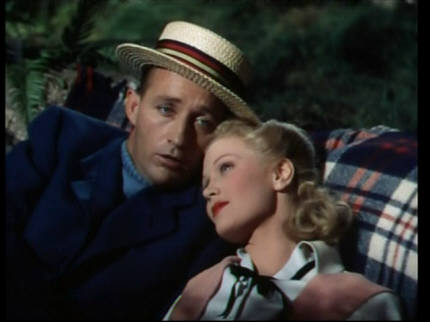
4. BLUE SKIES (1946)
Bing Crosby saved Paramount Studios from bankruptcy in the 1930s, and by 1946 he was one of the biggest stars in the world. This movie may be corny and sentimental by today's standards, but that is what I love in a musical. The pairing of Bing and Fred Astaire is great too, and this movie also boasts a massive Irving Berlin score. My favorite number in this film is the ballad "You Keep Coming Back Like A Song", which was nominated for an Oscar for Best Song. I keep coming back to watch this musical time and time again.

3. THE MUSIC MAN (1961)
When I was in seventh grade we had a music teacher who for one whole semester taught us about The Music Man. I will never forget that class. We disected and analyzed this great musical inside and out. We though Robert Preston is not a great singer, he is the Professor Harold Hill. The studios had discussed stars like Bing Crosby or Dan Dailey for the role. Preston originated the role on Broadway, and this movie not only gives me an appreciation for traveling salemen, but also it makes me want to visit Iowa and/or Gary, Indiana! The supporting cast of Shirley Jones, Buddy Hackett, Paul Ford, and a young Ronnie Howard make this movie too.


2. WORDS AND MUSIC (1948)
In the 1940s, song writer biographical movies were popular. However, they bore little resemblance to the writer's actual lives. Words And Music was the story of my favorite song writers Lorenz Hart and Richard Rodgers. In the movie they were played by Mickey Rooney and Tom Drake respectively. The plot of the story was nothing like their real lives, but what makes the movie for me is the music as well as the great stars that appear. Everyone from Judy Garland to Perry Como appeared in the movie. If you are a fan of good music then this movie is for you. If you are a fan of accurate biographies then read a book on Rodgers and Hart. Lorenz Hart is a fascinating character and Mickey Rooney plays him well.

1. SWEENEY TODD: THE DEMON BARBER OF FLEET STREET (2007)
I never thought I would have a modern musical as my favorite musical of all time. However, I am a huge fan of the movies of director Tim Burton, and Johnny Depp rarely makes a bad movie. Depp is not a singer, but he pulls of the role of Sweeney Todd perfectly. Tim Burton films the movie in such a way that you are transported back in time to the slums of London, and he uses colors in a way that the movie is nearly black and white. I am not a fan of the music of Stephen Sondheim, but they are presented in a way that they are woven effortlessly into the fabric of the movie. The movie is a little bit violent of course, but the story and the film itself is flawless - for a modern musical that is saying a lot.

Wednesday, July 13, 2011

MOVIE SHOWCASE: BLUE SKIES

For over two decades, Bing Crosby was the number one star at Paramount. He successfully rescued the studio from bankruptcy in the early 1930s. Despite that, Paramount rarely put Bing in a technicolor movie. However, when the studio did put Bing in a big budget musical, the result was always out of this world. That was the result of 1946's Blue Skies.

As in Holiday Inn (1942), Blue Skies is designed to showcase the songs of Irving Berlin. The plot, which is presented in a series of flashbacks with Astaire as narrator, follows a similar formula of Crosby beating Astaire for the affections of a leading lady. Comedy is principally provided by Billy De Wolfe.

Joan Caulfield was the protege of Mark Sandrich - who directed many of the Astaire-Rogers musicals - and who was originally slated to direct this film. He died of a heart attack during pre-production and Stuart Heisler was drafted in to replace him. Heisler wanted Caulfield replaced, but Crosby - who was reportedly having an affair with Caulfield - protected her.

Tap dancer Paul Draper was the initial choice to partner Bing Crosby, however, during the first week of production Draper's speech impediment and his trenchant criticism of Caulfield's dance ability led Crosby to insist on his replacement by Astaire who, then forty-seven, had already decided that this would be his final film and that he would retire, having spent over forty years performing before the public. The film was billed as "Astaire's last picture" and its very strong performance at the box office pleased him greatly, as he had dearly wanted to go out on a high note.

The reasons for Astaire's (temporary) retirement remain a source of debate: his own view that he was "tired and running out of gas", the sudden collapse in 1945 of the market for Swing music which left many of his colleagues in jazz high and dry, a desire to devote time to establishing a chain of dancing schools, and a dissatisfaction with roles, as in this film, where he was relegated to playing second fiddle to the lead. Ironically, it is for his celebrated solo performance of "Puttin' On The Ritz," which featured Astaire leading an entire dance line of Astaires, that this film is most remembered today.


The story is told in a series of vignettes and musical numbers that serve to show events in flashback. Our narrative link is New York radio star Jed Potter, who once was a renowned Broadway hoofer. The conceit is that he is on the air, telling his life story... which does not yet have an ending. The tale starts just after World War I and centers around two men who became friends while serving in the Army: rising dancer Potter and the business-minded Johnny Adams. While young, hardworking Potter dreams of and works for stardom, the more laid-back and less disciplined Adams has hopes of becoming a successful nightclub owner.


In time, dancer Potter falls in love with a band singer, a "very pretty girl" named Mary O'Hara. He takes Mary to Adams' nightclub, and she takes a shine to Adams. Potter warns Mary that his old buddy is not the marrying kind. So, of course, she marries Adams. The union is not a happy one, despite the birth of a child. Adams' nightclub business is anything but a resounding success, and it turns out Potter was right: Adams is self-centered and unable to commit to his nightclubs, his marriage, or his daughter. The couple divorces, and Mary tries again with Potter. The two even become engaged. But Mary can't go through with the wedding and takes off. A devastated Potter turns to booze and subsequently suffers an accident that puts an end to his dancing career. He winds up behind a radio microphone, sharing his story with his audience, hoping that wherever Mary is, she can hear him.


Blue Skies was one of the biggest money makers of 1946. On a personal note, the film contains one of my favorite Bing songs "You Keep Coming Back Like A Song". The song was nominated for an Oscar for best song but lost. The movie also ranks as one of Bing Crosby's best movies for Paramount. If you are a Bing Crosby fan and/or a Fred Astaire fan, then this movie is for you. Blue Skies has got it all...