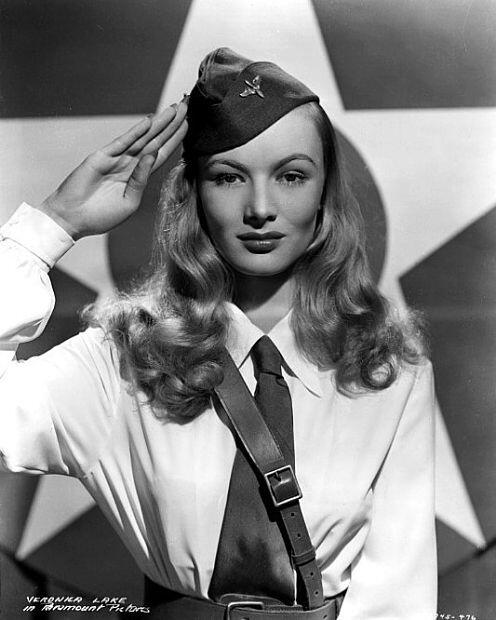
Showing posts with label Veronica Lake. Show all posts

Thursday, November 20, 2025

THE STYLE OF VERONICA LAKE

1940s Hollywood was a time of dynamic change and artistic innovation, and few stars embodied this era like Veronica Lake. Known for her striking beauty and signature peekaboo hairstyle, Lake became an iconic figure of film noir during the 1940s. With her captivating screen presence, she starred alongside some of Hollywood's most celebrated actors, including Alan Ladd in This Gun for Hire (1942), a film that helped establish both of their careers. Her sultry look and enigmatic allure quickly made her one of the era's most beloved actresses, with her films drawing large audiences who adored her blend of glamour and grit. She became a major star at Paramount Pictures, where she was cast in a series of successful noir thrillers, establishing herself as a defining figure in the genre.

However, despite her early success, Veronica Lake's career faced difficulties as the 1940s progressed. Her troubled personal life, including a series of difficult marriages and struggles with alcoholism, often overshadowed her professional achievements. Nevertheless, she continued to make a significant impact in the industry. In the mid-1940s, Lake's popularity began to wane, but she remained a powerful symbol of the 1940s femme fatale. She had a complex legacy as an actress who helped shape the golden age of film noir and set the standard for many of the actresses who followed. While other stars of the time, like Rita Hayworth and Ava Gardner, carried on with more sustained careers, Lake's life and career are often seen as a cautionary tale of fame's fleeting nature.

Despite the ups and downs of her career, Veronica Lake's contribution to Hollywood is undeniable. Her image, forever captured in iconic films like The Blue Dahlia (1946), remains a staple of the classic Hollywood aesthetic. Her sultry screen persona influenced a generation of actresses, and her distinctive look – from her platinum blonde hair to her mischievous smile – is still celebrated in pop culture today. Lake's legacy endures not just in her films but also in the fashion and beauty trends she set. The peekaboo hairstyle, a defining feature of her image, remains one of the most recognizable styles of the 1940s, symbolizing the blend of glamour and mystery that defined her career and the era she represented...


Thursday, November 14, 2019

BORN ON THIS DAY: VERONICA LAKE

One of the tragic stars of Hollywood was Veronica Lake. However, she was one of the beautiful in her day.  Lake was born Constance Frances Marie Ockelman in the New York City borough of Brooklyn in 1922. Her father, Harry Eugene Ockelman, was of German and Irish descent,, and worked for an oil company aboard a ship. He died in an industrial explosion in Philadelphia in 1932. Lake's mother, Constance Frances Charlotta (née Trimble; 1902–1992), of Irish descent, married Anthony Keane, a newspaper staff artist, also of Irish descent, in 1933, and Lake began using his surname.

The Keanes lived in Saranac Lake, New York, where young Lake attended St. Bernard's School. She was then sent to Villa Maria, an all-girls Catholic boarding school in Montreal, Quebec, Canada, from which she was expelled. Lake later claimed she attended McGill University and took a premed course for a year, intending to become a surgeon. This claim was included in several press biographies, although Lake later declared it was bogus. Lake subsequently apologized to the president of McGill, who was simply amused when she explained her habit of self-dramatizing. When her stepfather fell ill during her second year, the Keane family later moved to Miami, Florida. Lake attended Miami High School, where she was known for her beauty. She had a troubled childhood and was diagnosed with schizophrenia, according to her mother.


In 1938, the Keanes moved to Beverly Hills, California. While briefly under contract to MGM, Lake enrolled in that studio's acting farm, the Bliss-Hayden School of Acting (now the Beverly Hills Playhouse). She made friends with a girl named Gwen Horn and accompanied her when Horn went to audition at RKO. She appeared in the play Thought for Food in January 1939. A theatre critic from the Los Angeles Times called her "a fetching little trick" for her appearance in She Made Her Bed.

She also appeared as an extra in a number of movies. Keane's first appearance on screen was for RKO, playing a small role among several coeds in the film Sorority House (1939). The part wound up being cut from the film, but she was encouraged to continue. Similar roles followed, including All Women Have Secrets (1939), Dancing Co-Ed (also 1939), Young as Your Feel (1940), and Forty Little Mothers (also 1940). Forty Little Mothers was the first time she let her hair down on screen.

Lake attracted the interest of Fred Wilcox, an assistant director, who shot a test scene of her performing from a play and showed it to an agent. The agent, in turn, showed it to producer Arthur Hornblow Jr., who was looking for a new girl to play the part of a nightclub singer in a military drama, I Wanted Wings (1940). The role would make Lake, still in her teens, a star. Hornblow changed the actress's name to Veronica Lake. According to him, her eyes, "calm and clear like a blue lake", were the inspiration for her new name. The rest is movie noir history, and it is sad that her last years were spent in illness and forgotten memories. Today, as always, we can celebrate the life of Veronica Lake...


Monday, July 4, 2016

PHOTOS OF THE DAY: CLASSIC PATRIOTIC HOLLYWOOD

What present Hollywood is missing in its stars is a sense of patriotism. Classic Hollywood really rallied about the country, especially during World War II. On this 4th of July, I thought I would take a look at some of the patriotic pictures from classic Hollywood...

Ann Miller (1923-2004)

Ava Gardner (1922-1990)


Claudette Colbert (1903-1996)


Colleen Moore (1899-1988)


Cyd Charisse (1922-2008)

Veronica Lake (1922-1973)


Friday, March 7, 2014

THE LAST DAYS OF VERONICA LAKE

One of the most beautiful visions of 1940s films was that of Veronica Lake. With her "peek-a-boo bang" she was an iconic image of film noirs. Some of her popular films of the time included ‘This Gun for Hire’, ‘The Hour Before Dawn’, ‘Hold That Blonde’, and ‘Out of this World’ among others. Veronica was a big screen name in the 1940s and her success in acting seemed unstoppable.

By the early 1950's however, Lake's career had hit the skids. Still suffering from schizophrenia, and in a state of paranoia, she turned to drinking heavily to relieve herself from the burden. This only added to her deteriorating mental state and, with the stress of three broken marriages, a domineering stage mother, a manic depressive personality, and a self destructive addiction to liquor she pushed herself over the edge. After 1952, she would make only two more films, both grade B horror flicks. The beautiful super star with the peekaboo hair do, who entertained and inspired so many, never received the professional help which would have saved her from the mental suffering and she would endure it alone. She eventually frequented cheap hotels in New York City and worked as a bartender where she obtained a steady supply of booze. She never revealed her true identity and even her co-workers were in the dark about her glamorous past.

By the late 1960's she had reached rock bottom, holing up in her apartment out of paranoid fears that the FBI was following her and tapping her phone. Those who knew her in the 60's said that the once great beauty had turned into a worn out mess, with rotting teeth, unwashed hair, and the pasty complexion of a bloated alcoholic. Saranac Lake native, James Quigley, recalls an encounter with her while she was working at a popular New York City bar at #1 Fifth Avenue in the 60's. He introduced himself as a Saranac Laker and Veronica seemed happy to meet someone from her old hometown. Jim said "I went to the bar at #1 Fifth Avenue, a very chic and popular bar for New Yorkers. Veronica was tending bar and when I told her I was from Saranac Lake she cried, kissed me and continuted to work. What a moment!"
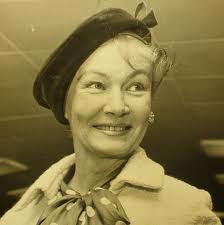
 
  In the early 1970s Veronica made a brief return to the spotlight with the publication of her autobiography, which earned her enough cash to relocate to the British Isles. She married for a fourth time- to an English sea captain, a commercial fisherman known as "Captain Bob" but that soon ended in divorce. In early 1973, she returned to the states. According to the doctors who treated her, she was already "pretty far along" with an acute case of hepatitis and she was not long in Saranac Lake before she was admitted to Will Rogers Hospital. According to her doctor in Vermont, Warren Beeken, Saranac Lake did not have the resources to treat her as well as the Medical Center in Burlington, so on June 26, 1973 she was transferred to the Fletcher Allen Hospital.

 
 Her presence in the hospital was not publicized- because, according to her publicist William Roos- "Frankly, I didn't think she was going to die". He was not aware of the extreme state of her medical condition. According to Dr. Beeken, her case of hepatitis had persisted for some time before she entered the Fletcher Allen Hospital, and her condition had deteriorated rapidly. Word of her true identity quickly spread throughout the facility, and the hospital staff visited her room to pay their respects. She visibly brightened due to the attention, signing autographs for the nurses and speaking confidently of future plans. According to one nurse who attended her in her final days, "She was very cheerful and friendly, happy and looking forward to the future, and still retained a shadow of her former beauty." Yet, she was also utterly and completely alone- with no guests or phone calls, a sad state for one once so well known. Dr. Beeken looked in on her one last time on the evening on July 6, when acute renal failure had set in.

Early on the morning of July 7, 1973, Veronica Lake passed away, alone and forgotten at age of 50. After hearing of his mother's death, her son Michael, who lived in Hawaii, asked his father, Lake's 3rd ex-husband, Andre de Toth, for money to fly to Vermont, but his request was denied. Michael had to take a loan out to fly to Vermont to claim the body from the Corbin Palmer funeral home, located near the Fletcher Allen hospital. She was then cremated but her ashes were stored at the funeral home until payment could be made. Her sparsely attended Manhattan memorial service was paid for by a friend, veteran ghostwriter Donald Bain, who penned Lake's incomplete autobiography.

Not even her ashes made the event; as they were still stored at the funeral home in a squabble over money. Her ashes remained there until March 1976, when two friends volunteered to bring Lake's ashes to Florida. Bain sent the funeral home $200 to cover the back storage fees, and the ashes were shipped to the Park Avenue residence of a friend, William Roos. Roos and Dick Toman supposedly took the ashes south for their ceremonial deposit in the water off Miami but it appears that this isn't the end of the story. It is claimed that the ashes somehow found their way to a curio shop in the Catskills, a place called 'Langley's Mystery Spot', in Phoenicia, N.Y. Even in death, Veronica Lake did not get the respect and recognition she deserved. It was a shame and a tragedy...


Saturday, September 3, 2011

BORN ON THIS DAY: ALAN LADD

I consider myself to be somewhat of a classic movie fan, but I have to admit I have not seen many movies starring Alan Ladd. I can probably count the amount of them on one hand. In his short life, Ladd was a memorable movie star, and he was born on this day, September 3rd in 1913.

Ladd was born in Hot Springs, Arkansas. He was the only child of Ina Raleigh Ladd and Alan Ladd, Sr. He was of English ancestry. His father died when he was four, and his mother relocated to Oklahoma City where she married Jim Beavers, a housepainter. The family then moved again to North Hollywood, California where Ladd became a high-school swimming and diving champion and participated in high school dramatics at North Hollywood High School, graduating on February 1st, 1934. He opened his own hamburger and malt shop, which he called Tiny's Patio. He worked briefly as a studio carpenter (as did his stepfather) and for a short time was part of the Universal Pictures studio school for actors. But Universal decided he was too blond and too short and dropped him. Intent on acting, he found work in radio.


Ladd went on to star in many Paramount Pictures' films, with a brief timeout for military service in the United States Army Air Force's First Motion Picture Unit. He appeared in Dashiell Hammett's story The Glass Key, his second pairing with Lake, and Lucky Jordan, with Helen Walker. His cool, unsmiling persona proved popular with wartime audiences, and he was quickly established as one of the top box office stars of the decade.

In 1946, he starred in a trio of silver screen classics: the big screen adaptation of Richard Henry Dana's maritime classic, Two Years Before the Mast (for which he also received critical acclaim), the Raymond Chandler original mystery The Blue Dahlia (his third pairing with Lake), and the World War II espionage thriller, O.S.S..

He formed his own production companies for film and radio and then starred in his own syndicated series Box 13, which ran from 1948-49. Ladd and Robert Preston starred in the 1948 western film, Whispering Smith, which in 1961 would become a short-lived NBC television series, starring Audie Murphy.


When former agent Albert R. Broccoli formed Warwick Films with his partner Irving Allen, they heard Ladd was unhappy with Paramount and was leaving the studio. With his wife and agent Sue Carol, they negotiated for Ladd to appear in the first three of their films made in England and released through Columbia Pictures The Red Beret/Paratrooper (1953), Hell Below Zero (based on Hammond Innes's book The White South) (1954) and The Black Knight with each co-written by Ladd's regular screenwriter Richard Maibaum. (1954). In 1954 Ladd formed a new production company, Jaguar Productions, originally releasing his films through Warner Bros. and then with All the Young Men through Columbia.

In November 1962, he was found lying unconscious in a pool of blood with a bullet wound near his heart, an unsuccessful suicide attempt. In 1963 Ladd filmed a supporting role in The Carpetbaggers. He would not live to see its release. On January 29, 1964 he was found dead in Palm Springs, California, of an acute overdose of "alcohol and three other drugs", at the age of 50; his death was ruled accidental. He was entombed in the Forest Lawn Memorial Park Cemetery in Glendale, California. Not until June 28, 1964 did Carpetbaggers producer Joseph E. Levine hold an elaborate premiere screening in New York City with an afterparty staged by his wife at The Four Seasons Restaurant...