Showing posts with label Shemp Howard. Show all posts

Tuesday, August 28, 2018

CURLY JOE DERITA: THE LAST STOOGE

My son and daughter are both old enough now to appreciate the comedy of The Three Stooges. It makes me happy that their comedy transcends decades and generations. The best comedies are the early ones with Curly Howard, but it is worth noting that each Stooge that tried to replace him each brought something new to the role. The final stooge that was a part of the group was Joe "Curly Joe" DeRita. He was born Joseph Wardell on July 12, 1909. DeRita was born into a show-business family in Philadelphia, Pennsylvania, the son of Florenz (DeRita) and Frank Wardell, and of French-Canadian and English ancestry. He was the youngest of his 5 brothers. Wardell's father was a stage technician, his mother a professional stage dancer, and the three often acted on stage together from his early childhood.

Taking his mother's maiden name, DeRita, the actor joined the burlesque circuit during the 1920s, gaining fame as a comedian. During World War II, DeRita joined the USO, performing through Britain and France with such celebrities as Bing Crosby and Randolph Scott. In the 1944 comedy film The Doughgirls, about the housing shortage in wartime Washington, D.C., he had an uncredited role as "the Stranger", a bewildered man who repeatedly showed up in scenes looking for a place to sleep.


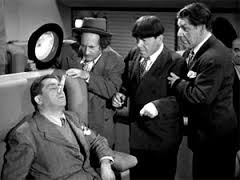
The Three Stooges (Curly Howard, Larry Fine, and Moe Howard) had been making short comedies for Columbia Pictures since 1934. Curly suffered a disaling stroke on May 6, 1946, forcing him to retire. He died on January 18, 1952 at the age of 48. His brother Shemp Howard, the original third Stooge before leaving the act in 1932 for a solo career, only wanted to be a temporary replacement. Joe DeRita was also starring in his own series of shorts at Columbia (in The Good Bad Egg, Wedlock Deadlock, Slappily Married, and Jitter Bughouse). Stooges producer-director Jules White attempted to recruit Joe DeRita for the Three Stooges, because he wanted "another Curly." However, the strong-willed DeRita refused to change his act or imitate another performer, and White eventually gave up on DeRita (DeRita's own short-subject contract was not renewed after four films, the final entry being Jitter Bughouse). DeRita returned to burlesque and recorded a risque LP in 1950 called Burlesque Uncensored.

When Shemp Howard died unexpectedly of a heart attack on November 22, 1955 at age 60, he was succeeded by Joe Besser. Columbia eventually shut down the short-subjects department at the end of 1957, and Besser quit the act to take care of his ailing wife. The two remaining Stooges seriously considered retirement. Then Columbia's television subsidiary, Screen Gems, syndicated the Stooges' old comedies to television, and the Three Stooges were suddenly television superstars.


Moe and Larry now had many job offers, but they were in need of a "third Stooge." Larry had seen DeRita in a Las Vegas stage engagement and told Moe that DeRita would be "perfect for the third Stooge." Howard and Fine invited DeRita to join the act, and this time he readily accepted. When he first joined the act in 1958 (shortly after appearing in a dramatic role in the Gregory Peck western, The Bravados), DeRita wore his hair in a style similar to that of former Stooge Shemp Howard and did so during initial live stage performances. However, with television's restored popularity of the Three Stooges shorts featuring Curly Howard, it was suggested that Joe shave his head in order to look more like "Curly". At first, DeRita sported a crew cut; this eventually became a fully shaven head. Because of his physical resemblance to both Curly and Joe Besser, and to avoid confusion with his predecessors, DeRita was renamed Curly Joe.

The team embarked on a new series of six theatrical Three Stooges films, including Have Rocket, Will Travel (1959), DeRita's on-screen debut with the Stooges, and Snow White and the Three Stooges (1961). Aimed primarily at children, these films rarely reached the same comedic heights as their shorts and often recycled routines and songs from the older films. (Moe and Larry's advanced ages - Moe was 62 and Larry 57 at the time of the first Curly Joe film - plus pressure from the PTA and other children's advocates, led to the toning-down of the trio's trademark violent slapstick.) While DeRita's physical appearance was vaguely reminiscent of the original "Curly", his characterization was milder and not as manic or surreal. The characterization evolved over time; early sketches featuring Curly Joe (such as a commercial for Simoniz car wax) have him effectively as a fifth wheel while Moe and Larry divided most of the comedy between themselves, while by the mid-1960s, Larry's role had been reduced and Curly Joe divided much of the comedy with Moe. Curly Joe also showed a bit more backbone, even occasionally talking back to Moe, calling him "buddy boy".


The Stooges eventually folded in 1970 when Larry Fine suffered a stroke, although Moe always had dreams or recreating the group. In 1974, with Moe's blessing, DeRita attempted to form a truly "new" Three Stooges. He recruited burlesque and vaudeville veterans Mousie Garner and Frank Mitchell to replace Moe and Larry for nightclub engagements. However, they were poorly received thereby ending the group. Mitchell had worked with original Stooges organizer Ted Healy decades earlier in an abortive attempt to replace the Stooges after they had split from Healy. Mitchell had also replaced Shemp as the "third stooge" in a 1929 Broadway play.

On July 3, 1993, the last surviving Stooge, Joe DeRita died of pneumonia nine days before his 84th birthday at the Motion Picture & Television Country House and Hospital in Woodland Hills, California. DeRita is interred in a grave at the Pierce Brothers Valhalla Memorial Park Cemetery in North Hollywood, California; his tombstone reads "The Last Stooge"...


Wednesday, April 8, 2015

THE THREE STOOGES: THE FALL OF CURLY

As early as 1942, the life of a stooge had begun to take its toll on Curly. Playing a human punchbag day in, day out for years, enduring constant blows to the head — most of which, according to Moe Howard, were every bit as real as they looked — brought on a series of minor cerebral haemorrhages that slowed him down to the point that he was unable to make personal appearances. Shemp, now under contract to Columbia himself, was brought in to replace Curly in live performances. Curly’s doctors insisted that he also take time off from his punishing filming schedule. Cohn flatly refused to give Curly leave of absence, and it was not long before his declining health became evident on screen. His deterioration can first be seen in 1945 short If A Body Meet A Body. By this time, Curly was forgetting his lines, and his balletic physicality and tireless energy, vital components of the Stooges’ comedy, were visibly ebbing away.

There’s no doubt that Curly’s hard-partying lifestyle contributed to his health problems — he was a massive drinker and, pinhead appearances to the contrary, a voracious womaniser — but neither is there any disputing that Harry Cohn forced him to keep working while he was clearly seriously ill, exacerbating his condition until, later in 1945, the inevitable happened and Curly, aged 42, suffered his first major stroke.

This should have signalled, at the very least, an extended period of rest and recuperation. Yet, incredibly, he was back at work within a month, despite physical impairments that rendered his performances so sluggish and lacklustre they’re painful to watch. The team’s directors, most often Del Lord or Edward Bernds, attempted to disguise Curly’s dire state by using old footage and putting more emphasis on Moe and Larry. For their part, the other Stooges took on the extra responsibility willingly, hoping that Curly would eventually recover sufficiently to resume his role. The results of this combined effort were better than might be expected, in spite of Curly’s infirmity and ravaged appearance (his fat cherub look was a thing of the past).


But it was a losing battle and in 1946, between takes on the short Half-Wits Holiday (a remake of the 1935 two-reeler, Hoi Polloi), Curly suffered a massive, paralysing stroke. His days as a Stooge were over, his career and his health wrecked by dedication to the un-gentle art of slapstick and by Harry Cohn’s gross callousness — callousness compounded with stupidity since his treatment of Curly had cost him one of his studio’s most valuable assets.

Naturally, Cohn didn’t see things that way. His opinion of the Stooges, even while they were raking in money, was that their act was so lacking in sophistication that they were effectively interchangeable, and that pretty much any comic performer who looked funny enough could fill Curly’s shoes in a second. In this he was as mistaken as many observers have been since. The Stooges might not have had the finesse of Chaplin or Keaton, the humanity of Laurel & Hardy or the transcendent novelty of the Marx Brothers, but their chemistry was unique. And if it was not immediately apparent to Cohn what replacing Curly entailed, the endless auditions for a new third Stooge alerted him to what Moe and Larry already knew: they were not going to find another Curly. Curly died tragically on January 28, 1952 at the age of 48...


SOURCE

Tuesday, December 4, 2012

THE LAST DAYS OF TED HEALY


In prior articles, I posted stories on one of my favorite comedy team - The Three Stooges. Three brothers - Moe, Shemp, and Curly Howard along with Larry Fine were comic geniuses for decades. However, behind every comedy team is usually a good manager or producer who really discovers their talent and makes them into stars. That person on the side of The Three Stooges was Ted Healy.

Ted Healy was born on October 1, 1896 and although he is chiefly remembered today as the creator of The Three Stooges, he also had a successful stage and film career of his own. Healy discovered the act in 1925 as they were performing on vaudville. They were originally billed as "Ted Healy And His Stooges", but the trio broke away from Healy in 1934 due to his mismanagement of them and their finances.


Healy went on to establish a promising career in motion pictures, where he was successful in both comedic roles (where he was often grouped with new "stooges", including Jimmy Brewster, Red Pearson and Sammy Glasser) and dramatic roles. After Larry Fine, Moe Howard and Curly Howard left his act in 1934, Healy appeared in a succession of films for 20th Century Fox, Warner Brothers, and MGM. During this period, Healy took to wearing a full toupée in public. He was 41 and under contract to MGM at the time of his death on December 21, 1937, a few hours after preview audiences had acclaimed his work in the Warner Brothers film Hollywood Hotel

A cloud of mystery still hangs over the cause of Healy's death. Newspaper accounts attributed it to serious head injuries sustained in a nightclub brawl while celebrating the birth of his first child. Conflicting reports claimed the comedian died of a heart attack at his Los Angeles home. The death certificate issued by the state of California lists his cause of death as nephritis, or inflammation of the kidneys.

Two days before his death, Healy had visited Moe Howard's wife, Helen, at their Hollywood apartment with the news that Betty (Hickman), his second wife, was pregnant. Excited at the prospect of his first child, he told Howard's wife, "I'll make him the richest kid in the world." Howard later stated in an interview that Healy had always wanted children and that it was ironic that the impending birth of his first child shortly preceded his own death. Howard recalled, "He was nuts about kids. He used to visit our homes and envied the fact that we were all married and had children. Healy always loved kids and often gave Christmas parties for underprivileged youngsters and spent hundreds of dollars on toys."


At the time of Healy's death, the Stooges (consisting of Moe, Larry, and Curly) were at Grand Central Terminal in New York City preparing to leave for a personal appearance in Boston. Before their departure, Howard called Rube Jackter, head of Columbia Pictures' sales department, to confirm their benefit performance at Boston's Children's Hospital. During the conversation, Jackter told Howard that the night editor of The New York Times wanted to talk to him. Howard phoned The Times. The editor, without even a greeting, queried curtly, "Is this Moe?" Howard said it was. The editor then asked, "Would you like to make a statement on the death of Ted Healy?" Howard was stunned. He dropped the phone. Folding his arms over his head, Howard started to sob. Curly and Larry rushed into the phone booth to warn Howard that their train was about to leave. They found him crumpled over, crying. Since Howard seldom openly showed his emotions, Larry cracked to Curly, "Your brother's nuts. He is actually crying." Howard did not explain the reason for his emotional breakdown until he boarded the train. When they arrived back in Hollywood, they learned the details of Healy's death from a writer friend, Henry Taylor. Taylor told Howard that Healy had been out drinking at the Trocadero nightclub on the Sunset Strip, and an argument broke out with three college boys. Healy called them vile names and offered to go outside the club to take care of them one at a time. Once outside, Ted did not have a chance to raise his fists. The three men jumped him, knocked him to the ground and kicked him in the head, ribs and stomach. Healy's friend actor Joe Frisco came on the scene, picked him up from the sidewalk and took him to his apartment, where Ted died of what medical officials initially called a brain concussion.


However, a very different account asserts that Healy was beaten to death by screen legend Wallace Beery, Albert R. Broccoli (later producer of James Bond films), and notorious gangster (and Broccoli's cousin) Pat DiCicco. This account appears in E. J. Fleming's book The Fixers: Eddie Mannix, Howard Strickling, and the MGM Publicity Machine (2004) about legendary MGM "fixers" Mannix and Strickling. Under orders from studio head Louis B. Mayer, MGM sent Beery, one of their most valuable properties, to Europe for several months, while the story of the "three college boys" was fabricated to conceal the truth. (Immigration records confirm a four-month trip to Europe on Beery's part immediately after Healy's death, ending April 17, 1938). There is no proof or creditibility that this is the case though.

Despite his sizable salary, Ted Healy died penniless. MGM's staff members started a fund to pay for his burial. Moe Howard later mentioned that producer Bryan Foy of the famed Foy family of vaudevillians footed a sizeable portion of the bill for the funeral. According to Howard, even in the heyday of his stage career, Ted refused to save money and spent every dime of his salary as fast as he earned it. Healy loved betting on horses, and his favorite reading matter was race track charts.

Healy was survived by his widow, Betty Healy (née Hickman, whom he married on May 15, 1936) and his son, John Jacob Nash — who was baptized in St. Augustine's Church, opposite MGM, a week after Healy's death. John Nash, who legally changed his name to Theodore John Healy in 1959, died on July 16, 2011 from liver failure as a complication of prostate cancer in Stone Mountain, Georgia, a suburb of Atlanta. The death of Ted Healy was a sad death in stark contrast to all the laughs and fun he was responsible for giving vaudville and movie audiences through the years...

Friday, August 3, 2012

SHEMP HOWARD: THE PART TIME STOOGE

Last year I wrote three articles on the Three Stooges. I wrote about the golden age of the Stooges with Moe, Larry, and Curly. However, another stooge who filled in after Curly got sick and late died, should not be forgotten. I consider himself a part time stooge and that is Shemp Howard.

Born on March 11, 1895 Shemp was eaised in Manhattan, New York. He was the third of the five Horwitz brothers and of Lithuanian Jewish ancestry. Shemp Howard, like many New York-based performers, found work at the Vitaphone studio in Brooklyn. Originally playing bit roles in Vitaphone's Roscoe Arbuckle comedies, showing off his goofy appearance, he was entrusted with speaking roles and supporting parts almost immediately.

He was featured with Vitaphone comics Jack Haley, Ben Blue, and Gus Shy, then co-starred with Harry Gribbon, Daphne Pollard, and Johnnie Berkes, and finally starred in his own two-reel comedies. (A 1934 Gribbon-Howard short, Art Trouble, also featured the then unknown James Stewart in his first film role.) Shemp would seldom stick to the script, and would liven up a scene with ad-libbed, incidental dialogue or wisecracks. This became a trademark of his performances. Late 1935 Vitaphone licensed rights to produce short comedies based on the "Joe Palooka" comic strip. Shemp was cast as "Knobby Walsh" and although he was only a supporting character, Shemp became the comic focus of the series, with Johnny Berkes and Lee Weber as his foils. Shemp costarred in the first seven shorts, released during 1936 and 1937; nine were produced all together, with the last two done after Shemp left Vitaphone to move to greener pastures on the West Coast.

Away from Vitaphone he attempted, unsuccessfully, to lead his own group of "stooges" in the Van Beuren musical comedy short The Knife of the Party. Otherwise, Shemp Howard's solo career was very successful. He followed his brothers' lead, moved to the West Coast in 1937, and picked up supporting actor roles at several studios, predominantly at Columbia Pictures and Universal Studios. He performed with such comic greats as W. C. Fields, with whom he played the bartender in the 1940 film The Bank Dick, and the comedy team Abbott and Costello, who would reportedly trim his scene-stealing material. He also lent comic relief to Charlie Chan and The Thin Man murder mysteries, and was in several Universal B-musicals of the early 1940s, among them Strictly in the Groove, How's About It?, Moonlight and Cactus, and San Antonio Rose, in which he is paired with Lon Chaney, Jr. as a faux Abbott and Costello. In most of these, his improvisational skills are highlighted. He was briefly teamed with comedians Billy Gilbert and Maxie Rosenbloom for three B-comedy features in 1944–45. He also played a few dramatic parts, such as his supporting role in Pittsburgh (1942) starring Marlene Dietrich and John Wayne.


From 1939 onwards, Shemp appeared frequently in Columbia's two-reel comedies, co-starring with Columbia regulars Andy Clyde, The Glove Slingers, El Brendel, and Tom Kennedy. Howard was given his own starring series in 1944; he was working for Columbia in this capacity when his brother Curly was felled by a debilitating stroke on May 6, 1946. Shemp reluctantly replaced Curly in Columbia's popular Stooge shorts, knowing that Moe and Larry would be out of work if he refused. Initially, Shemp rejoined the Stooges on a temporary basis until Curly recovered, but as Curly's condition worsened, it became apparent that Shemp's association with the Stooges would be permanent. (Prior to replacing Curly on film, Shemp had substituted for his brother in some personal appearances in the early 1940s.)

Shemp's take as the third Stooge was much different from Curly's. While he could still roll with the punches as the recipient of Moe's slapstick abuse, he was more of a laid-back dimwit versus Curly's energetic man-child persona. And unlike Curly, who had many distinct mannerisms, Shemp's most notable characteristic as a Stooge was a high-pitched "bee-bee-bee-bee-bee-bee!" sound, a sort of soft screech done by inhaling. This was rather multi-purpose, as Shemp uttered this sound when scared, sleeping (done as a form of snoring), overtly happy, or dazed.

Shemp appeared with Moe and Larry in 73 short subjects and the feature film Gold Raiders. He suffered a mild stroke in November 1952, though he recovered from it within weeks and without noticeable effect on his remaining films with the Stooges (largely remakes of earlier films that recycled footage to reduce costs).


On November 22, 1955, while returning home by taxicab from attending a boxing match (one of Shemp's favorite pastimes), Shemp died of a heart attack. Shemp was lighting a cigar after telling a joke when he suddenly slumped over on his friend Al Winston's lap. Moe Howard's autobiography states that Shemp died on November 23, 1955 and most subsequent accounts point to that date because of Moe's book. But much of Moe's book was finished posthumously by his daughter and son-in-law, and some specific details were confused as a result.

The Los Angeles county coroner death certificate states that Shemp Howard died on Tuesday November 22, 1955 at 11:35 PST; confirming that, Shemp's obituary appeared in the November 23 afternoon editions of L.A. newspapers, establishing the night of November 22 as the date of death. He was entombed at Home of Peace Cemetery in East Los Angeles, the same place his brother Curly was buried.


Even though Shemp was no Curly, the shorts he made with the other Stooges and every other film appearance was worth seeing. Shemp did not appear with the team in all of their short, but on even his solo work he was a stooge at heart and a stooge that should be regarded with comic admiration...