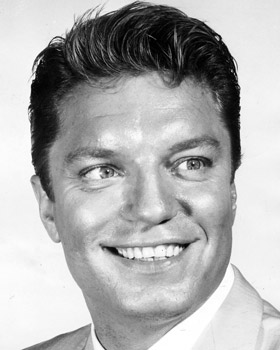
Here is an interesting article from the Chicago Tribune on January 21, 1966...
EVEN WHEN HE COOKS, DENNIS HAS EAGER AUDIENCE--HIS BIG FAMILY
By Freida Zylstra
Hollywood--Dennis Day is one performer who never has to worry about a full house when he is singing his do-re-mi's or when he is practicing the ABC's of cookery.
"With nine eager and always hungry sons and daughters I'm assured of an audience," he says. "I like to barbecue-broil steaks and chops, make endless varieties of Dagwood sandwiches, and originate marinating sauces."
"Dennis is no menace in the kitchen," Mrs. Day adds. "He often does the weekly marketing and is an excellent host when we entertain."
Dennis, whose real name is Eugene Dennis McNulty, was born in New York City. He began singing as a child at family, school, and church affairs. He graduated with honors from Manhattan college and after serving in the navy resumed his singing career on radio and in night clubs. It was Mary Livingston who "discovered" Dennis for the Jack Benny radio shows. In 1948 Dennis married Peggy Almquist. The Days' nine children are 17 years old, 16, 15, 13, 11, 10, 7, 4 and 2. The family lives in a rambling two story ranch house in a canyon in West Los Angeles. They have a stable with two horses and enjoy their swimming pool and outdoor patio, barbecue and game area.
"We recently remodeled our kitchen to accomodate cooking n a grand scale," Dennis said. "We now have three ovens, two warming ovens and two dish washers--not counting my wife."
When the Days entertain they consider 20 or 30 an average group around the table--"and usually more than half of them are children," Dennis commented.
Because of the differences in the children's schedules, Mrs. Day usually cooks and serves in shifts. She has a great collection of recipes and dishes that keep or "hold" in the warming ovens.
"We like Italian foods--lasgna and other baked casserole specialties," Dennis said. "Peggy and I like to study foreign cookbooks for new ideas."
Among Peggy's favorite casseroles are wild rice baked with chunks of creamed chicken and mushrooms and a casserole of hard cooked eggs, sliced in a rich cream sauce with shreds of either turkey or ham.
One of the Days' favorite hors d'oeuvres is made of small, thinly sliced white bread rounds, toasted on one side, buttered on the other, and spread with a seasoned mixture of beaten egg whites, grated swiss cheese, finely grated red and green peppers, and minced parsley. The mixture is spread on the bread rounds, topped with a few bits of chopped raw bacon and then slowly broiled until browned.
"This one is different," Dennis commented. "Guests love it, but never know for sure what it is."
A popular make-ahead vegetable dish that the Day family likes is baked zucchini. "It's a delicious combination with almost any other meat or main dish," Peggy said.
Her recipe follows:
BAKED ZUCCHINI CASSEROLE
(Six Servings)
1 1/2 pounds fresh zucchini
2 tablespoons butter
1/4 cup grated parmesan cheese
1 onion, chopped, sauteed
2 cups tomato sauce,
(combine Italian and Mexican tomato sauce, or season to taste with oregano or basil)
1 cup seasoned cracker or bread crumbs
6 to 8 slices mozzarella cheese
Cut washed squash in quarters and saute lightly in butter, covering to steam cook, about 3 or 4 minutes. Place in baking dish and sprinkle with parmesan cheese and sauteed onions. Cover with sauce and top with crumbs. Heat thoroughly in oven at 325 degrees for about half an hour. Just before serving, place slices of mozzarella cheese on top and heat just enough to melt cheese...
SOURCE
Tuesday, November 13, 2012
Sunday, November 11, 2012
MEMORIES OF MARTHA RAYE
I received this story in an email from my mother. It's very interesting and shows what kind of a person Martha Raye was...
The most unforgivable oversight of TV is that Martha Raye's USO shows were not taped. I was unaware of her credentials or where she is buried. Somehow I just can't see Brittany Spears, Paris Hilton, or Jessica Simpson doing what this woman (and the other USO women, including Ann Margaret & Joey Heatherton) did for our troops in past wars. Most of the old time entertainers were made of a lot sterner stuff than today's crop of activists bland whiners. The following is from an Army Aviator who takes a trip down memory lane:
It was just before Thanksgiving '67 and we were ferrying dead and wounded from a large GRF west of Pleiku. We had run out of body bags by noon, so the Hook (CH-47 CHINOOK) was pretty rough in the back. All of a sudden, we heard a 'take-charge' woman's voice in the rear.There was the singer and actress, Martha Raye, with a SF (Special Forces) beret and jungle fatigues, with subdued markings, helping the wounded into the Chinook, and carrying the dead aboard. 'Maggie' had been visiting her SF 'heroes' out 'west'.We took off, short of fuel, and headed to the USAF hospital pad at Pleiku.
As we all started unloading our sad pax's, a 'Smart Mouth' USAF Captain said to Martha.... "Ms Raye, with all these dead and wounded to process, there would not be time for your show!"
To all of our surprise, she pulled on her right collar and said ....."Captain, see this eagle? I am a full 'Bird' in the US Army Reserve, and on this is a 'Caduceus' which means I am a Nurse, with a surgical specialty....now, take me to your wounded!"He said, "Yes ma'am.... follow me."Several times at the Army Field Hospital in Pleiku, she would 'cover' a surgical shift, giving a nurse a well-deserved break. Martha is the only woman buried in the SF (Special Forces) cemetery at Ft Bragg...
The most unforgivable oversight of TV is that Martha Raye's USO shows were not taped. I was unaware of her credentials or where she is buried. Somehow I just can't see Brittany Spears, Paris Hilton, or Jessica Simpson doing what this woman (and the other USO women, including Ann Margaret & Joey Heatherton) did for our troops in past wars. Most of the old time entertainers were made of a lot sterner stuff than today's crop of activists bland whiners. The following is from an Army Aviator who takes a trip down memory lane:
It was just before Thanksgiving '67 and we were ferrying dead and wounded from a large GRF west of Pleiku. We had run out of body bags by noon, so the Hook (CH-47 CHINOOK) was pretty rough in the back. All of a sudden, we heard a 'take-charge' woman's voice in the rear.There was the singer and actress, Martha Raye, with a SF (Special Forces) beret and jungle fatigues, with subdued markings, helping the wounded into the Chinook, and carrying the dead aboard. 'Maggie' had been visiting her SF 'heroes' out 'west'.We took off, short of fuel, and headed to the USAF hospital pad at Pleiku.
As we all started unloading our sad pax's, a 'Smart Mouth' USAF Captain said to Martha.... "Ms Raye, with all these dead and wounded to process, there would not be time for your show!"
To all of our surprise, she pulled on her right collar and said ....."Captain, see this eagle? I am a full 'Bird' in the US Army Reserve, and on this is a 'Caduceus' which means I am a Nurse, with a surgical specialty....now, take me to your wounded!"He said, "Yes ma'am.... follow me."Several times at the Army Field Hospital in Pleiku, she would 'cover' a surgical shift, giving a nurse a well-deserved break. Martha is the only woman buried in the SF (Special Forces) cemetery at Ft Bragg...
Friday, November 9, 2012
SINGER SPOTLIGHT: GUY MITCHELL
The music industry in the 1950s was quickly changing. After the soldiers came home at the end of World War II, vocalists for the most part became more popular than the big bands. In addition by the early 1950s novelty songs became a fad to music listeners. One music executive that embraced this and really pushed it down the music listener's ears was Mitch Miller. Miller was responsible for much of the music that came out of Columbia Records at this time. In my opinion, he had horrible tastes in music but he did have an eye for talent. One of the greatest singers that he signed to Columbia was crooner Guy Mitchell.
Mitchell was born Al Cernick in Detroit, Michigan in 1927. From an early age it was apparent that he had a remarkable talent for music, especially as a vocalist. This talent led Warner Brothers Pictures to put young Al Cernick under contract as a budding musical personality. In the early forties he did some vocalizing on radio in Los Angeles, then moved up to San Francisco with his family. Besides singing with his high school band, in 1945 he was a country music vocalist in that city. After two years of military service he signed on as male vocalist with the orchestra of Carmen Cavallaro and appeared on recordings made for the Decca label. The first of these was released in early 1948 and featured Al on the tunes "Dream Girl" and "Encore Cherie" for Decca.
Continuing in 1949, Al Cernick now known on record as Al Grant recorded some sides for the King Record label based in Cincinnati, Ohio. With Dewey Bergman he recorded "Cabaret" and "This Day Is Mine". In September of that year "A Frame Without A Picture" and "I Thought I Was Dreaming" was recorded with Rufe Smith. The last King record was released in June of 1950 - "Forget Me Not" with Dewey Bergman. Back on April 1, 1950 Al Grant, aka Al Cernick, was signed to Columbia Records. The A & R man for Columbia was the most important record producer of the time, Mitch Miller, who seemed to develop a Midas Touch since coming over from Mercury Records and bringing Frankie Laine with him. His first order of business was to transform Al Cernick (Grant) into a new personality with a new name to match. Cernick became Guy Mitchell.
By the end of 1950, Mitchell without a big hit at Columbia was struggling, and Mitch Miller took a more hands on approach with Guy Mitchell on the next session and acted as arranger and conductor. The result was "My Heart Cries For You" and "The Roving Kind". Guy Mitchell's days as an unknown entertainer were over.
The song "My Heart Cries For You" was partially written by Percy Faith and was adapted from a song supposedly composed by 18th century French Queen Marie Antoinette. "The Roving Kind" was a long time British sea chanty (originally known as "The Pirate Ship") often performed by Pete Seeger and The Weavers. Both sides were blockbuster sellers and made Guy Mitchell a new force on the popular music scene. Mitchell pulled off the rare double, where each side sold one million records on its own, and a gold record was awarded for each side individually. For more than five months both sides of the record were played constantly on radio and sales kept adding up. The young singer born in the motor city of Yugoslav immigrant parents had made it at last.
Seemingly a spillover effect happened in early 1952. There was so much action on the new release that copies of Mitchell's previous effort for Columbia started selling. And so, "You're Just In Love", the duet with Rosie Clooney, came back and actually made the top twenty five on the hit parade for a few weeks. Taking just a short time to catch his breath at his new fame, Guy Mitchell hit again with his next release for Columbia. "Sparrow In The Treetop" and "Christopher Columbus" on #39190 was out in March and immediately entered the best seller lists. Again it was a two sided hit, though certainly not with the force of his previous hit disc. "Sparrow" got into the top ten and remained on the hit parade for four months, while the flip side charted at number twenty seven and sold moderately well on its own. And so for a time in early 1951, there stood Guy Mitchell with five songs on the best seller lists. Not a shabby accomplishment for someone who saw five years or more of failed opportunities and missed stardom. The tide had turned and Guy Mitchell had arrived in a big way.
In September of 1956 Guy was in the New York studios of Columbia Records with the Ray Coniff Orchestra and put together a snappy tune called "Singing The Blues" and coupled it with "Crazy With Love". The song "Singing The Blues" was a phenomenal seller. It was that rare crossover tune that sold on the pop, country, and R & B charts all at once. It proved that someone besides Elvis could achieve that trifecta. It remained in the number one spot for an unbelievable ten straight weeks, and lasted on the charts for more than five months. It was a multi-million seller, and worldwide tallies put the number at twelve million or more.
Mitchell also starred in a couple of movies - "Those Redheads From Seattle" with Teresa Brewer in 1953 and "Red Garters" with Rosemary Clooney in 1954. Mitchell had a pleasant personality on the screen, but his acting was slightly wooden. On television he starred in his own "Guy Mitchell Show"on U.S. Television he starred in numerous TV Specials in the U.S.A. and here in Britain. Together with Gracie Fields, he starred in the first "Sunday Night At The London Palladium" on Britain's ITV network. On his first visit to Britain, in 1952, he appeared for two weeks at the London Palladium selling every ticket within 24 hours - a box office record that still stands today. One of the highlights of Guy's career was in 1954 when he was honoured to appear in the Royal Variety Show at the London Palladium before Her Majesty, The Queen and Prince Philip.
The 1960's saw a slowing of pace with Guy concentrating on acting rather than singing, although he did score some minor successes, most notably with two excellent 'country' albums "Travelling Shoes" and "Singin' Up A Storm" for the Starday label. He appeared in the NBC western television series"Whispering Smith" in which he starred with his friend Audie Murphy and he even made another movie,"The Wild Westerners".
Life had not always been easy for Guy and he had more than his share of personal problems. Two divorces, illness and alcoholism took their toll. By the mid 1970's Guy had decided to go into semi-retirement and concentrate on ranching.
At the start of the 1980's Guy appeared on a 3 hour U.S.A. television tribute to Mitch Miller. At the end of Guy's 15 minute spot the audience made it clear that he was far from being a forgotten man. As a result Guy was tempted back into the recording studios and, in 1982, an album of many of Guy's hits, newly recorded in stereo, reached No. 2 in the Dutch hit parade. This only emphasised the fact that Guy Mitchell records had never stopped selling. When persuaded to play a 'comeback tour' of Britain in 1984, even the most enthusiastic fan was staggered by the response. A capacity audience of 2000 at London's Barbican Centre gave Guy a standing ovation through three encores - scenes that were to be repeated as the tour progressed around the Country.
1990 saw Guy filming in Scotland for BBC Television. A six one hour series called "YOUR CHEATIN' HEART' gave Guy a cameo roll as Jim Bob O'May with his band 'The Wild Bunch'. Guy sang seven songs in the series which were released on BBC Records. The same year saw Guy appearing in country music concerts including headlining at the Morecambe International Country Music Festival. On New Years Eve, Guy appeared in a three hour television spectacular for ITV live from the London Palladium.
In 1991 Guy returned to Australia for a most successful concert tour, radio and TV. However, Guy was involved in a serious horse riding accident that left him with fractured ribs and severe internal injuries. A period in intensive care was followed by a lengthy stay in a Sydney hospital before he was fit enough to travel home to Las Vegas.
Over the following years Guy made further concert tours of both the U.K. and Australia, concerts in Florida, Chicago and at the Greek Theatre in Los Angeles, at the Mexico State Fair in Albuquerque, the Hacienda Hotel on the 'Strip' in Las Vegas, the Flamingo Hotel in Laughlin, Nevada, and a major tour in California with the Guy Lombardo Orchestra. He became a mainstay in demand at hotels and casinos in Las Vegas. It was there that Guy passed away in July of 1999 at the age of 72 putting an end to a most remarkable career.
Guy Mitchell is not remembered as a top singer as Frank Sinatra or Dean Martin is, and maybe Mitchell came along too late. However, his output for Columbia was tremendous, and he made the studio a ton of money in the 1950s. I don't think I have ever heard a bad Mitchell recording, and I hope more people discover this underrated crooner...
Mitchell was born Al Cernick in Detroit, Michigan in 1927. From an early age it was apparent that he had a remarkable talent for music, especially as a vocalist. This talent led Warner Brothers Pictures to put young Al Cernick under contract as a budding musical personality. In the early forties he did some vocalizing on radio in Los Angeles, then moved up to San Francisco with his family. Besides singing with his high school band, in 1945 he was a country music vocalist in that city. After two years of military service he signed on as male vocalist with the orchestra of Carmen Cavallaro and appeared on recordings made for the Decca label. The first of these was released in early 1948 and featured Al on the tunes "Dream Girl" and "Encore Cherie" for Decca.
Continuing in 1949, Al Cernick now known on record as Al Grant recorded some sides for the King Record label based in Cincinnati, Ohio. With Dewey Bergman he recorded "Cabaret" and "This Day Is Mine". In September of that year "A Frame Without A Picture" and "I Thought I Was Dreaming" was recorded with Rufe Smith. The last King record was released in June of 1950 - "Forget Me Not" with Dewey Bergman. Back on April 1, 1950 Al Grant, aka Al Cernick, was signed to Columbia Records. The A & R man for Columbia was the most important record producer of the time, Mitch Miller, who seemed to develop a Midas Touch since coming over from Mercury Records and bringing Frankie Laine with him. His first order of business was to transform Al Cernick (Grant) into a new personality with a new name to match. Cernick became Guy Mitchell.
By the end of 1950, Mitchell without a big hit at Columbia was struggling, and Mitch Miller took a more hands on approach with Guy Mitchell on the next session and acted as arranger and conductor. The result was "My Heart Cries For You" and "The Roving Kind". Guy Mitchell's days as an unknown entertainer were over.
The song "My Heart Cries For You" was partially written by Percy Faith and was adapted from a song supposedly composed by 18th century French Queen Marie Antoinette. "The Roving Kind" was a long time British sea chanty (originally known as "The Pirate Ship") often performed by Pete Seeger and The Weavers. Both sides were blockbuster sellers and made Guy Mitchell a new force on the popular music scene. Mitchell pulled off the rare double, where each side sold one million records on its own, and a gold record was awarded for each side individually. For more than five months both sides of the record were played constantly on radio and sales kept adding up. The young singer born in the motor city of Yugoslav immigrant parents had made it at last.
Seemingly a spillover effect happened in early 1952. There was so much action on the new release that copies of Mitchell's previous effort for Columbia started selling. And so, "You're Just In Love", the duet with Rosie Clooney, came back and actually made the top twenty five on the hit parade for a few weeks. Taking just a short time to catch his breath at his new fame, Guy Mitchell hit again with his next release for Columbia. "Sparrow In The Treetop" and "Christopher Columbus" on #39190 was out in March and immediately entered the best seller lists. Again it was a two sided hit, though certainly not with the force of his previous hit disc. "Sparrow" got into the top ten and remained on the hit parade for four months, while the flip side charted at number twenty seven and sold moderately well on its own. And so for a time in early 1951, there stood Guy Mitchell with five songs on the best seller lists. Not a shabby accomplishment for someone who saw five years or more of failed opportunities and missed stardom. The tide had turned and Guy Mitchell had arrived in a big way.
In September of 1956 Guy was in the New York studios of Columbia Records with the Ray Coniff Orchestra and put together a snappy tune called "Singing The Blues" and coupled it with "Crazy With Love". The song "Singing The Blues" was a phenomenal seller. It was that rare crossover tune that sold on the pop, country, and R & B charts all at once. It proved that someone besides Elvis could achieve that trifecta. It remained in the number one spot for an unbelievable ten straight weeks, and lasted on the charts for more than five months. It was a multi-million seller, and worldwide tallies put the number at twelve million or more.
Mitchell also starred in a couple of movies - "Those Redheads From Seattle" with Teresa Brewer in 1953 and "Red Garters" with Rosemary Clooney in 1954. Mitchell had a pleasant personality on the screen, but his acting was slightly wooden. On television he starred in his own "Guy Mitchell Show"on U.S. Television he starred in numerous TV Specials in the U.S.A. and here in Britain. Together with Gracie Fields, he starred in the first "Sunday Night At The London Palladium" on Britain's ITV network. On his first visit to Britain, in 1952, he appeared for two weeks at the London Palladium selling every ticket within 24 hours - a box office record that still stands today. One of the highlights of Guy's career was in 1954 when he was honoured to appear in the Royal Variety Show at the London Palladium before Her Majesty, The Queen and Prince Philip.
The 1960's saw a slowing of pace with Guy concentrating on acting rather than singing, although he did score some minor successes, most notably with two excellent 'country' albums "Travelling Shoes" and "Singin' Up A Storm" for the Starday label. He appeared in the NBC western television series"Whispering Smith" in which he starred with his friend Audie Murphy and he even made another movie,"The Wild Westerners".
Life had not always been easy for Guy and he had more than his share of personal problems. Two divorces, illness and alcoholism took their toll. By the mid 1970's Guy had decided to go into semi-retirement and concentrate on ranching.
At the start of the 1980's Guy appeared on a 3 hour U.S.A. television tribute to Mitch Miller. At the end of Guy's 15 minute spot the audience made it clear that he was far from being a forgotten man. As a result Guy was tempted back into the recording studios and, in 1982, an album of many of Guy's hits, newly recorded in stereo, reached No. 2 in the Dutch hit parade. This only emphasised the fact that Guy Mitchell records had never stopped selling. When persuaded to play a 'comeback tour' of Britain in 1984, even the most enthusiastic fan was staggered by the response. A capacity audience of 2000 at London's Barbican Centre gave Guy a standing ovation through three encores - scenes that were to be repeated as the tour progressed around the Country.
1990 saw Guy filming in Scotland for BBC Television. A six one hour series called "YOUR CHEATIN' HEART' gave Guy a cameo roll as Jim Bob O'May with his band 'The Wild Bunch'. Guy sang seven songs in the series which were released on BBC Records. The same year saw Guy appearing in country music concerts including headlining at the Morecambe International Country Music Festival. On New Years Eve, Guy appeared in a three hour television spectacular for ITV live from the London Palladium.
In 1991 Guy returned to Australia for a most successful concert tour, radio and TV. However, Guy was involved in a serious horse riding accident that left him with fractured ribs and severe internal injuries. A period in intensive care was followed by a lengthy stay in a Sydney hospital before he was fit enough to travel home to Las Vegas.
Over the following years Guy made further concert tours of both the U.K. and Australia, concerts in Florida, Chicago and at the Greek Theatre in Los Angeles, at the Mexico State Fair in Albuquerque, the Hacienda Hotel on the 'Strip' in Las Vegas, the Flamingo Hotel in Laughlin, Nevada, and a major tour in California with the Guy Lombardo Orchestra. He became a mainstay in demand at hotels and casinos in Las Vegas. It was there that Guy passed away in July of 1999 at the age of 72 putting an end to a most remarkable career.
Guy Mitchell is not remembered as a top singer as Frank Sinatra or Dean Martin is, and maybe Mitchell came along too late. However, his output for Columbia was tremendous, and he made the studio a ton of money in the 1950s. I don't think I have ever heard a bad Mitchell recording, and I hope more people discover this underrated crooner...
Wednesday, November 7, 2012
EDDIE ANDERSON: MORE THAN ROCHESTER
Anderson was born Edmund Lincoln Anderson on September 15, 1908 in Oakland, California. His father, "Big Ed" Anderson, was a minstrel performer, while his mother, Ella Mae, had been a tightrope walker until her career was ended by a fall. Anderson started in show business as part of an all African-American revue at age 14, later working in vaudeville with his brother, Cornelius. Anderson's vocal cords were ruptured when he was a youngster selling newspapers in San Francisco. The newsboys believed those who were able to shout the loudest sold the most papers. The permanent damage done to his vocal cords left him with the gravel voice familiar to both radio listeners and television viewers over a course of more than twenty years.
Anderson's first appearance on The Jack Benny Program was on March 28, 1937. He was originally hired to play the one-time role of a redcap on the Benny program. The Benny show received a large amount of mail about Anderson's appearances on the radio program; Benny decided to make him part of the cast as his butler and valet, Rochester van Jones. Neither Benny nor Anderson could recall how they came up with the name of Rochester for Anderson's character. Anderson always credited Benny for the invention of the Rochester van Jones name, saying that the name was copyrighted and that Benny later on sold it to him for a dollar.When Anderson became a regular member of the Benny show cast, he became the first African-American to have a regular role on a nationwide radio program.
Among the most highly-paid performers of his time, Anderson invested wisely and became extremely wealthy. Until the 1950s, Anderson was the highest paid African-American actor, receiving an annual salary of $100,000. In 1962, Anderson was on Ebony magazine's list of the 100 wealthiest African-Americans. Despite this, he was so strongly identified with the "Rochester" role that many listeners of the radio program mistakenly persisted in the belief that he was Benny's actual valet. One such listener drove Benny to distraction when he sent him a scolding letter concerning Rochester's alleged pay, and then sent another letter to Anderson, which urged him to sue Benny. In reality, Anderson did well enough to have his own valet. A similar letter came from a correspondent in the South who was angered that on an episode of the radio show where Benny was sparring with Anderson, Benny allowed himself to be struck by Anderson. Benny retorted in a letter that it would not have been humorous the other way around. Anderson would appear with Jack Benny even after Benny's weekly series ended in 1965. Upon Benny's death in 1974, a tearful Anderson, interviewed for television, spoke of Benny with admiration and respect.
What a lot of people didn't know is Anderson had an astute business sense; in 1948, he saw the value and potential of Las Vegas as an entertainment center. With the idea of building and operating a hotel and casino there where African-Americans would be welcome, he asked for investors to join him in the venture. Anderson failed to attract enough people willing to invest, and he was unable to complete the plan. When the Moulin Rouge Hotel, an integrated hotel and casino, opened in 1955, Anderson was brought in for its opening. He expressed regret at the thought that the hotel might have been his if he had the further financial backing.
Many African-American entertainers during the 1930s and 1940s were treatedly horribly by the industry. I am sure Eddie Anderson had his share of bigotry and injustice, but it is nice to hear how Eddie Anderson had a good career in the business and did a lot of wonderful things in addition to making people smile...
Labels:
actors,
comedian,
Eddie Anderson,
Jack Benny,
old time radio
Monday, November 5, 2012
HISTORY OF A SONG: EDELWEISS
"Edelweiss" is a show tune from the 1959 Rodgers and Hammerstein musical The Sound of Music. It is named after the edelweiss, a white flower found high in the Alps. It is sung by Captain Georg Ludwig von Trapp and his family during the concert near the end of Act II as a defiant statement of Austrian patriotism in the face of the pressure put upon him to join the navy of Nazi Germany.
In the 1965 film adaptation, the song is also sung by the Captain earlier in the film as he rediscovers music and a love for his children. It was introduced in the original Broadway production by Theodore Bikel.
While The Sound of Music was in tryouts in Boston, Richard Rodgers felt Captain von Trapp should have a song with which he would bid farewell to the Austria he knew and loved. He and Oscar Hammerstein II decided to write an extra song that Captain von Trapp would sing in the Kaltzberg Festival (Salzburg Festival in the film) concert sequence towards the end of the show. As they were writing it, they felt that this song could also utilise the guitar-playing and folk-singing talents of Theodore Bikel, who created the role of Captain von Trapp on Broadway. In the movie, the song was sung surprisingly well by non singer Christopher Plummer.
The Lindsay and Crouse script provides a metaphor of the edelweiss flower, as a symbol of the Austria that Captain von Trapp, Maria and their children knew would live on in their hearts despite the Nazi Anschluss (annexation of their homeland.) As such, the metaphor of this song builds on an earlier scene when Gretl presents a bouquet of edelweiss flowers to Elsa Schraeder during her visit to the von Trapp household. Rodgers provided a haunting waltz-time melody, based on simple romantic Biedermeier era tunes like Hänschen klein and others, to the simple Italian style ritornello lyric that Hammerstein wrote about the appearance of the Edelweiss flower. This song turned out to be one of the most beloved songs in the musical, and also one of the best-loved songs of Rodgers and Hammerstein.
This song was the last song that Rodgers and Hammerstein wrote together; Hammerstein was suffering from stomach cancer, which would take his life nine months after The Sound of Music opened on Broadway.
Although the stage production uses the song only during the concert sequence, Ernest Lehman's screenplay for the film adaptation uses the song twice. Lehman created a scene that makes extra use of the song. This scene, inspired by a line in the original script by Howard Lindsay and Russel Crouse, calls for Captain von Trapp to sing this song with his children in their family drawing room and rediscover the love he felt for them. Lehman also expanded the scope of the song when it was sung in the Salzburg Festival concert scene so that Captain von Trapp and his family would call the crowds to join in the song with him, in defiance of the Nazi soldiers posted around the arena. It is interesting to note that one of the Nazi commandants is shown singing in a baritone, revealing that he cares more for Austria than for the Reich.
The great popularity of the song has led many of its audience to believe that it is an Austrian folk song or even the official national anthem. However, Austria's official anthem is "Land der Berge, Land am Strome". Hugh Fordin in his biography of Oscar Hammerstein speaks of "the ability of the authors to simulate the quality of an authentic folk song..."Ol' Man River" had the ring of a black laborer's song...Thirty years later "Edelweiss was widely believed to be an old Austrian song, though Oscar...composed it for the Sound of Music."
In the 1965 film adaptation, the song is also sung by the Captain earlier in the film as he rediscovers music and a love for his children. It was introduced in the original Broadway production by Theodore Bikel.
While The Sound of Music was in tryouts in Boston, Richard Rodgers felt Captain von Trapp should have a song with which he would bid farewell to the Austria he knew and loved. He and Oscar Hammerstein II decided to write an extra song that Captain von Trapp would sing in the Kaltzberg Festival (Salzburg Festival in the film) concert sequence towards the end of the show. As they were writing it, they felt that this song could also utilise the guitar-playing and folk-singing talents of Theodore Bikel, who created the role of Captain von Trapp on Broadway. In the movie, the song was sung surprisingly well by non singer Christopher Plummer.
The Lindsay and Crouse script provides a metaphor of the edelweiss flower, as a symbol of the Austria that Captain von Trapp, Maria and their children knew would live on in their hearts despite the Nazi Anschluss (annexation of their homeland.) As such, the metaphor of this song builds on an earlier scene when Gretl presents a bouquet of edelweiss flowers to Elsa Schraeder during her visit to the von Trapp household. Rodgers provided a haunting waltz-time melody, based on simple romantic Biedermeier era tunes like Hänschen klein and others, to the simple Italian style ritornello lyric that Hammerstein wrote about the appearance of the Edelweiss flower. This song turned out to be one of the most beloved songs in the musical, and also one of the best-loved songs of Rodgers and Hammerstein.
This song was the last song that Rodgers and Hammerstein wrote together; Hammerstein was suffering from stomach cancer, which would take his life nine months after The Sound of Music opened on Broadway.
Although the stage production uses the song only during the concert sequence, Ernest Lehman's screenplay for the film adaptation uses the song twice. Lehman created a scene that makes extra use of the song. This scene, inspired by a line in the original script by Howard Lindsay and Russel Crouse, calls for Captain von Trapp to sing this song with his children in their family drawing room and rediscover the love he felt for them. Lehman also expanded the scope of the song when it was sung in the Salzburg Festival concert scene so that Captain von Trapp and his family would call the crowds to join in the song with him, in defiance of the Nazi soldiers posted around the arena. It is interesting to note that one of the Nazi commandants is shown singing in a baritone, revealing that he cares more for Austria than for the Reich.
The great popularity of the song has led many of its audience to believe that it is an Austrian folk song or even the official national anthem. However, Austria's official anthem is "Land der Berge, Land am Strome". Hugh Fordin in his biography of Oscar Hammerstein speaks of "the ability of the authors to simulate the quality of an authentic folk song..."Ol' Man River" had the ring of a black laborer's song...Thirty years later "Edelweiss was widely believed to be an old Austrian song, though Oscar...composed it for the Sound of Music."
Saturday, November 3, 2012
FORGOTTEN ONES: DAISY AND VIOLET HILTON
One of my favorite movies to watch at Halloween is the classic Freaks (1932). The movie was not really a horror movie persay, but it is an examination of the cruelty of human kind to people who are different. Still the movie is dark and fits perfectly in with Halloween. Two of the cast mates in the film were Daisy and Voilet Hilton.
The girls were born in Brighton, England, on 5 February 1908. Their mother was Kate Skinner, an unmarried barmaid. The sisters were born joined by their hips and buttocks; they shared blood circulation and were fused at the pelvis but shared no major organs. Skinner's boss Mary Hilton, who helped in childbirth, apparently saw commercial prospects in them, and thus effectively bought them from their mother and took them under her care. According to the sisters' autobiography, Mary Hilton with her husband and daughter kept the twins in strict control with physical abuse; they had to call her "Auntie Lou" and her current husband "Sir". They trained the girls in singing and dancing.
A medical account of the birth and a description of the twins was provided for the British Medical Journal by the physician in charge at the time of their birth. He reported that subsequently the Sussex Medico-Chiurgical Society considered separation, but unanimously decided against it as it was believed that the operation would certainly lead to the death of at least one of the twins. He notes that these twins were the first to be born in the United Kingdom conjoined and to survive for more than a few weeks.
The Hilton sisters toured first in England at the age of three as "The United Twins". Mary Hilton took them on to a tour through Germany, Australia, and to the USA. In true sideshow manner, their performance was accompanied by an imaginative "history". Their controllers kept all the money the sisters earned. In 1926 Bob Hope formed an act called the Dancemedians with the Hilton Sisters, who had a tap dancing routine. When Mary died in Birmingham, Alabama, her daughter and her husband took over. They kept the twins from public view for a while and trained them in jazz music.
In 1931, the sisters gathered enough courage to sue their managers, gaining freedom from their contract and US$100,000 in damages. They left the sideshows and went into vaudeville as "The Hilton Sisters' Revue". Daisy dyed her hair blonde and they began to wear different outfits so they could be told apart. They had numerous affairs, failed attempts to get a marriage license and a couple of short marriages. In 1932, the twins appeared as themselves in the cult classic Freaks. In 1951 they starred in Chained For Life, an exploitation film based on their lives.
The Hiltons' last public appearance was in 1961 at a drive in movie theater in Charlotte, North Carolina. Sadly,their tour manager abandoned them there, and with no means of transportation or income, they were forced to take a job in a nearby grocery store. On January 4, 1969, after they failed to report to work, their boss called the police. The twins were found dead in their home, victims of the flu. According to a forensic investigation, Daisy died first; Violet died between two and four days later...
The girls were born in Brighton, England, on 5 February 1908. Their mother was Kate Skinner, an unmarried barmaid. The sisters were born joined by their hips and buttocks; they shared blood circulation and were fused at the pelvis but shared no major organs. Skinner's boss Mary Hilton, who helped in childbirth, apparently saw commercial prospects in them, and thus effectively bought them from their mother and took them under her care. According to the sisters' autobiography, Mary Hilton with her husband and daughter kept the twins in strict control with physical abuse; they had to call her "Auntie Lou" and her current husband "Sir". They trained the girls in singing and dancing.
A medical account of the birth and a description of the twins was provided for the British Medical Journal by the physician in charge at the time of their birth. He reported that subsequently the Sussex Medico-Chiurgical Society considered separation, but unanimously decided against it as it was believed that the operation would certainly lead to the death of at least one of the twins. He notes that these twins were the first to be born in the United Kingdom conjoined and to survive for more than a few weeks.
The Hilton sisters toured first in England at the age of three as "The United Twins". Mary Hilton took them on to a tour through Germany, Australia, and to the USA. In true sideshow manner, their performance was accompanied by an imaginative "history". Their controllers kept all the money the sisters earned. In 1926 Bob Hope formed an act called the Dancemedians with the Hilton Sisters, who had a tap dancing routine. When Mary died in Birmingham, Alabama, her daughter and her husband took over. They kept the twins from public view for a while and trained them in jazz music.
In 1931, the sisters gathered enough courage to sue their managers, gaining freedom from their contract and US$100,000 in damages. They left the sideshows and went into vaudeville as "The Hilton Sisters' Revue". Daisy dyed her hair blonde and they began to wear different outfits so they could be told apart. They had numerous affairs, failed attempts to get a marriage license and a couple of short marriages. In 1932, the twins appeared as themselves in the cult classic Freaks. In 1951 they starred in Chained For Life, an exploitation film based on their lives.
The Hiltons' last public appearance was in 1961 at a drive in movie theater in Charlotte, North Carolina. Sadly,their tour manager abandoned them there, and with no means of transportation or income, they were forced to take a job in a nearby grocery store. On January 4, 1969, after they failed to report to work, their boss called the police. The twins were found dead in their home, victims of the flu. According to a forensic investigation, Daisy died first; Violet died between two and four days later...
Labels:
actress,
Daisy Hilton,
forgotten,
Freaks,
Violet Hilton
Thursday, November 1, 2012
MY FIVE FAVORITE FILMS OF THE 1960S
The decade of the 1960s was a decade of change for America. It also was a decade of change for the movies. The movies finally were allowed to show more sex and violence that they had been able to show since the official Hays code was enacted in 1934. The popular movies at the time was a reflection of those changes. It was really hard to do this top five favorite movies, because there was so many quality films in the 1960s. Here are my five favorites though:
5. COOL HAND LUKE (1967)
Paul Newman became a star in the 1950s, but his super stardom was cemented by the 1960s, and great movies like Cool Hand Luke definitely helped. Newman stars in the title role as Luke, a prisoner in a Florida prison camp[ who refuses to submit to the system. In 2005, the United States Library of Congress deemed Cool Hand Luke to be "culturally, historically, or aesthetically significant" and selected it for preservation in the National Film Registry. Upon its initial release, Bosley Crowther wrote an NYT Critic's Pick review, saying "what elevates this brutal picture above the ruck of prison films and into the range of intelligent contemplation of the ironies of life is a sharp script by Donn Pearce and Frank R. Pierson, and splendid acting by Paul Newman and George Kennedy. I would agree.
4. IN COLD BLOOD (1967)
The true crime novel In Cold Blood written by Truman Capote is one of my favorite novels of all time, and this 1967 adaption is true to the novel and in ways is superior to the book. It stars Robert Blake as Perry Smith, Scott Wilson as Richard "Dick" Hickock and John Forsythe as Alvin Dewey. The film follows the trail of Smith and Hickock: they break into the home of the Clutter family in Holcomb, Kansas, kill all four members of the family, go on the run, are found and caught by the police, tried for the murders and eventually executed. Although the film is in parts faithful to the book, Brooks created a fictional character, "The Reporter" (played by Paul Stewart). This was also the first commercially released film in the US to use the word 'bullshit'. The film was nominated for four Academy Awards, but no acting awards. I personally do not like Robert Blake, but he deserved at least a nomination for his gritty role.
3. THE GREAT ESCAPE (1963)
Another prison drama, this movie takes place during World War II. The Great Escape is a 1963 American film about an escape by Allied prisoners of war from a German POW camp during World War II, starring Steve McQueen, James Garner, and Richard Attenborough. The film is based on the book of the same name by Paul Brickhill, a non-fiction account of the mass escape from Stalag Luft III in Sagan (now Å»agaÅ„, Poland), in the province of Lower Silesia, Nazi Germany. The characters are composites of real men. The film was made by the Mirisch Company, released by United Artists, and produced and directed by John Sturges. The story was adapted by James Clavell, W. R. Burnett, and Walter Newman from Paul Brickhill's book The Great Escape. Brickhill had been a prisoner at Stalag Luft III during World War II. The film was to some extent a work of fiction, based on the real events but with compromises made for purposes of commercial appeal, serving as a vehicle for its box-office stars. While many of its characters were fictitious, most were amalgams of several real characters and many were based on real people Hilts' dash for the border by motorcycle was added by request of McQueen, who did the stunt riding himself except for the final jump (done by Bud Ekins). If you want to find a movie to have a guy’s movie night with, you can not go wrong with this film.
2. WHATEVER HAPPENED TO BABY JANE (1962)
Is this movie a horror movie or just a campy film that spotlights two aging stars. I can never tell, but I love to watch this movie at Halloween. It is not real scary other than the part with the dead rat (I have a phobia of rodents), but the movie is fun to watch. What Ever Happened to Baby Jane? is a 1962 American psychological thriller (not really a horror film) produced and directed by Robert Aldrich, starring Bette Davis and Joan Crawford. The screenplay by Lukas Heller is based on the novel of the same name by Henry Farrell. In 2003, the character of Baby Jane Hudson was ranked #44 on the American Film Institute's list of the 50 Best Villains of American Cinema. The film was nominated for five Academy Awards, winning one for Best Costume Design, Black and White. Before, during and after the film's production and release, there was heavy fighting between Davis and Crawford, which included Davis actually kicking Crawford in the head (she went for small stitches) and Crawford putting weights in her clothes for the scene of Jane's dragging Blanche (Davis got muscular backache as a result). Not even director Aldrich could stop the fighting, which escalated in the coming months. I think that real life drama makes the movie fun to watch.
1. PLANET OF THE APES (1968)
One of my favorite television shows was The Twilight Zone, which was created by Rod Serling. He also was the brainchild behind this original Planet Of The Apes in 1968, and he was responsible for the terrific ending which has become one of the greatest movie endings in all of cinema history. The film tells the story of an astronaut crew who crash-land on a strange planet in the distant future. Although the planet appears desolate at first, the surviving crew members stumble upon a society in which apes have evolved into creatures with human-like intelligence and speech. The apes have assumed the role of the dominant species and humans are mute creatures wearing animal skins.The script was originally written by Rod Serling but had many rewrites before eventually being made. Directors J. Lee Thompson and Blake Edwards were approached, but the film's producer Arthur P. Jacobs, upon the advice of Charlton Heston, chose Franklin J. Schaffner to direct the film. Schaffner's changes included creating a more primitive ape society, instead of the more expensive idea of having futuristic buildings and advanced technology. The film was groundbreaking for its prosthetic makeup techniques by artist John Chambers, and was well received by critics and audiences, launching a film franchise, including four sequels, as well as a short-lived television show, animated series, comic books, various merchandising, and eventually a remake in 2001 and a reboot in 2011. I enjoyed both of the remakes, but nothing can compare to the original film. The movie was much more deeper than anyone realized in 1968, and almost 45 years later, the film is my favorite of the decade…
Of course there are movies I left out but I wish I didn't have to. Honorable mention goes to: The Music Man (1961), The Hustler (1961), To Kill A Mockinbird (1962), The Odd Couple (1968), and Midnight Cowboy (1969).
Subscribe to:
Posts (Atom)