Showing posts with label Jane Russell. Show all posts

Thursday, May 28, 2026

THE BANNING OF THE OUTLAW

In 1941, while filming "The Outlaw," Howard Hughes felt that the camera did not do justice to Jane Russell's bust. He employed his engineering skills to design a new cantilevered underwire bra to emphasize her figure. Hughes added curved structural steel rods that were sewn into the brassiere under each breast cup and connected to the bra's shoulder straps. This arrangement allowed the breasts to be pulled upwards and made it possible to move the shoulder straps away from the neck. As a result, the design allowed for a larger amount of Russell's bosom to be exposed. Contrary to many media reports afterward, Russell did not wear the bra during filming; according to her 1988 autobiography, she said the bra was so uncomfortable that she secretly discarded it. She wrote that the "ridiculous" contraption hurt so much that she wore it for only a few minutes, and instead wore her own bra. To prevent Hughes from noticing, Russell padded the cups with tissue and tightened the shoulder straps before returning to the set. She later said "I never wore it in 'The Outlaw', and he never knew. He wasn’t going to take my clothes off to check if I had it on. I just told him I did." The famed bra ended up in a Hollywood museum—a false witness to the push-up myth.

Although the film was completed in February 1941, Hughes had trouble getting it approved by the Hollywood Production Code Administration due to its emphasis on and display of Russell's breasts. The Production Administration set the standards for morally acceptable content in motion pictures, and ordered cuts to the film. Hughes reluctantly removed about 40 feet, or a half-minute, of footage that prominently featured Russell's bosom. However, 20th Century Fox decided to cancel its agreement to release "The Outlaw"; as a result, Hughes stood to lose millions of dollars. Ever the resourceful businessman, he schemed to create a public outcry for his film to be banned. Hughes had all his managers call ministers, women's clubs and housewives, informing them about the 'lewd picture' Hughes was about to release. 

The public responded by protesting and trying to have the film banned, which generated the publicity Hughes needed to establish a demand for the film and get it released. The resulting controversy created enough interest to get "The Outlaw" into theaters for just one week in 1943, and then it was pulled due to violations of the Production Code. The film was released widely on April 23, 1946 when RKO Radio Pictures premiered the film in San Francisco, where the theater owner was arrested for showing a film "offensive to decency." The MPAA maintained that Hughes switched prints and did not show the version that was approved. Hughes resigned from the MPAA and filed a $1,000,000 lawsuit demanding triple damages. He lost the suit and all the appeals. Despite the legal battles and many bans, United Artists continued to roadshow the film in 1946 and 1947 and it set records almost everywhere it was shown. Originally banned in New York, it was finally shown on September 11, 1947 when the ban was lifted...


Friday, July 4, 2025

PHOTOS OF THE DAY: MORE PATRIOTIC HOLLYWOOD

 o celebrate the 4th of July/Independence Day, here is some more photos from classic Hollywood celebrating the holiday...


Jane Russell


Liberace


Anita Page


Shirley Jones


Andy Griffith


Debbie Reynolds


Sunday, March 17, 2024

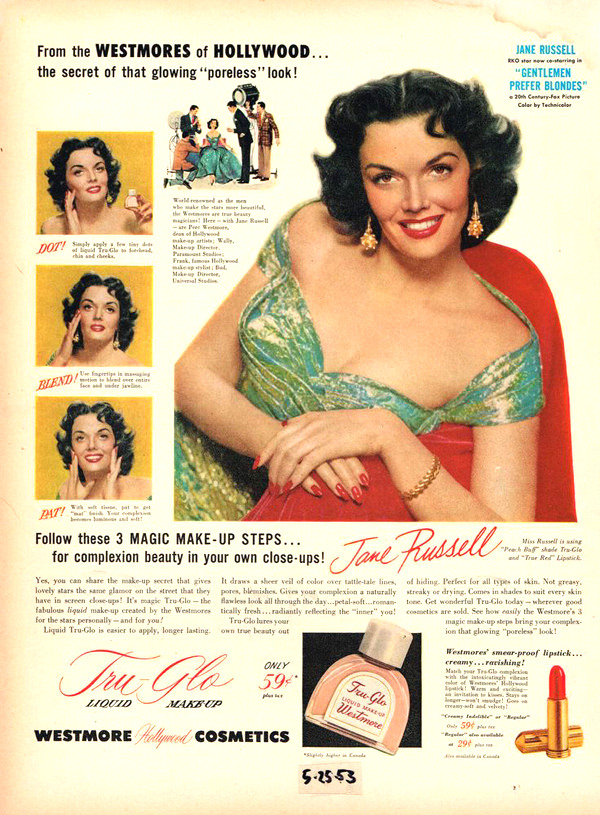
CELEBRITY ADS: JANE RUSSELL

Here is the beautiful Jane Russell with an advertisement for Westmore cosmetics. This was around 1952/1953 because the ad talks about Jane appearing in Gentlemen Prefer Blondes...


Sunday, January 8, 2023

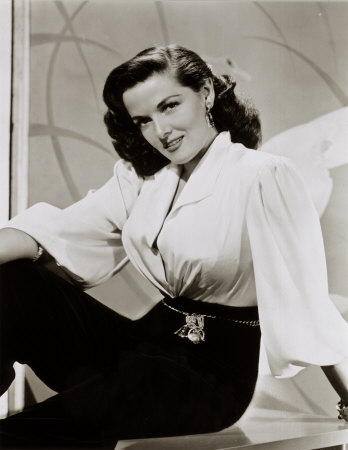
HOLLYWOOD BEAUTY: JANE RUSSELL

One of classic Hollywood's most beautiful actresses was Jane Russell. The camera loved her as these examples show...


Friday, January 20, 2017

PHOTOS OF THE DAY: STILL MORE ODD PAIRINGS

Hollywood is full of some of the most different people in the world - working in the entertainment business I think puts some different people together that you would never picture being together. Here is the 4th addition of this series showing more odd pairings...


Lou Costello, Elvis Presley, and Jane Russell

Eddie Murphy, Ella Fitzgerald, and Michael Jackson

Jimmy Stewart, James Cagney, and Orson Welles

Bing Crosby and Rudy Vallee

Marlon Brando and Jack Nicholson

Bono and Frank Sinatra

Friday, December 23, 2011

SEX SYMBOLS OF THE CINEMA: ONES I MISSED

Any fellow blogger knows that there is only so much space to write your thoughts and ideas. With my series on the sex symbols of the cinema, I was only picking four actresses for each decade. That is not a lot, and there were stars that I missed and did not profile that I should have. Here are some of the great sex symbols that did not get recognized:


JEAN HARLOW (1911-1937)
Not putting Jean Harlow on the original list was the biggest mistake of the series. Harlow was sex on film in the 1930s. Unfortunately, Jean died way too young. She was more than a sex symbol though. Harlow was amazing to see in "Dinner At Eight" (1934), and every role she was in, she made the movie that much better. She not only had great sex appeal, she had great comedic timing.

CAROLE LOMBARD (1908-1942)
I always considered Carole Lombard a great comedic actress more than a sex symbol, but like Harlow I think she was both. Also like Jean Harlow, Carole died too young. Lombard made some great movies like "Made For Each Other" (1939) and "To Be Or Not To Be"(1942) - and even in corny movies like "We're Not Dressing" (1934), Lombard was funny and sexy as well.


JANE RUSSELL (1921-2011)
Jane Russell was basically the brunette answer to Betty Grable and Marilyn Monroe. Russell made the bustline famous in movies, but despite being a sex symbol she was talented as well. Russell was a good singer as well and as an actress she easily could act alongside the likes of Bob Hope, Robert Mitchum, and Clark Gable.

BRIGITTE BARDOT (BORN 1934)
Even though I pride myself a movie fan, I have never seen a Brigitte Bardot movie. I only know her from seeing her animal activism in recent years, but she was a great beauty. She left the entertainment industry in 1973, but Bardot made over 40 films that really revolutionized how sex symbols were looked at. She took sex in the industry to a whole new level.


SOPHIA LOREN (BORN 1934)
Sophia Loren is one of the few women who can make being in her 70s sexy. Loren, like Bardot, started out at the beginning of the new sexual revolution in the film industry. Her first film was "Aida" (1953) and she went on to seduce audiences and co-stars like Frank Sinatra, John Wayne, and Cary Grant. She remains one of the most beautiful active working classic actresses in the business.

Do you have any other sex symbols that we should have profiled? Who else did we miss? I would love to keep revisiting this topic from time to time on my blog. I want to thank everyone who read and commented on this series, and thank you to all of the movie sex symbols who made writing this series so easy...

Tuesday, March 1, 2011

RIP: JANE RUSSELL

LOS ANGELES – She was the voluptuous pin-up girl who set a million male hearts to pounding during World War II, the favorite movie star of a generation of young men long before she'd made a movie more than a handful of them had ever seen. Such was the stunning beauty of Jane Russell, and the marketing skills of the man who discovered her, the eccentric billionaire Howard Hughes.

Russell, surrounded by family members, died Monday at her home in the central coast city of Santa Maria. Her death from respiratory failure came 70 years after Hughes had put her on the path to stardom with his controversial Western "The Outlaw." She was 89.

Although she had all but abandoned Hollywood after the 1960s for a quieter life, her daughter-in-law Etta Waterfield said Russell remained active until just a few weeks ago when her health began to fail. Until then, she was active with her church, charities that were close to her heart and as a member of a singing group that made occasional appearances around Santa Maria.

"She always said 'I'm going to die in the saddle, I'm not going to sit at home and become an old woman,'" Waterfield told The Associated Press on Monday. "And that's exactly what she did, she died in the saddle."

It was an apt metaphor for a stunningly beautiful woman who first made her mark as the scandalously sexy and provocatively dressed (for the time) pal of Billy the Kid, in a Western that Hughes fought for years with censors to get into wide release. As the billionaire battled to bring the picture to audiences, his publicity mill promoted Russell relentlessly, grinding out photos of her in low-cut costumes, swimsuits and other outfits that became favorite pinups of World War II GIs.

By the time she made her third film, the rollicking comedy-western "The Paleface," in which she played tough- but-sexy Calamity Jane to Bob Hope's cowardly dentist sidekick, she was a star. She went on to appear in a series of potboilers for RKO, including "His Kind of Woman" (with Robert Mitchum), "Double Dynamite" (Frank Sinatra, Groucho Marx), "The Las Vegas Story" (Victor Mature) and "Macao" (Mitchum again).

Although her sultry, sensual look and her hourglass figure made her the subject of numerous nightclub jokes, unlike Marilyn Monroe, Rita Hayworth and other pinup queens of the era, Russell was untouched by scandal in her personal life.


"The Outlaw," although it established her reputation, was beset with trouble from the beginning. It took two years to make, according to its theatrical trailer, and director Howard Hawks, one of Hollywood's most eminent and autocratic filmmakers, became so rankled under producer Hughes' constant suggestions that he walked out.

Russell's only other notable film was "Gentlemen Prefer Blondes," a 1953 musical based on the novel by Anita Loos that cast her opposite Monroe. She followed that up with the 1954 musical "The French Line," which — like "Gentlemen Prefer Blondes" — had her cavorting on an ocean liner. The film was shot in 3-D, and the promotional campaign for it proclaimed "J.R. in 3D. Need we say more?" In 1955, she made the sequel "Gentlemen Marry Brunettes" (without Monroe) and starred in the Westerns "The Tall Men," with Clark Gable, and "Foxfire," with Jeff Chandler. But by the 1960s, her film career had faded.

"Why did I quit movies?" she remarked in 1999. "Because I was getting too old! You couldn't go on acting in those years if you were an actress over 30."

She continued to appear in nightclubs, television and musical theater, including a stint on Broadway in Stephen Sondheim's "Company." She formed a singing group with Connie Haines and Beryl Davis, and they recorded gospel songs. For many years she served as TV spokeswoman for Playtex bras, and in the 1980s she made a few guest appearances in the TV series "The Yellow Rose."

She was born Ernestine Jane Geraldine Russell on June 21, 1921, in Bemidji, Minn., and the family later moved to Los Angeles' San Fernando Valley. Her mother was a lay preacher, and she encouraged the family to build a chapel in their back yard. Despite her mother's Christian teachings, young Jane had a wild side. She wrote in her 1985 autobiography, "My Paths and Detours," that during high school she had a back-alley abortion, which may have rendered her unable to bear children.

She was the leader of the Hollywood Christian Group, a cluster of film people who gathered for Bible study and good works. After experiencing problems in adopting her three children, she founded World Adoption International Agency, which has helped facilitate adoptions of more than 40,000 children from overseas.

She made hundreds of appearances for WAIF and served on the board for 40 years. As she related in "My Path and Detours," her life was marked by heartache. Her 24-year marriage to Waterfield ended in bitter divorce in 1968. They had adopted two boys and a girl. That year she married actor Roger Barrett; three months later he died of a heart attack. In 1978 she married developer John Peoples, and they lived in Sedona, Ariz., and later, Santa Barbara. He died in 1999 of heart failure. Over the years, Russell was also beset by alcoholism. She was able to rebound from troubles by relying on lessons she learned from her Bible-preaching mother.

"Without faith, I never would have made it," she commented a few months after her third husband's death. "I don't know how people can survive all the disasters in their lives if they don't have any faith, if they don't know the Lord loves them and cares about them and has another plan."