Showing posts with label Jack Oakie. Show all posts

Wednesday, February 19, 2014

RECENTLY VIEWED: COLLEGE HUMOR

Bing Crosby made quite an impact as a leading man in his first feature film The Big Broadcast in 1932. Paramount Studios quickly signed him up to a contract and next up for Bing would be the college musical College Humor. In this film at least they had the decency to cast 30 year old Bing as a professor. As students they had 30 year old Jack Oakie and 34 year old Richard Arlen! This film was basically a Jack Oakie movie with Bing thrown in for added appeal.

Barney Shirrel (Jack Oakie) starts his first semester at Mid West University and works his way up in the fraternity with the help of Tex Roust (Joe Sawyer) and Mondrake (Richard Arlen), an alcoholic college football star. Barney is passionate about engineering and the law, and between his varied studies, football, and the fraternity, he neglects his girl friend Amber (Mary Kornman).

In the next term, Mondrake gives his class sweater to Barney's sister Barbara (Mary Carlisle). His drinking problem intensifies, however, when he learns that Barbara is falling in love with Professor Danvers (Bing Crosby), the singing drama teacher. When Mondrake fails to show up at an important football game against a rival university, Danvers finds him in jail. With the school's reputation at stake, Danvers has him released and takes him to the football field in time to play in the game.


Afterwards, Danvers is called before the college president (Lumsden Hare). Although rivals for Barbara's affections, Danvers stands up for Mondrake. The college president expels Mondrake for drunkenness and forces Danvers to resign because of his involvement in the matter. Feeling guilty over causing Mondrake's expulsion, Barbara proposes marriage to him. Later, however, she admits that she is not in love with him, but with Danvers. Mondrake bows out of the relationship, and Barbara rushes to Danvers' side before he leaves.

During the next term, Barney has followed Mondrake's example and taken up drinking and smoking, which is not appealing to Amber. At the big football game, Barney is in sorry shape. Mid West is losing until he receives inspiration from Tex, who has returned to watch the game. After being knocked out, Barney recovers and wins the game for Mid West.


Some time later, Barney and Amber get married and they move to his father's dairy, where Barney works his way up from the lowest position. Barney and Amber enjoy listening to Danvers singing his song on the radio.

The best part of the film was Bing's singing, and he sang some good ones like: "Down The Old Ox Road", "Moonstruck", and "Learn To Croon". Another wonderful draw of the film is Mary Carlisle, who is with us as of this writing, at the age of 101. She is probably the last person alive who was involved in this 80 year old film. There was not enough Bing and Mary Carlisle, and too much Jack Oakie for my taste. The only movie I ever liked Oakie in was The Great Dictator in 1940. I loved my years in college, but I only remotely liked this collegiate offering. If it was not for Bing, this film would have been a horrible bomb...

MY RATING: 6 OUT OF 10

Wednesday, July 20, 2011

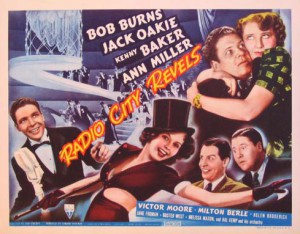
FORGOTTEN FILMS: RADIO CITY REVELS

It has been awhile since I started watching old movies. When I started my love of classic Hollywood, there was no TCM buy luckily I had a dinosaur called the video tape recorder. Before TCM entered the airwaves, its sister channel TNT used to show old movies. It was there that I saw a mediocre musical called Radio City Revels.

The movie deals with two out-of-work songwriters in New York City, Harry Miller (Jack Oakie) and Teddy (Milton Berle), who live next door to sisters Billie (Ann Miller) and Gertie (Helen Broderick) Shaw, who used to tour in vaudeville and have been left stranded and income-less by its demise. Miller’s and Teddy’s only source of income is a correspondence course in songwriting that they’ve sold to exactly one student, Arkansas hillbilly Lester Robin (played by rustic comedian Bob Burns, who had enough of a reputation in 1938 he’s actually given top billing).

Robin is frustrated because while he’s awake he can only come up with songs other people already wrote (like an hilariously fractured version of “My Bonnie Lies Over the Ocean”) but when he’s asleep he dreams the most beautiful — and original — melodies and lyrics, only to forget them when he wakes up. Miller and Teddy realize this unique talent and start transcribing Lester’s nocturnal emissions, peddling them as their own and becoming star songwriters for the company owned by Paul Plummer (Victor Moore, even more annoyingly whiny than usual). The premise is so weird that at least one critic summed it up by saying it seemed as if the film’s writers had been asleep when they came up with it.


The draw of the movie for me was the appearance of singer Jane Froman in a minor role. She played the vocalist for Hal Kemp's band. It is infortunate that she did not have a bigger role, it might have helped the movie. Froman never had much of a movie career, but her voice was wonderful. Kenny Baker was the male vocalist in this opus. Baker got his start as the comic foil for Jack Benny on his radio show, and he left the Benny organization to make his way in film. Like Froman, Baker did not have much of a movie career either.


RKO spent some serious money on this movie — at least two of the numbers, including “There’s a New Moon Over the Old Mill,” are staged on splendiferous sets (the “Old Mill” number takes place on a beautiful white, stylized art deco mill and features four mill maids desperately waiting for male mates. Great comic actors like Victor Moore and Helen Broderick were features as second bananas in the film, but with no major stars it was hard to see who they would be second banana to.


It is utterly baffling who they thought the audience for it would be, and as it turned out there wasn’t one: RKO spent $810,000 making Radio City Revels and lost $300,000 on it. The movie was not great, and it is mostly forgotten today, but the film is worth watching if it is just for the 1930s stars that the movie spotlighted...