
Wednesday, July 30, 2025
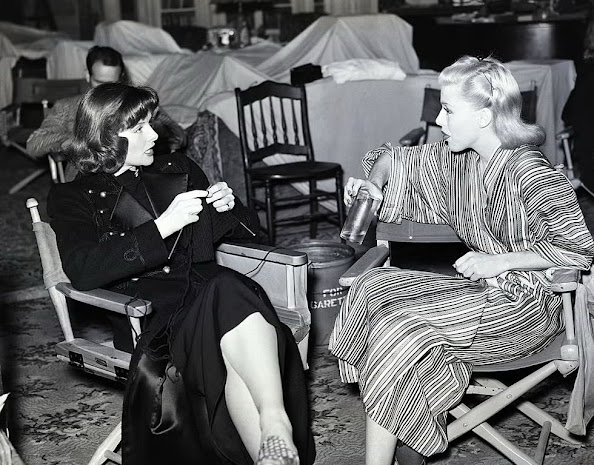
STORY BEHIND THE PHOTO: KATHERINE HEPBURN & GINGER ROGERS
For this photo, we have two greats of show business - Katharine Hepburn and Ginger Rogers. This was taken on the set of their 1937 movie Stage Door. Directed by Gregory La Cava, the film tells the story of aspiring actresses living in a boarding house in New York City, struggling to make their way in the competitive theater world...

Saturday, July 26, 2025
RECENTLY VIEWED: HAPPY GILMORE 2

In May 2024, it was announced that Netflix had greenlit the film, taking over for the first film's distributor Universal Pictures. Kyle Newacheck was hired to direct the film, with Tim Herlihy co-writing the screenplay with Sandler. In July, Nick Swardson announced he would star in the film. In August, Sandler revealed Benny Safdie would have a role in the film, with football player Travis Kelce set to make a cameo. In September, McDonald and Julie Bowen were confirmed to be reprising their roles, with Bad Bunny, Margaret Qualley, and Maxwell Jacob Friedman also added to the cast. John Daly would reveal he had filmed scenes for the film. Happy Gilmore 2 premiered at the Lincoln Center in New York City on July 21, 2025. The film was released on Netflix on July 25, 2025.

In order to get the movie at all, you need to see the original movie. This sequel is LOADED with callbacks, and for fans of the original film it is a treasure trove of memories. Some of the high points in the movie are the appearances of Christopher McDonald and Ben Stiller. I love how they brought their characters up to present time. Like I said the movie is a fun romp, full of nostalgia. As a comedy sequel it is definitely no Caddyshack 2, but it is no 1995 Happy Gilmore. The movie has some really serious moments, that I don't want to spoil for you. Also, I think Adam Sandler is using his wife and children too much in his movies, and they are not really good actors. That being said, I recommend this movie. It was a fun 2-hour nostalgic golf comedy movie...
MY RATING: 8 out of 10

Friday, July 25, 2025
RIP: CLEO LAINE

So I did.
On stage, she wore a diaphanous gown and had an afro that looked like a sunburst mane as the spotlight hit it. And when the applause died away, she sang a capella. Then came the second number — Carole King's "Music," accompanied by Laine's saxophonist husband John Dankworth and his band, in an arrangement designed to establish her jazz credentials. In Britain, she and Dankworth had been playing clubs and concerts since the 1950s, but American audiences were just meeting her.
This song was also designed, I soon learned, to show off her range, from gravelly low notes, to keening ethereal sounds a full four octaves higher. In one particularly glorious passage she went from her lowest note to her highest and back down again in the space of 44 seconds. On her album Cleo Laine Live at Carnegie Hall you can hear her do it live for an audience that's clearly as astonished as mine was.
Now, vocal pyrotechnics are fun. But they're not everything for a pop singer. Laine, I discovered in years of following her, had everything. She excelled at jazz, pop, and classical stylings — among the few vocalists to receive Grammy nominations in all three of those categories — and was so popular in Britain that she was made a Dame in 1997.

Give her a comic number and she'd land every joke, a talent she developed in the theater, where she began her career as an actress, and went on to star in musicals on the West End, regularly stopping such shows as Showboat, and A Little Night Music with ballads. Give her the right one and she could nearly stop your heart.
I remember her holding the last note of "Send in the Clowns" at an outdoor amphitheater many years after I saw that first concert and, I swear, even the crickets stopped for her, the audience so captivated that no one wanted to break the silence.
As she finished that last note, I started counting — one-one-thousand, two-one-thousand, three-one-thousand ... and got to seven before every hand in the place came together in the only "thunderclap" of applause I've ever heard.
Laine continued performing for six decades — all but the last with her husband. He died hours before they were to give a concert in 2010, and she went on without him, only telling the audience at the end that he'd passed away — because, she said, that's what he'd have wanted.
In recent years her voice had dimmed, but not enough that there was ever reason to argue with the Sunday Times critic who said in the 1970s, that Cleo Laine was "quite simply the best singer in the world."

I remember her holding the last note of "Send in the Clowns" at an outdoor amphitheater many years after I saw that first concert and, I swear, even the crickets stopped for her, the audience so captivated that no one wanted to break the silence.
As she finished that last note, I started counting — one-one-thousand, two-one-thousand, three-one-thousand ... and got to seven before every hand in the place came together in the only "thunderclap" of applause I've ever heard.
Laine continued performing for six decades — all but the last with her husband. He died hours before they were to give a concert in 2010, and she went on without him, only telling the audience at the end that he'd passed away — because, she said, that's what he'd have wanted.
In recent years her voice had dimmed, but not enough that there was ever reason to argue with the Sunday Times critic who said in the 1970s, that Cleo Laine was "quite simply the best singer in the world."

Wednesday, July 23, 2025
MARION COTILLARD AS EDITH PIAF

Marion Cotillard was chosen by director Olivier Dahan to portray the French singer Édith Piaf in the biopic "La Vie en Rose" (2007) before he had even met her, saying that he noticed a similarity between Piaf's and Cotillard's eyes. Producer Alain Goldman accepted and defended the choice even though distributors TFM reduced the money they gave to finance the film thinking Cotillard wasn't "bankable" enough an actress, preferring Audrey Tautou, hot from appearing in "Amélie" (2001) to play Piaf. Dahan was willing to reduce his budget by $5 million to get Cotillard.
To help portray Piaf, Cotillard shaved back her hairline and shaved off her eyebrows, which were later penciled in, to better resemble the singer. She shrank her body from its petite 5'6" frame to Piaf's minuscule 4'11" stature by crippling and curling her form. When Cotillard played the older Édith Piaf, make-up could take up to five hours.
"I couldn't leave the character on 'La Vie En Rose.' It was weird because I used to kind of judge actors who would stay in character on set or who would have a hard time leaving the character behind when the movie was done. I had this very dumb idea that "Okay, it's a big part of your life but it's your job. Go home and go back to yourself." It turns out it's not that easy. In the process I was in character almost all the time. Even when I went home, there was something that was not entirely me."
Cotillard's performance earned her several accolades including the Academy Award for Best Actress — marking the first time an Oscar had been given for a French-language role — the BAFTA Award for Best Actress in a Leading Role, the Golden Globe Award for Best Actress – Motion Picture Musical or Comedy and the César Award for Best Actress in a Leading Role for her performance. The film also won the Academy Award for Best Makeup, the BAFTA Award for Best Makeup, Costume Design, Film Music, four additional César Awards and grossed $86.3 million worldwide...

Saturday, July 19, 2025
HOLLYWOOD LOVE: FRANK SINATRA AND MIA FARROW

In the months that followed their wedding, Farrow traveled with Sinatra on his film shoots, portraying the role of the devoted wife. Yet the dynamic soon began to reveal cracks, as Farrow grew restless with the idea of being just a companion on the sidelines. In 1967, Farrow made the pivotal decision to accept the lead role in "Rosemary’s Baby," a horror film that would later define her career. Her commitment to the film led to a clash with Sinatra, who had cast her in a role in his own upcoming movie, The Detective. Farrow’s involvement in Rosemary’s Baby soon ran over its scheduled timeline, creating a rift with Sinatra that would culminate in a drastic turn. While Farrow was immersed in the haunting scenes of the film, Sinatra’s frustration grew, feeling sidelined as his wife’s professional ambitions took precedence over her commitment to their marriage. When Farrow failed to report for filming on The Detective, Sinatra, in a decision that spoke to his own sense of pride and professionalism, replaced her with actress Jacqueline Bisset. The couple's relationship continued to strain, as Sinatra’s lawyer served Farrow with divorce papers on the set of Rosemary’s Baby in November 1967, a dramatic moment that underscored the tragic end to their whirlwind romance.

The divorce papers, served amid the intensity of filming, came as a blow to Farrow, who later admitted that she bore some responsibility for the marriage’s failure. Reflecting on the relationship, Farrow described herself as an “impossibly immature teenager” during that period, noting how their vast age difference had contributed to the dissolution of their union. Sinatra, in contrast, was accustomed to a lifestyle and partner dynamic that Farrow could not comfortably conform to. In hindsight, she acknowledged that they had been at different stages of life, and despite her deep admiration for Sinatra, their needs ultimately clashed in ways that were irreconcilable. The age gap, combined with Sinatra’s traditional expectations and Farrow’s desire for a career, created an insurmountable rift. Though the romance was short-lived, it left an indelible mark on both of their lives. The two managed to mend their friendship in the years following their divorce, remaining close and supportive of one another until Sinatra’s death, an unusual yet enduring connection forged through mutual respect and affection.
Their wedding day, captured in photographs at the Sands Hotel in Las Vegas, remains etched in Hollywood history. The images show a young, hopeful Mia Farrow alongside the charismatic Sinatra, both of them draped in a mix of glamor and vulnerability. Farrow’s pixie cut, a daring fashion statement at the time, contrasted with Sinatra’s classic, polished look, encapsulating the blend of old Hollywood and the emerging modern era. These photos reveal the undeniable chemistry between them, a bond that, despite the challenges, was once filled with genuine warmth. Yet, the marriage was emblematic of the intense pressures that often plagued Hollywood couples, caught between personal aspirations and public scrutiny. Sinatra and Farrow’s relationship story became part of the Hollywood lore, capturing the imagination of fans who saw in them a mix of romance, mystery, and sadness. Though their marriage ended, the brief union left behind a powerful narrative of love, ambition, and the struggles that come with balancing personal and professional lives under the spotlight.

In August 1968, their divorce was finalized, closing a chapter on what could have been a legendary love story. The aftermath saw both continue to build their legacies, with Sinatra further solidifying his place as a music and film icon, while Farrow’s performance in Rosemary’s Baby catapulted her into stardom, forever intertwining her name with one of cinema’s most haunting films. They each pursued separate paths but kept a bond that would last through the decades, with Farrow speaking warmly of Sinatra even after his passing. This marriage, though short-lived, stands as a reminder of how love and ambition can collide, especially in an industry that magnifies every flaw and tests the resilience of relationships. Sinatra and Farrow’s wedding day photos remain a poignant glimpse into a fleeting but unforgettable romance—a union that was both a product of its era and a timeless tale of two people who, despite their differences, found a moment of connection in the unpredictable world of fame...

Thursday, July 17, 2025
RIP: CONNIE FRANCIS

"It is with a heavy heart and extreme sadness that I inform you of the passing of my dear friend Connie Francis last night," said her copyrights and royalties manager, Ron Roberts, in a post on social media. "I know that Connie would approve that her fans are among the first to learn of this sad news."
"Pretty Little Baby" most recently became a viral song on TikTok, which Francis joined shortly after, and the song has been used in more than 17 million videos totaling more than 27 billion views globally on the app.
"I'm flabbergasted and excited about the huge buzz my 1962 recording of 'Pretty Little Baby' is making all over the world," Francis said. "To think that a song I recorded 63 years ago is captivating new generations of audiences is truly overwhelming for me."
"Pretty Little Baby" was included on Francis' 1962 album, "Connie Francis Sings 'Second Hand Love' & Other Hits," which charted on the Billboard Top LPs chart. The singles "Together" and "Don't Break the Heart that Loves You" both peaked at no. 1 on the Easy Listening chart.
In May of this year, "Pretty Little Baby" broke into Spotify's Global and U.S. charts for the first time.
Francis was born Concetta Rosa Maria Franconero in Newark, New Jersey on Dec. 12, 1937, and is estimated is to have sold more than 200 million records worldwide in her lifetime.
She started singing on TV programs when she was a child. Her first hit, "Who's Sorry Now," debuted in 1958. In 1960, Francis was only 21 when she became the first female artist to get a Billboard Hot 100 No 1 hit, with her song "Everybody's Somebody's Fool."
Francis went on to have 53 hits on the Billboard charts over the course of her decades-long career.
In 1964, she was awarded a special Golden Globe for her contributions to the recording world.
In 2001, "Who's Sorry Now" was named one of the Songs of the Century in a list compiled by the Recording Industry of America and the National Endowment for the Arts...

Sunday, July 13, 2025
FINAL RESTING PLACES: BILLIE HOLIDAY

One of the greats of jazz was the amazing Billie Holiday. Holiday had a seminal influence on jazz and pop singing. Her vocal style, strongly inspired by jazz instrumentalists, pioneered a new way of manipulating phrasing and tempo. She co-wrote only a few songs, but several of them have become jazz standards, notably "God Bless the Child", "Don't Explain", "Fine and Mellow", and "Lady Sings the Blues". She also became famous for singing "Easy Living", "Good Morning Heartache", and "Strange Fruit". Billie, who had an addiction to alcohol and drugs, was arrested on a few occasions for drug possession. As her health declined in the 1950's, so did the quality of her voice and career. In 1959, she was diagnosed with cirrhosis of the liver, and died from pulmonary edema and heart failure caused by the cirrhosis on July 17 of that year. As she was dying in the hospital, Billie was once again arrested for drug possession and police were guarding her hospital room until the end. She is buried at Saint Raymond's Cemetery in the Bronx, NY...

Subscribe to:
Posts (Atom)