Saturday, March 4, 2017

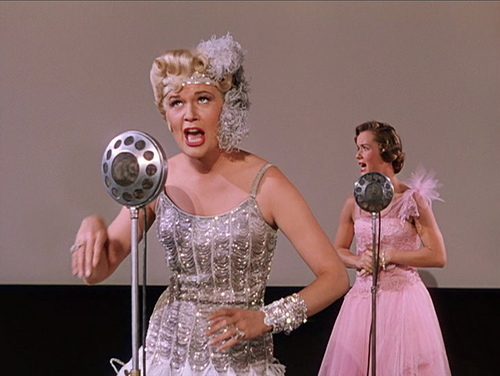
TEN THINGS YOU DON'T KNOW ABOUT ETHEL MERMAN


"There’s No Business Like Show Business" was  Ethel Merman's signature song, and it encapsulates her image: brassy and camp, cheerful and a little abrasive. Most readers can probably hum a few bars of this and a few other Merman songs, maybe even offer a decent impression of her legendary singing voice, but how much do they really know about La Merm?

To celebrate Merman's birthday on January. 16, we offer 10 things you may not have known about the brash songstress

1. She recorded a disco album. In 1979, disco was king. And it wasn't just popular, it was versatile. You could set almost anything to a disco beat and end up with a catchy treat for the dance floor – Beethoven's 5th Symphony, the Star Wars theme, the quacks of a disco duck… or Ethel Merman's greatest hits. Merman recorded seven of her top songs, producers added disco beats, strings and background vocals, and a cult classic was born. Although the album only made a minor splash in the clubs and never charted, it has since found a cherished and campy place in gay culture. 


2. She named her daughter Ethel Jr. Merman had two children, and they were both juniors: her son Robert and her daughter Ethel, both born to Merman and her second husband, Robert Levitt. While "Junior" wasn’t a legal part of young Ethel's name, she was nicknamed "Ethel Jr." Ethel Jr. died of a drug overdose in 1967 at the age of 25.

3. She sang with the Muppets. In the 1960s and '70s, Merman made guest appearances on a wide variety of television shows. On The Carol Burnett Show she dueted with Burnett; on Sha Na Na she knocked the boys to the ground with the power of her voice; on That Girl she reprised her role from Gypsy and gave Ann tips for achieving stardom. And then there was her Muppet Show appearance, an unexpectedly sweet guest star turn in which Merman cheered up a despondent Fozzie Bear and went on to sing with the whole gang. 

4. She was self taught. That big voice didn't come from years of lessons, working and studying to increase her range and power. No, it was all natural – Merman never had a singing lesson in her life. And yet her powerful voice could reach every corner of a Broadway theater, right to the back row, without amplification. And her enunciation was so crystal clear that every word could be heard and understood by the folks in that back row. Composer George Gershwin was so impressed that he begged her never to work with a vocal teacher. 


5. Tonsillitis improved her voice. In 1929 the young starlet contracted a severe case of tonsillitis. Merman agreed to a tonsillectomy despite fears that it would ruin her greatest asset, her big and distinctive voice. To her surprise and delight, once she had recovered and tried singing again, her voice was even more powerful than it had been before the surgery. 

6. She was married to Ernest Borgnine for 32 days. Merman's marriage to Borgnine was her fourth, last and briefest. Merman admitted she didn't have the best judgment when it came to men: in a radio interview, she noted of her many marriages, "We all make mistakes, that's why they put rubbers on pencils, and that's what I did. I made a few loo-loos!" Her 1972 memoir Merman includes a chapter entitled "My Marriage to Ernest Borgnine" that consists of nothing more than a single blank page. But don't worry about Borgnine – he got off his own quip too, commenting about the marriage, "Biggest mistake of my life. I thought I was marrying Rosemary Clooney." 

7. Jacqueline Susann fell in love with her. It may or may not be true that Merman had an affair with Susann, queen of the trashy novel. Some say that Merman was spotted making out with the author on a couch at a party; others assert that Merman, though a staple of gay culture, wasn't interested in other women at all. But what's certain is that Susann once showed up at Merman's New York apartment, distraught and screaming "I love you!" Susann went on to base her Valley of the Dolls character Anne, an aging stage actress, on Merman. 


8. Her role in Gypsy was her biggest triumph – and her biggest disappointment. Merman loved playing Rose Hovick, mother of Gypsy Rose Lee and June Havoc, on Broadway in Gypsy. Her interpretation brought rave reviews from fans and critics alike – she was called brilliant and indomitable. Yet she didn't win the Tony that year (it went to Mary Martin in The Sound of Music, and Merman took it in stride, quipping "How are you going to buck a nun?"), and, surprisingly, she didn't land the role in the film. Merman fully expected to play Rose on the silver screen, having been assured by the director that the role was hers. But in the end, without much explanation, the film role was given to Rosalind Russell. Though Merman considered the loss of the movie "the greatest professional disappointment of my life," she stuck with the Broadway show, even continuing on the national tour with a severe back injury.

9. In 1954, Ethel made the splashy musical "There's No Business Like Show Business" featuring a slew of Irving Berlin tunes. Her co-stars included Dan Dailey, Mitzi Gaynor, Donald O'Connor, and the great Marilyn Monroe. Ethel did not think she was so great, and she hated Marilyn for her unprofessional behavior on the set. As a result, Merman made life miserable on the set for the blond bombshell and would intimidate Monroe so much that Marilyn would throw up after every scene they had together.

10. She loved dirty jokes. Merman had a blue sense of humor and a mouth like a sailor's. She delighted in opportunities to share vulgar jokes – whether she was shouting them across crowded rooms or including them in greeting cards... 


Saturday, February 25, 2017

CELEBRITY ADS: CLAUDETTE COLBERT

Here in Pennsylvania, the cigarette tax is so high that I am not sure how anyone can afford to smoke. That was not the case in classic Hollywood days. Almost every star would promote smoking, whether in their movies or in adverstisements. Here is an ad featuring the beautiful Claudette Colbert. This was from 1948 when she was also promoting her newest film Sleep My Love...


Friday, February 17, 2017

A PREGNANT MARILYN MONROE

Extraordinary photographs purporting to show a secret pregnancy of film icon Marilyn Monroe can today be revealed for the first time.

The world exclusive images of the beautiful Some Like It Hot actress and model were sold as original color slides at an auction in Hollywood in November last year from the estate of well known Monroe confidante Frieda Hull.

But the stunning photos went under the radar, selling for a mere $2,240 with wealthy collectors not aware of their true significance.

Now DailyMail.com can reveal the six unique images were the prized possession of Monroe's loyal friend Hull, which she dubbed the ‘pregnant slides’ – a reference to a shocking secret the screen siren kept right up until her death.

The shots were taken on July 8, 1960, outside Fox Studios in New York after Monroe had completed costume and hair tests for her film The Misfits, starring Clark Gable and Montgomery Clift .

The images clearly show a prominent bump from Monroe’s belly which Hull claimed was evidence the star was in the early stages of pregnancy.

And DailyMail.com can reveal the would-be father was not Monroe's then husband, playwright Arthur Miller, it was in fact Italian-French actor Yves Montand – who she met on the set of film Let's Make Love and who she had a very public affair with.


DailyMail.com spoke to Tony Michaels, the man who bought the color slides at the ‘once-in-a-lifetime’ Marilyn Memorabilia Auction held by Julien’s Auctions in LA.

Tony, 56, was a close friend and next door neighbor of Frieda Hull before she passed.

He reveals that Hull had confided in him about Monroe’s secret pregnancy and claims the ‘pregnant slides’ are genuine evidence that she was with child.

The images were the prized possession of Hull, who died in 2014

And in an extraordinary and tragic Hollywood tale Tony says Monroe kept her pregnancy a secret from the world before 'losing' the baby during a hospital visit.


Tony told Daily Mail: ‘Frieda was very proud of those slides and she was very proud to keep them a secret until the day she died.

‘But she told me the story behind them, that Marilyn got pregnant by Yves Montand.

‘It wasn’t a guess or a presumption, it was something she knew for sure, she was very close to Marilyn.

‘As far as she was concerned Marilyn was pregnant in the summer of 1960 and the slides prove it.’

Monroe had wanted a baby more than anything in the world, but that joy was denied her.

She had three miscarriages prior to losing this baby, all of which played out in the public eye. The star suffered with a condition called endometriosis her entire life that caused severe menstrual pain and she also struggled to conceive.

‘I suggested she sell the slides and all her other memorabilia so she could afford a better place to live, but again she refused, she said she would never sell out on her friend of ten years Marilyn...


Monday, February 13, 2017

RECENTLY VIEWED: SINGIN IN THE RAIN

It was a sad day for movie musicals when Debbie Reynolds died in December of 2016. She was really the last tie to the classic movie musical. Even before her death my friend mentioned how him and his son (who is friend's with my son) were going to see a viewing of Singin In The Rain. My son is very picky when it comes to movies, and unlike my friend's son, my son does not like to watch different movies. So after some sweet talking, I convinced my seven year old to go with me to see this 1952 classic. I'm glad I did because he loved it! His favorite part of the movie was the comedic parts with Jean Hagen, but he always loved the song Singin in The Rain. (I used to sing it to him as I gave him a bath). It was sad to see the talented Debbie Reynolds on the screen only two weeks after she died, but it was awesome to see it on the big screen. The showing was sold out ,and people applauded after the musical numbers - it literally brought tears to my eyes.

More on the actual movie though - The film was only a modest hit when first released. Donald O'Connor won the Golden Globe Award for Best Actor – Motion Picture Musical or Comedy, and Betty Comden and Adolph Green won the Writers Guild of America Award for their screenplay, while Jean Hagen was nominated for the Academy Award for Best Supporting Actress. But it has since been accorded legendary status by contemporary critics, and is frequently regarded as the best movie musical ever made and the best film ever made in the "Freed Unit" at Metro-Goldwyn-Mayer.

Singin' in the Rain
was originally conceived by MGM producer Arthur Freed, the head of the "Freed Unit" responsible for turning out MGM's lavish musicals, as a vehicle for his catalog of songs written with Nacio Herb Brown for previous MGM musical films of the 1929–39 period. Screenwriters Betty Comden and Adolph Green wrote two entirely new songs, "Make 'Em Laugh" and "Moses Supposes", the latter with music director Roger Edens providing the music.


In the famous dance sequence in which Gene Kelly sings the title song while spinning an umbrella, splashing through puddles and getting soaked to the skin, Kelly was sick with a 103 °F (39 °C) fever. The rain in the scene caused Kelly's wool suit to shrink during filming. A common myth is that Kelly managed to perform the entire song in one take, thanks to cameras placed at predetermined locations. However, this was not the case, as the filming of the sequence took place over 2–3 days.Another myth is that the rain was mixed with milk in order for the drops to show up better on camera; but the desired visual effect was produced, albeit with difficulty, through back lighting.


Debbie Reynolds was not a dancer when she made Singin' in the Rain; her background was as a gymnast. Kelly apparently insulted her for her lack of dance experience, upsetting her. In a subsequent encounter when Fred Astaire was in the studio, he found Reynolds crying under a piano. Hearing what had happened, Astaire volunteered to help her with her dancing. Kelly later admitted that he had not been kind to Reynolds and was surprised that she was still willing to talk to him afterward. After shooting the "Good Morning" routine, which had taken from 8:00 a.m. until 11:00 p.m. to shoot, Reynolds' feet were bleeding. Years later, she was quoted as saying that "Singin' in the Rain and childbirth were the two hardest things I ever had to do in my life."

Donald O'Connor had to stay in bed in the hospital for several days after filming the "Make 'Em Laugh" sequence, due to his smoking up to four packs of cigarettes a day!


I could go on and on about this movie, but fans of classic musicals know all about this film. What was so great about this 2017 movie theater viewing was how the film really held up. It was great to see young people in the audience - my seven year old son one of them - laughing and tapping along to the movie. A few observations I made watching the film was how great Donald O'Connor was in the film. He was really amazing, and he was such an underrated performer I feel. In some of the scenes you can see how scared Debbie Reynolds was, but she was a great match to Gene Kelly and Donald O'Connor. One of my favorite dancers, Cyd Charisse, was in the movie for one dance number with Kelly, and it was great to see her larger than life as well - except in the movie theater I could see a big black and blue mark on her upper leg! 

Seeing Singin' In The Rain in a 2017 movie theater - what a glorious feeling...

MY RATING: 10 OUT OF 10


Monday, February 6, 2017

BORN ON THIS DAY: BABE RUTH

Usually when a profile a birthday on the blog, it is someone directly related to Hollywood. However, since my son is not addicted to baseball, I wanted to profile who I think is the greatest baseball player of all time - Babe Ruth. He would have been a young 111 today! George Herman Ruth Jr. was born on February 6,1895 at 216 Emory Street in Pigtown, a working-class section of Baltimore, Maryland, named for its meat-packing plants. Its population included recent immigrants from Ireland, Germany and Italy, and African Americans. Ruth's parents, George Herman Ruth, Sr. (1871–1918), and Katherine Schamberger, were both of German American ancestry. According to the 1880 census, his parents were born in Maryland. The paternal grandparents of Ruth, Sr. were from Prussia and Hanover, respectively. Ruth, Sr. had a series of jobs, including lightning rod salesman and streetcar operator, before becoming a counterman in a family-owned combination grocery and saloon on Frederick Street. George Ruth Jr. was born in the house of his maternal grandfather, Pius Schamberger, a German immigrant and trade unionist. Only one of young George's seven siblings, his younger sister Mamie, survived infancy.


Many aspects of Ruth's childhood are undetermined, including the date of his parents' marriage. When young George was a toddler, the family moved to 339 South Woodyear Street, not far from the rail yards; by the time the boy was 6, his father had a saloon with an upstairs apartment at 426 West Camden Street. Details are equally scanty about why young George was sent at the age of 7 to St. Mary's Industrial School for Boys, a reformatory and orphanage. As an adult, Babe Ruth suggested that not only had he been running the streets and rarely attending school, he was drinking beer when his father was not looking. Some accounts say that, after a violent incident at his father's saloon, the city authorities decided this environment was unsuitable for a small child. At St. Mary's, which George Jr. entered on June 13, 1902, he was recorded as "incorrigible"; he spent much of the next twelve years there

In early 1914, Ruth was signed to a professional baseball contract by Jack Dunn, owner and manager of the minor-league Baltimore Orioles, an International League team.Babe Ruth's first appearance as a professional ballplayer was in an inter squad game on March 7, 1914. Ruth played shortstop, and pitched the last two innings of a 15–9 victory. Arriving in Boston to play for the Red Sox from 1914-1919, Babe emerged as a great star of the sport. Playing with the New York Yankees from 1920 to 1934, cemented himself as an icon of the game. Many of his records have been broken, but he is still the Great Bambino to anyone who has a love of the game. Happy birthday Babe...


Saturday, January 28, 2017

RIP: JOHN HURT

John Hurt, the esteemed British actor known for his burry voice and weathered visage — one that was kept hidden for his most acclaimed role, that of the deformed John Merrick in David Lynch’s The Elephant Man — died Friday in London. He was 77.

The two-time Oscar nominee's six-decade career also included turns on the BBC’s Doctor Who and in A Man for All Seasons (1966), Midnight Express (1978) and three Harry Potter films.

He announced in June 2015 that he had been diagnosed with pancreatic cancer.

On screens big and small, Hurt died what seemed a thousand deaths. “I think I’ve got the record,” he once said. “It got to a point where my children wouldn’t ask me if I died, but rather how do you die?”

One of his most memorable came when he played Kane, the first victim in Ridley Scott’s Alien (1979), in which he collapses over a table and a snakelike alien bursts out of his chest. (How'd they do that? There was an artificial chest screwed to the table, and Hurt was underneath.)

“Ridley didn’t tell the cast,” executive producer Ronald Shusett told Empire magazine in 2009. “He said, ‘They’re just going to see it.’ ”

“The reactions were going to be the most difficult thing,” Scott explained. “If an actor is just acting terrified, you can’t get the genuine look of raw, animal fear. What I wanted was a hardcore reaction.”

Hurt then lampooned the famous torso-busting scene for director Mel Brooks — whose production company produced 1980's The Elephant Man — for the 1987 comedy Spaceballs.


The Elephant Man received eight Academy Award nominations, including one for Hurt as best actor, but went home empty on Oscar night. (Hurt lost out to Robert De Niro as boxer Jake LaMotta in Raging Bull.)

Hurt also garnered an Oscar best supporting actor nomination and a Golden Globe win in 1979 for Midnight Express, in which he portrayed a heroin addict in a Turkish prison. The Alan Parker drama was based on the true story of Billy Hayes (played by Brad Davis), an American college student caught smuggling drugs.

“I loved making Midnight Express,” he said in 2014. “We were making commercial films then that really did have cracking scenes in them, as well as plenty to say, you know?”

His more recent film appearances came in Snowpiercer (2013), The Journey (2016) and Jackie (2016). He is set to be seen in the upcoming features That Good Night and My Name Is Lenny and was to play Neville Chamberlain in the upcoming Joe Wright drama Darkest Hour.


John Vincent Hurt was born Jan. 22, 1940, in Chesterfield, Derbyshire, England. He studied art at his parents’ behest, earning an art teacher’s diploma. Disillusioned with the prospect of becoming a teacher, Hurt moved to London, where he won an acting scholarship at the Royal Academy of Dramatic Art. He studied there for two years, securing bit parts in TV shows.

Hurt made his London stage debut in Infanticide in the House of Fred Ginger in 1962. That year, he acted in his first film, The Wild and the Willing, and his role as the duplicitous baron Richard Rich in Oscar best picture winner A Man for All Seasons helped him become more widely known in the U.S.

Hurt brought his peculiarly powerful persona to the role of Mr. Ollivander in Harry Potter and the Sorcerer’s Stone (2001) and Harry Potter and the Deathly Hallows: Part 1 (2010) and Part 2 (2011).

Hurt also was known for his rich, nicotine-toned timbre, which won him many voiceover assignments. He was the narrator in The Tigger Movie (2000), Dogville (2003), Manderlay (2005) and Charlie Countryman (2013).


For the small screen, Hurt starred in the TV shows The Storyteller, The Alan Clark Diaries, The Confession and Merlin and in the miniseries Crime and Punishment and Labyrinth. He notably played the War Doctor in the 2013-14 season of Doctor Who.

The accomplished stage actor performed with the Royal Shakespeare Company and Royal Academy of Dramatic Art. In 1994, he starred opposite Helen Mirren in Bill Bryden’s West End production of A Month in the Country, and he scraped out an edgy and vigorously dour performance in Samuel Beckett’s autobiographical one-man drama Krapp’s Last Tape in 1999.

When asked about the difference between film and stage acting, Hurt explained: “It’s rather like two different sports. You use two completely different sets of muscles.”

In 2012, Hurt was honored with a lifetime achievement award by the British Academy of Film and Television Arts, then was knighted by Queen Elizabeth II in July 2015.

Survivors include his fourth wife Anwen Rees-Myers, whom he married in 2005, and sons Alexander and Nicholas...